Showing posts with label Colli Tortonesi. Show all posts

Saturday, November 4, 2023

Daniele Ricci: From Milan Toll Collector to Timorasso disruptor

Colli Tortonesi Timorasso will be "the next big thing" to emerge from Piemonte and it owes its current position and future potential to the pioneering work of Walter Massa. Massa was not only interested in Timorasso for his own account: "He began to proselytize as regards the variety to anyone who would listen." Daniele Ricci worked as his understudy and acolyte and learned everything that he could before going off and leveraging that knowledge into his own enterprise. I explore Ricci and his wines in this post.

The Backstory
The Ricci Timorasso story goes back to 1929 when the grandparents of Daniele Ricci (Carlo and Clementina) bought Cascina San Leto, land ensconced within an amphitheater of vineyards close to the center of Costa Vescovato. The new owners planted vineyards (6 to 7 ha) and wheat and embarked on cattle-rearing.

During Carlo's stewardship, Timorasso production in Colli Tortonesi declined as farmers shifted to Cortese (more productive) or left farming completely. Carlo, however, bucked both these trends, remaining faithful to the vine and passing it down to successive generations. This was a part of the patrimony when Daniele took control of the estate as a 3rd-generation farmer after a stint as a toll collector on the Italian highway system.

The original Costa Vescovato estate currently sits at 15 ha, 11 of which are planted to vines and 6.5 ha of which are dedicated to named vineyards. In addition to the vines, the estate is planted to small quantities of ancient grains, an orchard, and a vegetable garden. The farmhouse is also resident on this property.

Daniele and his son Mattia secured 8 ha of land in Carezzano in 2022 and immediately planted 1 ha to Timorasso. 

The chart below shows the Ricci holdings in the two Colli Tortonesi communes. Named vineyards are described in colored rectangles.


Formation and Evolution of the Ricci Wine-View
Ricci worked as Mazda’s understudy before going off and planting the 1.5 ha Vigna di Carlo at Cascina San Leto. Walter went on to mentor a large number of the small farmers in the region and they, in turn, formed an association organized around his production principles. They met regularly to compare notes and taste each others wines.

Massa’s  principles, at that time, were as follows:
  • Hand harvesting
  • Maceration on the skins 
  • Soft pressing
  • Fermentation with indigenous yeasts in stainless steel tanks
  • Spontaneous malolactic fermentation after temperatures reduced to 10 - 18 degrees C
  • Wine aged for 1 year in stainless steel tanks (with batonnage)
  • Light filtration prior to bottling
  • Minimum 6 months bottle aging.
Given his early association with Walter, it is more likely than not that Ricci adhered to these principles early in his winemaking career.

The Colli Tortonesi formula was a key element in Timorasso’s success. The success, in turn, led to (i) new market entrants and (ii) some of the disciples changing the formula and profile of the Timorasso wine in order to place their own stamp on the market. Daniele Ricci was one of these change agents.

Daniele has great respect for the vine and life and sought to “produce varietal wines that are representative of tradition and terroir while working as naturally as possible in both the vineyard and the cellar.” This is manifested in the vineyard by organic farming. He practiced organic farming beginning in 1999 and became certified (Suole e salute) in 2017. But it is in the cellar that Ricci has shown the widest divergence (the disrupting bit) from the traditional recipe with practices such as:
  • Long maceration on skins
  • Exclusive use of indigenous yeasts
  • Refining in underground amphorae
  • No filtration
  • No fining
  • Minuscule sulfur.
Daniele Ricci crafts Timorasso wines from calcareous clay marl vineyards planted in 1986, 1989, 1992, and 1996. His traditional production method is fermentation in stainless steel followed by elevage in stainless steel or untreated oak or acacia barrels. In the case of his Io Camino Da Solo wine, however, the grapes are macerated for 100 days in amphora before transfer to untoasted oak barrels for 12 months aging.

Ricci’s application of these techniques are explicated in his wine portfolio as captured in the chart below.


In addition to the wines shown above, Ricci also makes two sparkling wines dedicated to his Grandmother Clementina. The first is a classic method sparkling wine from 100% Timorasso grapes. It is zero dosage and aged 36 months on the lees. The base wine is a blend of wine macerated for 90 days on skins and wine fermented and aged in acacia barrels in effect a blend of Giallo di Costa and San Leto). The second sparkling wine is a Rosé which has all the characteristics of the wine above except that 5% Barbera is added to the blend and the wine is aged for 24 months on the lees.

I tasted a 2019 vintage of the Derthona recently.


Beautiful brown-orange color attesting to the 3-day skin contact. Derthona nose. Sage and herbs ascendant. Elegant. Wax, spice, peach, lychee, and sago porridge also detected on the nose. Bright acidity with orange-tangerine, drying metal and pepper spice on the palate. Medium weight. Balanced.

©Wine -- Mise en abyme

Monday, October 23, 2023

Il Poggio di Gavi: Another Gavi-DOCG-based producer of Colli Tortonesi Timorasso wine

Wines from the Timorasso variety have historically been the preserve of "traditional" Colli Tortonesi producers but, as the potential of the variety has become more apparent, "non-local" producers have jumped into the fray.


One such entrant is Il Poggio di Gavi, a winery located in the heart of Gavi DOCG. I report on this estate, and its Timorasso wine, herein.

The Rovereto-Hills property encompassing Il Poggio di Gavi was initially purchased by the father of Franca Odone in 1919 as a family hunting lodge. The lodge was eventually passed on to Franca who cleared the land to plant vineyards. She began making wine from those grapes in 1976. In 2003 she passed the control of the estate on to her daughter Francesca.

The estate makes a number of sparkling, white, and red wines from grapes grown on the 3-ha Gavi estate but it is the Colli Tortonesi offering that is of interest for this post.

The estate owns a 2-ha plot in Colli Tortonesi's Val Borbera, a zone characterized by:
  • Elevations ranging between 400 and 600 m
  • The highest-altitude vineyards in Colli Tortonesi
  • Significant diurnal temperature variation.
  • Marly clay and silty marl soils (Lower Oligocene origins).
The Il Poggio plot, dedicated to Timorasso, resides on calcareous clay soils at elevations ranging between 500 and 750 m. The 20-year-old vines have south and southeast exposures.

The first wine from this vineyard was produced from grapes harvested in 2018. The grapes are hand-harvetsed in small crates for transport to the cellar where they are vinified in stainless steel tanks using indigenous yeasts. The wines are aged in steel tanks. The first vintage yielded 83 cases.

I recently tasted the 2019 edition of this wine.


Like most of the Timorasso wines from Gavi producers that I have tasted, this wine was approachable up front. It had a Timorasso-specific, aromatic nose with notes of honeyed wax, sage, pepper spice, sweet white fruit, green and dried herbs, and a marine character. A complex, layered nose.

Weighty on the palate with lime skin, lime-infused salinity, chalky minerality, and coal. Chalky minerality becomes prevalent with the passage of time. A lengthy finish. 

Retains the complexity on the nose but more linear on the palate over time. Unlike the best Timorasso wines, the palate does not transit well to the following day.

©Wine -- Mise en abyme

Sunday, August 8, 2021

A case for Colli Tortonesi Timorasso as "the next big thing" (out of Piemonte)

Colli Tortonesi Timorasso wine is "the next big thing," a conclusion at which I have arrived while conducting an ongoing deep dive into the variety, its history, and the players. In my view, Colli Tortonesi producers have, with their Timorasso efforts, developed the critical components, the raw material, necessary for the wine to gain consideration but it is the entrance of the "non-local" producers, and the potential that they unleash, that elevates the region and the wine from "great potential" to "the next best thing." My arguments are summarized in the chart below and detailed in the text following.


The Critical Components
A Heralded White Wine 
What is a Timorasso wine? According to Elisa Semino of La Colombera, the Timorasso variety yields a great, long-lived, mineral wine. She loves the minerality that comes with Timorasso wine, a minerality which, in her view, comes from the grape (the sapidity, conversely, comes from the soil). According to Marco Volpi of Cantine Volpi, Timorasso produces a structured, mineral, aged wine which evolves further in the bottle, demonstrating increasing levels of a honeyed character. If picked optimally, the variety will produce alcohol levels ranging between 13% and 16%. 

Wines made from Timorasso grapes are highly acclaimed. Kerin O' Keefe (one of today's leading Italian wine experts) refers to Timorasso as "one of the most exciting wines coming out of Italy right now" boasting "more depth, body and complexity than many Italian whites." Berry Bros and Rudd, a historical UK wine retailer, tags the wine as "one of the most exciting autochthonous grape varieties to surface in recent years." Pietro Oddero, of the joint venture Monilià, thinks that "Timorasso is the most interesting variety in Italy." These, and many other such laudatory comments, have been directed at wine made from the Timorasso variety.

Key to the current standard of Timorasso wine quality are: (i) a dynamite cultivar; (ii) a cooperative growing environment; (iii) the effects of a warming climate

The Timorasso Variety
"Timorasso is a native grape variety of the province of Alessandria, with a quality white-berried grape, grown essentially in the Curone, Grue, Ossona, and Val Borbera valleys, in an area where the vine finds a valid 'habitat' thanks to the soil, sunshine and the position sheltered from the winds" (Consorzio).

According to stradacollitortonesi.com, the Timorasso variety is a part of the ampelographic heritage of Liguria, Piemonte, Lombardia, and Emilia Romagna and is assumed to have originated somewhere between Liguria and Piemonte. The characteristics of the variety are shown in the chart below.


D'Agata identifies a "first degree parentage relationship between Lambruschetto and Timorasso while the Lambruscos from Emilia-Romagna were genetically distant."

Versatility
One of the key strengths of Timorasso is its versatility; it delivers consistently high fruit quality, regardless of geography, and wine, regardless of style. As regards geography, the north of Colli Tortonesi is flat, coming in at about 100-m elevation. The hills begin in Vho and Monleale (100 - 200 m) and there is a cluster of wineries around Costa Vescovata (300 m). Beginning at Costa Vescovato, the climate differs from that of the lower altitudes. Val Bobera is a sight to behold, with high mountains and deep valleys. Ezio Poggio's vineyard sits at 500 m.

In terms of style, the variety allows for the production of still (will vary based on fermentation/aging vessels, maceration time, and whether they have been fermented on the skins), sparkling (metodo clasico and charmat method), and sweet wines. 

Phenolic Richness
Writing in openingabottle.com, Kevin Day characterizes the Timorasso variety thusly: "Timorasso has a rich phenolic character, meaning the natural phenols and polyphenols in the grape yield a lot of aromas, flavors, textures, and characters." In other words, these factors, when coupled with the variety's thick skin, renders Timorasso an ideal candidate for skin-contact winemaking.

Growing Environment
The Timorasso vine prefers poor and marginal soils with especially limited water reserves. The current Timorasso growing environment is illustrated in the chart below.


With elevations ranging between 400 and 600 m, Val Borbera has the highest-altitude vineyards in Colli Tortonesi. It also has a markedly different temperature profile. According to Maurizio Carucci of Cascina Barbàn, the Tortona hills, with its hot, humid summers, are more reflective of a Po Valley influence. Val Borbera, on the other hand, is colder in the winter, has more significant diurnal temperature variation, and much more rainfall over the course of the growing season. The diurnal temperature variation supports the production of highly aromatic grapes while the cool temperatures extends the growing season. Maurizio sees at least a 20-day difference in harvest dates between the two zones.

According to Gian Paolo Repetto (Vigneti Repetto), Colli Tortonesi lies between Serravalle Scriva and Tortona and this translates to Tortonian soils in the north, Serravalian soils in the south, and Sant'Agata fossil marls in the middle (see here for my graphical illustration of this concept). The northern part of the zone has more clay, partially calcareous, partially less. This composition lends itself to wines with great structure. The Sant'Agata Fossili soils are rich in limestone and tend to produce mineral, sapid wines. The south has the highest elevations and young, rocky soils. The Timorasso wines from this zone are fine and elegant.

Global-Warming Benefits
According to Elisa, the Timorasso cultivar has benefited from a warming environment. Thirty years ago, the farmers harvested partially ripe Barbera in the middle of October. Ripening was a problem for Timorasso in this environment. It was not warm enough; plus there was rain in the middle of October. In today's world, fully ripe Barbera is harvested in the middle of September and Timorasso is fully ripe in that same timeframe.

Gian Paolo concurs with Elisa’s assessment that global warming has been beneficial to Timorasso. Historically it had been difficult to grow the variety because of botrytis and rot prior to harvest. With global warming, the variety is able to attain full ripeness earlier and harvest occurs in the warmer mid-September period.

In Elisa’s view, the combination of soils and early ripening makes Colli Tortonesi the best Piemontese terroir for exploitation of the variety.

A Stable of Dedicated, Quality Producers
After producing his initial Timorasso vintage, and conducting further research to tighten up the production process, Walter Massa began to proselytize about the variety to anyone that would listen. Daniele Ricci worked as his understudy and acolyte and learned everything that he could from Massa before going off and founding his own winery in Casca Vescovato. This 1.5-ha vineyard, named Vigna di Carlo, was planted in 1995. Andrea Mutti and Luigi Boveri also planted their Timorassos in 1995.

Elisa Semino, now of La Colombera, did her thesis on the Timorasso variety and, according to Walter, worked at his estate in 2000 while collecting data for her study. After graduation, Elisa and her dad were among the first five Colli Tortonesi wineries to heed Walter's Timorasso call.

Walter went on to mentor a large number of the small farmers in the region who saw his success and wanted to replicate it in their environments. They formed an association organized around Massa's production principles and met regularly to compare notes and taste each other's wines. 

Grape-growing, as practiced by Colli Tortonesi Timorasso producers, is artisanal:
  • Most vineyards are farmed by the owners who are also, in many cases, the winemaker
  • The vineyards are mainly a part of a wider farm
  • Vineyards are part of a polyculture rather than being a monoculture (as is mostly the case in the Langhe)
  • Growers pursue sustainable farming with many either practicing or certified organic
  • There is a general thrust to minimize the use of chemicals in the vineyards
  • Individual holdings range between 1 and 3 ha with a handful of producers between 5 and 10 ha, and two or three of the 60 farming in excess of 10 ha.
A Captivating Origin Story
The current incarnation of the Timorasso variety has a captivating origin story. The variety is native to the hills and valleys of southeast Piemonte but, given its (i) unpredictable results and (ii) farming difficulties, most of the region's farmers were replacing it with Cortese in the late 1970s (Cortese had higher yields and Gavi was all the rage). Thirty years ago Timorasso plantings ranged between 3 and 5 ha for the entire region. The variety had experienced a steady decline over the preceding century due to (i) the amount of work required in the vineyard, (ii) its susceptibility to illness, and (iii) its relatively low yield.

Cortese was the dominant white variety planted on the Massa estate but Walter was dissatisfied with its performance. The microclimate was not ripening the grapes adequately, leading to low-quality wines. He wanted to produce a high-quality white wine and embarked on a journey to establish whether Timorasso could fill that role. Prior to Walter's endeavor, Timarosso had only contributed as a component in blended wines.

The journey began in 1987 when Walter filled 580 bottles of his first vintage with grapes sourced from 400 vines scattered around the family vineyard. The results were good enough to encourage further exploration. In 1990 he planted Timorasso vines in a 1.4-ha plot called Costa del Vento. This vineyard had steep, south-facing slopes sitting at elevations ranging between 250 and 300 meters. Some of the vines that he had secured for planting were over 100 years old and ungrafted.

Walter vinified small batches for a number of years, testing different techniques, and was eventually convinced as to the viability and ageability of the wine. Over the course of the testing he discovered that the wine became better the longer it rested in the bottle. His first commercial vintage was in 1995.

Walter went on to mentor a large number of the small farmers in the region who saw his success and wanted to replicate it in their environments. They formed an association organized around Massa's production principles and met regularly to compare notes and taste each other's wines. 

Unique Market Niche
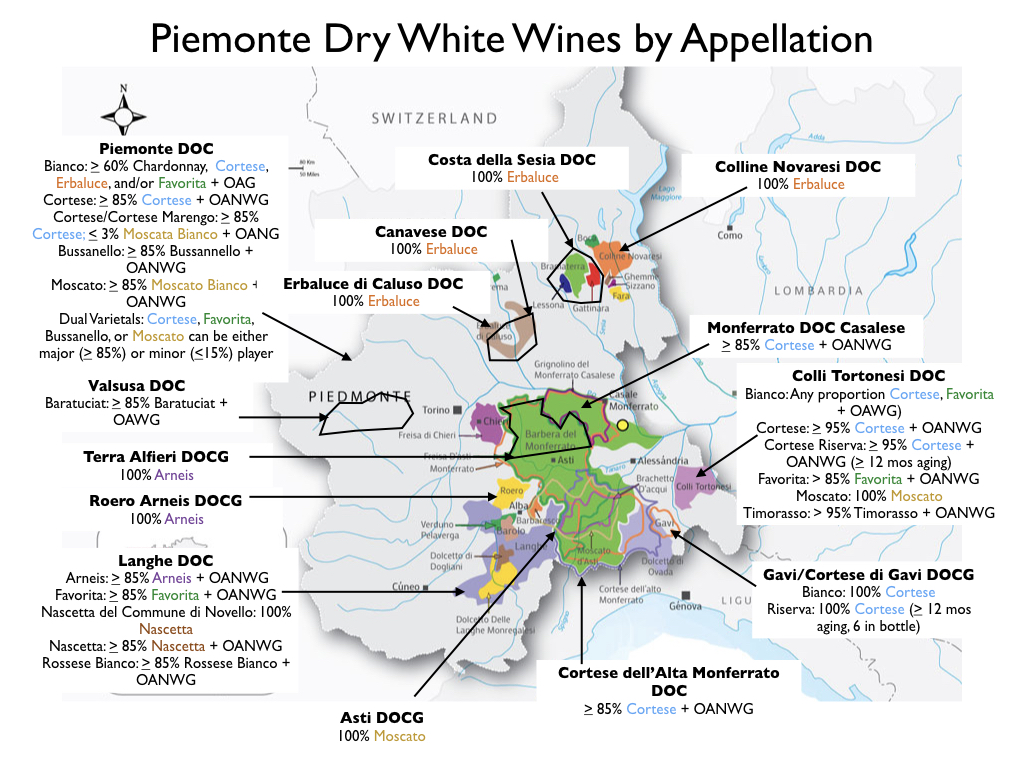
Piemonte is best known for its red wines -- primarily in the southern part of the region but also with  strong representation in the north -- based on Nebbiolo but it is also the source of vibrant indigenous white wines; wines that I have captured in the chart below and written about in a comprehensive study. 


Erbaluce-based wines dominate in the morainic soils of the north while Cortese-based wines hold sway in the limestone soils of the south. 

Even back at this time, after having only drunk one bottle of Timorasso, I was referring to it as the wine to watch. It is unique in comparison to the other white wines from Piemonte. While high-acid and mineral like some of the other white Piemontese varieties, it adds: an aromatic nose; salinity and sapidity on a phenol-rich palate; and long life, with improvement (a honeyed petrol note) over its residence in the bottle.

While some of the studied white Piemontese cultivars have smaller footprints than does Timorasso, this does not apply to Arneis and Erbaluce.

Customer Appreciation
For the region, the outlook is bright, according to Gian Paolo Repetto. Their is huge interest in the region and its wines. Even with all the recent dislocation in the world, they were able to sell all the Derthona they produced.

Protect the Patrimony
A key part of patrimony-protection is establishing Derthona as Timorasso from a specific place, the original home of the variety. Anyone can plant Timorasso vines but only Colli Tortonesi producers can make Derthona wines. Key to this is the approval of the Derthona appellation. According to Elise, this will probably occur with the 2021 vintage.

The Consorzio has submitted an application to the appropriate authorities for the designation of a Derthona sub-appellation within the Colli Tortonesi DOC covering the production of Timorasso vines within its borders. While Derthona is currently used on the labels of some producers, it is not an official designation. Further, it is a registered trademark of Walter Massa, who has encouraged its widespread adoption and use. The submittal covers a Riserva (released a minimm of 2.5 years after harvest), a Derthona, and a Piccolo Derthona (both requiring a minimum of 1 year aging). The difference between a Derthona and a Piccolo Derthona will be based on quality parameters as well as tasting panel assessments. Some of the key quality elements of the upcoming appellation will be the designation of minimum altitudes in each commune as well as minimum alcohol levels for each wine type.

A second patrimony-protection action has been the limiting of vineyard growth to maintain the artisanal nature of the wine and region. The members of the Consorzio have agreed to limit the total hectares under production to 300, and to attain this number through slow growth. In addition to ensuring that the region does not flood the market with its wine (with the resultant impact on pricing potential), this step will ensure the retention of the current agricultural profile.

"Foreign" Producers -- The Catalysts in the Woodshed
There is no doubt in my mind that, left to its own devices, Colli Tortonesi Derthona Timorasso would have eventually become "a big thing." But I do not believe that it would have aggregated its potential in such a manner -- and in such a timeframe -- that it would gain consideration as a candidate for "the next big thing." I feel that the interest and involvement of the "foreign" producers have been instrumental in this regard. First, lets look at these new entrants.

According to Elisa Semino of La Colombera, "Famous producers are now arriving in the region ... a sign of respect for the region; they believe in the variety and are planting it in its home region."

As shown in the table below, outsider interest began with Cascina La Ghersa in 2007, with a gap until the early part of the 2010s, with a rush of entrants in the last two years of the decade.

Table 1. "Non-Local" market entrants by year of initial vintage.

Initial Vintage

Producer

Producer Origins

Timorasso Holdings

Source(s) of Purchased Fruit

2007

Cascina La Ghersa

Moasca

Casasco and Sarezzano; 1.8 ha


2013

Fontanassa

Gavi

?

?

2014

Roagna

Barbaresco

Montemarzino; 1 ha


2015

Borgogno

Barolo

Monleale; 3 ha


Cascina Gentile

Capriata d’Orba

?

?

2018

Broglia

Gavi


Costa Vescovata


Sassai

Capriata d’Orba

Profigate and Ca’ del Borgo; 5 ha

Castellania and Monleale


Vietti

Barolo

Monleale; 4.1 ha


2019

La Spinetta

Asti

Montegioco, Monleale, and Montemarzino; 5 ha


Monilia

Barolo

Monleale; 1.5 ha

Monleale


Reis

Langhe and Monferrato


Sarezzano

N/A

Alvio Pestarino

Capriata d’Orba

Stazzano; ?


Pio Cesare

Alba

?; 2.5 ha

Vho


Voerzio Martini

La Morra

?


Why did the identified producers launch these out-of-region initiatives? According to Franco Ziliani (Italian blogger and wine critic) the factors driving these producers towards Timorasso wines are as follows:
  • They are impressed by the work of Massa and his disciples
  • They understand the greatness of Timorasso
  • They want to expand the the range of their reds with an important white
  • Vineyards are a bargain in Colli Tortonesi when compared to the sky-high costs in Barolo and its surrounds.
From the perspective of selected "foreign" entrants:
  • Vietti was impressed with the characteristics and future outlook of Timorasso
  • Pietro Oddero thinks that Timorasso "is the most interesting indigenous white variety in Italy."
  • The Reis team decided to do a project as a group and wanted it to be something challenging. Given cost and availability constraints, it most likely could not be in Barolo. Their Timorasso venture was both a testament to the friendship and a bow to the potential of the variety.
What advantages did the locals see accruing to the region as a result of this new presence?
  • Walter Massa saw these entrants as advantageous because of their perceived ability to market Timorasso in foreign markets
  • Gian Paolo Repetto, head of the Consorzio,  and Proprietor of Vigneti Repetto, feels that these entrants have been a "blessing" in that they have raised the profile of the region.
In my view, the Langhe producers saw an in-built marketing message:
Colli Tortonesi Timorasso is an aromatic, medium-bodied, structured, mineral, aged wine made by artisanal producers from the recently rescued Timorasso cultivar. This cultivar, which had been given up for dead, was wrangled back into existence by the tenacity and foresight of the caped-crusader Walter Massa, a winemaking practitioner who has to be seen to be believed. And oh, by the way, Colli Tortonesi is the original home of the variety, with a terroir, inclusive of Langhe-like soils, that maximizes the grape's potential.
It did not hurt that this wine aligned with their need for a counter-balancing white wine as well as with the characteristics of their red wines. These foreign producers have:
  • Provided a stamp of approval for the region
  • Brought about the potential for Timorasso to be considered as the white wine to complement Piemonte's reds
  • Have expanded the potential audience for Timorasso wines by bringing their own customers into the mix
  • Potentially increased the international spread (and acceptance) of the wine by running it through their distribution channels
  • Added to the wherewithal of the region by bringing into the deliberations a sophistication that can only be attained after generations of working in the international market
  • Elevated the value proposition for the region and the wine
  • Expanded Timorasso production beyond the traditional stainless-steel fermentation/aging vessels to include materials such as oak (barrique and cask), ceramics, concrete, etc. 
  • Aided in the efforts to protect the patrimony.

©Wine -- Mise en abyme

Wednesday, July 28, 2021

Elisa Semino: Winemaker at La Colombera and Queen (it's not even close) of Colli Tortonesi Timorasso

Conrad Mattern, whom I have previously described as the number one Timorasso fan, places La Colombera at the apex of Colli Tortonesi Timorasso production. In his view, "Walter Massa, La Colombera, and Claudio Marrioto are the 'Triumvirate of Timorasso; that is, their wines represent the pinnacle of Timorasso production."

I recently had the honor of interviewing Elisa Semino, the estate's winemaker, via Zoom to discuss the region, the estate, the variety, the estate's wines, and the future of the foregoing. Elisa is an open and enthusiastic interview subject and I came away enriched. I report on our conversation in this post.


La Colombera History
According to Elisa, her great-grandfather came to Vho from the small town of Montemarzino in 1937. They established the La Colombera farm on Monte Colombino (not really a mountain) where they grew grapes and grain and raised chickens and animals. Her grandfather expanded the grape growing but it was left to her father -- Piercarlo -- to introduce winemaking on the farm. He ceased selling grapes and sold bulk wine to private clients who came into the fold via word-of-mouth.

Walter Massa had been talking to them about Timorasso but the first "collaboration" was La Colombera purchasing used barriques from him in 1998 to house their best Barbera grapes. The wines produced from this vintage was called Elisa and was the estate's first commercial label.

La Colombera made the decision to plant Timorasso in 1997. At that time they farmed 20 ha and grapegrowing was limited to red grapes and a little bit of Cortese. The soil is Tortonian (the origin point of the band that continues through Barolo) and, from their perspective, was best suited to red grapes. But, on the other hand, Timorasso was born in Colli Tortonesi so would probably flourish if planted in the "right" places. They set out to find the right spots in their vineyard through experimental plantings in 1997, 1998, and 2000. The first Timorasso label was the 2000 vintage. There was a subsequent Timorasso planting in 2005. The 2006 was the first vintage of the cru Il Montino.

La Colombera Today
The farm currently holds 25 ha of land and, as at its founding, continues to operate a polyculture. In addition to the vineyards, the farm grows 15 ha of grain, grows fruits, and raises animals and chickens. Grape-growing is distributed as follows:
  • 15 ha in Vho. This is the traditional La Colombera home, with plantings of Timorasso, Barbera, etc. The Il Montino cru is located in this holding.
  • Cascina Machetta -- planted to Barbera, for the Monleale label, and Timorasso
  • Santa Croce -- a Sarezzano plot bought in 2017. Planted to 2 ha of Cortese and 3 ha of Timorasso with 3 additional ha of Timorasso coming online in 2022.
Elisa was absolutely giddy when talking about the Sarezzano property. This land sits on the hills above a limestone quarry which has been inoperative for well nigh 100 years. The deal was closed prior to completion of the soil analysis which, when completed, showed a striking similarity to the soil of Il Montino.

The Timorasso Variety
La Colombera is very happy with the variety. Timorasso is in the DNA of Colli Tortonesi: "one region, one grape." According to Elisa, people only drank red wines in the 1990s. She remembers when she was in University in Milan, Professor Scienza told her that it was very good that she was pursuing the Timorasso variety. It is cyclical, he said. People are going for red wine now but in 10 -15 years they will be pursuing a big white wine (This should be considered within the context of Professor Scienza having been in contact with Walter Massa regarding Timorasso beginning in 1992).

To Elisa, Timorasso is a great variety which makes a great, long-lived, mineral wine.

The terroir is well-suited to the variety. The soils are similar to Langhian soils but Colli Tortonesi is warmer and has less rain in the summer.

The variety has benefited from a warming environment. Thirty years ago, the farmers harvested partially ripe Barbera in the middle of October. Ripening was a problem for Timorasso in this environment. It was not warm enough; plus there was rain in the middle of October. In today's world, fully ripe Barbera is harvested in the middle of September and Timorasso is fully ripe in that same timeframe.

Viticulture
La Colombera farms organically but is not currently certified. No herbicides or pesticides have been used on the estate in the past 15 years. Grass is planted between the vineyards rows and is mowed twice per season (depending on the need). Vines are trained Guyot. 

Vineyards are cleaned at the beginning of September and are harvested by hand when the Timorasso grapes have attained a golden color.

Winemaking
Grapes from all the Timorasso vineyards are vinified and aged separately. Elisa uses seven different vineyards in Vho and Sarezzano as sources for grapes for her Derthona wine. The grapes for Il Montino comes from the Vho cru of the same name.

The grapes are neither destemmed or macerated. They are soft-pressed  and placed into stainless steel tanks for indigenous-yeast fermentations. The fermentations begin at 15℃ and end at 18℃. The wine remains on lees (with batonnage) for 9 months. The Derthona wine is blended prior to bottling to ensure uniformity.

Notes on Elisa's winemaking:
  • She does not macerate because that brings in a different style of wine. She is producing a traditional Derthona
  • She loves the minerality that comes with Timorasso wine. In her view, the minerality comes from the grape and the sapidity from the soil
  • Her Derthona is a Timorasso classico. In the future, it is possible that they will extend beyond just the Montino cru; Santa Croce, for example, is a "fabulous place."
  • It is also possible that they may use barrels in wine production in the future. The Timorasso from Santa Croce is an interesting grape and it is possible that they may use barrels on the grapes from that plot in the future. It would most likely be big barrels in order to minimize wood uptake in the wine.
La Colombera Timorasso Wines
The estate produces two Timorasso wines: Derthona and Il Montino. The Derthona is classic in that it is a blend of multiple vineyards. She expects to see honey, peaches fruit and minerality in this wine. I have previously reported on my tasting of an edition of this wine.

In the Il Montino, you get the best Timorasso vines in La Colombera. It is also the earliest Timorasso vineyard in the estate, planted as it was in 1997.

During my conversation with Elise, I tasted the 2018 vintage of this wine. A complex mix of aromas on the nose: apple, orange, tangerine, sweet fruit, minerality, limestone, sea spray, and spice. Smooth and open on the palate. Full, round mouthfeel. Sapidity, with a long, spicy finsh.


"Foreign" Producers
Famous producers are now arriving in the region. In her view, this is a sign of respect for the region; they believe in the variety and are planting it in its home region. Many of these producers are locating in Monleale, primarily because it is the home of Walter Massa, but some are branching out to communes such as Sarezzano.

The local producers have excellent relations with the newer producers who are simultaneously helping to introduce the variety to the world while helping to preserve the patrimony at home.

Elise hinted at the potential of two new Langhe producers entering in the Sarezzano commune. My attempts at drawing her out were unsuccessful.

Timorasso Vintages
I asked Elisa about past vintages that she had liked. She liked 2005 (unique because of the first use of malolactic fermentation), 2006, 2017 (full-bodied but nervous) and 2020 (preferred for its acidity).

The Future
For the region, further establishing Derthona as Timorasso from a specific place, the original home of the variety. Anyone, in any region, can plant Timorasso vines but only Colli Tortonesi producers can make Derthona wines. Key to this is the approval of the Derthona appellation. According to Elise, this will probably occur with the 2021 vintage.

Secondly, maintaining the artisanal nature of the wine and region while increasing the international profile.

For La Colombera, the future is "Timorasso, Timorasso, Timorasso." They are also in the process of building a formal tasting room. They have historically tasted wines with customers on Saturday and Sunday but more and more visitors are coming into the area, seeking to taste the wines in place. The new tasting room will seek to capitalize on, and provide the infrastructure for, these customer visits.


©Wine -- Mise en abyme

Thursday, July 15, 2021

Monlià: A Timorasso startup from La Morra giants Oddero and Osteria More e Macine

"There is gold in them thar hills." This was the sound reverberating around the Langhe hills in the decade of the 2010s. And it was emanating from the lips of Langhe producers. And they were not talking about the Langhe hills. Rather, they were talking about the Tortonesi hills. And the gold was white: Timorasso white.

I have previously catalogued the Langhe entrants into the Colli Tortonesi Timorasso space and provided the rationale behind the surge. In this post I detail one of the newest entrants: Monlià, a partnership between the La Morra entities Oddero and Osteria More e Macine.


The Partners
International Wine Report describes Oddero thusly:
Nestled in the Langhe hills, Oddero brings a long tradition of family winemaking ... Today the legacy of Giacomo Oddero lives on through his daughter Mariacristina, who entered the family business near the end of the 1990s, and grandchildren Isabella and Pietro.
Oddero dedicates its full attention to the winemaking process, blending ancient wisdom and modern production techniques with patience and tenacity, from the pruning of the vines to the pressing of the grapes, up to the aging of selected vintages. The vines grow in some of the best and sunniest sites (known as sôri) on the hills in the Barolo and Barbaresco zones and beyond.

Tom Hyland, writing in Forbes, describes More e Macine as offering "a wide variety of traditional plates, with extremely fair pricing, along with an outstanding wine selection, with several selections by the glass. Piemontegirl concurs: "Ito and his crew will serve you good food and wine in a fantastic atmosphere. If you look around, it is almost guaranteed one of the winemakers in the area will sit at one of the tables, drinking coffee or wine, chatting with their friends."

Isabella and Pietro manage the Oddero interests in this project.

The Project
The project was jump-started in an Autumn 2017 mealtime discussion at the tavern. As has been the case for most of the new entrants into this market, the advice and counsel of Walter Massa was sought out during the formative stages of the project.

The foundation of the effort was the purchase of a 1.45 ha eastern-facing plot in Monleale. This 450m-elevation site has very fine calcareous clay soil with some limestone presence.

The freshly planted vineyard would not yield fruit for some time but the team wanted to begin honing its processes and practices and so bought fruit for an initial vintage.

Monlià 2019 Derthona Colli Tortonesi Timorasso
As has been the case for a number of the new entrants, Monlià did not adhere to the traditional Timorasso production process. Rather, it blended Oddero winemaking practices with traditional methods to come up with the final product.

The grapes were pressed and then racked off the gross lees. Fermentation was 30% in stainless steel tanks and 70% in 2500 l Austrian oak barrels. There was no malolactic fermentation. The wines remained on lees — with batonnage — for one year and were blended one month prior to bottling. 


The nose is aromatic, flavorful, and full of promise with notes of sweet white fruit, honeycomb, sea spray, herbs, and pepper. Complexity and elegance. The wine still has a ways to go in order to deliver the promise of the nose on the palate. Broad-based and relatively approachable. Lime skin with a pepper spice finish. Less structure, salinity, and minerality than some of the wines I have encountered to date. It will be interesting to follow its development path.

©Wine -- Mise en abyme

Sunday, July 4, 2021

Ceramic-vessel-use in post-modern Timorasso production: Ricci, Vietti, I Carpini, and Sassaia

Post-modern Timorasso production expanded beyond the traditional stainless steel fermentation/aging vessels to include materials such as oak (barrique and cask), ceramics, concrete, etc. I have covered oak use by Martinetti and Sassaia and will explore ceramic implementations in this post.

Daniele Ricci
The first instance of amphora use that I explore is from the organic Costa Vescovato farmer Daniele Ricci who crafts four Timorasso wines from calcareous clay marl vineyards planted in 1986, 1989, 1992, and 1996. His traditional production method is fermentation in stainless steel followed by elevage in stainless steel or untreated oak or acacia barrels. In the case of his Io Camino Da Solo wine, however, the grapes are macerated for 100 days in amphora before transfer to untoasted oak barrels for 12 months aging.

Vietti
Luca and Elena Currado detailed their Timorasso production process during a Zoom Master Class with Brian Larky of Dalla Terra Winery Direct. According to Luca, because Timorasso is a white variety, everyone thinks that it needs to be protected from oxygen. On the contrary, he says. Timorasso is a variety that needs oxygen. Further, it has a lot of phenolics in the skin but likes some skin contact.

Vietti, according to Luca, had completed three experimental vintages prior to its initial release on the market. The first experiment withheld oxygen from the wine; and the result was "stinky." This led him to conclude that some oxygen exposure was required. He did not want to use barriques because he did not want the oak transfer that came with that. He settled, instead, for a mix of large casks and ceramic eggs, with the eggs providing the same amount of oxygen transfer without material impediment.

In Timorasso production, the lees need to remain suspended in the solution in order to limit reduction. Fluid movement within the egg effectuates lees-stirring.

Luca sees two styles of winemaking within the Colli Tortonesi region: on the one hand, fresh, brilliant, vertical wines and, on the other, high-skin-contact phenolic wines. Vietti's aim is to make a wine that is somewhere in the middle.

Clayver Vessels
I Carpini and Sassaia both use Clayver ceramic vessels in their wine production. The Clayver is a stoneware round egg that was inspired by clay amphorae and produced for the first time in 2014.

Clayver ceramic vessels (Source: clayver.it)

The round shape (in addition to being esthetically pleasing):
  • Keeps the grape cap moist during fermentation
  • Generates convective movements which reshuffle the fine lees
  • Renders it "resistant, isolating, and easy to sterilize."
In addition, the wall thickness "generates thermal inertia and a uniform oxygen exchange." There is no material transfer into the wine.

I Carpini
I Carpini is an organic farm producing Timorasso dry and sparkling wines from grapes grown in the Pozzol Groppo commune. Its Timox is an orange wine which was initially made in small amphorae beginning in 2011. The winery purchased seven Clayvers in 2015. 

The grapes for the Timox wine macerate for 15 days. Fermentation initiates spontaneously while the grapes are housed in an open tank. Post-fermentation the wine is transferred to the Clayver vessels for 12 months aging on the lees.

Sassaia
Enrico de Alessandrini of Sassaia first learned of the Clayver Technology in 2017 and became enamored. After further research, he eventually employed the technology in the 2018 trials for fermentation of whites and aging of reds. He sees the advantages of the technology as :
  • Consistent porosity
  • Ease of sanitation
  • Easier batonnage.
Sassaia expects to use the technology for both fermentation and aging going forward. It will be used, particularly, as part of the neutral regime in the production of the Derthona Riserva.

©Wine -- Mise en abyme

Thursday, June 24, 2021

Navigating the waves of a post-modern Timorasso environment

The Early Modern history of the Timorasso variety was characterized by decline, despair, invisibility, and replacement while its Late Modern history is defined by revival, refinement (of the variety's viticulture and viniculture), and recruitment (of local producers and customers). The world took notice of what was going on in Colli Tortonesi and came calling. The developments around this "foreign" contact forms a major portion of what I call Timorasso's post-Modernism.

Invasion of the Body Snatchers
Timorasso is a body-rich, white wine a characteristic that is partially responsible for the interest of "foreign" players.

The earliest external interest in Timorasso predated the post-Modern (whose origin date I am establishing as 2010). The earliest case of non-local Timorasso activity was the collaboration between Massa and Martinetti which resulted in the production of a barrique-fermented and -aged Timorasso (Martin), the first vintage of which was the 1997. The owners of Cascina Montagnola did purchase property and begin production of wines in the region as far back as 1988 but they did not plant Timorasso vines until 2003 and introduced their first wine on the market in 2006. With this length of presence in the region I do not think that they qualify as outsiders.

As shown in the table below, outsider interest began with Cascina La Ghersa in 2007, with a gap until the early part of the 2010s, with a rush of entrants in the last two years of the decade.

Table 1. "Non-Local" market entrants by year of initial vintage.

Initial Vintage

Producer

Producer Origins

Timorasso Holdings

Source(s) of Purchased Fruit

2007

Cascina La Ghersa

Moasca

Casasco and Sarezzano; 1.8 ha


2013

Fontanassa

Gavi

?

?

2014

Roagna

Barbaresco

Montemarzino; 1 ha


2015

Borgogno

Barolo

Monleale; 3 ha


Cascina Gentile

Capriata d’Orba

?

?

2018

Broglia

Gavi


Costa Vescovata


Sassai

Capriata d’Orba

Profigate and Ca’ del Borgo; 5 ha

Castellania and Monleale


Vietti

Barolo

Monleale; 4.1 ha


2019

La Spinetta

Asti

Montegioco, Monleale, and Montemarzino; 5 ha


Monilia

Barolo

Monleale; 1.5 ha

Monleale


Reis

Langhe and Monferrato


Sarezzano

N/A

Alvio Pestarino

Capriata d’Orba

Stazzano; ?


Pio Cesare

Alba

?; 2.5 ha

Vho


Voerzio Martini

La Morra

?


Why did the identified producers launch these out-of-region initiatives? According to Franco Ziliani (Italian blogger and wine critic) the factors driving these producers towards Timorasso wines are as follows:
  • They are impressed by the work of Massa and his disciples
  • They understand the greatness of Timorasso
  • They want to expand the the range of their reds with an important white
  • Vineyards are a bargain in Colli Tortonesi when compared to the sky-high costs in Barolo and its surrounds.
From the perspective of selected market entrants:
  • Vietti was impressed with the characteristics and future outlook of Timorasso
  • Pietro Oddero thinks that Timorasso "is the most interesting indigenous white variety in Italy."
  • The Reis team decided to do a project as a group and wanted it to be something challenging. Given cost and availability constraints, it most likely could not be in Barolo. The Timorasso venture is a testament to the friendship as well as the potential of the variety.
On the other hand, did the "locals" welcome these "foreigners?" And what advantages did they see accruing to the region as a result of their presence?
  • Walter Massa saw these entrants as advantageous because of their perceived ability to market Timorasso in foreign markets
  • Conrad Mattern, a distributor of Timorasso wines in Germany, "senses mixed feelings among the "locals"as regards the new, high profile entrants... They like what these big-name producers can do in terms of marketing Timorasso but, on the other hand, these are large producers and are accompanied by a 'smidgen' of industrialization.
  • Gian Paolo Repetto, head of the Consorzio,  and Proprietor of Vigneti Repetto, feels that these entrants have been a "blessing" in that they have raised the profile of the region
  • Marco Volpi of Cantine Volpi is supportive of those who come in and buy vines and gives a nod of approval to the Barolo producers in this regard. "Those who come into the region and invest are making a positive contribution and should be encouraged."
Breaking from the base Wine Style in the Post-Modern
Massa and his band of Merry Timorassists spent a large part of the Late Modern getting the Timorasso recipe just right. And they were very successful. So much so that the rest of the world began to take notice; and to come around.

Once the formula was established, producers began to experiment to see: (i) if they could make a better wine or (ii) if they could differentiate by putting their personal spin on it. And though the "foreign" producers were major players in this shifting of the goal posts, as shown in the figure below, local  producers were also in the mix.

During this period, the Timorasso offerings expanded from a standard dry white wine to incorporate orange, sweet, and sparkling styles. In the case of the standard dry white wine, the changes were wrought by different fermentation and/or aging vessels. For illustrative purposes I will highlight the production styles of La Morella and Sassaia.

La Morella sources the Timorasso grapes for its wine from Carrezano Superiore and macerates it on the skins for 60 days. The wine is then fermented in stainless steel to 30% completion, at which point 70% of the wine is removed and placed into 2500 l Austrian oak casks until fermentation is complete. The wines are then aged separately in oak and stainless steel for 1 year. One month before bottling the oak- and SS-aged wines are blended.

The Sassaia team ran a number of tests to determine its most relevant wine style. Higher-potential-alcohol grapes were vinified locally using (i) the traditional stainless steel method and (ii) hyperoxidation in neutral barrique. The lower-potential-alcohol grapes were harvested in 5 - 6 kg bins and shipped to Gevrey-Chambertin for further processing.


In the barrique-fermented and -aged wine, the oak used was 100% new; in the future Sassaia will be targeting 25% new oak.

The Terre di Libarna Subzone
The Val Borbera is the valley formed by the Borbera River. It is surrounded by high mountains which serve to isolate it from surrounding valleys as well as the ravages of industrialization. As shown in the map below, the Alta Val Borbera runs in a northeasterly direction while the lower valley runs almost directly east.


According to Cascina Barbàn, wine has been made in Val Borbera for centuries, with documents from Napoleanic times illustrating the breadth of grapegrowing across the region. As late as the 1960s, 275 ha of vineyards were planted between Vignole Borbera and Carrega Ligure with 60 of those located in Alta Val Vorbera. Most of the plantings were dedicated to Timorasso.

With elevations ranging between 400 and 600 m, Val Borbera has the highest-altitude vineyards in Colli Tortonesi. It also has a markedly different temperature profile. According to Maurizio Carucci of Cascina Barbàn, the Tortona hills, with its hot, humid summers, are more reflective of a Po Valley influence. Terre di Libarna, on the other hand, is colder in the winter, has a more significant diurnal temperature variation, and much more rainfall over the course of the growing season. The diurnal temperature variation supports the production of highly aromatic grapes while the cool temperatures extends the growing season. Maurizio sees at least a 20-day difference in harvest dates between the two zones.

Val Borbera soils are primarily marly clay and silty mary originating in the Lower Oligocene.

Ezio Poggio is the third generation of his family to farm in Val Borbera. He initiated his Timorasso-recovery project with the aid of his sister in in 2003 when they began working with local farmers as well as planting new vineyards. His first was harvest was booked in 2008. Ezio's ongoing work to showcase the differences between Val Borbera and Tortona Hills Timorasso was rewarded with the former being awarded subzone designation in 2011. The subzone Terre di Libarna is illustrated in the figure below.


Processing Timorasso Wines outside the Colli Tortonesi Region
This was a non-issue prior to the arrival of the non-local producers. My first encounter with this phenomenon was my research finding that Borgogno transported its Timorasso grapes back to its main Langhe facility for processing. The first producer that I had the opportunity to discuss this with was Marco Volpi of Cantina Volpi. He feels that the region should be attracting capital and he is not necessarily on board with allowing "foreign" producers to buy grapes and process them outside the region and still get to affix the DOC label to their wines.

In my conversation with Gian Paolo Repetto, I asked him about any quality risks associated with grapes being trucked out of the area for processing. He indicated that those grapes could only be processed in Piemonte and the use of refrigerated trucks would mitigate against significant quality impacts. Gian Paolo indicated that processing-location was something under active discussion at the Consorzio and that they may arrive at a scheme wherein they grandfather the status quo but limit new entrants to processing their grapes within the Colli Tortonesi boundary in order to claim the appellation label. It is important to maintain interest in the appellation, says Gian Paolo, but it is also important to balance that with maintenance of quality.

The Sassaia wine produced in Gevrey-Chambertin in 2019 obviously could not be labeled Colli Tortonesi. However, since Derthona "was still just a registered trademark and not yet submitted to the region as the proposed new appellation name, the consortium permitted Sassaia the use of DERTHONA without Colli Tortonesi Timorasso."

Derthona Appellation
The Consorzio has submitted an application to the appropriate authorities for the designation of a Derthona sub-appellation within the Colli Tortonesi DOC covering the production of Timorasso vines within its borders. While Derthona is currently used on the labels of some producers, it is not an official designation. Further, it is a registered trademark of Walter Massa, who has encouraged its widespread adoption and use. The submittal covers a Riserva (released a minimm of 2.5 years after harvest), a Derthona, and a Piccolo Derthona (both requiring a minimum of 1 year aging). The difference between a Derthona and a Piccolo Derthona will be based on quality parameters as well as tasting panel assessments.

Some of the key quality elements of the upcoming appellation will be the designation of minimum altitudes in each commune as well as minimum alcohol levels for each wine type.

**********************************************************************************************************
The Timorasso grape has gone from the brink of extinction to a high-potential, high-expectation variety whose future now lies in the hands of the marketers and the consumers. The producers, led by the inimitable Walter Massa, developed a base wine that gained the world's attention and now a second wave of producers are seeking to expand the envelope of exactly what is  a Timorasso wine. Through it all, the wine's characteristics continue to shine through. The post-modern era is still in its youth; it will be interesting to see the developments along the way

©Wine -- Mise en abyme