Showing posts with label Chateau Musar. Show all posts

Thursday, December 8, 2022

Lebanese Wine: Renaissance Interruptus

My most recent post covered the role of the Phoenicians in the spread of wine across the Mediterranean. As was the case for Iranian wine, production in the Levant contracted with the introduction of Islam to the region, with wine permitted only for use by Christians in the course of their religious pursuits.

The "modern" phase of the Lebanese wine industry began in 1857 with French Jesuit monks who settled in the Bekaa Valley in the mid-19th century. This group was gifted a 25-acre plot of land in the Bekaa and chose to employ it in grape-growing. Thus was born Chateau Ksara, an enterprise still in existence today. 

The early wines were made for personal consumption with the monks moving from raisin-based wines to wines made from grapes grown on Cinsault, Carignan, and Grenache vines imported from Algeria, at that time the biggest wine hub outside of France.

At the end of the First World War, the Ottoman Empire was dismantled and Lebanon was placed under a French Protectorate. This brought in a large number of French soldiers and Administrators and drove up the demand for wine. Chateau Ksara switched from wines for personal use to a commercial enterprise in order to meet this demand.

In the early 1970s the Vatican issued a papal edict requiring that the Catholic Church sell any and all commercial concerns. This forced the Jesuits to sell Chateau Ksara to a Lebanese investment group in 1973.

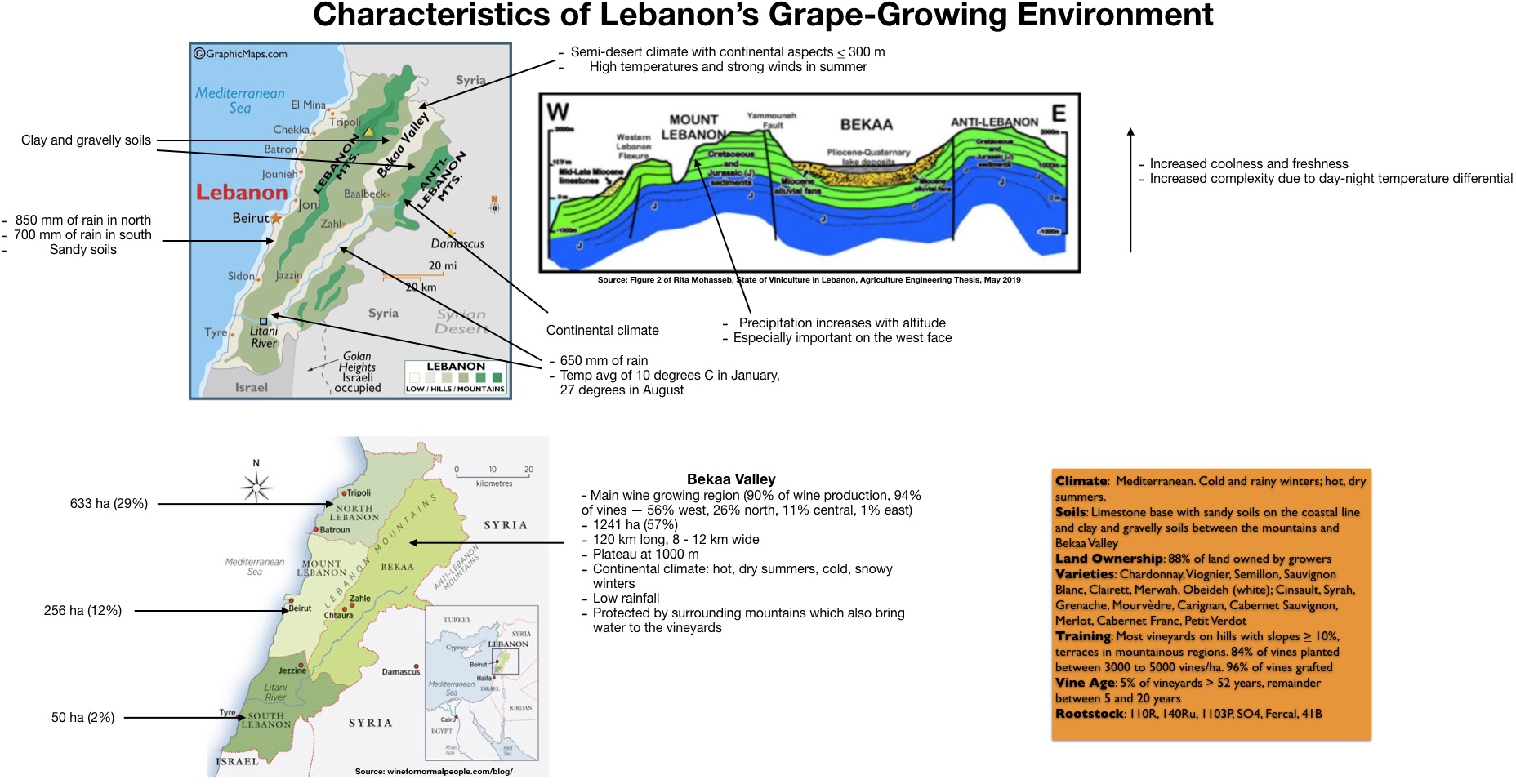
At the beginning of the Lebanese Civil War (1975 -90) a total of six commercial wineries were operational within the country. At the end of the war, Chateaus Kefraya, Ksara, Musar, and Nakad and Domaine des Tourelles, plus six new producers, dusted off the sands of war and turned their full attention to the resurrection of the Lebanese wine industry. By the mid-1990s, the number of wineries had grown to 14 and to 60 by 2018. The country was conducive to grape growing, with a dry, sunny climate and protection of the vines afforded by the peaks of the Lebanon and Anti-Lebanon Mountains.
The characteristics of the Lebanese grape-growing environment are shown in the chart below.

Chateau Musar: One of The North Stars of Lebanese Wine
One of most enduring stories of Lebanese wine has been the efforts of Chateau Musar's Serge Hochar to produce wine during the course of the Civil War. I had the honor and priviledge of tasting the estate's wines with him prior to his untimely death. The below observations are from notes taken at the tasting.

Chateau Musar's vineyards are located in Lebanon's Bekaa Valley with red and white wine grapes grown in distinctly separate environments. The red wine grapes -- Cabernet Sauvignon, Cinsault, and Carignan -- are planted in the southern portion of the Bekaa Valley on soils that are gravel over limestone. These old vines yield between 30 and 35 hl/ha. The white varieties are the indigenous Obaideh and Merwah which are planted in high-altitude (1500 m ) vineyards. Grape growing is organic and, at harvest, the berries are hand-picked by Bedouin tribespeople and trucked over the mountain to the winery which is 2.5 hours removed.

Grapes for the red wines are fermented by varietal in cement vats and then racked into French oak barriques after 6 months (In the tasting, Serge indicated that he had tried stainless steel fermentation but that it had "destroyed" the wines. He uses stainless steel for some of the younger-generation wines but exclusively uses concrete for the Hochar and Musar wines.). The barrique wines are blended after 12 months of initial residence and then returned to the barriques for an additional 12 months. The mature wine is then bottled unfiltered and aged for 3 - 4 years before being released to the market.

The white wines are fermented in French oak for 6 - 9 months before blending and bottling and are then stored in the Musar cellars for an additional 6 years prior to market release.


Serge and the Author

Renaissance Interruptus
By 2020, this Lebanese winemaking renaissance had been brought to heel by:
  • A popular revolution
  • A financial crisis -- loss of 95% of the value of the Lebanese pound
  • The impact of the coronavirus
  • A massive explosion in the Beirut port which killed in excess of 200 people, wounded over 6000 people, and dealt a massive blow to the port infrastructure and adjacent business/residential districts
  • Rising poverty
  • A fuel and electricity crisis.
These conditions served to cause a contraction in both the local (30 - 35% decline 2020 over 2019) and export (30% decline) wine markets. Wine imports have decreased by 65%. Wine producers are hit especially hard by these conditions because they need hard currency to import equipment, sulfur, yeast, bottles, corks, and labels.

Given the need for hard currency, as well as the limited local consumption, Lebanese winemakers will be forced to focus on the export market in order to survive. The prospects are better for establishments with name recognition in foreign markets as marketing funds are not readily available. 

©Wine -- Mise en abyme

Tuesday, October 29, 2013

Chateau Musar tasting with Serge Hochar

On Tuesday, October 15th, I got an opportunity to see a living legend when Stacole Fine Wines hosted Serge Hochar, of Chateau Musar, for a tasting of his estate's wines. The event was held at Luma on Park (Winter Park, FL) and was aimed at area wine retailers and restaurateurs. Before describing the tasting I would like to take a step back in order to place Serge and Chateau Musar into their proper places in the wine firmament.

Chateau Musar's vineyards are located in Lebanon's Bekaa Valley and that statement is in and of itself a testament to the grit and determination of Serge Hochar. You have heard of conflict diamonds; these are "despite-conflict" wines.

The Bekaa Valley is a 75-mile (65-km) long, 10-mile (16 km) wide, 3000-feet (1000 m) high strip of land located about 19 miles (30 km) east of Beirut between the Lebanon and Anti-Lebanon Mountains (which serve as shields against the deserts to the east and the rains from the west). The valley experiences long, gentle summers, wet winters, and 240 days of sunshine annually and is well irrigated by the waters that flow from the mountain peaks. The soils of the region are primarily clay limestone.

Source: massaya.com
The first vineyards in the valley were planted in 1857 by Jesuit Christians and, today, over 90% of Lebanese wines are produced in the region. Red wine grapes include Cinsault, Carignan, Grenache, Syrah, Mourvedre, Cabernet Sauvignon, and Merlot. White wine grapes include Ugni Blanc, Clairette, and Chardonnay.

Chateau Musar's red and white wine grapes are grown in distinctly separate environments. The red wine grapes -- Cabernet Sauvignon, Cinsault, and Carignan -- are planted in the southern portion of the Bekaa Valley on soils that are gravel over limestone. These old vines yield between 30 and 35 hl/ha. The white varieties are the indigenous Obaideh and Merwah which are planted in high-altitude (1500 m ) vineyards. Grape growing is organic and, at harvest, the berries are hand-picked by Bedouin tribespeople and trucked over the mountain to the winery which is 2.5 hours removed.

Grapes for the red wines are fermented by varietal in cement vats and then racked into French oak barriques after 6 months (In the tasting, Serge indicated that he had tried stainless steel fermentation but that it had "destroyed" the wines. He now uses stainless steel for some of the younger-generation wines but exclusively uses concrete for the Hochar and Musar wines.). The barrique wines are blended after 12 months of initial residence and then returned to the barriques for an additional 12 months. The mature wine is then bottled unfiltered and aged for 3 - 4 years before being released to the market.

The white wines are fermented in French oak for 6 - 9 months before blending and bottling and are then stored in the Musar cellars for an additional 6 years prior to market release.

Now back to the tasting. The wines were tasted in the order presented below and, surprisingly to me, we tasted the reds prior to the whites. Serge said that we would understand the ordering in due time. The tasting was called to order by Brian Koziol MS of Stacole and he then turned the microphone over to Serge after a brief introduction. Serge made a few remarks and then proceeded to walk us through the wines.


The 2009 Hochar exhibited plum and berry characteristics along with minty herbal notes and an earthy minerality. The wine was brisk and persistent with red pepper tones and a long finish. Serge said that this wine was simpler when compared to the Chateau Musar because it was designed to be more approachable. He called it his "fruit juice" wine.

The 2005 Chateau Musar is a blend (as are all Musars) of 1/3 each of Cabernet Sauvignon, Carignan, and Cinsault. According to Serge, it took him 17 years of trial and error to come up with the final blend. In relating the wine to a human, he sees the Cabernet Sauvignon as the skeleton, the Carignan as the flesh and muscles, and the Cinsault as the skin. The wine had notes of jasmine, plum, and mints to go along with an herbaceousness and a flinty-stony minerality. This medium-bodied wine was bright with supple tannins and a richness and persistence that was apparent on both the palate and the finish.

The 2002 Chateau Musar was redolent with jammy berry flavors along with mint, eucalyptus, pepper, coffee, smoke, and petrol. Firm, drying tannins with medium body and excellent length of finish.

The 1999 Chateau Musar showed cherries and strawberries along with mint, cedar, truffle, and mushrooms. This medium-bodied wine had elements of rust on the palate and is balanced with a long finish. This wine needs more time. Serge said that his wines can be drunk after 15 years but require a minimum of 25 years to be truly enjoyable.

The final red was the 1977 Chateau Musar. This wine exhibited dark fruits, pineapple, tarragon and mint. It had tar notes reminiscent of a Barolo. Additional aromas included blackpepper, iodine, coffee, dried blood, and iron. The finish was moderate in length and the wine appeared tired to this taster.

The first white tasted was the Blanc 1998. This wine had a golden color and, validating Serge's decision re the tasting order, was more powerful than any of the reds. This wine exhibited citrus, stone fruit, fresh herbs, tea, thyme, honey, beeswax, white pepper, and a certain nuttiness. Vibrancy on the palate. Racy acidity with some structure and a long, thin finish. This wine, believe it or not, still needs time. The nose started out with faint aromatics but gained complexity in the glass.

The Blanc 2000 had a floral component but was more endowd with rust, stone, and white pepper. Grippy green tannins accompany a moderate length finish.

The Blanc 2004 had similar characteristics to the 2000 except for additional citrus and grassy notes. This wine was lighter in body than the prior two, was metallic on the palate, and had a short, drying finish. This wine is unimpressive at this time but, given the characteristics of Hochar wines, may need more time in bottle to reveal its swan-ness.


There was much more variation around the red wines once you got beyond consistent mint and spice characteristics. Some exhibited red fruit, some black, and some both. There were distinct mineral elements ranging from flinty to stony to earth. The wines north of 1999 need more time in bottle. There was consistency in the whites with vintage-related amplification. All of these wines are long-lived.

©Wine -- Mise en abyme