Showing posts with label Santorini. Show all posts

Thursday, June 17, 2021

Assyrtiko, Carricante, and Timorasso: Three peas in a pod?

The consistent threads that have emerged through my tastings of Timorasso wines are salinity, bright acidity, and mineral notes. This combination of aromas, tastes, and textures calls to mind for me wines made from Assyrtiko and Carricante in their native regions. 


In this post I seek to validate, or discard, my assertions as to the similarities of these wines. The post will examine the varieties in alphabetical order.

Assyrtiko
The Assyrtiko grape, according to Yiannis Karakassas MW (one of the world's leading expert on this variety), probably originated on the volcanic island of Santorini from whence it spread to other parts of Greece and other regions of the world. Today Santorini is home to 800 ha (40% of Greece's plantings) of Assyrtiko vines.

According to Yiannis, there are key differences in Assyrtiko grown in different parts of Greece. "If you have a scale with minerality on one side and fruit on the other, Santorini comes down hard on the minerality side, with high minerality, saltiness, and evaporating smoke. If you go to mainland Greece, the Assyrtiko is broader, with more fruit. In the islands, the Assyrtiko is balanced between fruit and acidity."

Diving further into Santorini Assyrtiko, Yiannis sees these wines as having/being:
  • A distinctive taste of rocks and salt
  • Tight and firm in its youth with stone or tropical fruit aromas, depending on the ripeness, along with the telltale rocky saltiness.
  • Vertical and powerful on the palate with the unique combination of high alcohol (up to 15.5% abv) and high acidity (pH can be as low as 2.8 and TA as high as 7.5 g/l).
The Santorini Growing Zone
The 73-square-kilometer archipelago of islands, the southernmost landmass in the Cyclades chain, lies 113 km to the north of Crete, the largest and most populous of the Greek isles and itself famed for its ancient Minoan society. Santorini is one of the European Union's protected designation of origin (PDO) regions with PDOs for dry and sweet white wines. The characteristics of the zone are summarized in the chart below.


In addition to the lack of moisture, another significant challenge to Santorini viticulturists is the stiff wind that buffets the island during the growing season and could damage the berries if they were exposed to the elements.  The solution that has been employed for eons is to (i) eschew vine density and (ii) train the vines such that they can afford protection to the otherwise vulnerable berries.  Vine canes are intertwined and trained into a circle and the berries grow within this protective cordon.  The circular structure can be positioned above ground or in a below-ground hollow where the top of the vine is parallel to the surface.

Source: Winesfromsantorini.com

Santorini vines are, for the most part, in excess of 50 years old.  Vines are retained until the yield is almost zero or when the vine dies.  When the vine is no longer productive, it is replaced by a branch from a nearby vine which is buried to a depth of 30 cm into the soil.  After that branch has developed its own roots and has begun producing berries (a period of between 3-5 years) it is cut away from the tethering parent.

Wine Styles
Santorini Assyrtiko dry wines conform to the following styles:
  • Classic -- taut; made from 100% Assyrtiko
  • Blended with Athiri and/or Aidani; wines are broader and softer
  • Lees aging
    • Few months to two years on lees
    • Fills out the mid-palate and balances the bright acidity
    • Can add more complexity
  • Oak -- best examples display a creamy, toasty complexity.
Aging
Due to demand pressures and the cost of library maintenance, the Santorini producers have not built out extensive libraries of their wines. Yiannis recently conducted a seminar on aged Assyrtikos and noted that (i) the wines can age but are inconsistent and subject to bottle variation and (ii) brilliant examples exhibit no signs of fatigue, showing, instead, pale colors and nutty, toasty characteristics.

Carricante
This section draws from my original research, email exchanges with Benjamin North Spencer and Brandon Tokash, and Benjamin’s book The New Wines of Mount Etna.

Carricante is an ancient white variety -- prevalent on Mt Etna's eastern face -- that yields low-potassium, low-pH, high acidity wines (benanti.it). The bunches are of average length at ripening, with medium-sized berries of a green-yellowish color.

Carricante (tenutaterrenere.com)
Frank Cornelissen, one of the leading winemakers on the mountain, has historically viewed the variety as too acidic to produce world-class wine. Ian d'Agata, author of Native Wine Grapes of Italy, on the other hand, is quoted in Szabo's Volcanic Wines thusly: "potentially one of Italy's greatest cultivars ..." that "... when properly tended to, yields wines of great longevity and intense mineral character."

The variety (The New Wines of Mt Etna):
  • Is the result of a natural crossing between Montonico Pinto and Scacco
  • Is the primary white wine grape variety on Mt Etna
  • Produces pale yellow wines with beautiful freshness and savory flavors
  • Is most often blended with Catarratto, Minella Bianca, and non-aromatic Sicilian varieties to create sophisticated still table wines with great aging potential
  • Is productive, but when grown above 400 m, the loading decreases and the quality improves
  • Exhibits a slight petrol or kerosene scent in some wines
  • Produces its best examples in the Milo area of Mt Etna.
According to Salvo Foti, famed Sicilian viticulturist, Carricante vines have to be somewhere between 10- and 15-years old in order to begin giving great concentration. Salvo said that both his father and grandfather worked Carricante and the wine's high acidity was extremely important in the days before widespread access to refrigeration. The wine is also great for raw fish, the main dish in the area.

There is a saltiness in the east side Carricante that is lacking in wines made from grapes grown on the north side of the mountain. 

A few years ago I attended Contrada dell'Etna and drank only the white wines from Etna's east and southeast flanks in order to imprint the characteristics of those wines on my senses. The key observation coming out of that exercise was as follows: 
As is the case for the Santorini Assyrtikos, Carricante-based wines from the east to south flanks of Etna are characterized by salinity, minerality, and acidity and, at optimum, these characteristics meld extremely well. These characteristics also allow the wines to age well (based on my experiences drinking aged Benanti Pietra Marina wines). While the characteristics of the wines are consistent, the quality of individual wines will vary based on winemaking practices, elevation, soil composition, and other related factors.
The Growing Environment
Mount Etna has a mountain climate in a southern setting. In general, warm days, cool nights, winter snow, winds, and sunny days. The steep vineyards grow on well-drained volcanic soils which forces the vines to dig deep in search of nutrients. Vineyards are planted to high density with a low-yield training system. Labor intensity is high. 

Climate in the area of interest
As shown on the below chart, growing conditions in the east and southeast differs from the conditions in the north and southwest.

Derived from Nesto and di Savino

The southeast and eastern slopes are unprotected from the autumn and winter rains but the combination of rapid runoff and early morning sun contribute to their attractiveness as growing regions (especially for whites).

The volcano's southeast flank experiences markedly different climatic conditions than north-slope-resident wineries. First, it is warmer in the southeast than in the north; 4 to 7 degrees warmer, as a matter of fact.

Second, with no protective layer of mountains, the region bears the full brunt of the wind and rain coming in off the Ionian Sea. In the fall and spring, dry winds form over North Africa, pick up moisture over the Mediterranean, and barrel into the Sicilian coast at upwards of 50 miles an hour. These winds are called Scirocco and an event can last from 1/2 day to several days. The wind makes it easier to farm organically as it helps to keep mold at bay.

Third, the southeast is unprotected from the autumn and winter rains but the combination of rapid runoff and early morning sun contribute to its attractiveness as a growing region 9especially for whites).

Wine Styles
Etna DOC has established the following requirements for its white wines:
  • Etna DOC Bianco -- to be made from Carricante (> 60%), Catarratto (< 40%), and up to 15% of other non-aromatic grapes such as Minella or Trebbiano
  • Etna DOC Bianco Superiore -- to be made from Carricante (> 80%) and Catarratto or Minnella (< 20%). All grapes to be sourced exclusively from the area of Milo on the eastern side of the volcano.
According to The New Wines of Mount Etna, young Carricante is quite shy. It has a "pale color  with subtle aromas and flavors of white flowers, pear and citrus." If blended with Minella, that variety adds a "spicy, white peach profile to the blend." The 100% Carricante wine is a "crisp Etna Bianco with increased acidity, temperate fruit, and saline flavors" with the finest wines showing their best after 4 years in the bottle. 

In conversations with Benjamin and Brandon, they had the alcohol of the Carricante wines ranging between 11% and 14.5%, with the most fine (Benjamin) at 13%. 

Aging
According to The New Wines of Mount Etna, the best flavors arrive through extended aging. As the wine ages, "the light citrus profile ... evolves to sun-dried citrus zest, ginger, herbs, and toasted almonds."

Only three Superiore producers (Brandon) use oak. For Benjamin, oak adds roundness, a sense of body, subtle autolytic characteristics, a creaminess, and concentrated flavors. Brandon prefers his Etna Bianco Superiore unoaked. He "really enjoys the salinity, minerality that sometimes vibrates on the lips, fruit, and acid that shines through. It gives an ummuddled sense of layered clarity that integrates well with aging."

Timorasso
Kerin O' Keefe (one of today's leading Italian wine experts) refers to Timorasso as "one of the most exciting wines coming out of Italy right now" which "boasts more depth, body and complexity than many Italian whites." Berry Bros and Rudd, a historical UK wine retailer, tags the wine as "one of the most exciting autochthonous grape varieties to surface in recent years." These, and many other such laudatory comments, have been directed at wine made from the Timorasso variety.

Characteristics
"Timorasso is a native grape variety of the province of Alessandria, with a quality white-berried grape, grown essentially in the Curone, Grue, Ossona, and Val Borbera valleys, in an area where the vine finds a valid 'habitat' thanks to the soil, sunshine and the position sheltered from the winds" (Consorzio).

According to stradacollitortonesi.com, the Timorasso variety is a part of the ampelographic heritage of Liguria, Piemonte, Lombardia, and Emilia Romagna and is assumed to have originated somewhere between Liguria and Piemonte. The characteristics of the variety are shown in the chart below.


D'Agata identifies a "first degree parentage relationship between Lambruschetto and Timorasso while the Lambruscos from Emilia-Romagna were genetically distant."

Cultivation Challenges
Cultivation of the variety is challenging and has partly been responsible for it going from one of the most planted white varieties in Piemonte to being convincingly supplanted by Cortese in Alessandria. Elisa Semino (quoted in Civita del bere): "... difficult to follow in the vineyard, because it has thick foliage and the shoots must be well-managed: they must be sorted in the row when they are still young so as not to break them. It has good production but requires green pruning to rebalance the right amount of branches/vine."

In a conversation I had with Marco Volpi of Cantine Volpi, he mentioned that the variety had experienced a steady decline over the preceding century due to (i) the amount of work required in the vineyard, (ii) its susceptibility to illness, and (iii) its relatively low yield. For the best results, he said,  the grape has to be harvested at optimal ripeness but care has to be exercised in this pursuit as it is susceptible to sunburn. Leaves have to be removed to provide access to sunlight but should not be the leaves that provide direct shade from the sun. 

In response to a question regarding the pros and cons of Timorasso, Gian Paolo Repetto (Vigneti Repetto) said that the only pro was the possibility of producing a great wine. That has to be balanced against a number of negatives:
  • It is a difficult variety to grow
  • Material sticks to the equipment during pruning and have to be constantly cleaned off
  • Double and triple buds at bud break; these have to be cleaned out manually
  • The short distance between buds are a disease risk
  • Sunburn is an ever-present risk.
A grower with both Timorasso and Cortese in his/her vineyard will put three times more work in the vineyard for the former. Growers deserted Timorasso in the past because the market did not reward them for the effort expended. 

The Wines
Writing about Walter Massa wines in Wine Spectator, Kerin O'Keefe states thusly:
When young, Vigneti Massa's full-bodied Timorasso wines boast alluring floral scents, creamy apricot and apple flavors, and bright acidity. As they age, they gain in mineral complexity and boast dried fruit, almond and honeyed notes seamlessly balanced with fresh acidity. I've tasted numerous vintages over the years, and the wines evolve beautifully for at least fifteen years. As the vines get older, these superb whites may increase their aging potential.
I tasted a 2016 Cascina Montagnola Morasso and reported as follows:

Light gold color. Viscuous in the glass. Sage on the nose at first blush. Elevated, high-toned, and elegant, initially. Sea spray and lemon grass. Weighty on the palate, with spice, acidity, minerality, salt, lime, and a bitter character, all preceding a cupric finish. This is a complex wine. With a little time, a slatey, rocky minerality emerges, along with a furriness reminiscent of a tannin texture. The palate is fully cleansed with each new taste. With further residence, petrol, lychee, phenolic, saline, menthol, and spice notes along with a saline-acid-pine mix on the palate. Broader on the palate with time. An excellent wine.

Growing Environment
In the past, the vineyards were widespread in the valleys previously mentioned, valleys which are "notoriously wild and difficult for many agricultural crops." The Timorasso vine prefers poor and marginal soils with especially limited water reserves. The current Timorasso growing environment is illustrated in the chart below.


The average vineyard size in the chart above is based on a total of 43.2 ha spread over 18 vineyards. It should be noted that Volpe (10 ha) and La Spinetta (5 ha) represent almost 1/3 of the total hectares. If their numbers are removed from the population, the average vineyard size declines to 1.76 ha.

Observations
  • These wines have similar profiles as it relates to salinity, acidity, and minerality but Timorasso is more aromatic and structured than either the Assyrtiko or Carricante
  • The Timorasso and Assyrtiko present a higher alcohol profile than does the Carricante
  • Both the Timorasso and Carricante exhibit petrol notes with age
  • The use of oak is much more advanced in Santorini than in Etna Bianco Superiore or Timorasso but Timorasso has the stuffing to handle oak well
  • Surprisingly low levels of malolactic fermentation across the three environments
  • Volcanic soils in Santorini and Mt Etna; Calcareous clay dominant in Colli Tortonesi.
  • Low rainfall levels in Colli Tortonesi and on Santorini; significant rainfall on the east flank of Mt Etna.
  • Relatively stressed vines in each location
  • Strong winds from sea in all three locations.
©Wine -- Mise en abyme

Saturday, March 13, 2021

An Assyrtiko wine tasting organized by Cinque Wine Bar (Athens, Greece): Domaine Hatzimichalis, Gaia Winery, and Avantis Santorini Winery

I chatted with Yiannis Karakasis MW on InstagramLive during the lockdown as to the current and future states of Greek wine. When the conversation turned to Assyrtko, he stated thusly:
There are over 2000 ha of Assyrtiko vines planted nationwide, with 40 - 45% of those plantings in Santorini. If you have a scale with minerality on one side, and fruit on the other, Santorini comes down hard on the minerality side with high minerality, saltiness, and evaporating smoke. If you go to mainland Greece, the Assyrtiko is broader, with more fruit. In the islands, the Assyrtiko is balanced between fruit and acidity.
The Assyrtiko tasting organized by Cinque Wine Bar would allow us to test this hypothesis as two of the wines were from Santorini while the third was from mainland Greece. Below I provide a brief description of each of the estates.

The Producers
Domaine Hatzimichalis
This estate was founded when Dimitris Hatzimichalis purchased land in the Atalanti Valley (Central Greece) in 1973, an area which had, hitherto, been "home to a tradition of small-scale viticulture." Grapegrowing in the region is advantaged due to its location "between the cool breezes of Mount Parnassus and the Euboean Gulf of the Aegean Sea."

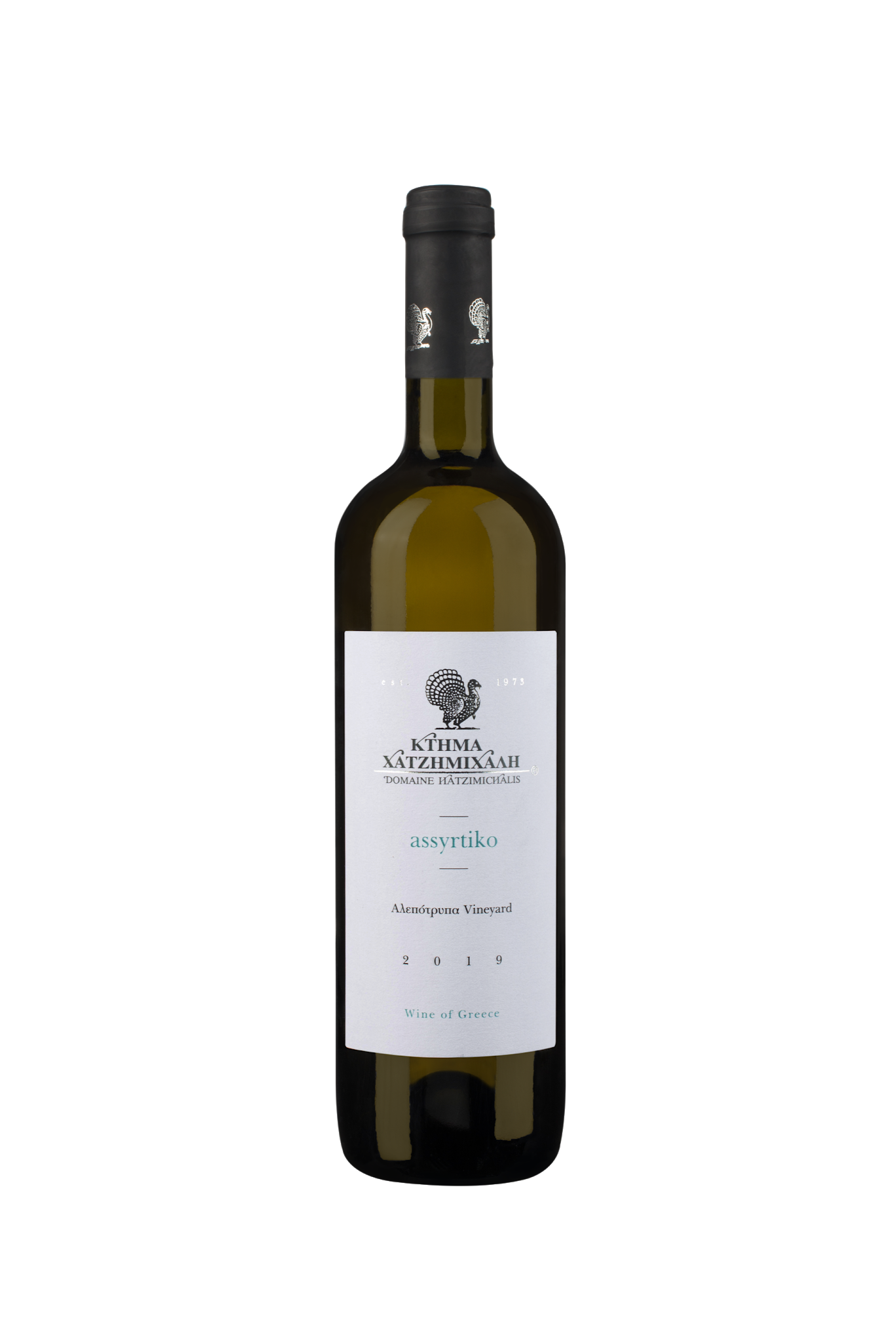
The estate is spread over 220 ha planted to a total of 25 varieties. The Assyrtiko vines are from a 4-ha vineyard named Alepotrypa, the soil of which is clay loam with hints of limestone and sand. Fifty percent of the vines are newly planted - 5 years ago -- while the remaining 50% were grafted onto 20 - 25-year-old rootstock originally utilized by Chardonnay scions.

All of the work in the vineyard is done by hand, inclusive of harvesting. The grapes are vinified in stainless steel tanks after which they spend six months aging on the lees.

The estate was represented at the tasting by Leonidas Hatzimichalis.

Gaia Winery
This is a very important estate in the context of Greek wine history. According to Yiannis Karakassis, along with Alpha Estate, Domaine Geravassilou, Ktima Kir Yianni, Ktima Pavlidis, Boutari, and Sigalas, Gaia sits firmly in the first wave of producers that established the foundations of Greek wine.

Gaia produces wine both in Santorini (PDO Santorini) and Nemea (PDO Nemea - PGI Peleponnese). The grapes and wine for this tasting were sourced from Santorini. I have previously detailed the Santorini environment but will summarize it here as presented on the Gaia website:
  • Volcanic, nutrient-poor porous soil that is phylloxera-free
  • Long hours of sunshine
  • Paucity of rainfall
  • Sea mist and strong winds during the summer
    • Humidity retained by the soil for plant use
  • Basket-training system for the indigenous Assyrtiko vines
    • Protection from warm winds and intense sunlight in the summertime.
The climate on Santorini is Mediterranean -- which is generally favorable for grape-growing -- but vintage quality on Santorini is determined by: rainfall intensity; absence or presence of heat waves in June and early July; and the nighttime humidity in the July-August period.

The Gaia Santorini vineyard is planted with 70 - 80-year-old, own-rooted vines which yield about 3000 kg/ha. No irrigation is allowed on the island.

The grapes for the Gaia Wild Ferment are carefully selected from the Pyrgos vineyard. The grapes are subjected to a 12-hour cold soak before being placed in 1000L stainless steel tanks and new French, American, and Acacia barriques for wild-yeast fermentation. The wines are stirred on the lees every second day.

We were led in the tasting of the Gaia wine by Giannis Paraskevopoulos. He is the co-owner of the estate and its Oenologist in addition to being a Professor at the University of Oenology in Athens.

Avantis Santorini Winery
The Avantis Santorini estate was launched in 2012 by winemaker Apostolos Mountrichas. The estate is located at 200 m elevation on volcanic soil. The estate owns 1.5 ha of land and purchases grapes to meet its overall needs. Yields are at 13.75 hl/ha.

Grapes for the Afoura wine are harvested and then cold-soaked for 24 hours prior to pressing in a vertical hydraulic basket press. The juice is then funneled into stainless steel tanks where it is fermented using indigenous yeasts. Post-fermentation the wine is transferred to 1000L oak barrels for aging. The wine spends 12 months on the lees with batonnage every 15 days. The wine is filtered prior to bottling.

We were led in the tasting by Nikitas Prassas of Cinque Wine Bar. On hand was the Oenologist Kotseridas George who is a Professor of Oenologie at the University of Agriculture, Athens, and also serves as a Consultant to Avantis Winery.

Tasting the Wines
The first wine tasted was the 2019 Hatzimichalis Assyrtiko Atalanti Valley. Leonidas predicted that this wine would show fruit aromas plus the Assyrtiko character. For me it was very aromatic. Lime and salinity on the nose with those two characteristics carrying through to the palate, along with a mineral character, acidity, and a lengthy finish. It would end up exhibiting a little more heft than was the case for the Gaia.

The Gaia 2019 Assyrtiko Wild Ferment showed minerality, a marine character, salinity and mint on the nose. A skin-contact texture on the palate along with citrus skin, salinity, minerality, and bright acidity. Minerality dominant. 


I tasted the 2011 edition of this wine back in 2012 and had noted smoke, dill, baking spices, and burnt citrus on the nose, Searing acidity. Saline and some oak tannins. The most floral of the wines in the flight, A slight vegetal note. Spicy.


Avantis Santorini Winery 2018 Afoura -- A fino note on the nose along with oiliness and barrel notes.  Slightly honeyed. Wooden notes flow through to the palate. I am not a big fan of wooded Santorini Assyrtikos.


Observations and Comparisons
The tasting provided three different characters for us to analyze in that even though the latter two wines were from Santorini, the Afoura was aged in wood.

Assyrtiko is clearly one of the leading white grape varieties in the world. In a 2012 tasting in New York City organized and hosted by Wines of Santorini, Jordan Mackay, the panel leader, stated that he found the wines from Santorini striking and "... one of the most singular and distinctive wines in the world." Yiannis Karakasis MW says that "Santorini always works because they produce great wine" and he views Assyrtiko as a starting point for anyone looking to begin an exploration of Greek wine.

I traveled through North Greece back in 2015 and tasted a few Assyrtikos there. My observations at the time were as follows:
The Assyrtikos encountered in North Greece were fruitier and had less mineral and acidity characteristics than their Santorini counterparts. I think that this variety, under the proper conditions, and with the proper winemaking, can be a winner for the region. I tasted tank- and barrel fermented samples at Wine Art Estate and found the former to have complex tropical notes, riper fruit, and less minerality than the wines of Santorini while the latter had toast notes and a harmonic combination of fruit and oak. I was more tolerant of oak in the North Greece Assyrtiko than I am with it in a Santorini Assyrtiko.
In Closing
I would like to once again express my sincerest thanks to the team at Cinque Wine Bar for putting this long-distance event together. I enjoyed it immensely and found it educational to boot. I would also like to thank all of the winery representatives for taking the time to share your knowledge and your wines with us. And, finally, I would like to thank the winelover community for fostering the kind of environment wherein members so selflessly undertake activities which redound to the benefit of members beyond themselves.


©Wine -- Mise en abyme

Saturday, April 18, 2020

Greek Wines: Santorini and Beyond (A conversation with Yiannis Karakasis MW), Part 1

I held an InstaLive Chat session with Yiannis Karakasis on April 17th, the topic of which was Greek Wines: Santorini and Beyond. Given the wealth of information shared by Yiannis, I thought it important to provide the details of that conversation on this platform.


We began with background information on Yiannis. He was an officer in the Hellenic Navy where he served as a helicopter pilot. He was pursuing his WSET Diploma  while serving and made the decision to leave the military to concentrate on his wine studies. This was a big risk. He was rewarded, though, in that he was able to earn his MW in four years. Since attaining the MW he has been mostly educating, consulting, and writing about Greek and Cypriot wines. The most important thing for him currently is communicating his passion about Greek wines.

In terms of the positioning of Greek wines today, Yiannis sees the industry as being in a better place than it was 10 years ago. We have heard, says Yiannis, the Santorini story, but it is a niche market for initiated people and Somms in fine restaurants to whom Greek wines are important. The industry has a long way to go to attain his goal of it being the first alternative after France, Italy, and Spain in terms of recognition and quality. They will not play in the quantity game because production is 2.1 million hL annually. Greek wine can move towards this point with a lot of work in the vineyard.


Greek wine cannot become mainstream if we cannot expand the discussion beyond Santorini to other terroirs, other varieties. Santorini always works because they produce great wine; but there is more. He thinks that they should be focusing on these new stories, on new terroirs and new varieties. When people taste wines from Naousa, Nemea, or Keffalonia, they are immediately connected to those places.

We are only at the beginning of the terroir discussion in Greece, he said. There is some discussion in Naousa, and the beginning of a discussion in Nemea; but why are there not more single-vineyard offerings in the latter, the largest PDO in Greece. Currently there are only two or three producers crafting single-vineyard offerings in Nemea. Sigalis and a few other winemakers are producing single-vineyard wines in Santorini.

It is important that producers come up with single-vineyard offerings so that they can be sampled over time and see where they are going. Yiannis will be querying the growers in upcoming discussions (the lockdown willing) as to what are the constraints to providing these types of offerings. The single-vineyard discussion, though, is for the "sophisticated" among us. We still need to get people comfortable with three or 4 varieties at the consumer level.

In terms of important terroirs he pointed out the North, with its four PDOs for Xinomavro, the Peloponnese and Assyrtiko, the Mainland for Savatiano, and Crete for Vidiano (white) and Liatiko (red). Further, in Crete we can talk about international varieties becoming local. For example, the Rhone varieties (Syrah, Grenache, Mourvedre) have adapted beautifully to the terroir. The Grenache from Manousakis, for example, is a different Grenache, elegant and refined. If you go to Keffalonia, the western portion is prime territory for Robola and Mavrodaphne while Assyrtiko dominates to the east.

There are 230 varieties recorded in the database, according to Yiannis, but there may be 230 more undiscovered. But discussion of new varieties may be complicating things more than they should be at this time. People wanting to begin an exploration of Greek wines should begin with four or so varieties: Assyrtiko, Malagousia (or, maybe, Moschofilero), Agiorgitiko, and Xinomavro. If you go deeper into red wines, there are too many stories. He is finding new discoveries every day in the "Greek wine book."

I will continue with Part 2 of the discussion on the morrow.

©Wine -- Mise en abyme

Wednesday, March 28, 2012

Assyrtiko seminar presented by Wines from Santorini

Santorini's wines and winemakers were effectively showcased at a March 22nd seminar and walk-around tasting arranged by Wines from Santorini and held at the Gansevoort Park Avenue Hotel in New York City.  I have previously written a post on the Santorini wine region in preparation for this event. This post focuses on the seminar that preceded the more broadly targeted walk-around tasting.

The seminar was scheduled for 11:30 am.  I arrived in the hotel lobby shortly before that time and, after a few missteps, found my way to the side elevator that would take me up to the floor on which the seminar was being held.  The elevator opened onto a narrow hallway with the seminar sign-up desk in that hallway to the left of the elevator door.  Further down the hallway, the white tablecloths and glasses signaled the room in which the seminar would be held.  After signing in I was told that preparations were still underway and was directed to the right to wait in the hotel's rooftop bar.  We were finally summoned to the seminar room at 11:45 am.


The room ran east to west and was furnished with 10 to 12 rows of long tables, each set with places for six tasters.  On the eastern side of the room, there was a raised platform which faced out to the room and on which were six name tags and a number of bottles of wines.  This was clearly the seating for the seminar panelists.  I estimate that between 40 and 45 non-panelists attended the seminar.


In its invitation email, Wines from Santorini had indicated that Jordan MacKay would be the panel leader.  The panel members, and a few salient points about each, are presented in the table below.


Sofia Perpera provided opening remarks from her position on the podium.  This event, according to Sofia, was part of a 3-year program to (i) increase the public's awareness of PDO wines from Santorini; (ii) establish Assyrtiko as one of the top wines in the world; and, ultimately, (iii) to encourage the grape growers in Santorini to farm this grape given all the challenges (wind, encroachment of the tourist industry, etc.) that they face.  Sofia illustrated the plight of the farmer with the following statistic: in the 1800s, Santorini had 4000 ha under vine; that number had slipped to 2500 ha in the 1980s and stands at 1200 ha today.  Rather than viewing tourism solely as a threat to the farmer, Sofia believes that it can be a savior for the vineyards by the tourists spreading the word of the culture after returning to their homelands.  At the conclusion of her remarks Sofia introduced the panelists and the winemakers present in the room and then turned the microphone over to panel leader Jordan MacKay.


Jordan MacKay, in his opening bit, said that he finds the wines from Santorini striking  and then proceeded with a presentation on the history of the islands, the location of the wine-growing areas, soil characteristics, climate, and viticulture.  He closed by doubling down on his opening statement: Assyrtiko was now characterized as one of the most singular and distinctive wines in the world.  And with that he proceeded to the tasting phase of the seminar.


The tasting design called for three flights of four wines each with the first two flights being dry whites and the final flight focused on Vinsanto.  The dry white flights had been poured prior to our entry in the room.  In an attempt to display the food-friendliness of the wines, a plate of small bites was provided for the taster to sample along with the wine if he/she so desired.  The entire flight was tasted and then the panel and audience members debated the merits.


Flight 1

The wines in this flight were tasted in the following order:
2011 Gavalas Santorini
2011 Hatzidakis Santorini
2010 Karamolegos Santorini
2009 Sigalas Kavaliero


All of the above wines are 100% Assyrtiko and had alcohol levels that fell between 13% and 14%.  The 2011 Gavalas Santorini had citrus, steel, zest, florality, beer and minerality  on the nose and searing acidity, florality, and metal on the palate.  This wine had a long, searing finish.  The 2011 Hatzidakis Santorini exhibited minerality, hints of florality, and citrus on the nose.  On the palate, razor-edged acidity, coating minerality, and a white pepper spiciness.  The 2010 Karamolegos Santorini was more expansive on the nose than the preceding two wines with notes of burnt citrus skin.  Broader on the palate with lower acidity and fuller body.  Citrus zest, salinity, spiciness, and a hint of bramble.  Long finish.  The 2009 Sigalas Kavaliero was the only single-vineyard wine in the tasting.  Salinity and citrus. Full mouthfeel with a long finish.

Paul Grieco, in remarking on this flight, noted the searing acidity and lack of sameness.  He initially thought that the Karamolegos had seen oak but saw that that was not the the case.


Sofia noted that 2011 had been a great vintage in Santorini because of the frequency of winds during the summer and that was good for the vines because these winds are their only source of moisture.  She felt that 2011 was a year with added dimension.  For example, it was one of the most aromatic vintages ever.  One of the other panelists noted that the minerality of these wines was like brimstone; it was intense but the wines still had great balance.

Michael Madrigale found the Sigalas to be rich and expressed a preference for having these wines with food.  Grieco thought that the wines would be a great match for salads.  Jordan thought that they would match well with olives, sharp feta cheese, onions, and capers.  The wines could be aperitifs but they scream out for food.  Someone from the audience suggested lamb with lemons.

Tom Pastuszak remarked on the intense saline minerality of the wines while Madrigale commented on the complex aromas of wines 2 and 3.  Wine 2 had bitter herb and mustard grain aromas while wine 3 had asphalt and exhaust aromas.  Sofia commented that this, the modern style of Santorini wines, came into being after the 1980s.  Prior to that time, the style had been more oxidative.

Flight 2

The wines in this flight were tasted as follows:

2009 Estate Argyros
2010 Santowines Nykteri
2011 Gaia Assyrtiko Wild Ferment
2007 Boutari Kallisti Reserve


All of the wines of this flight are 100% Assyrtiko and all have seen oak.  The 2009 Estate Argyros has been 20% fermented in new French oak.  On the nose, oak and toasted wood.  On the palate searing acidity flattened out by the oak, minerality, salinity, creme brûlée with burnt sugar.  Alcohol on this wine is 13%.  The 2010 Santowines Nykteri was aged for 3 months in new French oak.  On the nose oak, baking spices, vanilla.  Weighty on the palate with burnt orange, smoke, and a creamy richness.  The 2011 Gaia Assyrtiko Wild Ferment was fermented using wild yeast with 50% of the fermentation carried out in stainless steel tanks.  Aged in barrel for 5 months.  On the nose: smoke, dill, baking spices, and burnt citrus.  Searing acidity.  Saline and some oak tannins.  The most floral of the wines in this flight.  A slight vegetal note. Spicy.  The 2007 Boutari Kallisti Reserve was fermented in oak and then aged for 7 months in French oak.  Evidence of oxidation.  Sherry-like.  Burnt orange peel and peppery.  Hotter than the other wines in this flight.

Paul Grieco opened up the panel comments by saying that he saw no uniqueness in these wines and, further, that he would prefer to speak to a winemaker than a lumber merchant (That was truly funny and quite characteristic of Grieco's acerbic wit.).  Madrigale jumped to the flight's defense with the comment that oak can help Assyrtiko to work with food by softening its sharp edges and by broadening the types of food with which it could be paired.

Flight 3

The wines in this flight were tasted as follows:

2006 Roussos Vinsanto
2004 Santowines Vinsanto
2000 Koutsoyiannopoulos Vinsanto
1989 Argyros Vinsanto

The 2006 Roussos Vinsanto is a blend of 65% Assyrtiko, 15% Aidani, and 15% Athiri.  It has 180 g/l of residual sugar and 11.5% abv.  On the nose honey, figs, molasses, oxidation, and burnt citrus.  On the palate great balance between acidity and sugar.  The 2004 Santowines Vinsanto is a blend of 80% Assyrtiko and 20% Aidani with 238 g/l of residual sugar and 10.9% abv.  Piney oak note.  Phenolic. Honey.  On the palate weighty, thick, rich. Long, balanced finish.  The 2000 Koutsoyiannopoulos Vinsanto is 60% Assyrtiko and 40% Aidani with residual sugar of 280 g/l and 13% abv.  This wine had the deepest color of all the wines in this flight.  Heavy and thick with figs, dates, cough syrup and almonds on the nose. Unbalanced.  The final wine of the flight and of the seminar was the 1989 Argyros Vinsanto.  This wine is a blend of 80% Assyrtiko, 10% Aidani, and 10% Athiri and has residual sugar of 240 g/l and 10% abv.  On the nose green bark, pine, dill, syrupy, honey, and creme caramel.  On the palate thick, rich and smooth with a smooth, long finish.

***********************************************************************************************************

At this time the seminar was brought to a close so that the walk-around tasting could begin on time.  The tasting phase of the seminar had been somewhat unbalanced with the first flight getting significantly more discussion time than did the final flight but that might have been predicted given human nature. All in all it was a very revealing and informative seminar which accomplished the task of showcasing the wines and educating the attendees about the region.  I think that the organizers did a great job of panel selection by building a panel of young, hip sommeliers with out-of-the-box perspectives balanced by significant wine-related accomplishments.

Paul Grieco made a comment that people who really appreciate wine are at heart acid hounds.  And I agree with him.  For an acid hound, Assyrtiko hits a sweet spot.  For me it aligns with a Margaret River Chardonnay, a Chablis, or a Loire Valley Sauvignon Blanc.  It does not have similar characteristics to those wines -- they are each unique in their own way -- but it possesses the aura of greatness that surrounds them all.  I am not similarly disposed to the Nykteri style of Assyrtiko, but that is a personal choice. To me the oak alters the trajectory of the natural acidity and softens up the wine.

The Vinsanto is sublime.


© Wine -- The View From Orlando

Wednesday, March 21, 2012

Santorini Wine Region

Wines from Santorini, the organization tasked with promoting the region's wines, is hosting an associated seminar and trade tasting at the Gansevoort Park Avenue Hotel in New York on March 22 (2012).  I will be in attendance at both elements of the program and will be reporting my findings on this blog at sometime in the near future.  In the meantime, following is an overview of the Santorini wine region.

Santorini is a 73-square-kilometer archipelago of islands which are the remnants of an ancient volcanic eruption that blew apart their common progenitor, leaving the behind the imposing caldera (Thira) and a number of smaller islands.  The islands, the southernmost landmass in the Cyclades chain,  lies 113 km to the north of Crete, the largest and most populous of the Greek isles and itself famed for its ancient Minoan society.

Greek Wine Regions. Source: winesworld.net


Santorini is one of the European Union's protected designation of origin (PDO; a geographic area used to define a specific quality wine; a European-wide designation that replaced national AOC-type designations in the most recent revision of the European Wine Law) regions with PDOs for dry and sweet white wines.  The Santorini viticultural region is 1400 ha in size and runs from sea level up to elevations ranging between 150 and 250 meters.

Santorini has a temperate Mediterranean climate with warm, dry summers and mild winters.  Rain is in short supply except for a few short, sharp downpours during the winter months.  During the summer months, humidity falls to the ground in a rain-like fashion, a phenomenon that the locals call "pous" which loosely translates to "mist from the sea."  During the summer months a hot wind -- Livas -- dominates while north and northwest winds are the order of the day during fall and winter.

Santorini's soil is a testament to its violent past.  It is a combination of chalk and shale beneath volcanic deposits of ash, lava, and pumice littered with magnesium and ferrous rocks of varying size.  These rocks enrich the phylloxera-free soil with calcium, magnesium, and ferrous iron, the source of the minerality for which the region's wines are known.

In addition to the lack of moisture, another significant challenge to Santorini viticulturists is the stiff wind that buffets the island during the growing season and could damage the berries if they were exposed to the elements.  The solution that has been employed for eons is to (i) eschew vine density and (ii) train the vines such that they can afford protection to the otherwise vulnerable berries.  Vine canes are intertwined and trained into a circle and the berries grow within this protective cordon.  The circular structure can be positioned above ground or in a below-ground hollow where the top of the vine is parallel to the surface.

Source: Winesfromsantorini.com

Santorini vines are, for the most part, in excess of 50 years old.  Vines are retained until the yield is almost zero or when the vine dies.  When the vine is no longer productive, it is replaced by a branch from a nearby vine which is buried to a depth of 30 cm into the soil.  After that branch has developed its own roots and has begun producing berries (a period of between 3-5 years) it is cut away from the tethering parent.

The table below shows the varieties that are currently used in Santorini wines.  Assyrtiko plantings account for 90% of the region's white wine varieties while Mandilaria accounts for 70% of the red varieties.


There are three PDO appellations in Santorini today: Santorini, Vinsanto, and Nykteri.  Santorini is a dry white wine blended from Assyrtiko (minimum 75%) with Aidani and Atheri added to round out Assyrtiko's lack of fruit and aroma.  This wine is bone dry with citrus and mineral notes.  Vinsanto is  sweet white made from Assyrtiko (minimum 50%), Aidani, and other indigenous varieties.  The grapes are sun-dried for between one and two weeks after harvesting before they are subjected to a long. slow fermentation followed by several years of bottle aging.  Nykteri is a dry white wine made from Assyrtiko (75%) Aidani, and Atheri.  The wine gets its name from the tradition of the grapes being picked at night in order to retain the delicate aromas.  Today the grapes are picked early in the morning and are preseed and fermented before nightfall.  The fermented wine must spend a minimum of three months in barrel. The final product has a semi-yellow color and notes of jasmine, citrus, pear, and vanilla.

A number of non-appellation wines are produced in Santorini:
  • Mezzo -- a Vinsanto variant with lower sugar levels
  • A dry red made from the Mandilaria grape
  • Brouska -- the grapes are aged for a number of days before being pressed and fermented on the skins.  This wine is barrel-aged.
Notable Santorini producers are Antoniou, Argiros, Hatzidakis, Sigalas, and Heliopoulos.

© Wine -- The View From Orlando