Saturday, April 18, 2020

Greek Wines: Santorini and Beyond (A conversation with Yiannis Karakasis MW), Part 1

I held an InstaLive Chat session with Yiannis Karakasis on April 17th, the topic of which was Greek Wines: Santorini and Beyond. Given the wealth of information shared by Yiannis, I thought it important to provide the details of that conversation on this platform.


We began with background information on Yiannis. He was an officer in the Hellenic Navy where he served as a helicopter pilot. He was pursuing his WSET Diploma  while serving and made the decision to leave the military to concentrate on his wine studies. This was a big risk. He was rewarded, though, in that he was able to earn his MW in four years. Since attaining the MW he has been mostly educating, consulting, and writing about Greek and Cypriot wines. The most important thing for him currently is communicating his passion about Greek wines.

In terms of the positioning of Greek wines today, Yiannis sees the industry as being in a better place than it was 10 years ago. We have heard, says Yiannis, the Santorini story, but it is a niche market for initiated people and Somms in fine restaurants to whom Greek wines are important. The industry has a long way to go to attain his goal of it being the first alternative after France, Italy, and Spain in terms of recognition and quality. They will not play in the quantity game because production is 2.1 million hL annually. Greek wine can move towards this point with a lot of work in the vineyard.


Greek wine cannot become mainstream if we cannot expand the discussion beyond Santorini to other terroirs, other varieties. Santorini always works because they produce great wine; but there is more. He thinks that they should be focusing on these new stories, on new terroirs and new varieties. When people taste wines from Naousa, Nemea, or Keffalonia, they are immediately connected to those places.

We are only at the beginning of the terroir discussion in Greece, he said. There is some discussion in Naousa, and the beginning of a discussion in Nemea; but why are there not more single-vineyard offerings in the latter, the largest PDO in Greece. Currently there are only two or three producers crafting single-vineyard offerings in Nemea. Sigalis and a few other winemakers are producing single-vineyard wines in Santorini.

It is important that producers come up with single-vineyard offerings so that they can be sampled over time and see where they are going. Yiannis will be querying the growers in upcoming discussions (the lockdown willing) as to what are the constraints to providing these types of offerings. The single-vineyard discussion, though, is for the "sophisticated" among us. We still need to get people comfortable with three or 4 varieties at the consumer level.

In terms of important terroirs he pointed out the North, with its four PDOs for Xinomavro, the Peloponnese and Assyrtiko, the Mainland for Savatiano, and Crete for Vidiano (white) and Liatiko (red). Further, in Crete we can talk about international varieties becoming local. For example, the Rhone varieties (Syrah, Grenache, Mourvedre) have adapted beautifully to the terroir. The Grenache from Manousakis, for example, is a different Grenache, elegant and refined. If you go to Keffalonia, the western portion is prime territory for Robola and Mavrodaphne while Assyrtiko dominates to the east.

There are 230 varieties recorded in the database, according to Yiannis, but there may be 230 more undiscovered. But discussion of new varieties may be complicating things more than they should be at this time. People wanting to begin an exploration of Greek wines should begin with four or so varieties: Assyrtiko, Malagousia (or, maybe, Moschofilero), Agiorgitiko, and Xinomavro. If you go deeper into red wines, there are too many stories. He is finding new discoveries every day in the "Greek wine book."

I will continue with Part 2 of the discussion on the morrow.

©Wine -- Mise en abyme

Monday, April 13, 2020

Emergent Spanish wine regions: The Balearic Islands

Pedro Ballesteros Torres, in a 2/2/18 Decanter article on Spanish wine trends, wrote about newly emergent wine regions, areas propelled by the aggregated effects of:
  • Developments in viticulture and oenology
  • Climate change
  • A resurgence of the perennial value of indigenous varieties
  • A market eager to reward niche identities.
The regions identified by Torres as emergent are illustrated in the map below.

Emergent Spanish wine regions

I will provide a brief overview of each of these regions, including the reasons why they are considered emergent, in a series of blog posts beginning today with the Balearic Islands.

The Balearic Islands, the autonomous division of Spain located off its east coast, are, due to their excellent climate, sandy beaches, and natural beauty, one of Europe's most popular holiday destinations.

The Balearic Islands (Source: Wikipedia)

But wines are also made there, with Mallorca, the largest of the islands, the source of one of the Cutting Edge Wines discussed in a previous post..

Winemaking in the Balearic Islands has a very long history, a history which was upended by the onset of Phylloxera. The ravages of the French vineyards meant that they had to look to other sources for fruit; and grape-growing in the Balearics expanded rapidly to meet this new demand. Balearic Island vineyards were decimated when the louse made landfall in the islands in 1891, causing a widespread shift to non-vine agricultural crops among the growers.

Even the resolution of the phylloxera issue did not result in a return to grape-growing in the Balearics; instead, grapes were grown only for local consumption. In the 1990s, however, a number of local winemakers decided to improve the quality of wine produced in the islands (Catavino) and, in furtherance of that goal: planted international varieties to complement the local varieties; enhanced irrigation systems; and introduced stainless steel and oak barrels for fermentation and aging.

Grapes are grown on all three of the Balearic Islands but the most vinously significant is Mallorca. The chart below shows the distribution of appellations among the islands and illustrates that the only regional DOs are in Mallorca.


There are a number of reasons why these islands can be considered as emergent (Cellartours.com):
  • International varieties now appear with increasing frequency across the islands' vineyards
  • Fresher, more aromatic whites are now the mainstay of production
  • A new generation of winemakers are bringing a sense of the importance of terroir to wines and winemaking and are utilizing their best sites to produce wines of class and quality
  • The wines have moved beyond the local tourist market and have begun to make waves on the Spanish mainland.
******************************************************************************************************
The regions identified as emergent by Torres in his initial article are:
©Wine -- Mise en abyme

Monday, April 6, 2020

Cutting-Edge Spanish wines: Parés Baltà Hisenda Miret 2017, DO Penedès

This is the final wine in my series on the Vinos de Vanguardia (Wines on the Cutting Edge) of the Spanish wine industry. These eight wines were so designated by Wines from Spain and were discussed and evaluated by a four-person expert panel at that organizations Spain's Great Match Miami event (November 5, 2019).


I have covered seven of the wines in previous posts (Tajinaste Blanco 2018, Quinta da Muradella Blanco 2015, Edetària Selecció Blanc Vinyes Velles 2016, Conde de los Andes Rioja Blanco 2016, Guimaro Finca Meixemann 2017, AN/2 by Anima Negra 2017, Bodegas Mustiguillo Finca Terrerazo 2015) and will cover the final wine (Parés Baltà Hisenda Miret 2017) herein.

Penedès DO
Parés Baltà is located in the Penedès DO, a wine region that straddles both the Barcelona and Tarragona provinces.

Map of Penedes DO (Source: Penedes DO)
The region is wide and open, covering, as it does, a long strip of land between the sea and the mountains. It is divided into three distinct zones (see map above):
  • Penedès Superior -- the land near the inland mountain range; higher rainfall and larger contrasts between minimum and maximum temperatures; the soil is a mix of limestone, sand, and clay.
  • Penedès Marítime -- the land between the sea and the coastal hills. The climate here is a mild Mediterranean (due to its proximity to the sea) and the soil is a mix of limestone, sand, and clay.
  • Penedès Central -- the plain between Superior and Marítime. The climate is a mix of the two and the soil has the same composition.
The Tramonta wind blows in from France in the winter but is diminished by the Montserrat Range.

White grape varieties are dominant with 4/5ths of the 15,200 ha devoted to their plantings. The white grapes are Xarel.lo (the most widely planted with 7000 ha under vine), Macabeu, Parellada, Chardonnay, Riesling, and Sauvignon Blanc. Red varieties include Garnatxa, Monastrel, Pinot Noir, Syrah, Merlot, Cabernet Sauvignon, Samó, and Ull de Llebre.

Penedès is known for its still wine and its Cavas. In the case of the still wines, most are drunk in the year after bottling. The Cava producers have upped their game by introducing a category (2014) called Classic Penedès which covers traditional and ancestral Cava production with a requirement of 100% organic, 100% Penedès, and 100% Reserva (minimum 15 months aging).

Parés Baltà
Vines were first planted in the area that surrounds the winery back in 1790. Current family ownership stretches back to 1978 when Mr Joan Cuisine took control of the winery.

The enterprise controls five vineyards but the one of interest to us is Finca Cal Miret in the town of Sant Martí Sarroca. The vines are resident on deep, brown agrillaceous limestone soils at elevations ranging between 298 and 325 m and inclines of between 5 and 15%. Varieties planted include Garnatxa, Xarel.lo, Macabeu, Syrah, Merlot, and Muscat.

All of the Parés Baltà vineyards are Demeter-certified biodynamic. Initial studies began in 2010, with the first biodynamic treatments produced, and applied, in 2011. Vineyards are cultivated without the use of herbicides, pesticides, or fertilizers. Sheep provide fertilization material to the vineyards in the period following the harvest. The estate practices green pruning -- to increase air circulation and sun exposure -- and green harvesting -- to increase concentration and character in the remaining grapes.

Hisenda Miret
Hisenda Miret is a 100% Garnatxa wine which is fermented in stainless steel for 3 weeks with thrice-daily punchdowns. The wine is aged for 5 months in new and 2-year-old French oak barrels.


The 2017 edition of this wine showed intense red fruit and a florality out of the glass. It jumps out at you. Complex. The intensity carries through to the palate. The tannin makes its presence felt, as does the acidity. Lengthy finish. I loved this wine.

©Wine -- Mise en abyme

Friday, April 3, 2020

Sparkling wines of Piemonte: Villa Sparina Metodo Classico Blanc de Blanc (Gavi DOCG)

In that I am currently writing a series on Italian sparkling wines, I want to taste as broad a range of those wines as possible but it is especially tough to acquire them in Central Florida. As I was calling around yesterday, I found that Tim's Wine Market (Downtown) had bottles of Villa Sparina Metodo Classico Blanc de Blanc in stock; I hightailed it over there immediately to acquire a bottle for tasting purposes.


Villa Sparina is produced at the Villa Sparina Resort and Winery, located in Monterotondo, the heart of Piemonte's Gavi DOCG. The facility was founded by the Moccagatta family in the 1970s. The location of the DOCG and the winery are shown in the following two slides.


The estate sits on 100 ha, 70 of which are dedicated to grapes for the production of Gavi and Barbera.

Monterotondo is a cru for the Cortese grape of Gavi, the grape that is the basis for the Villa Sparina Metodo Classico Brut. The grapes are grown in vineyards resident at 250 - 300m altitude with mainly south and southwest exposures and soils of clay and marl. The vines are trained Guyot and are planted 4000 vines/ha density.

The grapes for the base wine are fermented in stainless steel tanks over a 3-week period. Second fermentation is carried out in bottles with the wine spending 36 months on its lees.

The wine had an initial breadfruit nose upon opening which gave way to a sweet white flower/fruit, citrus, citrus skin, pineapple and a steadily increasing pepper spice. Peach on the palate with a lemony-lime acidity. Medium weight, not as crisp as I prefer. Sparing, emaciated bubbles. Mineral persistence -- chalky clay -- on the palate. Short finish. The taste profile falls somewhere between a Franciacorta and a Prosecco; shaded towards the Prosecco end of the spectrum.

©Wine -- Mise en abyme

Tuesday, March 31, 2020

Differentiating between the Grechetto and Grechetto Gentile varieties in central Italy

I have encountered and tasted Grechetto wines at various times in the past but my interest was heightened during research on the sparkling wines of Italy when I encountered a "variety" called Grechetto Gentile. Was it the same grape with some kind of colloquial appendage? Or was it a totally different variety? I intended to find out.

My research revealed that a single Grechetto variety had been listed on the National Register of Vine Varieties since 1970 but that genetic work done in 2013 had shown that two distinct varieties existed: Grechetto di Orvieto (clone G5) and Grechetto di Todi (clone G109). Prior to 2013, then, these varieties would have been unknowingly blended together.

The characteristics of the varieties are shown in the chart below.


Both varieties originated in Greece but are now inextricably linked to the wine regions of Central Italy. Grechetto di Orvieto is planted throughout the home range but is most famous for its role in the wines of Orvieto DOC in Umbria and Lazio. The wine is generally used in blends (with one or more of the following varieties: Chardonnay, Malvasia, Trebbiano, Verdello) where it adds richness and structure plus citrus and dried-nut characteristics. However, a number of the regional DOCs permit varietal wines from this grape. The wines from this grape are generally light-bodied and high in acidity. Synonyms for the variety are Grechetto, Greghetto, Grechetto Spoletino, Greco Spoletino, and Greco Bianco di Perugia.

Grechetto di Todi wines are generally considered superior to Grechetto di Orvieto wines. the grape shows some similar identifying traits as the Grechetto di Orvieto but has the same DNA as the Pignoletto variety. As a wine, Gentile has a more pronounced freshness and is more aromatic and less almondy than the Grechetto di Orvieto. It also has a signature bitter finish.

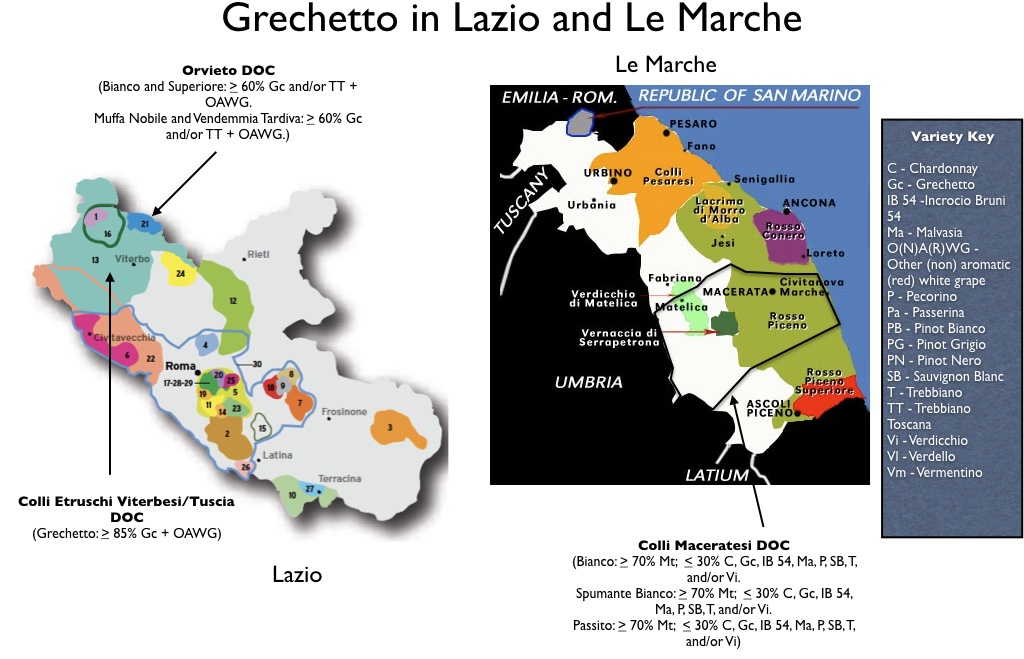
The figure Immediately bellow summarizes the DOCs and regions wherein one finds the two Grechetto varieties while the details from each region are provided in the Appendix.


As I mentioned previously, I have tasted and documented some past tastings of Grechetto wines. The first is Marco Caprai's 100% Grechetto from Colli Martani DOC. We tasted the 2018 Grechetto Grecante as we milled around the bar at West Palm Wines prior to a Caprai tasting. The wine was perfumed, floral, waxy and with yellow fruit on the nose. Herbs, a bitterness, textured and mineral on the palate. The minerality and texture combined to restrain the fruit flavors. Interesting mix of acidity, bitterness, and minerality. Textural intensity diminished with time. I loved this wine so much that I bought half a case.


The 2015 Greco di Renabianca is a 100% Grechetto which is labeled Umbria Bianco IGT. I tasted this wine while on a visit to Terre Margaritelli in Torgiano, Umbria. This wine is named after a 12th century soldier, recalling the myriad battles between towns that took place in the flat lands below the estate. Aged 2- 3 months in barrique and 1 year in bottle. This wine brought to mind sweet hazelnuts, eucalyptus and white fruits. Lime, spice and a rusticity on the palate. Powerful.


Appendix: Instances of Grechetto and Grechetto Gentile in Central Italy


©Wine -- Mise en abyme
Friday, March 27, 2020

Mapping the DOC sparkling wines of Abruzzo and Molise

In my quest to map the sparkling DOC(G) wines of Italy I have completed overviews of the sparkling wines of North and Central Italy and will now turn to the southern sparklers, beginning with the wines of Abruzzo and Molise.

Why do you treat these two regions together you ask? First, they were a single political unit from the time of the Kingdom of Naples, only splitting into two with the carving out of the province of Campobasso in 1963 to form the region of Molise. Second, they only have three (Abruzzo) and one (Molise) DOC sparkling-wine zones.

Both regions are mountainous, with mountain regions accounting for 65% of available lands and serving to keep rainstorms and inclement weather from the west at bay. Storms from the east do bring significant rainfall to the regions from time to time. The climate is temperate in areas facing the Adriatic Sea and continental in the areas facing the Apennines.

While Abruzzo is known for its red wines from the Montepulciano d'Abruzzo cultivar, Molise is "the most obscure of the Italian wine regions." In discussing the regions in two separate Vinous articles, Ian D'Agata made the following observations:
  • They produce too many inexpensive wines that are little or no better than generic bulk wine and should not be bottled
  • The bad white wines are insipid, tart, thin, ... fruit-challenged
  • The less successful reds are downright caricatural, overly smoky, overly ripe, and overly oaked
  • 75% of Abruzzo wine is made by 40 different Coops.
Ian sees some hope on the horizon though:
  • A new generation of viticulturists and winemakers are joining the family wineries and improving the quality of those wines
  • Many Abruzzo estates are seeking vineyards higher up in the mountains in an effort to improve grape quality.
The key to "vinous bliss," as he sees it, is to know who are the best producers in each of the regions.

The chart below shows the sparkling wine zones in Abruzzo (topmost figure) and Molise.


Some observations:
  • Limited number of DOC sparkling wine zones in each of the regions
  • Very little overlap in the indigenous grapes utilized in the production of sparkling wines in the two regions
  • Primarily cuvées in Abruzzo while Molise permits a broad array of varietal sparkling wines.
Not much to see here. My next stop on this journey will be in Campania.


©Wine -- Mise en abyme

Wednesday, March 25, 2020

Domaine Tortochot Chambertin: Stellar representation of a classic vineyard

Prior to the onset of Covid-19, and the attendant ill effects on commerce and community, Sunday was the day that our group normally gathered at Parkview (Winter Park, FL) for our Burgundy and BLT brunch. Each attendee brought a bottle of Burgundy to share and we bought dishes off the stellar Parkview menu.


Covid-19 drove us off the avenue and into the confines of our homes (some of us anyway) but that did not diminish our desire for community and bottles of Burgundy. We decided to not let distance and the virus get in our way and convened a Zoom tasting where everyone could participate from the comfort of their own home. As per usual, a bottle of Burgundy was a requirement.

I brought a bottle of 2012 Domaine Tortochot Chambertin to the party and Parlo created a killer BLT to accompany same. I describe the estate and the wine in this post.


Domaine Tortochot
The domaine is a 4th-generation, 12-ha Gevrey-Chambertin estate founded by Paul Tortochot in the 19th century. Today the estate is owned by sisters Brigitte and Chantal, with the latter managing day-to-day operations.

The Tortochot holdings in and around Gevrey-Chambertin are shown in the map below. In addition to the Grand Cru vineyards shown on the map, the domaine owns seven rows of vines in Clos Vougeot.

Tortochot Burgundy parcels
(Source:http://www.tortochot.com/en/burgundy-wines/)

Domaine Tortochot began a move towards organic farming with the planting of an experimental vineyard in 2003. A wholesale conversion to this farming method was undertaken in 2008.

The domaine's goals, as regards organic farming, are to: (i) promote good soil vitality through enrichment and (ii) permit good micro-organism development through the addition of hummus. Synthetic chemical substances are prohibited, with vine protection provided by the plant's natural resistance, supplemented, as necessary, by treatment with fungicides based on products such as rock powders, special sulfur or copper preparations, plant-based preparations, and fungal antagonists. Sex-confusion pheromones are used against grape worms.

As regards vineyard structure and practices:
  • Vines are trained low and planted at 10,000 vines/ha
  •  Vines are pruned in May and June to seven to eight bunches per vine
  • Young shoots are removed in July to reduce extraneous sap flow
  • Green harvesting is employed to ensure optimal ripeness of the remaining bunches
  • A variety of grasses are deployed between rows to
    • restore the vineyard ecosystem
    • create hummus
    • maintain a fauna of beneficial insects.
Grapes are harvested by hand based after attainment of an optimal sugar/acid balance. The grapes are destemmed and cold-macerated for four to five days prior to fermentation. Fermentation is facilitated by indigenous yeasts and includes twice-daily punchdowns and an end-of-day pumpover. The must is devatted and the pomace pressed after which the free-run and pressed juices are blended. The juice settles out for 24 hours before being transfereed to the cellar for malolactic fermentation and aging in 100% new, medium-toast, French oak barrels. The wine ages between 14 and 18 months before being bottled unfined and unfiltered.

Le Chambertin Vineyard
This 13.5 ha property is the most important vineyard in Gevrey-Chambertin and one of the top three in Côte de Nuits; it was so well regarded that the town, and seven of its vineyards, appended the name as a suffix to theirs.

The climate is continental with significant diurnal temperature shifts allowing daytime ripening and freshness-retention during the night. The vines reside on well-drained stony soils consisting of a thin layer of pebble-strewn, chalky topsoil over a deep rocky base.

Some of the notable vignerons who own property in this vineyard include Rousseau, Dugat-Py and Leroy; notable negociants are Latour and Bouchard.

The Tortochot holdings comprise 39.83 ares (0.98 acres) located on the highest part of the vineyard where the soil is much whiter and is very marly. This location suggests a less concentrated wine than grapes sourced from mid-slope.

Domaine Tortochot Chambertin 2012
The 2012 vintage was a difficult vintage in Burgundy as producers battled rain, hail, and mildew. According to Decanter, it was not an ideal year for organic and biodynamic domaines. Yields were restricted with varying quality even within a single domaine.

The wine was made as described previously with an 18-month aging period.

The wine was popped and poured. A strong barrel note upon opening but blew off quickly. Pinot fruit, baking spices, pepper and a slightly resinous character. Lean but good character. Balanced. Red fruit and coal. Cupric coating on the palate early gives way to a lengthy, drying finish. With time in the glass, perfection.


©Wine -- Mise en abyme