Wednesday, January 29, 2020

Constructing the wines of Martin Woods Winery (McMinnville, Oregon)

The high quality of the Martin Woods' wines, as tasted at Swirlery, set me on a mission to elaborate the environment and the processes that yielded these sterling wines. In my first post on the topic, I reported on the pedigree of the vineyards from which the grapes are sourced. In this post I investigate the construction of the wines that we tasted.

Evan Martin, winemaker/owner at Martin Woods

Lineup of the wines we tasted

The tools and techniques employed in constructing the wines are displayed in the table below. It should be noted that, with two exceptions, the wines are all single-vineyard; a key focus of the estate.


Techniques/Practices Employed in the Construction of the Martin Woods’ Wines Tasted at Swirlery

Wine Press Vessel Fermentation Aging  (Mths) Barrel Type Barrel Size (L) Barrel Age (Years) Lees
Willamette Valley Chardonnay 2018 (Yamhill (55%) and Havlin (45%) Whole Cluster Oregon Oak Indigenous yeasts
11
Oregon Oak 228, 400
7-8
Stirring
Eola-Amity Hills Chardonnay 2017 (Willakia) do. French, OR Oak do.
9
French, OR Oak do. N/A No stirring
Havlin Vineyard Pinot Noir 2017

1.5 ton open-top fermenters; 20% whole cluster/whole berries  Ind. yeasts; 17 days on skins; pumpovers & punchdowns 22 (12 on lees) French (50%) & OR (50%) oak 228 (< 5% new)

Yes
Hyland Vineyard Pinot Noir 2017

1.5 ton open-top fermenters; 20% whole cluster/whole berries Ind. yeasts; 15 days on skins; pumpovers & punchdowns
10
French (50%) & OR (50%) oak 228, 400

Yes
Jesse James Vineyard Pinot Noir 2017

1.5 ton open-top fermenters; 20% whole cluster/whole berries Ind. yeasts; 17 days on skins; pumpovers & punchdowns 18 (12 on lees) French (50%) & OR (50%) oak 10% new 2 - 10 Yes
Havlin Vineyard Gamay Noir 2017

1.5 ton open-top fermenters; 35% whole cluster/whole berries Ind. yeasts; 14 days on skins; pumpovers & punchdowns
9
French oak
228
8
Yes
Walla Walla Valley Cabernet Franc 2017 (Seven Hills Vineyard and McClellan Estates

1.5 ton open-top fermenters; 100% destemmed Ind. yeasts; 16 days on skins; pumpovers & punchdowns 18 (11 in barrel and 7 in Flextanks)


3 - 4 Yes


1.5 ton open-top fermenters; 50% whole cluster Ind. yeasts; 16 days on skins; pumpovers & punchdowns 18 (11 in barrel and 7 in Flextanks)


3 - 4 Yes


1 ton closed-top fermenters; 100% carbonic Ind. yeasts; 5 weeks for carbonic; pumpovers & punchdowns 18 (11 in barrel and 7 in Flextanks)


3 - 4 Yes

White Wines
The Martin Woods' Chardonnays are whole-cluster-pressed, barrel-fermented and barrel-aged on the lees. They are unfined and lightly filtered.

Whole-Cluster Pressing
According to Dawson Raspuzzi, whole-cluster pressing is employed in the making of high-end white wines. During this process the entire grape bunch is pressed very gently to release the juice. The resulting product, if the process is done properly, produces a more delicate and less astringent wine due to limited contact with those areas (skins, seeds, stems) with the highest tannin concentration. In addition to its textural contribution, whole cluster pressing increasing the juice/solids ratio as the stems facilitate the complete draining of the press cake.

Alcoholic Fermentation in Oak Barrels
According to Ibern-Gomez, et al*., "Fermentation in oak barrels leads to wines with much more complex sensory properties, largely attributed to the phenols extracted from oak wood."

In a study on barrel-fermentation of white wines (S. Herjavec, et al., The quality of white wines fermented in Croatian Oak, Food Chemistry, 100, 2007), the authors stated thusly:
One of the practices used to intensify the aroma and flavor characteristics of white wines is to ferment the must in oak barrels, and Chardonnay is one of the most suitable varieties for this. Wines produced by fermentation and maturation in oak barrels have different flavor characteristics to those which have undergone barrel maturation only after fermentation in stainless steel. One reason for this is that actively growing yeasts are capable of transforming volatile flavor components, extracted from oak wood, into other volatile metabolites.
This metabolite transformation results in what Zac Brown, Winemaker at Alderlea Vineyards, describes as "better integration of the oak and softer mouthfeel when compared to a white that is finished and then transferred into oak barrel to age."

Oak Aging
Wine is aged in wooden barrels to: (i) enhance its flavor, aroma, and complexity through transfer of substances from the wood to the wine; and (ii) allow gradual oxidation of the wine.

In the first instance, many of the wood's native aromatic compounds, as well as the aromatic compounds created during seasoning and toasting, are absorbed, and integrated, into the wine, thus contributing to wine richness and aromatic complexity. As noted by Dr. Murli Dharmadikari, common descriptors of oak-aged wines are oaky, vanilla, smoky, toasty, spicy, and coconut.

In terms of gradual oxidation, wine loss from barrels amount to approximately 2% per year, resulting from the fact that water and ethanol are smaller molecules and will diffuse into the wood and, ultimately, escape as vapor.  If the air in the cellar is dry, more water is lost and the wine is more concentrated in terms of alcohol.  If the environment is too humid then more alcohol is lost, reducing the ethanol content in the remaining wine.  This loss of liquid opens up a space between the wine surface and the barrel which the winemaker generally "tops up" in order to prevent oxidation and acetic spoilage.  During this "topping-up" process, small amounts of oxygen are dissolved in the wine.  Oxygen is also introduced into the wine during winery operations such as filtering and racking.

The oxygen which is now in the wine reacts with resident phenolic compounds in a manner such that: (i) tannins are softened (polymerization and precipitation as well as tannin-polysaccharide combinations); (ii) complex aromas develop; and (iii) there is improvement in the wine's body and mouthfeel.  It should be noted here that the tannin resident in the wine at this time is the oak tannin absorbed from the barrel (30% from the innermost four millimeters of wood).

In the aforementioned Herjavec, et al., study, the authors found that the sensorial characteristics of barrel-aged wines were modified, due to the wood-derived compounds. These wines manifested roundness in taste with a complex retro nasal aroma." Barrel toast also affected flavor perception: aging in medium-toast barrels yielded a smoky, roasted, and raw oak flavor while light toast resulted in a more fruity aroma.

Cooperage
The oak used in the maturation of alcoholic beverages fall into one of three species: Quercus alba, Quercus robur, and Quercus sessilis.  Q. robur and Q. sessilis, and their respective subspecies, are European white oaks while Q. alba is the source of 45% of the white oak lumber produced in the US.  American oak used in barrel production is sourced from Kentucky, Missouri, Arkansas, and Michigan but there is no apparent regional distinction.  European oak, on the other hand, may have designations which reach all the way to the forest from which the oak originated.  For example, French oak from the department of Alliers may be sourced from a forest named Tronçais.

It should be noted that Martin Woods utilizes Oregon Oak in its elevage, a practice I had not previously encountered. Subsequent research has shown that this oak species (Quercus garryana) has characteristics and chemistry similar to European oak and "if very well seasoned the resulting wine might benefit substantially rather like one of the features  of French oak" (http://www.oregonbarrelworks.com/Oregonoak.html). Martin Woods restricts the use of new oak to 5% or less.

Lees Aging
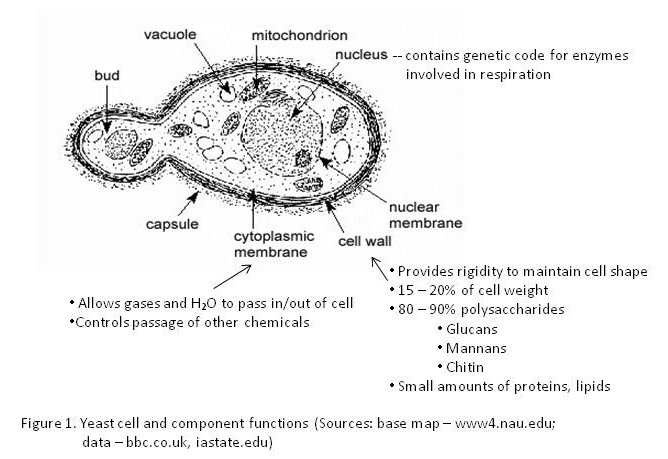
Murli Dharmadhikan (Yeast Autolysis, extension.iastste.edu) defines yeast autolysis as "... self-destruction of the cellular constituents of a cell by its own enzymes" following its death. Figure 1 below shows the component parts of a healthy yeast cell while Figure 2 shows an overview of the process  -- autolysis -- that occurs once that yeast cell has consumed all of the available nutrients and dies. At a high level, autolysis encompasses (i) the degradation of intracellular materials and (ii) degradation of the cell wall.


The detailed autolysis process is shown in Figure 3 below. The yeast extract, product of the degradation of intra-cellular material, is confined to the cell until such time as the cell wall becomes porous enough to allow the material to seep out. It should be noted that degradation and compound creation continues outside the degraded cell walls.

Figure 3. Details of yeast autolysis
The lees-aged wine is enriched by the compounds released during the constituent-degradation process.
Red Wines
There is no pre-fermentation cold soak nor is any sulfur added anywhere in the processing. The red wines are mostly whole-cluster-fermented for 14 -17 days with indigenous yeasts in open-top fermenters after which they are transferred to cooperage for elévage. The exception is the Cabernet Franc which is fermented differentially in both closed and open-top fermenters. The benefits that accrue to the white wines from oak usage in elévage are relevant here also.

Whole Cluster Fermentation
Paul Adams (SevenfiftyDaily) identifies the following benefits from whole-cluster fermentation:
  • Influences the tannin character of the wine (due to stem inclusion)
  • Less intense color but the color that is there is more stable in that it is bound with the tannins
  • Provides air space among the grapes and creates channels for juice to flow and circulate
  • Helps dissipate the heat created by fermentation.
There is no pump over or punch downs for 7 - 10 days thus allowing carbonic maceration.  There is one punchdown per day after this initial period.

Carbonic Maceration
In this method of vinification the grapes are hand-picked in whole bunches and placed serially into the fermentation tank.  The weight of the most recently placed grapes causes the lower bunches to burst and the juice that is released begins to ferment.  The carbon dioxide that is released during this process causes in-berry fermentation and the production of brightly colored, low-tannin wines with a characteristic fruity flavor. 

********************************************************************************************************
Over two posts I have described the sources of the grapes and the winemaking process of Martin Woods Winery. Both elements are of the highest order and clearly explain the quality that the final product displays. The practices are in line with the best winemaking are in line with the best in Burgundy and is innovative in its extensive use of Oregon Oak in fermentation and elévage.

©Wine -- Mise en abyme

Tuesday, January 28, 2020

A tasting of Martin Woods (McMinnville, Oregon) wines: Fruit sources

Swilery, one of my favorite hometown wine bars, has been working with its distributors to provide focused tastings with artisanal winemakers from around the world. A case in point -- and the subject of this post -- was the early-November tasting of the wines of Martin Woods, a small Oregon-based producer of, primarily, Chardonnay and Pinot Noir. The winery was represented by Evan Martin who owns the enterprise along with his wife Sarah.

Evan Martin (Owner/Winemaker at Martin Woods), Natasia Lynn
And Frank Zaun (Terroir Selections)
I have not delved into the wines of Oregon at any depth and was very impressed with the offerings at this tasting. We sampled two Chardonnays, three Pinot Noirs, one Gamay, and a Cabernet Franc from the Walla Walla Valley AVA and the results drove me to further explore the source(s) of their quality. This exploration will be rolled out over two posts: this one, dealing with fruit sources, and a subsequent post detailing key aspects of the Martin Woods winemaking process.


Martin Woods' goal, according to Evan, is the production of single-vineyard wines with a sense of place, "textural elegance," "expressive aromas," and with long aging potential. High quality fruit is a key part of any winemaker's success and, if the winery does not grow its own, the winemaker has to be diligent to ensure reliable sources with verifiable track records and vineyard management practices that align with his/her philosophy.

Fruit for the Martin Woods wines are purchased from the Willamette Valley and Walla Walla Valley vineyards identified in the two charts below and are discussed further in the text following.


  • The Willakis Vineyard, sole source of the fruit for the Eola-Amity Hills Chardonnay, is owned by Erath Winery, itself a major producer of Oregon wines. The 298-acre hillside estate has 19 acres devoted to Chardonnay vines and 100 acres devoted to Pinot Noir. Willakia is 100% sustainably farmed and is certified by the LIVE and Salmon Safe programs.
  • Yamhill Valley Vineyards, another Chardonnay source, was originally planted (34 acres) to Pinot Noir in 1983. The area under vines has since expanded to 150 acres and Chardonnay vines.
  • Havlin Vineyard is a source of both Pinot Noir and Chardonnay grapes. This vineyard was first planted (10 acres) in 2008 with the Pinot Noir clones Pommard, 115, and 777. The vineyard has since expanded to 40 acres.
  • Hyland Vineyards, located in the foothills of the Coast Range, is one of Oregon's oldest and most storied vineyards. First planted in 1971, it sits on 200 acres -- 180 under vine. "For decades its fruit has produced many award-winning wines from benchmark producers under their own labels."
  • Seven Hills Vineyard and McClellan Estate in Walla Walla Valley are the sources for the Cabernet Franc grapes. Seven Hills was first planted in 1984 (one of the first commercial vineyards in the Walla Walla Valley AVA), was expanded to 20 acres in 1989, and further expanded to 200 acres in 1997. Vineyard management practices include vertically trained canopies and controlled cluster spacing. The fruit from this vineyard is currently sold to 25 producers.
One of the shared experiences of the Willamette Valley vineyards shown above is the influence of the Van Duzer Corridor. This pathway through the Coast Range funnels cool marine air into the Willamette Valley from the Pacific Ocean 30 miles to the west. This air moderates temperatures which, in turn, delays fruit ripening and preserves acidity. A specific component of the Van Duzer Corridor, lying between the McMinnville and Eola-Amity Hills AVAs, has been designated as an AVA. The main characteristics of the new AVA is captured in the chart below.


The fruit from these organically farmed vineyards are purchased under long-term contracts. It appears as though the fruit sources for the Martin Woods wines have the appropriate pedigree.

©Wine -- Mise en abyme

Tuesday, January 21, 2020

The DOC sparkling wines of Toscana, Italy

As aptly described on tripadvisor.com, "The achingly beautiful Tuscany region of Italy is a touchstone of art, food, and culture. Made up of stunning countrysides and distinguished cities, Tuscany is the perfect escape for gastronomes, cognoscenti, and fans of the Italian Renaissance." The characteristic Tuscan landscape is a blend of gently rolling hills (66.5% of the region's 22,985 sq. km) leading to steep-peaked mountains (25%) and plains (8.5%).

But Tuscany is also a wine powerhouse, ranking sixth among Italian regions in overall wine production and third in terms of DOP wine production. It is renowned for its red wines with Sangiovese ruling the roost in Chianti, Montalcino and Montepulciano, and Bordeaux varietals prominent in the Maremma region (especially Bolgheri and Suvereto) as well as having some presence in Chianti and Montalcino.

Climate and soil composition in Tuscany is location-dependent. For example, Chianti-based producers operate in a continental climate with galestro and albarese soils while their coastal counterparts operate in temperate climates with stone- and rock-imbued clay soils.

Tuscany's focus on Sangiovese and red wines is reflected in the relative paucity of sparkling wines in the region. As shown in the following chart, a total of six DOCs offer approximately 11 labels to the market.


The Pomino DOC is Metodo-Classico-only. Four of the remaining sparkling DOCs are Charmat while sparkling wines made in the Maremma Toscana DOC could utilize either the Charmat or Metodo Classico processes.

The dominant variety used in these sparkling wines is Trebbiano Toscana; Pomino DOC (Metodo Classico) makes use of the classic Italian version of the Champagne varieties (Chardonnay, Pinot Bianco, Pinot Nero).

Toscana sparkling wines live in the deep, dark shadows of their red, still counterparts. There are no indications that this will change anytime soon.


©Wine -- Mise en abyme

Wednesday, January 15, 2020

The DOC sparkling wines of Liguria, Italy

The world of Italian sparkling wine is vast. And I have been capturing it graphically, one region at a time. To date I have mapped Piemonte, Valle d'Aosta, Lombardia, Friuli-Venezia Giulia, Trentino-Alto Adige, Veneto, and Emilia-Romagna. In this post I present a picture of Ligurian sparkling wines.

As shown in the map below, Liguria, the third smallest of the Italian regions, hugs the coast of the Gulf of Genoa and the Ligurian Sea in a thin semi-circle that runs from France to Tuscany. Squeezed between the Maritime Alps, the Ligurian Apennines, and the sea, this relatively skinny region is sized at 5422 km2 and is home to a population numbering 1.567 million.

The region is characterized by mountainous hinterlands and a lengthy coastline which is itself separated into the Riviera di Ponente and Riviera di Levante by the capital city of Genoa. The cliffs of the former fall to the sea whiole the latter is noted for its bays and beaches.

Liguria has a relatively warm climate given its northerly location. There is some agricultural activity in the region -- mainly flowers, olive trees, and vineyards -- but the bulk of economic activity is attributable to tourism and shipping through the ports.

The region supports about 6000 ha of vineyards, of which 500 ha is DOC. Vineyards are small and non-contiguous with most of the wine produced by artisans who grow, tend, and harvest the grapes heroically on steep limestone slopes. Annual wine production is approximately 280,000 hL, of which 75% is white. Only Valle d'Aosta produces less wine than does Liguria.

As shown in the chart below, sparkling wine is produced in the Val Polcèvera and Golfo del Tigullio - Portofino DOCs.


In both of these DOCs, Bianchetto Genovese and Vermentino are featured players while a variety called Albarola is additionally given prominence in Val Polcèvera DOC. It should be noted that a 2009 DNA study has concluded that Albarola and Bianchetto Genovese are genetically identical.

As was the case in Valle d'Aosta, neither Chardonnay, Pinot Nero, or Pinot Bianco feature in the production of sparkling wine in Liguria.

Abissi Sparkling Wine
Bisson Winery has been aging its Metodo Classico wines in 60 meters of water off the coast of Portofino since 2005. The wines -- there are three of them: Spumante Classico, Spumante Riserva, and Spumante Rosé -- are fermented traditionally to produce the base wines and are then bottled and lowered into the sea in July so that the second fermentation can be completed in the anaerobic conditions below the surface of the water.

The Spumante Classico and Riserva are blends of Bianchetto Genovese, Vermentino, and a third cultivar called Cimixià. The Rosé is a blend of Granaccia and Ciliegiolo.

The innovative method of aging is the brainchild of Pierluigi Lugano, the enterprise's winemaker. "When the wine bottles are picked up, they are enriched with incrustations (sic), seaweeds (and sometimes shellfishes, too) ... For health and sanitary reasons, bottles are then dried and wrapped under a protective, clear film, which also serves the purpose of preserving the natural ornament made by the sea,"

Source: Cellartracker.com

©Wine -- Mise en abyme

Tuesday, January 7, 2020

The DOC(G) sparkling wines of Italy's Emilia-Romagna region

Emilia-Romagna, the southern base of the regions that are grouped together as Northern Italy, is famous as the birthplace for quality foods such as Parmigiano Reggiano, Prosciutto di Parma, Aceto Balsamic di Modena, Lasagna, Tortellini, and Tagliatelle. As a center of food and automobile production, and with the third-highest per-capita GDP in Italy, Emilia-Romagna is one of the wealthiest and most developed regions in Europe.

With 136,000 acres under vine, Emilia-Romagna is the second-largest wine-producing region in Italy after Veneto. The largest wine-producing areas in the region are found in the alluvial plains but the wines from the foothills are attracting attention.


Of the 21 official Emilia-Romagna appellations (2 DOCGs, 19 DOCs), 10 (one DOCG and nine DOCs) provide at least one label under which sparkling wine can be produced. In a number of cases -- Colli di Parma DOC and Colli Piacentini DOC, for example -- the availability of varietal-specific labels provides the producer with the potential to offer between four and six separate sparkling wines.

The biggest concentration of sparkling wine production occurs in the area between Reggio Emilio in the northwest and Bologna, with the Lambrusco zone around Modena serving as the beating heart of this geographic range.

In terms of production methods, 10 of the available labels are Charmat-only while two follow the Champenoise method. All of the other labels allow for the use of both methods based on the producer's preference.

There are no sparkling-wine-only DOCGs/DOCs in Emilia-Romagna and it is the only region that I have encountered to date that does not have a vintage-dated sparkling wine on the official books.

While most of the indigenous varieties are utilized in the production of sparkling wine, mainstay varieties such as Chardonnay, Pinot Nero, and Pinot Bianco are vigorously utilized.

Lambrusco is the sparkling wine for which Emilia-Romagna is best known and I will delve into its application in the region in the following.

Lambrusco
"The main Emilia wine is undoubtedly Lambrusco, the fizzy and sometimes sparkling, jovial red wine from grapes grown on high trellised vines in five DOC zones in Modena and Reggio Emilio." The map below shows the Lambrusco production area within Emilia-Romagna.

Lambrusco production area 
(Source:http://emilialambrusco.com/en/lambrusco/)

Lambrusco first came to prominence as "cheap, cheerful and fizzy plonk served with ice cubes ... cloyingly sweet versions that flooded U.S. shelves in the 1970s and '80s" (O'Keefe). In an article asking readers to take a second look at the wine, Karen O'Keefe sees that "a number of producers now make distinct, slightly sparkling Lambruscos that belong on every wine lover's radar."

As shown in the sparkling wines maps, there are three specific Lambrusco DOCs (Sorbara, Grasparossa di Castelvetro, and Salamino di Santa Croce) and two other DOCs (Modena and Reggiano) which also produce Lambrusco sparkling wines.

Lambrusco di Sorbara is generally lightly colored, fragrant, and in possession of vibrant acidity. The grapes are thin-skinned, with very little pigment, and the bunches have berries of varying sizes. Grapes for this wine excel in the sandy, fertile plains between the Secchia and Panarao rivers. O'Keefe sees this wine as the most-refined of the Lambrusco category.

Lambrusco Grasparossa di Castelvetro is made from a "thick-skinned, late-ripening, darkly hued" grape that is definitively more tannic than the Sorbara variety. This variety does well in clay and silt soils.

Lambrusco Salamino di Santa Croce is the most planted of the Lambrusco grapes and is often blended with other Lambrusco wines to take advantage of its color and and acidity. The soils in the growing area are similar to the soils in the Sorbara region but some grapes are also grown in the clay and rocky soils close to the Reggio Emilia foothills.

Novobolle
Sparkling wine production in the province of Romagna peaked at the beginning of the 20th Century and then declined somewhat. In order to recapture this past glory the Romagna Consorzio has introduced a new trademark of Romagna Spumante DOC that every producer in the region can utilize if specified conditions are followed. The name of the new wine is Novebolle (nine bubbles) with Nove (nine) referring both the the nine hills of Romagna as well as the period (1900s) in which sparkling wine had flourished in the region.

The wine can be white or Rosé and can be made by either the Charmat or Traditional method. The composition of both wines are included in the second of the two sparkling wine maps above.

The first expression this new trademark has been captured in Bolé, a joint venture between two of the region's Coops: Caviro (the largest winery in Italy) and Terre Cevico.

Source: drwine.it

This Bianco is a mix of Trebbiano and Famosa (5%) made using the classic method. Plans call for increasing production from today's 45,000 bottles to 100,000 bottles and the production of a Rosé that adheres to the Consorzio's restrictions.

©Wine -- Mise en abyme

Saturday, December 28, 2019

A DOC(G) sparkling wine map of Veneto

Veneto is the ancestral home of Prosecco, the Italian sparkler of the day, but it is also home to wide range of other, mostly unheralded sparkling wines. I map the totality of Veneto sparkling wines in this post.

Veneto (18,398 km²) is the eighth-largest of the 20 Italian regions while its 4.8 million population places it in sixth position in that category. The region is planted to 90,000 ha of vines, 25% of which are DOC/DOCG-rated. While the region produces the most DOC wine of any region, some of these vines have been planted in new areas that have been deployed to take advantage of international market demand and the resulting wines have not been well-received.

Vine growth in Veneto is concentrated in the east, in the vicinity of the Venice Lagoon and the Adriatic Sea, and in the west close to the Alps and Lake Garda. In the west, the cooler, Alpine-influenced climate supports grape varieties such as Corvina, Rondinella, Garganega, and Trebbiano di Soave. The eastern portion of the region is warmer and more efficient at ripening varieties such as Glera, Merlot, Verduzzo, and Refosco. The central part of the region serves as a transition area between the east and west.

The two charts following map the distribution of sparkling wines in Veneto. Of 14 DOCGs, five produce sparkling wines (and there of those are sweet); of 29 DOCs, 20 produce one or more sparkling wines.


There are two sparkling-wine-only appellations: Lissini Durello and Vigneti della Serenissima DOCs. The dominant method of sparkling-wine production is Charmat. A total of four appellations are shared with neighboring regions: Garda and Lugana DOCs with Lombardia; Prosecco DOC with Friuli-Venezia Giulia; and Delle Venezie DOC with Trento and Friuli-Venezia Giulia.

I explore the Prosecco DOCG appellations and the shared- and sparkling-wine-only appellations in the following.

Prosecco DOCG Appellations
There are two separate Prosecco DOCG zones, both falling within the borders of the province of Treviso. The first, and having the greatest repute, is Prosecco di Conegliano-Valdobbiadene. This zone is approximately 50 km from Venice and 100 km from the Dolomites. It runs east to west from the plains to the foot of the Alps and incorporates the 15 hill communities that lie between Conegliano and Valdiobbadene. Approximately 6100 ha of vineyards are deployed on south-facing slopes that range between 50- and 500-meters high.

An area within the municipality of Valdiobbadene called Cartizze is considered the region's cru. This 106-ha area has a mild microclimate and a varied soil to include moraine, sandstone, and clay components. The vineyards are positioned on south-facing slopes and have excellent drainage.

Source: prosecco.it

The second DOCG zone is Colli Asolani/Asolo and is located in the Montello e Colli Asolani wine region. It encompasses a 5-mile-long ridge of gently rolling hills running between the towns of Cornuda and Asolo. The best vineyards are found on south-facing slopes where the gentle gradients and loose soil combine for excellent drainage and optimal sunlight exposure.

Source: colliasolani.it

Shared Appellations
Prosecco DOC
The Prosecco DOC was first awarded in 1969 and was restricted to wines produced in the Conegliano-Valdiobbadene region.  Growers felt that the brand was under attack by "imitators" using just the grape variety and moved to isolate those competitors by changing both the rules and the venue of the game.  Prosecco growers agitated for, and gained regulatory acceptance of: (i) extension of the Prosecco DOC to cover all of Friuli-Venezia-Giulia and approximately two-thirds of Veneto; (ii) promotion of the original Prosecco DOC to DOCG status; (iii) changing the name of the source grape from Prosecco to Glera; and (iv) restricting the use of the name Prosecco only to Glera sparkling wines produced within the delimited zones.  The growers felt that these actions would serve to protect their territory, the brand, and the quality of Prosecco.  The regulations authorizing these actions came into law in 2009.

The Grape(s)
Prosecco is primarily made from the Glera (formerly Prosecco; also known as Prosecco Bianco and Proseko Sciprina) grape variety, a native of northeast Italy which has been used to produce wines since Roman times.  This late-ripening, thick-skinned variety has greenish-yellow berries which evolve to a yellow-gold color as the grapes ripen.  The grapes are high in acid and have a white peach aromatic profile, qualities which render them eminently suitable for the production of sparkling wines.

Glera is primarily used in the production of fizzy and sparkling wines but there are a few examples of still Glera wines around.  In addition to Glera, Prosecco wines can contain as much as 15% of other grape varieties.  The most oft-used supplements are Verdiso, Branchetta, Perera, Glera Lunga, Pinot Bianco, Pinot Noir, Pinot Grigio, and Chardonnay.

Prosecco DOC Production Area
Prosecco DOC wines are authorized for production in Friuli-Venezia-Giulia and Veneto (provinces of Treviso, Belluna, Padova, Venezia, and Vicenzia).  Within the broader Prosecco DOC, there are two sub-zones: DOC Treviso Prosecco and Prosecco di Trieste. These sub-zones cover Prosecco made within these two provinces and wines made therein can so indicate on their labels.  Prosecco wines made in other provinces cannot carry the province name on the labels.


Source: prosecco.it


Prosecco Rosé
This is a new addition to the lineup and is viewed as having the potential to provide a significant sales boost to the Consorzio members who have been suffering the effects of the Coronavirus pandemic. The requirements for the new entrant are as follows:
  • Glera base blended with 10 - 15% Pinot Nero
  • Max yields 18 tons/ha for Glera and 13.5 tons/ha for Pinot Nero
  • from Brut Nature to Extra Dry
  • Prise de mousse must happen in vat according to the Charmat Method for a minimum of 60 days
  • Commercialization allowed fro January 1st following harvest
  • Labels must be vintage-dated (millesimato) with a minimum of 85% of the fruit coming form the stated vintage.
Delle Venezie DOC
This region specializes in the production of Pinot Grigio in an area spanning the totality of Friuli-Venezia Guilia, Veneto, and the Trento province of the autonomous Trento-Alto Adige region. The raisons d'etre of this expansive region are (i) proximity and (ii) pedi-climatic affinity. The wide plain between the Adriatic Sea and the Po River has been "developed over centuries by deposition of both calcareous and coarse material and gravel and sand" and also has good drainage capability.

The proximity to the Alps results in a cool and windy climate which contributes to high acid retention in the grapes, a characteristic of the wines. Water is limited but is sufficient for a regular ripening of the grapes.

The region experiences significant diurnal temperature variation:
A marked night-day temperature change during the ripening of the grapes ... enhances and maintains the aromatic outfit of the grapes ... this perfume, combined with the acidic framework, allows ... fresh and aromatic sparkling wines.
The sparkling wines must be tank-fermented and must contain no more than 32 g/L of residual sugar.

This DOC became functional with the 2017 vintage, replacing the IGT of the same name. The IGT which it supplanted will be known as IGT Trevenezie henceforth.

Lugana DOC
This is a white-wine specific border region that is 600 ha in size. The climate is influenced by the lake, with mild winters and warm summers -- almost Mediterranean -- the order of the day. The calcareous clay soils are deep and rich in mineral salts. The variety employed herein is Trebbiano di Lugana which yields wines that are balanced, structured, and fragrant.

Sparkling wines are produced using both the Charmat Method and the Metodo Classico. In describing the differences between the two, the consorziolugana.it states thusly:
In the former case, the taste profile displays greater simplicity and freshness, with primary aromas of citrus fruits (especially citrons) and a creamier, more generous perlage, while the latter it becomes more refined and complex, with a more elegant, lively bouquet and a more graceful, "crisp" perlage.
Sparkling-Wine-Only DOCs
Lissini Durello DOC
This appellation covers the high valleys of the Lissini Mountains between the provinces of Verona and Vicenza. The volcanic slopes provide the high hillside vineyards exposure, ventilation, and diurnal temperature variation, all of which contribute freshness and aromatic qualities to the sparkling wine.

The variety is Durella, indigenous to these mountains since the Middle Ages. The grapes are golden-hued with thick skins and acidulous flavor. Because of its high acidity the Durella destind fro sparkling wine is picked at full maturity.

Writing in Wine Enthusiast (Metodo Classico, Your Next Italian Sparkling Wine (That Isn't Prosecco)), Kerin O'Keefe describes these sparkling wines as boasting "... tension, energy, and finesse." O'Keefe also points out that an upcoming regulatory modification will have the name Lessini Durello used exclusively for Charmat sparklers while the Metodo Classico versions will be called Monte Lessini. Her wine recommendations are:
  • Coret Moschina 2012 Riserva 60 Mesi
  • Sandro de Bruno NV 36 Mesi
  • Fattori 2012 Ronca Non Dosato 60 Mesi Metodo Classico.
Vigneti della Serenissima DOC
This appellation covers the hilly and foothill areas of the provinces of Belluno, Treviso, Padua, Vicenza, and Verona between the Alps in the north and the Po Valley in the south. The climate is conducive to gradual ripening of grapes. Sparkling wines are produced using the classical method.

©Wine -- Mise en abyme

Thursday, December 26, 2019

Spanish "Wines on the Cutting Edge": Conde de los Andes Rioja Blanco 2016

Modernity in Spanish winemaking arose in response to consumer tastes shifting in the 1980s to more powerful, fruity wines and the desire of some producers to play in that market space. This headlong rush to modernity has been supplanted, though, by a number of trends identified in a Decanter article written by Pedro Ballesteros Torres. I have summarized the key findings of the article below.


Wines from Spain brought together a panel at its Spain's Great Match event in Miami to discuss eight wines which they see as being at the cutting edge of Spanish wine trends. I have covered the Tajinaste Blanco, Muradella Blanco, and Edetària Selecció Blanc Vinyes Velles in prior posts; I cover Conde de los Andes Rioja Blanco in this one.

The Paternina winery was founded in the village of Ollauri (Rioja Alta) in 1896 and the brand Costa de los Andes was carved out in the 1960s to provide wines made exclusively with fruit from superior estate vineyards. Over time the estate fell into disrepair and was eventually bought by the Murua family in 2014.

The Murua family sources grapes from a shortlist of neighboring growers under long-term contracts and is using that fruit to produce a single red and a single white wine. The grapes are sourced from the Rioja Alta villages of Ollauri, Haro, and Briñas. The climate here is Continental Mediterranean, with a distinct Atlantic influence, and the soils clay and limestone.

The Conde de los Andes Rioja Blanco 2016 is made from 100% Viura, one of the most widely planted white grapes in Rioja. This is a generously yielding cultivar which produces mildly acidic and mildly alcoholic wines. It is blended with Malvasia for white wine production and, in Rioja Alavesa, with Tempranillo for production of high-quality red Riojas. The fruit is susceptible to downy mildew and grey rot. Grapes for this wine are grown on vines that average 30 years of age.

The grapes are fermented in new French oak barrels for 3 months with batonnage. The wine is aged for an additional 7 months in the same barrels.


Waxy, honeyed white fruit, and spiciness on the nose. Bracing acidity and leaner on the palate than suggested by the nose. Citrus, citrus skin, and a coating minerality. One of the panelists saw this as a clean and classy Viura which marries richness and freshness and will age well.

Ballestores Torres identified the range and quality of whites as one of the key trends in Spanish wines and identified Viura as one of those whites of note. This particular white wine falls squarely into that camp.


©Wine -- Mise en abyme