Wednesday, February 12, 2014

A DRC mini-horizontal at Bern's Steak House

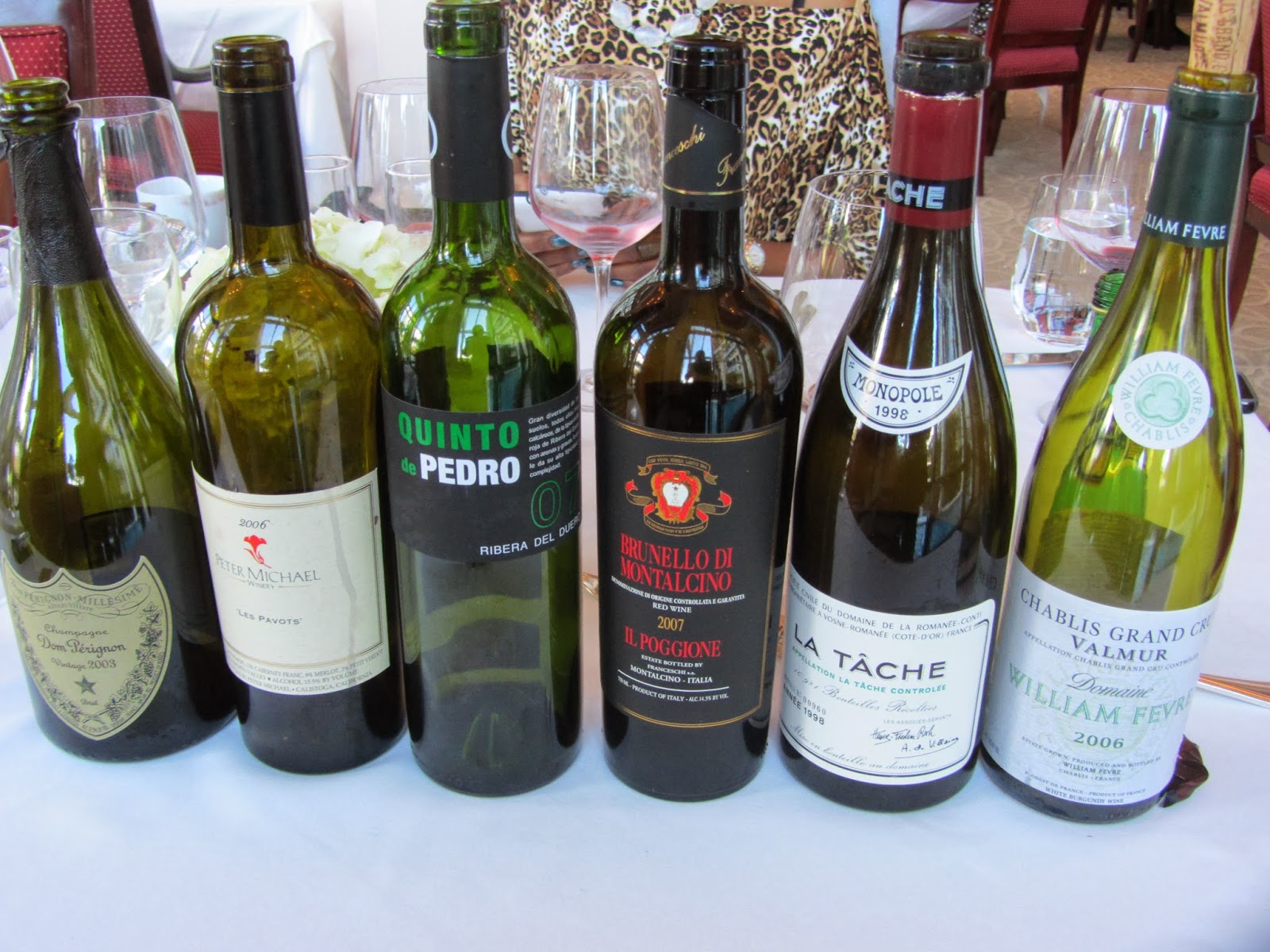
Ron's birthday is this week so we decided to join him and Bev in a pre-birthday celebration at Bern's Steak House in Tampa on Saturday night last (Bern's is the target of many wine interlopers and carpetbaggers who fly into town to relieve it of its treasures so we try to do our best to ensure that Florida gets its fair share.). Brad Dixon is Ron's regular Somm at Bern's and he proposed that we try a mini-DRC horizontal (Grands Echézeaux, Richebourg, and La Tâche). Bern's has been steadily increasing its prices for these high-end offerings from relatively low levels (when compared to auction actuals) but the wines that he was suggesting had not yet been given the elevator treatment. It did not take much discussion before we piled on board.

Brad Dixon, Sommelier, Bern's

Perceptions of the 2000 Red Burgundy vintage vary but, in general, the reds fared much better than did the whites. BBR describes the year as a red fruit vintage with the wines exhibiting "glorious quality and purity of fruit" and having "lasted better than expected." The tannins and acidity are lower than the 1999, according to BBR, but so is the expected longevity. Further, BBR sees some commonality with the 1997 vintage. Jancis Robinson says that producer was key in this vintage. The wines, she said, are not very concentrated but the "best will provide easy pleasure in the short to medium term."

While we waited for Brad to set up the DRCs, we continued our demolition of the 1975 Dom that Ron had brought along to ease the tedium of the chauffeured-drive from Orlando to Tampa. The Dom exhibited notes of lemon custard, creme brûlée, coffee, nuts, and a slight oxidation. On the palate still lively, with butterscotch, lemon peel, burnt orange, and a hint of tannin. Ron got lemon butter creme brûlée, toffee and roasted hazelnuts and expressed a particular liking for the "slight sherry oxidative notes" that can be found in older Champagnes. He also noted an "amazing acidity and ... nice, fine bubbles."

The first wine tasted in our DRC mini-horizontal was the 2000 Grands Echezeaux. This wine was initially highly floral -- lavender -- to accompany notes of petrol, cherries, and coconut. On the palate this wine was peppery and saline with drying tannins. Initially non-complex, acidic, and lacking a full, round mouthfeel. The finish was medium length. As the wine evolved in the glass, it developed weight but the fruit remained muted and the length remained a challenge. Ron noted cherries and tobacco leaf. He felt that the wine was probably 5 years away from its peak; "It took a while but started to open and strut its stuff." He agreed with my assessment of weight gain over time.

The second bottle was the 2000 Richebourg and this was served simultaneously with my escargot appetizer. The cheese- and garlic-heavy escargot paired well with the wine.

Escargot

The Richebourg was much darker at the core than the Grand Ech and had a floral nose with tar and petrol at the back end. My first thought was that someone had messed up and put a Barolo in a DRC bottle. As the wine evolved, notes of strawberry, watermelon, cigar box and cedar box became apparent. On the palate, spice, great acidity, and a very long finish. This is an extremely high quality wine.

The 2000 La Tâche was even darker at the core than was the Richebourg. Talcum powder and chalkiness on the nose. Over time the talcum powder evolved into soy. Rose petals tea, coffee, burnt tobacco, smoke, coffee grounds, nutmeg, and menthol. Power and weight on the palate along with bright acidity, non-aggressive tannins, and a long, drying finish. Ron characterized this as "another big step up." In his words, "the aromatics really soared after 1 hour in the glass." My La Tâche was accompanied by a robust Lobster Bisque.

Lobster Bisque

By this time my steak had arrived and Brad suggested a 1949 Canon in mag to accompany. This wine was replete with dried figs, tamarind, and mahogany. Wild red cherries, freshly turned earth, sweet tobacco, and a musty old closet. A little Brett. A herbaceousnes which Brad characterized as a hallmark of aging Cab Francs. A Burgundy lover's Bordeaux. Tamarind on the palate. Its acidity supported a long, sour finish.

Strip, Organic Carrots, Collard Greens, Onion Rings


At this time dessert was on offer but I was done. My table mates went on to indulge. I joined Ron for a 1907 and 1908 Madeira while the wives pursued Cognacs and Armagnacs.


Another excellent night together. The Canon was a little tired and the Grand Ech was low man on the DRC totem pole. The La Tache was, definitively, the wine of the night. So we rolled over to our room at the Epicurean across the street from Bern's while the Siegels began the long trek back to Orlando. I wish them well.

©Wine -- Mise en abyme

Tuesday, February 11, 2014

Solaia vintage classification schema: Rationale and translation

Solaia.net presents the totality of Solaia vintages (with the exception of the 2010) within the context of a classification scheme (The Early Years, The Early Classics, The Challenging Vintages, Underrated Vintages, Milestones Part 1, and Milestones Part 2) and the Galloni retrospective tasting utilized this same schema as its flighting mechanism. In neither case was an explanation of the schema given so I approached Niccoló Maltinti, US Antinori Brand Ambassador, with a request for clarification. Niccoló submitted my questions to corporate and the following perspective was provided by Renzo Cotarella, Antinori CEO and Chief Enologist.

In terms of the origin of the scheme, Renzo traces it back to the Galloni sit-down dinner. As he saw it, "it would have been difficult to taste 28 vintages in a row over the course of a dinner."

As it relates to the classification itself, the wines labeled as Classic are the products of generally warm, low-rain vintages where the grapes are handled in the classic manner during vinification. Markers of the Classic style are "pumping over, looser temperature control, and transfer in oak barrels after the malolactic fermentation."

The wines classed as Underrated "are the vintages that most of the tasters, especially American journalists, usually underestimated." These wines were co-located in order that tasters could "appreciate their absolute power and potential" rather than to compare them to "other unquestionably better vintages." Marchesi Antinori, according to Renzo, feels strongly that these wines were totally underestimated by the press and he picks out the 2008 vintage as an example. This wine, according to Renzo, is considered one of the greatest Solaia vintages ever by the winemaking team (It should be noted that the1990, 1997, and 2010 have received better critic scores.).

The Challenging vintages are those where the vagaries of the weather significantly affected the quality of the offering. One of the most striking examples is the 2002 vintage where the volume of rain resulted in poor Sangiovese harvests and the exclusion of that varietal from the blend. This vintage is labeled Annata Diversa to so signify. Some vintages were so challenging (1980 and 1981, for example) that no Solaia wine was produced in those years.

Milestone wines, according to Renzo, "are those vintages in which Solaia represents for us a benchmark not only in terms of quality but furthermore stylistically."

The placement of Solaia vintages into the classification schema is shown below.


In his article, Galloni mentioned that the Solaia's of the 1990s were Bordeaux-inspired while the wines of the 90's sought ripeness and concentration. He sees the wines of the 2000s as going back to its roots. The style of wine seems to have not dictated the placement in the above categories. There is an equal distribution of early classics between the '80s and '90s while wines from the '90s are 40% as likely to be underrated as are wines from the 2000s. What is apparent from the above though, is that Solaia, based on its own estimation, has been making consistently high quality wines all through the 1990s and 2000s: three of the 1990 vintages are classed as Milestone wines and two as Early Classics while six of the 2000 vintages are classed as Milestone wines.


©Wine -- Mise en abyme

Saturday, February 8, 2014

Dueling doctrines: Antonio Galloni versus Tom Stevenson

In a recent post, I coined the term "Galloni Doctrine" as a descriptor for his perspective on the role of a wine critic. Galloni's thoughts on the matter were shared in a Liv-ex interview wherein, in responding to a question on the impact of wine critics on markets and growers, he stated (in relation to the grower part of the question): "I firmly believe that it is not a critic's role to tell growers -- or even suggest by way of commentary/criticism -- how to make wine. Any sense of giving direction to growers is completely antithetical to my philosophy."

I used the Galloni doctrine as a filter through which to view Tom Stevenson's (one of the leading authorities on Champagne and sparkling wines) longstanding critiques of the champagnes of Domaine Jacques Selosse. As I said in the post, my writing the piece was in no way an endorsement of the Galloni doctrine, or advancement of the approach as a "framework" or guiding principle for all wine critics. I juxtaposed his thoughts and Stevenson's actions as a way to generate some dialogue on the matter."

And boy did I get some dialogue. From the man himself. In a lengthy comment on my article, Tom dispatched what he viewed as an erroneous observation made by one of the authors I had cited in my post, pushed back heavily on the Galloni doctrine, and shared his mystification as to why folks would endeavor to drink faulty (read oxidized) champagnes. I thought that Tom's comments were too important to remain buried in the comments of the article so I present them to you herein. In this particular post I present his take on the Galloni Doctrine (And please remember, Galloni does not have a doctrine. I gave him one because I slept at a Holiday Inn last night.). I will examine the issue of consumption of oxidized champagne in a subsequent post.

In ruminating on the role of a wine critic, Stevenson wondered whether they should mention wine faults when encountered and, if they do, should they just mention them without any further discussion. Or, would discussion of the problem be more constructive in the long term. It is this dilemma which informs his doctrine: (i) He believes that he has a fundamental right to examine and discuss elements of how specific producers make wine (and based on his years in the business, he is eminently qualified to do so); and (ii) in the cases where he encounters wine faults, he discusses the problem in a constructive way. Matter-of-factly, "others can do what they want but I have always taken this approach in my writing."

These two gentlemen approach wine criticism from two separate perspectives and, as a result, may be playing to different aspects of the value chain. I posit that Antonio sees himself as helping consumers make better decisions between the wines available on the market where, while Tom may see himself in that space to some extent, he sees his mandate as also encompassing assisting winemakers in making better wine. They, in his view, will make better wine if they are aware of the faults in their wine. And even moreso if consumers, based on reading his comments, mention the issue to the winemakers or their representatives. In this approach he is not committing the Galloni sin of telling winemakers how to make wine; he is telling them what is wrong with the wine that they are making.

The market seems to be signaling that both approaches are meritorious as both of these gentlemen are enjoying success, each in his own right. But I would suspect that most people would take the position that Adam Chilvers (Owner of wineontheway.com) took when we were discussing this post: "I think that a critic should point out flaws in wine. Why are they a "critic" if they don't voice their honest opinions which are based on their experiences and expertise? Isn't that what a critic is?"


Wine -- Mise en abyme

Monday, February 3, 2014

"Throwback" Brunch at Hyatt Regency Grand Cypress' (Orlando, FL) La Coquina restaurant

Hyatt Regency Grand Cypress opened for business as "Orlando's original luxury resort" on February 1, 1984 and, in that time, it has served travelers and locals alike with elegance and verve. I originally came to Orlando in 1990 and, at that time, there was a paucity of fine dining establishments in the area. Hyatt's Hemingway's (dinner; company holiday party) and La Coquina (brunch) provided both excellent fare and ambience and, as a result, I was a regular visitor to both. La Coquina, in my estimation, served by far the finest brunch in Central Florida and so "regulars" were heartbroken when the hotel discontinued this offering.

What made the La Coquina brunch special? According to Scott Joseph's Orlando Restaurant Guide (La Coquina is Closing, 9/10/12):
The brunch was distinct because the food stations were set up in the kitchen. Guest (sic) would walk among the cold salads, shellsfish, cheeses, and sausages to make their selections. Then, when ready for the entree, guest (sic) would step up to the chef's station and order from among three or four options to have the food prepared a la minute. They would return to their tables with the always wonderful food, and eat in the beautiful dining room with its soaring ceilings and cascading chandeliers. And, always, the champagne flowed freely.
My heart lit up with joy when I heard that the hotel was bringing the brunch back for one-time only -- February 2, 2014 -- as part of the celebration of its 30-year anniversary. I signed up immediately to partake in this revisit of the "scene of the crime."

The day of the brunch dawned bright and sunny, in stark contrast to the brooding, dreary, gloomy, wet weather we have been experiencing of late. Saru drove over to our house and joined us for the trip to the restaurant. The other members of our group were scheduled to meet us there. Once at the hotel, we turned the car over to the valet and made our way into the expansive lobby which appears to stretch for miles to the south and east. The focal point of the lobby is an elevated bar in the southeast quadrant which is separated from the pedestrian concourse by a water course. The memories came flooding back as I looked around: the many pre- and post-dinner drinks we had consumed on our way to or from Hemingway's; of the many times I had traversed the lobby while heading to brunches past; and of the large cage (no longer there) which was the home of a bright red, extremely voluble macaw (now a free-range bird).


The unusual entrance to La Coquina was ahead of us and to the right with its futuristic tangle of steel covering the stairs leading from the hotel lobby to the restaurant on the level below. The elegance of the restaurant's dining area begins to reveal itself as you descend and unfolds flower-like as you venture deeper into its folds. The outer walls of the restaurant are made of glass, providing stunning views of of Lake Windsong and the carefully manicured grounds beyond, as well as allowing the restaurant to be bathed in natural light. Inside the restaurant the tables were robed in white upon which sat multicolored chargers and flowers, along with glasses of various sizes and a supply of perfectly hefted silverware.


We were greeted at the Hostess Station by a smiling staffer who checked our names against the reservation list and, after enquiring after the rest of our party, led us to the best seat in the house, directly above the sun-drenched lake. And as Scott Joseph had reminisced, as soon as we sat down, the Champagne began to flow (It was Prosecco, actually). As I looked around, I saw fellow diners glowing with satisfaction (they had made it) and anticipation (of what was to come). They had thought that La Coquina had been permanently consigned to the dustbin of history; yet here they were sitting, in once-familiar seats at once-familiar tables. It was temporaray but that only contributed to the overall sense of satisfaction.


The Prosecco was not dry enough for my wife so the staff hustled a bottle of Argentinian sparkling to the table. While they were opening it, I mentioned that I was "locked and loaded" and queried after the corkage fee. After a brief negotiation (which consisted of them telling me what the corkage fee was), I had them open my bottle of Dom and settled back for a pre-Super Bowl brunch extravaganza.

The floor was flooded with wait staff. The main waiter at our table was J.P. but he appeared to be assisted by every other server in the room; plus some managers. When we were ready to peruse the offerings, J.P. led us between the tables and into the kitchen. Beautiful and bountiful. It began with a caviar station and worked through fruits and cakes and breads and cheeses, and seafood, among other delights, before ending at the cooking area where orders could be placed for one of the 10 or so entrees on offer. La Coquina had risen from the dead but was as energetic and energizing as ever. I headed to the starting point, grabbed a plate, and made a beeline for the caviar station.


I started with a caviar and cheese platter followed quickly by a shellfish platter. Both paired beautifully with the Dom, especially the juicy, grey-toned oyster flavors with the yeastiness and toasty notes of the Dom.


While running through the courses, I encountered a number of friends who had, like me, come to recapture some of the memories. I was in the kitchen with Adam of wineontheway.com and Eric K., looking over the wine offering of the hotel when we noticed that they had a bottle of DRC La Tache. We called the manager over and began a discussion about acquiring it. I went back to my table while the Manager went off to consult with his people about the sale of the bottle. The next thing I knew I was called over to the wineontheway table; they had bought the bottle. The wine appeared rather delicate in the glass but the fragrance was powerful. Strawberries and muted red fruits. Firm on the palate but elegant nonetheless. Still youthful. Balanced. Slight drying tannins. This elevated what had already been a glorious day. Oh well. I have to go back over to my table to entertain my guests. But I am taking my glass of La Tache with me.


During the course of the brunch I had numerous conversations with management, staff, and patrons as to their observations regarding the event and the likelihood of this happening again. Patrons were wholeheartedly in support of bringing back the weekly brunch, as were the staff. Both groups hoped that the enthusiastic response to the offering would push management to revisit their decision to terminate the brunch. In two separate conversations with the Jon Couts, Director of Restaurants, he indicated that brunches are expensive animals with food costs alone approaching 45%. While the hotel is happy to see the great turnout of the event, and while brunches are a great way to connect with the local populace, management will continue to look at the success of this event as validation of the 30-years of service that they have provided in the Orlando area.

Great day. Great event. We ended up covering both seatings. We were the first to arrive and almost the last to leave. We did not want to let it go. I cannot leave without mentioning the phenomenal music played by the pianist. He ranged from Royals (Lorde) to Phantom of the Opera without missing a beat. The Broncos could have learned a thing or two from him.


©Wine -- Mise en abyme

Saturday, February 1, 2014

Spanish Wine Experience at East End Market (Orlando, FL)

It has been raining heavily in Orlando for the past few days but these heavenly blessings did not dampen the enthusiasm of the 180 (or so) attendees at last night's Spanish Wine Experience presented by the Spanish River Grill Group (SRGG; my nomenclature) at the East End Market. The event, held in association with wineontheway.com, was aimed at building name recognition for the soon-to-be-opened Txokos Basque Kitchen as well as to familiarize potential patrons with the types of wines that they are likely to encounter at the establishment (scheduled to open in the next few weeks).

Txokos Basque Kitchen is the new restaurant offering of Chef Henry and Michelle Salgado of Spanish River Grill (New Smyrna, FL) fame, which will bring Basque cuisine -- the current rage on the world food scene -- to Central Florida. Txokos will be utilizing La Bretxa, the third member of SRGG, for fresh local seafood and Spanish provisions and the Market Garden as a source of fresh vegetables and herbs. Both La Bretxa and the Market Garden (farmed by East End owner John Rife) are also located at the East End Market.


The event was held on the second floor of the market. Guests were welcomed by Erin Allport, Head of Marketing and Operations for SRGG, given wine glasses, and then ushered into the tasting area.


The tasting was distributed over two rooms with seven of the eleven distributors pouring wine in the larger of the two and the remaining four in the second. The distributors pouring wine at the event were as follows:
  • Vinecraft
  • Republic National
  • Stacole
  • Winebow
  • Premier
  • Noble
  • Classical
  • Fine Wine Importers
  • Askari
  • Opici


The larger room had its southern aspect taken up by an open kitchen, with a high counter separating the kitchen staff from the patrons. A variety of pintxos (classic Basque bites, with or without bread and with or without skewers) were placed on flat trays on the counter to allow patrons to taste at their leisure. The wine tasting stations were arrayed against the remaining wall space. Centrally placed tables and ottomans rounded out the furnishings in that room. Soothing semi-classical guitar music -- ably dispensed by Brian Hayes -- wafted in and around the wine-laced conversation of the attendees.


This one went fast


The smaller of the two rooms had a ham-carving station in addition to the pouring tables and central seating.


The pintxos were pleasing to the eye as well as the palate and paired well with the wide array of available wines. I was pretty partial to the Tuna and Piquillo which, unlike most of the other things on offer, required multiple bites to dispatch. It was almost hypnosis-inducing watching the carver at work with the Jamon Serrano, the dried-cured Spanish ham. The paper thin slices, when paired with the accompanying dried figs, Marcaona almonds, bread, and tomato aioli, were just heavenly.

This was definitely the largest collection of Spanish wines that I have seen in one place in Orlando. Vinecraft poured a Carballo Listan Blanc from the Canary Islands which was "gone too soon." I look forward to encountering it again sometime in the future. When I was in Basque country late last year it seemed that every bartender wanted to serve me Txakoli with my pintxos; and there is a reason. They go well together. There were two pretty decent Txakolis on offer last night from Premier and Noble (Berroja Berroia) and Opici (K5). I liked the 2006 RODA I Reserva and 1994 Lopez de Heredia Tondonia Gran Reserva; but I am very partial to Riojas (especially aged) at this point in my life.

The event was well organized, implemented, and received. The staff did an extremely good job of rapidly clearing away the remnants of meals and the kitchen staff labored furiously to replace pintxos platters as fast as they were devoured. The patrons appeared to have had a great time. They were buzzing from room to room and station to station. This was definitely not a "critical" tasting; this was a party. If this event is representative of what Txokos Basque Kitchen will bring to Orlando -- a spicy mix of food, wine, and people -- then sign me up.


©Wine -- Mise en abyme