Thursday, July 29, 2010

The Virginia Wine Industry and the Upcoming Wine Bloggers Conference

In light of the announcement that the next Wine Bloggers Conference (WBC) will be held in Charlottesville, VA, I sought out an insiders perspective on (i) the Virginia wine industry and (ii) the potential impact of the WBC being held in the state.  The person I turned to for his insights was Dr. Bruce Zoecklein, Professor of Enology at Virginia Tech, State Enologist, and head of the Wine/Enology - Grape Chemistry Group (WEGCG), also at Virginia Tech. Before delving into Dr. Zoecklein's expertise, responsibilities, and perspectives, an overview of the VA wine industry is in order.

According to Virginia Tech the VA wine industry:

  • Utilizes 2500 acres across the state for grape growing
  • Generates $35 million annually in tax revenues
  • Ranks 8th in the country in wine production
  • Supports 165 wineries
  • Hosts over 1 million tourists annually
  • Primarily plants Chardonnay, Cabernet Franc, Merlot, and Cabernet Sauvignon.
The industry has the resources of the University and the state at its disposal for grape quality research and improvement initiatives.

The primary resource available to the industry from the University is the Dr.-Zoecklein-led WEGCG which: (i) conducts/oversees wine-related research and provides lab services; (ii) provides an Extension Service; and (iii) conducts onsite visits to wineries for consultation and data collection.  An example of the research conducted by the group is the development of the electronic nose, a tool that allows the grower to assess grape maturity and select optimal pick-time.  The Extension Service provides workshops, short courses, symposia, and printed/online material, all aimed at increasing the knowledge base of industry participants.

In addition to his teaching responsibilities and leading the WEGCG, Dr. Zoecklein also oversees the Enology Service Lab which provides fee-based analysis of wine or juice for in- and out-of-state customers.  The lab is staffed by two full-time chemists and provides chemical, physical, microbiological and sensory analyses upon request.  The lab was initially established to serve the VA industry but expanded its services to customers beyond state lines in order to have enough samples to run through the system to keep overhead down.  Revenues from the lab activities go back to the lab or into the program.

The WEGCG does not have a charter per se but works actively with VA winemakers to (i) lower their cost of production and (ii) increase the quality of their wine grapes.  One of the primary inputs to WECGC activities is the information gleaned from regular roundtables held with the winemakers.  At these meetings, wines are tasted blind and determinations made as to what the sensory problems are.  The WECGC will then design research programs to address the identified issues. Within the larger group of winemakers there is a smaller group of 15 or so who can, and have, worked on the worldwide stage. Dr. Zoecklein listens carefully to the input from this group.  Organizational success is measured by the number of wineries that adopt his recommendations.  As an example he cited the case of fermentable nitrogen in wine where today, based on his recommendation, the majority of winemakers are sending samples to be tested so that they can make adjustments prior to fermentation.

Dr. Zoecklein sees the VA wine industry as still embryonic, still learning what varietals to plant and where to plant them.  At a broader level, however, the industry operates in a favorable political climate peopled with progressive politicians.  The current governor, for example, is very supportive of the wine industry because he sees its potential impact on tourism, state tax revenues, and agricultural economic development.

When queried about VA terroir, Dr. Zoecklein said that VA was all about soil and climate variation: from the sand of the eastern shore, to the red clay of the Piedmont, and with some limestone thrown in for good measure.  What is more relevant in VA, he says, is hydrology -- soil moisture and soil moisture-holding capacity -- and the industry needs to get to a place where they understand the regional differences and its impact on varietals.

Dr. Zoecklein identified a number of challenges confronting VA winemakers:

  • The need to understand the nuances of climate and how those nuances affect winemaking styles
  • The need to understand what technologies are available and the to adopt the ones that are most germane
  • The need to better understand the marketplace and how best to market their wines.  Tourism is the main sales vehicle today but does not provide the economies of scale needed to get production costs down
  • The need to understand the economics of winemaking.  It is easy to spend a lot of money and not get a return on the investment.
The VA winemaking industry will be positively impacted by the WBC being held there next year, according to Dr. Zoecklein.  In his view it will increase industry visibility.  On a broader level, he sees blogs and bloggers as an increasingly important mechanism for getting the word out.

As regards the future, Dr. Zoecklein sees Virginia as part of a strong regional wine industry with, in its case, demonstrated excellence in Petite Manseng and Sauvignon Blanc.   He expects to have access to grant money to expand winemaker sensory training and to create specialized online programs for people looking to get into winemaking.  He sees the presence of technically trained individuals as key to the growth and development of the industry within the state.

Wednesday, July 28, 2010

Dinner in Paris: Gerard Depardieu's La Fontaine Gaillon

Gerard Depardieu, best-known in the U.S. for his Oscar-nominated role of Cyrano in Cyrano de Bergerac, is owner of a classic French restaurant called La Fontaine Gaillon and located in the heart of Paris at 1, place Gaillon in the 2nd Arrondisement.  Gayot.com describes the cuisine as "traditional French" and the establishment as a "... beautiful restaurant nestled in a 17th century beautiful mansion" with cuisine "... at par with the decor."

The restaurant having been recommended by the hotel concierge, and confirmed with vigorous nods by people that I queried during the course of the day, we set out in an under-air-conditioned taxi in search of a gastronomic tour de force.  We were not disappointed.

The restaurant is located at the confluence of Rue Gaillon, Rue St. Augustin, and Rue de Port-Mahon, directly in the vee formed by Rue Gaillon and Rue de Port-Mahon.  This geographical location places the restaurant in a position of prominence as viewed by the approaching patron and provides a commanding view of the surroundings looking from the inside out.  When recommending the restaurant, the concierge had suggested we sit on the terrace if possible and I had requested thusly when making the reservation.  When we presented at the entry, it became clear why such a recommendation had been made.  Check-in was at the gate of a half-moon-shaped courtyard which had seating for about 50 people and which was protected from the outside environment by well-manicured window boxes along the perimeter and by two large, off-white tents above.


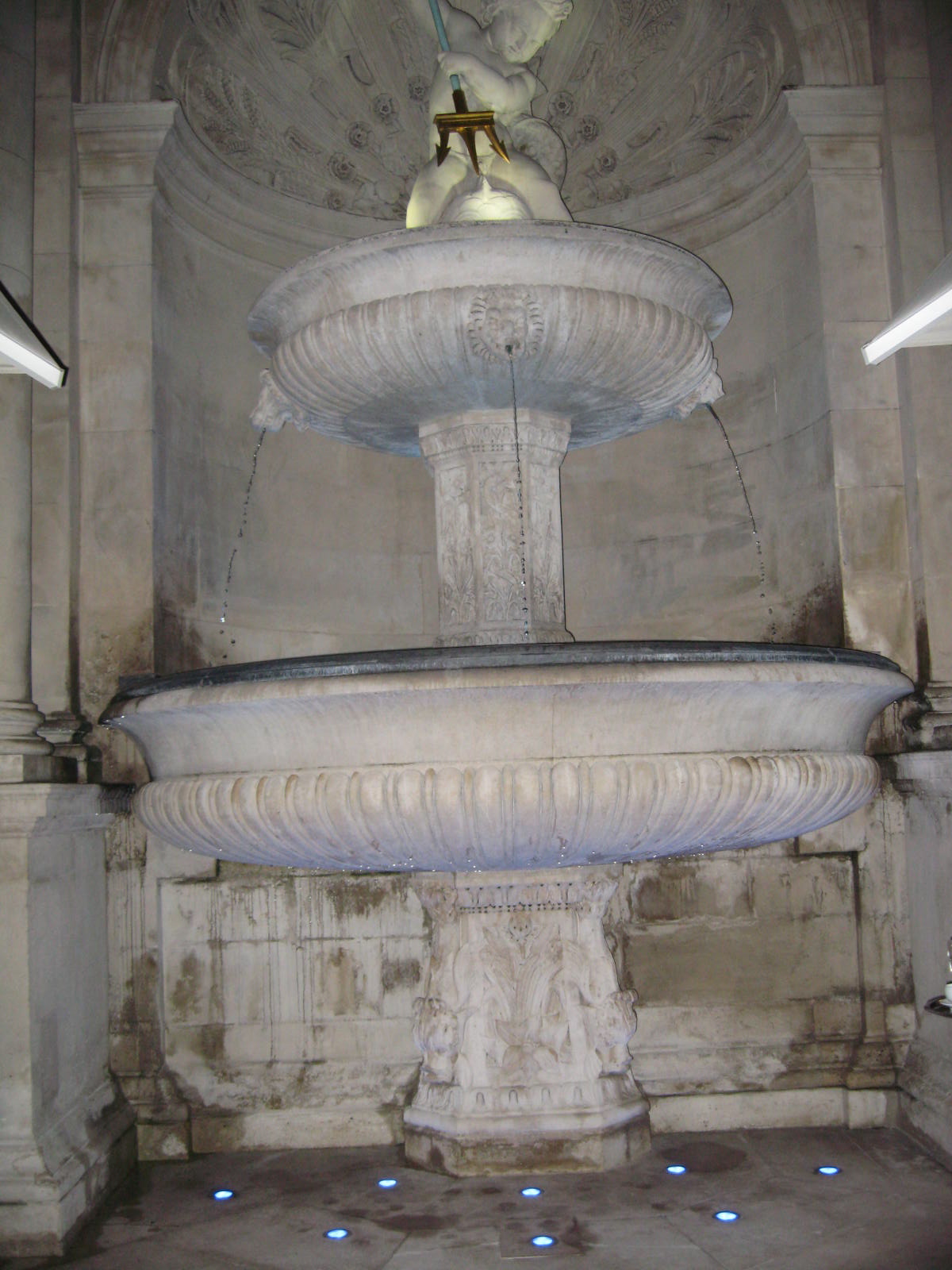
Directly across from the entrance, and hard against the building wall, was a massive, two-level fountain which reached almost to the eaves (In a 2004 article in the New York Times, Dana Thomas reported that the original building was constructed in 1872 for Sieur Fremont, the guardian of the royal treasury, and that the fountain was rebuilt in 1828 by Visconti, the architect who built Napolean's tomb.).


Our reservation was at 8:00 pm so it was still very bright outside when we were seated directly adjacent to the fountain.  We noted the sharply dressed, black-clad wait staff with vests and black ties for males and open-necked white shirts for females.  We were presented with an extensive wine list, once comfortably seated, and selected a 1998 Pommery Cuvee Louise to start the evening off.  The pale straw color and small, tight bubbles in the glass were harbingers of the full-mouth-enveloping acidity, the bread, the minerality, the burnt orange and long finish of this wine.

Our entree (remember, we are in Paris) was a Ravioli de Crevettes au Persil Chinois.  This was shrimp (large) in a see-through casing and flavorful it was.  It went wonderfully with the champagne.


Our main courses were, respectively, Aladdin de homard Breton (lobster), Cote de Veau (veal) a la creme et de Truffles Blanche, and Entrecote Black Angus Grilled, sauce Bernaise.  We paired the meats with a 2007 Chateau Giscours.


The desserts were an Assiette de Fruits rouges, glaze vanille; Soup de Peches blanches aux framboises basilic; and Profiteroles au Choclat chaud.


This was a Monday evening but by the time we were on our second glasses of champagne, the restaurant had begun to fill up.  It was a calm, unhurried environment, well-suited to enjoying the delicacies which had been placed before us that evening.  By the time we got up to leave, darkness had enshrouded the plaza and, as we got into our taxi, we cast one last, longing look at the vista shown below.


Goodbye for now, friend.  I will see you again.

Monday, July 26, 2010

Wine Lovers" #Cabernet Day Survival Guide

On Thursday, September 2nd, wine lovers are being invited to a worldwide, social-network-facilitated celebration of Cabernet Sauvignon, the king of grapes. On that day, individuals will share Cabernet Sauvignon wines in local environments and, through the connectivity afforded by social networks, with like-minded individuals around the block and around the world. On that day, any entry on a social network which includes the term #Cabernet will be shared with other members of the network who are monitoring that stream.

Wine lovers will experience this event in any number of ways: at home alone; at home with friends; at wine retailers; at wine bars; at wineries; at restaurants; or at some type of special event.  Given the amount of time allocated to the worship of this varietal, the aforementioned venues are not mutually exclusive.  If you do intend to enjoy the event away from the confines of your home, in a bar-hop, for example, please consider the use of a designated driver.

Your objectives for the day should be to have fun and, in so doing, honor the varietal.  You will Connect, Imbibe, and Share with other Cabernet lovers, both locally and globally.  It is recommended that you bring your own social network access tools (phone, iPad, etc.) if you are participating out of the home in order to ensure that you can comment, reflect, and share on your own time and pace.

At the event, once you have signed in, you should let the world know where you are and an approximation of the number of people there.  You should let the world know what wines you are opening and what you are experiencing.  Feel free to comment on what others are saying, both locally and virtually, as the data streams go by.  Be sure to include the term #Cabernet in all of your comments in order to ensure that your communication is included in the relevant stream.  Include the term #CSOrlando to allow us to capture metro-Orlando participation.

All in all, have fun and enjoy #Cabernet Day safely.

Sunday, July 25, 2010

#Cabernet Day: Open Letter to Metro-Orlando-Area Wine Purveyors

On Thursday, September 2nd, wine lovers are being invited to a worldwide, social-network-facilitated celebration of Cabernet Sauvignon, the king of grapes.  On that day, individuals will go to wineries, wine shops, restaurants, and homes to share Cabernet Sauvignon wines in local environments but, through the connectivity afforded by social networks, can also share their experiences with like-minded individuals around the block and around the world.  On that day, any entry on a social network which includes the term #Cabernet will be shared with other members of the network who are monitoring that stream.

The most recent event of this type was the #PinotNoir Smackdown, hosted by Ed Thralls (@winetonite), held on July 15th last.  That event, 2 hours in duration, and limited to Twitter, generated 2073 tweets from 323 locations and a ton of fun for all participants.  I wrote a piece on my experience and the biggest issue for me was the lack of participation by metro-Orlando wine establishments.

The upcoming #Cabernet Day provides you with an opportunity to rectify that oversight.  It will be hosted by Rick Bakas (@RickBakas), the social media guru at St. Supery, and will provide a number of substantive benefits for your company if you choose to participate. (i) Having a Cabernet Day provides you the opportunity for focused sales on a popular varietal and, within that varietal, brands of your choosing; (ii) Participating in the event allows you to increase your foot traffic through promoting the "feel-good" concept of bringing the world together; (iii) Your stock will rise in your customers' eyes.  You are now the hip, with-it, social media guy (gal) who is taking them beyond the walls of your establishment without them having to leave their seats.  The Wow! factor; (iv)  You will get an opportunity to see what folks beyond your block are drinking and thinking and this may affect future stocking decisions; and, last, but not least, (v) you will gain exposure to potential new customers.

Sounds good, you say.  What do I need in order to participate? That is easy.  You probably are already in possession of all the needed tools.  You will need computers (one with a large-screen display, or multiple laptops, would be the best-case scenario but use what you have), network access (DSL or wireless), and a social network account (Facebook, Twitter, etc.).

What should you do next?

  1. Commit to participation -- half-measures will not work.  Time and effort will be required in order to plan and implement a successful effort.  The event will run until 11:59 pm PST but you, obviously, will choose the hours during that time that you want to participate
  2. Register for the event -- http://cabernet.eventbrite.com/
  3. Determine the details of your participation -- brands that will be promoted, horizontals and/or verticals, foreign and/or domestic, outfitting customers for home-participation, allowing customers to bring bottles from home? etc.
  4. Promote the event heavily through all of you channels -- in-store, e-mail, website, other advertising channels
  5. Check this blog site regularly for updates.
On the day of the event you should be ready to facilitate your customers in their efforts to Connect, Imbibe, and Communicate.  According to Rick, "Put up the twitter stream so everyone can see it and interact. ... use twitterfall.com to pull in #cabernet tweets only."  Communication threads emanating from your establishment must have the #Cabernet term included in order to be a part of the #Cabernet Day stream.  Further, I am asking that you also add the term #CSOrlando so that we can determine local participation.

Once the event is over, you should take steps to measure its impact on revenue, customer perception, and, over a longer time period, new customer acquisition.

So.  Now you know.  What are we going to do about it.

Saturday, July 24, 2010

For Chateau Lafite press B5


Just when you thought the wine culture couldn’t become sexy enough. Coming to a store near you, the sleek, the exotic, the provocative…the wine vending machine? Whoa. I just heard the music stop. Call forensics, because this has the fingerprints of bad legislation written all over it. Nothing screams you’re a responsible drinker louder than a machine that checks your ID, takes your picture, and performs a breathalyzer test. Smile and say cheese; government cheese that is. Big brother is watching. Do I sound a bit jaded? Nooo, never. I must say all these steps do sound a tad cumbersome and intrusive.

Currently, these machines are being test-marketed in Pennsylvania. The Liquor Board is making claims of consumer convenience and modernization of the purchasing process...Yawn...Other claims include keeping minors from the being able to purchase the wines...Are you still awake?...Ahhh, earth to Liquor Board, minors are not going to purchase kiosk wine unless you offer Mad Dog 20/20. Sorry, I’m not buying this line.

Personally, I prefer to examine the wine before I purchase it. I like to check out the fill level, capsule spin, the flush of the cork, and the color. The kiosk process feels impersonal and inconvenient. If the kiosks offer high-end labels then I possibly do see a benefit, since the wines will be refrigerated. Then again, I still prefer to examine the bottle prior to purchase so this still creates a problem.

I say this not knowing the details of a return policy, so my views may change. The whole process may not appeal to the wine connoisseur but may possibly appeal to the casual drinker. I prefer we save the vending machines for our snickers fix. I predict this pilot program fails to leave the ground. Until next wine…

Friday, July 23, 2010

Book Review: When the River's Ran Red

When the River's Ran Red (Palgrave MacMillan, 2009) is Vivienne Sosnowski's telling of the travails that beset the American wine industry as a result of Prohibition and how the players in this fledgeling industry survived this misbegotten experiment in social engineering.  It is a historical tale with a good ending for the producers of wines and spirits, those who made their living getting product from the producer to the consumer, the consumer, and government tax receipts.  Not so for the "Drys" and those employed in "enforcing" the Prohibition statutes.

The book -- arranged into 10 chapters, and 200 pages long (exclusive of front matter, notes, bibliography, and index) -- has six main themes: the development of the American wine industry prior to the passage of the constitutional amendment ushering in Prohibition; the preparation, or lack of same, of the winemakers for the onset of Prohibition; the broader social and political battle that was waged over the Prohibition issue; winemakers' initiatives to "ride out" Prohibition; the battle for repeal; and the euphoria accompanying repeal.

The book begins slowly, somewhat dry and peppered with numerical data and historical facts.  We are made to know that the Franciscans were probably the first to grow grapes in California (1823), followed by George Yount in the 1840s, and that Agoston Haraszthy, a Hungarian emigre, brought in clippings to Sonoma.  The role of the early immigrant Italian families in the development of the wine industry in Napa and Sonoma counties is explained in some detail.  The names read like a roll call from the wine hall of fame: Seghesio, Simi, Passalacqua, Foppiano, Cuneo.  Despite the effects of Phylloxera and the San Francisco earthquake, the domestic industry had raced past imports, going from a ratio of .03:1 gallons-consumed in 1850 to 3.5:1 gallons-consumed in 1896.  The 1910 census showed a total of 145 million grape vines in California.

The author paints a broad-brush picture of the national battle leading up to the institutionalization of Prohibition with the passage of the 18th Amendment.  We learn of the Drys -- the forces in favor of passage -- and their arguments and the counter arguments of the Wets -- the forces arrayed against passage. We learn that, in California, "Prohibition was a confrontation between North and South, a war between Southern California's Presbyterian dominated Protestants, who had hailed from Arkansas and Oklahoma, and the multi-ethnic inhabitants of the Catholic dominated north, many of whom had come from Italy, France, and Spain, where wine was an integral part of life."

The author impresses upon us the deleterious effects of Prohibition on the domestic winemaking industry.  Prohibition had a loophole which allowed for home winemaking -- up to 200 gallons per year without incurring a tax liability -- and this was, initially, a boon for grape growers.  But the lack of relevant transportation infrastructure, as well as shady operators all along the supply chain -- eventually brought this safety net crashing down.  California went from 700 registered wineries at the beginning of Prohibition to 137 at its repeal; and many of the survivors had to resort to bootlegging and other "unsavory" practices in order to survive.  The author recounts these stories in an unvarnished fashion; as she does their encounters with Prohibition Agents and the rampant corruption associated with all aspects of Prohibition.

This book makes for good reading.  The author surrounds the dry historical facts with flowing, gripping descriptions of the anthropology, geography, agriculture, and environment of America's premier wine-growing regions.

Wednesday, July 21, 2010

Cru Bourgeois - Part Trois

For the 1855 Exposition in Paris, Emperor Napoleon III requested a classification system for France's best Bordeaux wines which were to be on display to visitors from around the world. The negociants from the wine industry created a hierarchical system that ranked the wines according to a chateau's reputation and trading price, which at that time directly correlated to the wine’s quality. Four wines were rated at the top as Premier Cru Classe (First Growths): Chateau Haut Brion, Chateau Margaux, Chateau Lafite Rothschild, and Chateau Latour.

A number of wines were then classified Second, Third, Fourth, and Fifth Growths. In total, only sixty (60) chateaux were ranked. The ratings did not include white wines, the sweet wines of Sauternes or Barsac, and the rankings were limited to the wines of the left bank, so no chateaux from St. Emilion or Pomerol were included.

Only two changes have been made since. Once in 1856 when Chateau Cantemerle was added as a Fifth Growth, and again in 1973, when Chateau Mouton Rothschild was reclassified from Second Growth to First Growth, making a total of five First Growths with which most everyone is familiar. In only ranking 60 chateaux, thousands of other chateaux were excluded. In 1932, a system was devised to include the “best of the rest” – the people’s wine - the Cru Bourgeois.

444 chateaux were included, separated into three (3) groups: The highest ranking was designated Cru Bourgeois Superieurs Exceptionnel (sometimes called Cru Exceptionnel or Cru Bourgeois Exceptionnel) (6 chateaux), followed by Cru Bourgeois Superieurs (99 chateaux), and finally Cru Bourgeois (339 chateaux). However, chateaux in any of these three categories could only use the term “Cru Bourgeois” on their wine labels.

This lack of distinct labeling led to the establishment of a panel in 2003 to re-evaluate the Cru Bourgeois classification with the idea that the newly ranked wines could place their elevated status on their label as a sign of quality. Four hundred and ninety chateaux registered to be included in the classification - the Bordeaux Chamber of Commerce listed 247 in their final rankings. Nine wines were ranked as Crus Bourgeois Exceptionnels, 87 as Crus Bourgeois Superieurs, and 151 as Crus Bourgeois. As with any such classification system, there was controversy over these rankings, and some very highly regarded wines such as Chateau Gloria and Chateau Sociando-Mallet did not even apply for classification, preferring to rely on the quality already associated with them by name.

The controversy boiled over and into the courts, where 78 chateaux (which had been excluded from the classification) leveled claims of bias (several members of the 2003 panel were owners of chateaux seeking the rankings), resulting in a February 2007 decision to overturn the new classification and return to the 1932 rankings, with all wines referred to as Cru Bourgeois. That decision was amended in July 2007, when the French courts ruled the use of the term “Cru Bourgeois” illegal.

Now we are set for the third try – the “Reconnaissance de Cru Bourgeois.” The new classification, ratified in 2009, will be set by a panel made up of wine professionals – but with no chateau owners – who are at present selecting “benchmark” wines which will set the quality standard for all the 290 wines from chateaux which have applied for Cru Bourgeois status.

Forty wines were selected from the Medoc and Haut Medoc, as well as forty from the various communes (St. Julien, St. Estephe, Margaux, etc.) to be judged and scored as the benchmarks for rating the 290 chateaux. The same panel that is rating the benchmarks will rate the applicants.

This time the designation of Cru Bourgeois will be an assurance of quality, which will be assessed on a yearly basis by an independent organization. The new system will have only one category, as they hope to avoid the controversy associated with the prior Exceptionnels and Superieurs. The chateaux will have to adhere to production rules and independent quality testing in order to remain in the classification. Although the production rules are yet to be finalized, proposals will govern, among other things, barrel and vat capacity, and a guarantee of 18 months aging in barrel. The new classification, scheduled to be announced on September 23, 2010, has already drawn criticism. A group of chateaux (including well-known names such as Chateau Chasse Spleen, Chateau Potensac, and Chateau Les Ormes de Pez), that were part of the Cru Bourgeois Exceptionnel ranking in 2003 have formed their own alliance, “Les Exceptionnels.”

Les Exceptionnels have stated that they will of course adhere to the standards of quality that brought them their original classification, but opined that the new system has gotten too complicated and does not necessarily guarantee quality.

There is also the question of expense - a 25 hectare (55 acre) property would need to invest in stainless steel tanks able to contain an extra 1,000 hectolitres (about 26, 500 gallons) of wine to ensure compliance with portions of the new regulations. These new vats alone would cost close to $250,000. If properties choose to increase barrel capacity, the cost will be far higher, to the tune of $800 - $1,000 per barrel.

Will the third time be the charm for the Cru Bourgeois classification?

Only time will tell. Stay tuned.