Saturday, March 21, 2020

The sparkling DOC(G) wines of Central Italy

With the sparkling wines of Northern Italy now in the books, I turn my attention to the sparkling wines of Central Italy.

There is a consensus among the internet maps of Italy that Central Italy includes the regions of Tuscany, Umbria, Marche, and Lazio; beyond that, the consensus falls down. I have seen maps which add Emilia-Romagna to the mix. I have seen maps which add Abruzzo to the mix. And I have seen maps which add both Abruzzo and Molise to the mix. For the purposes of this effort, I will treat Central Italy as being comprised of the initial regions mentioned. The reasons for this are twofold: (i) Emilia-Romagno has already been discussed within the bounds of Northern Italy and, (ii) according to Wikipedia:
Abruzzo is considered a region of Southern Italy in terms of its culture, language, history and economy, although geographically it may also be considered central. The Italian Statistical Authority also deems it to be part of Southern Italy, partly because of Abruzzo's historic association with the Kingdom of the Two Sicilies.
If Abruzzo falls within the sphere of Southern Italy then it stands to reason that the same will hold true for Molise.

The figure below captures the sparkling wine regions of Central Italy. Central Italy has four regions against Northern Italy's eight, less than half of the wine zones (31 versus 78), and a lower average wine zones/region (7.75 versus 9.75).
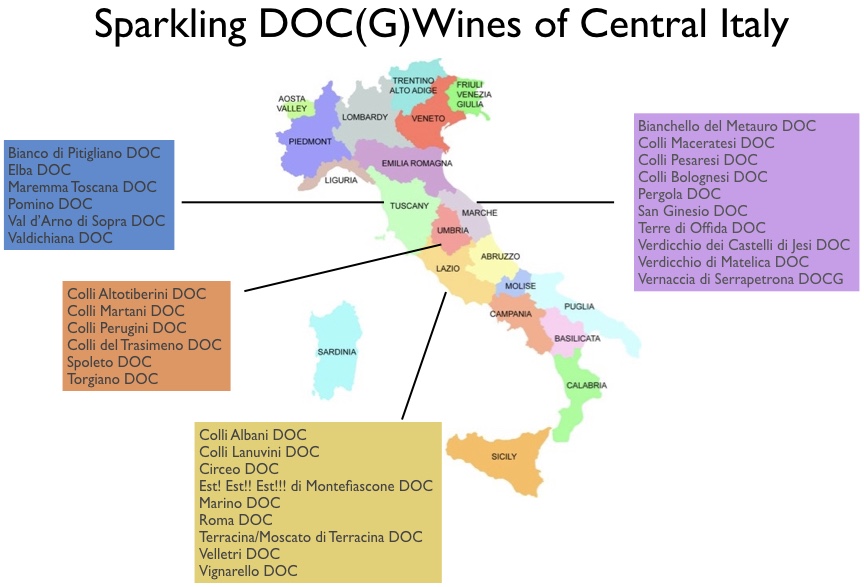

There is only one DOCG sparkling wine in Central Italy and no single sparkling wine standout on the order of Franciacorta or Alta Langa, for example.

A large part of the disparity in sparkling wines between North and Central Italy is locational. The more northerly regions are colder and produce crisper wines that are more conducive to sparkling wine consumption. Central Italy, on the other hand, has more of a Mediterranean climate -- and riper grapes -- over large parts of its surface area. In order to attain the acidity that is so integral to quality sparkling wine grapes, Central Italy producers have to source the grapes from higher-altitude vineyards.

The table below shows the wine varieties utilized in the production of Central Italy sparkling wines. A total of 99 varieties were employed in Northern Italy while 39 are utilized in Central Italy. Outside of the international cultivars, the most common varieties used across the Central Italy regions were Grechetto, Malvasia, and Trebbiano.


I now turn to a description of the sparkling wines in each of the Central Italy regions.

Toscana
As aptly described on tripadvisor.com, "The achingly beautiful Tuscany region of Italy is a touchstone of art, food, and culture. Made up of stunning countrysides and distinguished cities, Tuscany is the perfect escape for gastronomes, cognoscenti, and fans of the Italian Renaissance." The characteristic Tuscan landscape is a blend of gently rolling hills (66.5% of the region's 22,985 sq. km) leading to steep-peaked mountains (25%) and plains (8.5%).

But Tuscany is also a wine powerhouse, ranking sixth among Italian regions in overall wine production and third in terms of DOP wine production. It is renowned for its red wines with Sangiovese ruling the roost in Chianti, Montalcino and Montepulciano, and Bordeaux varietals prominent in the Maremma region (especially Bolgheri and Suvereto) as well as having some presence in Chianti and Montalcino.

Climate and soil composition in Tuscany is location-dependent. For example, Chianti-based producers operate in a continental climate with galestro and albarese soils while their coastal counterparts operate in temperate climates with stone- and rock-imbued clay soils.

Tuscany's focus on Sangiovese and red wines is reflected in the relative paucity of sparkling wines in the region. As shown in the following chart, a total of six DOCs offer approximately 11 labels to the market.


The Pomino DOC is Metodo-Classico-only. Four of the remaining sparkling DOCs are Charmat while sparkling wines made in the Maremma Toscana DOC could utilize either the Charmat or Metodo Classico processes.

The dominant variety used in these sparkling wines is Trebbiano Toscana; Pomino DOC (Metodo Classico) makes use of the classic Italian version of the Champagne varieties (Chardonnay, Pinot Bianco, Pinot Nero).

Toscana sparkling wines live in the deep, dark shadows of their red, still counterparts. There are no indications that this will change anytime soon.

Umbria
Umbria lies in the cultural and vinous shadows of its northwestern neighbor Tuscany but is renowned in its own right for its lush, rolling hills, its hilltop villages (Assisi, Perugia, Orvieto, Spoleto, Todi, Spello, Gubbio), and unique historic towns.

Umbria's main business activity is agriculture, with olive oil, truffles, sunflowers, and wine grapes as the primary offerings.

The Umbrian climate is continental; cold, rainy winters and dry summers. This climate is modified by the waters of Lake Trasimeno in the area west of Perugia.

Geologic processes through the ages have resulted in the following soils distribution in Umbria:
  • Alluvial sediments and debris along major river valleys
  • Gravels, sands, and clays deposited during the Pliocene and early Pleistocene
  • Marly deposits during the Oligocene - Miocene
  • Stratigraphic Umbria-Marche deposits from the Jurassic-Miocene
  • In the southwest, volcanic deposits from the eruptions of the Vulsino volcano.
As shown in the chart below, Umbria has six sparkling wine DOCs distributed over its surface area.


A few observations:
  • None of the major Umbria DOC/DOCGs (Sagrantino de Montefalco DOCG, Torgiano Rosso Riserva DOCG, and Orvieto DOC) produce any sparkling wine
  • A small number of varieties (six) have been formally designated by name for the production of sparkling wine. Only Valle d'Aosta (one) and Liguria (three) have fewer identified sparkling-wine-designated varieties
  • A preponderance of the international varieties have been designated as raw material for sparkling wine production in Umbria. Only Spoleto DOC -- of the six sparkling wine DOCs identified in the chart above -- does not specify, by name, one of the international varieties for use in the production of its sparkling wine.
  • Three of the sparkling wine DOCs are located in the north of the region, one in the middle, and two in the south.
  • Two Metodo-Classico-only DOCs and one Charmat-only DOC. The remaining four DOCs allow a mix of both production methods
  • The Spoleto DOC wine could have been designated a varietal sparkling wine.

Le Marche
The rugged environment of Le Marche provides a landscape that is less suitable for agricultural pursuits than is the case in neighboring Tuscany, Umbria, and Abruzzo, for example. The Apennine range forms the internal border of the region and descends almost to the Adriatic Sea, with arable land and living spaces confined to the river valleys and the coastline. The climate in the region is temperate, with a continental feel inland and Mediterranean along the coast.

At 878,000 hl of wine produced in 2018, Le Marche ranked 13th among Italian regions. Its calcareous soils provide optimal residence for Sangiovese, Trebbiano, Verdicchio, and Montelpuciano, among other varieties.

Given the length of its coastline, seafood is a key part of the Marchian diet. And the diet elevates the importance of white wine in the region, with the Verdecchios from Castelli di Jesi and Matelica having pride of place. Wine from the Pecorino grape is also growing in stature.

Below is a map of the sparkling wines of Le Marche.


Some observations:
  • Most of these wines are, given their 85% minimums, in effect, varietal sparkling wines
  • Most of the wines are made from indigenous rather than international varieties. The varieties of note are Aleatico, Biancame, Verdicchio, Maceratino, Passerina, and Vernaccia Nera
  • Most DOCs allow both Metodo Classico and Charmat production
  • A total of three red sparkling wines are produced in the region: Pergola DOC Spumante; San Ginesio DOC Spumante; and Vernaccia di Serrapetrona DOC Spumante.
Now let us turn to some of the most noteworthy sparkling wines from the region.

Vernaccia di Serrapetrona DOCG
This wine has been described as an "idiosyncratic sparkling red wine produced from the local Vernaccia Nera." This territory was granted DOC status in 1971 and elevated to DOCG in 2003. It is one of the smallest classified zones in Italy with only 20 ha of vineyards and 5000 cases produced. Vineyards must be sited between 450 and 600 m elevation.

Other than the fact that it is a sparkling red wine, Vernaccia di Serrapetrona is also unique in its production method: three fermentations. The first fermentation involves up to 60% of the handpicked grapes. The remaining 40% is dried on straw mats and added to the wine in the following January for the second fermentation. After resting for a few months, the wine is placed into pressurized containers where it is fermented using the Charmat method.

The result of this process is "an intensely aromatic wine displaying a raspberry red color, aromas of strawberries and cranberries, a hint of spice, firm tannins and bright acidity,"

Verdicchio dei Castelli di Jesi DOC and Verdecchio di Matelica DOC
These are the two DOCs that are the temples to Verdicchio, with the former being more revered than the latter. The sparkling wines from both regions require a minimum of 85% of the Verdicchio grape and can be made using either the Metodo Classico or Charmat methods.

The grapes for Verdicchio dei Castelli di Jesi are grown in the hilly areas around the town of Jesi, an area endowed with calcareous clay and limestone-rich soils. The area is blessed with a relatively dry maritime climate with persistent gentle onshore (morning) and offshore (afternoon) winds providing defenses against fungal diseases such as grey rot and mildew.

The Verdicchio di Matelica vineyards are located further inland in more of a continental climate but with soils akin to its compatriot. Vineyard orientation in Matelica is east-to-west, a situation unique to that DOC. A total of 740 ha of vineyards are planted at 400m - 500m elevation.

In his Forbes article on Italian sparkling wines, Tom Hyland identified the Colonnara Tradition Brut as one of the best examples of Verdicchio sparkling wine that he has tasted. The wine, he says, "... offers subdued herbal notes in the finish, along with bright pear and melon fruit."

In that same article, Hyland spoke favorably of a number of Verdicchio/Chardonnay cuvées:
  • Poderi Mattioli Dosaggio Zero -- vintage-dated blend that is aged 48 months on its lees
  • Umani-Ronchi Extra Brut millesimato -- 65% Verdicchio, 35% Chardonnay
  • Umani-Ronchi La Hoz -- 80% Verdicchio, 20% Chardonnay. The Verdicchio is aged in steel while the Chardonnay is aged in mid-sized oak barrels. The wines are aged on lees for 48 months.
Lazio
Lazio is comprised of mountains (26.1%), hills (54%), and plains (19.9%) and is, according to Vinous' Ian D'Agata, uniquely suited to viticulture:
  • Mild climate
  • Rich and varied geological mix of soils (well-drained volcanic soils prevalent)
  • Marine breezes
  • Adequate rainfall
  • Pronounced diurnal temperature shifts
  • Plethora of high-quality native grape varieties.
But, until recently, the region has only been known for light white wines suited to immediate consumption. Quality-focused winemakers have, within the last two decades, sought to improve the image of the wines by pursuing a lighter, crisper style. The main grape varieties planted in the region are Malvasia (30%) and Trebbiano (28%).

The chart below shows the DOC regions which specify requirements for the production of sparkling wines within their appellations.


Some observations:
  • Nine of the 30 DOC(G) regions have specifications for the production of sparkling wine
  • There is only one case (Circeo DOC and Chardonnay) where an international variety is included in the specifications; otherwise, all indigenous varieties 
  • There is some clustering of production in the regions to the southeast of Rome
  • For the most part, the specifications do not call for dominant-variety blends
  • The Trebbiano variety is the most widely utilized variety in Lazio sparkling wines.
In future posts I will move on to the sparkling wines of Southern Italy.

©Wine -- Mise en abyme

Wednesday, March 18, 2020

An overview of the sparkling wines of Northern Italy

Over the last few months I have been engaged in a project to map all of the DOC(G) sparkling wines of Italy. To date I have published posts on the sparkling wines of 12 of the 20 Italian regions. I have decided to pause at this time and take a look back at the grouping of wines that fall into the regions comprising Northern Italy.

The map below captures all of the DOC(G) wine zones in Northern Italy. Sparkling wine zones in Northern Italy range from one in Valle d'Aosta to 25 in Veneto. Most of the zones are DOC with a total of 14 DOCG zones. Piemonte and Veneto have the greatest number of DOCG sparkling wine zones with six and five, respectively.


The spreadsheet below shows the grape varieties used in sparkling wines segmented by region. A total of 99 varieties are employed in sparkling wine production in Northern Italy, ranging from a low of one in Valle d'Aosta to 49 in Emilia Romagna. The average is 12.375 varieties per region.


International varieties are the most broadly distributed across the regions with Chardonnay, Pinot Bianco, Pinot Nero, and Pinot Grigio each being used in six of the eight regions and Merlot in five. This fact highlights the fact that producers largely utilize regional indigenous varieties in making sparkling wines in their individual regions.

Following is a brief summary of the sparkling wines of each of the Northern Italian regions.

Piemonte Sparkling Wines
While the region is best known for its Nebbiolo grapes, and the resulting Barolo and Barbaresco wines, the below map shows that many of the appellations provide frameworks for the production of sparkling wine.


In most of the cases, the dominant DOC variety serves as the source material. If the producer does desire to do so, he/she could also utilize the much more forgiving Piemonte DOC for sparkling wine production. The map shows the designation under which sparkling wine is produced in each region and specifies the mix of allowed varieties and their relative proportions. The map also illustrates which wines are made via the Charmat Method and which use the traditional Champagne Method.

Asti DOCG is by far the largest sparkling wine appellation in Piemonte with 9700 ha under vine in 52 municipalities stretching across the provinces of Alessandria, Asti, and Cuneo. Most Asti production is via the Charmat method but, as the map shows, there is a designation for Asti Metodo Classico. The Moscato Bianco grape is used as the raw material for the Asti wine.

Alta Langa -- DOC in 2002, DOCG in 2011 -- is the new kid on the sparkling-wine block but the combination of its terroir, traditional Champagne varieties, traditional production method, skilled growers, and savvy producers bode well for the future. The Alta Langa DOCG is spread over 142 communes in the provinces of Alessandria, Asti, and Cuneo. Given the geographic scope of the region, one encounters a variety of climates, exposures, elevations and soil types. In general, the soil is a mildly fertile calcareous clay marl.

Vineyards are required to be planted at 250 m and above on the region's steep, terraced hillsides. Allowed varieties are Pinot Noir and Chardonnay and other non-aromatic grapes. Planting density is a minimum of 4000 vines/ha with the vines trained using the low espalier system and pruned traditional Guyot and spurred cordon. The maximum allowed yield is 11,000 kg/ha.

The Alta Langa producers -- 27 currently -- do not grow enough fruit to meet their needs but that gap is bridged with fruit from 80 growers who own their land and are guaranteed producer-payment for their grapes and labor.

Trentino-Alto Adige Sparkling Wines
The map below shows the sparkling wine regions of Trentino-Alto Adige.


Alto Adige DOC
I have written about the broader Alto Adige DOC elsewhere.

According to suedtirolersekt.it, "As a result of its overall climatic conditions, the abundance of microclimates, and the composition of the soils between the Alpine mountain landscape and Mediterranean valley soils, Alto Adige is virtually ideal for the production of sparkling wines." The key characteristics (as identified by the source) are as follows:
  • Locations from 500 to 1000 m
  • Abundant sun during the day
  • Cool temperatures during the night
  • Warm soils rich in minerals
  • Base wine varieties (Pinot Blanc, Pinot Noir, Chardonnay) with an affinity for the characteristic soils.
Trento DOC
Trento DOC is the specific appellation for sparkling wine produced in the Trento portion of Trento-Alto Adige. As is the case in Alto Adige, the wine is made using the Metodo Classico.

According to Kerin O'Keefe, the sparkling wines of this region show "pronounced aromatics, elegance, and bright acidity." Two producers that she recommends are Ferrari (2010 Perlé Nero Extra Brut Riserva) and Rotari (2011 Flavio Brut Riserva).

Approximately 7,500,000 bottles of sparkling wine are produced in this region annually.

Delle Venezie DOC
This region specializes in the production of Pinot Grigio in an area spanning the totality of Friuli-Venezia Guilia, Veneto, and the Trento province of the autonomous Trento-Alto Adige region. The raisons d'etre of this expansive region are (i) proximity and (ii) pedi-climatic affinity. The wide plain between the Adriatic Sea and the Po River has been "developed over centuries by deposition of both calcareous and coarse material and gravel and sand" and also has good drainage capability.

The proximity to the Alps results in a cool and windy climate which contributes to high acid retention in the grapes, a characteristic of the wines. Water is limited but is sufficient for a regular ripening of the grapes.

The sparkling wines must be tank-fermented and must contain no more than 32 g/L of residual sugar.

Friuli-Venezia Giulia Sparkling Wines
Friuli-Venezia Giulia, the most north-eastern of the Italian wine regions, is bounded by Austria to the north, the Gulf of Trieste to the South, Slovenia to the east, and the wine region of Veneto to the west. The region's location, as well as its history, has endowed it with a richness of diverse cultural influences.


Prosecco DOC
The Prosecco DOC was first awarded in 1969 and was restricted to wines produced in the Conegliano-Valdiobbadene region.  Growers felt that the brand was under attack by "imitators" using just the grape variety and moved to isolate those competitors by changing both the rules and the venue of the game.  Prosecco growers agitated for, and gained regulatory acceptance of: (i) extension of the Prosecco DOC to cover all of Friuli-Venezia-Giulia and approximately two-thirds of Veneto; (ii) promotion of the original Prosecco DOC to DOCG status; (iii) changing the name of the source grape from Prosecco to Glera; and (iv) restricting the use of the name Prosecco only to Glera sparkling wines produced within the delimited zones.  The growers felt that these actions would serve to protect their territory, the brand, and the quality of Prosecco.  The regulations authorizing these actions came into law in 2009.

Prosecco is primarily made from the Glera (formerly Prosecco; also known as Prosecco Bianco and Proseko Sciprina) grape variety, a native of northeast Italy which has been used to produce wines since Roman times.  This late-ripening, thick-skinned variety has greenish-yellow berries which evolve to a yellow-gold color as the grapes ripen.  The grapes are high in acid and have a white peach aromatic profile, qualities which render them eminently suitable for the production of sparkling wines.

In addition to Glera, Prosecco wines can contain as much as 15% of other grape varieties.  The most oft-used supplements are Verdiso, Branchetta, Perera, Glera Lunga, Pinot Bianco, Pinot Noir, Pinot Grigio, and Chardonnay.

Prosecco DOC wines are authorized for production in Friuli-Venezia-Giulia and Veneto (provinces of Treviso, Belluna, Padova, Venezia, and Vicenzia).  Within the broader Prosecco DOC, there are two sub-zones: DOC Treviso Prosecco and Prosecco di Trieste. These sub-zones cover Prosecco made within these two provinces and wines made therein can so indicate on their labels.  Prosecco wines made in other provinces cannot carry the province name on the labels.

Valle d'Aosta Sparkling Wine
Valle d'Aosta (Vallée d"Aoste in French), is a semi-autonomous region in northwest Italy which is bounded to the north, west, and south by the Alps and shares borders with both France and Switzerland.


DOC sparkling wine production is only allowed in the Morgex and La Salle subzone and, as such, is made from 100% Prié Blanc. Hundreds of tiny old vineyard plot -- a total of 70 ha -- dot the two communes and provide fruit to the five growers and the Coop.

Two of the most notable sparkling wine producers in the region are Caves Mont Blanc and Ermes Pavese. Caves Mont Blanc is a Coop that controls 18 ha through its 80 grower-owners. It is the foremost producer of Blanc de Morgex et de La Salle. It produces a Brut and Extra Brut with the difference being a 15-month bottle aging for the former and 17 months of the latter. Ermes Pavese produces between 700 and 1200 bottles of its zero dosage sparkler only in riper years. According to Madrose, this sparkling wine is "as unusual as it is delicious, ... at once rich and quite dry, speaking clearly of its Alpine origin, with delicate smokiness and lemon curd on the nose and full earthy minerality on the palate."

These are small-production wines that are difficult to obtain outside the market.

Lombardia Sparkling Wines
As shown in the chart below, there are eight DOC(G) sparkling wine appellations in Lombardia.


Two of these appellations (Franciacorta DOCG and Oltrepò Pavese Metodo Classico) are (i) sparkling-wine specific and (ii) utilize the Champagne method in the production process. In addition, Oltrepò Pavese DOC and Sangue di Giuda DOC are Charmat, with the remaining appellations accomodating either the Charmat or Metodo Classico methods.

With the exception of Riviera del Garda Classico DOC and Sangue di Giuda DOC, all appellations provide for a white sparkling wine. With the exception of Lugana DOC, Sangue di Giuda DOC, and Terre del Colleoni, all regions provide for the production of a Rosé. With the exception of Franciacorta, Lugana, and Riviera del Garda Classico, all regions allow for the production of varietal sparkling wines. Sangue di Giuda DOC is the only region that specifies a red sweet sparkling wine.

Franciacorta, Oltrepò Pavese Metodo Classico, and Terre del Colleoni allow for the production of vintage-dated sparklers while, in addition, Franciacorta and Oltrepò Pavese Metodo Classico allow for production of Riservas. Vintage-dated and Riserva sparkling wines are required to spend more time on the lees.

A total of 25 varieties are authorized for sparkling wine production across the region; many of these varieties are utilized in one or two applications. The almost ubiquitous varieties are Chardonnay, Pinot Noir, Pinot Banco, and Pinot Grigio.

Veneto Sparkling Wines
Veneto is the ancestral home of Prosecco, the Italian sparkler of the day, but it is also home to wide range of other, mostly unheralded sparkling wines.

The two charts following map the distribution of sparkling wines in Veneto. Of 14 DOCGs, five produce sparkling wines (and three of those are sweet); of 29 DOCs, 20 produce one or more sparkling wines.


There are two sparkling-wine-only appellations: Lissini Durello and Vigneti della Serenissima DOCs. The dominant method of sparkling-wine production is Charmat. A total of four appellations are shared with neighboring regions: Garda and Lugana DOCs with Lombardia; Prosecco DOC with Friuli-Venezia Giulia; and Delle Venezie DOC with Trento and Friuli-Venezia Giulia.

Emilia-Romagna Sparkling Wines
With 136,000 acres under vine, Emilia-Romagna is the second-largest wine-producing region in Italy after Veneto. The largest wine-producing areas in the region are found in the alluvial plains but the wines from the foothills are attracting attention.


Of the 21 official Emilia-Romagna appellations (2 DOCGs, 19 DOCs), 10 (one DOCG and nine DOCs) provide at least one label under which sparkling wine can be produced. In a number of cases -- Colli di Parma DOC and Colli Piacentini DOC, for example -- the availability of varietal-specific labels provides the producer with the potential to offer between four and six separate sparkling wines.

The biggest concentration of sparkling wine production occurs in the area between Reggio Emilio in the northwest and Bologna, with the Lambrusco zone around Modena serving as the beating heart of this geographic range.

In terms of production methods, 10 of the available labels are Charmat-only while two follow the Champenoise method. All of the other labels allow for the use of both methods based on the producer's preference.

Liguria Sparkling Wines
As shown in the chart below, sparkling wine is produced in the Val Polcèvera and Golfo del Tigullio - Portofino DOCs.


In both of these DOCs, Bianchetto Genovese and Vermentino are featured players while a variety called Albarola is additionally given prominence in Val Polcèvera DOC. It should be noted that a 2009 DNA study has concluded that Albarola and Bianchetto Genovese are genetically identical.

Abissi Sparkling Wine
Bisson Winery has been aging its Metodo Classico wines in 60 meters of water off the coast of Portofino since 2005. The wines -- there are three of them: Spumante Classico, Spumante Riserva, and Spumante Rosé -- are fermented traditionally to produce the base wines and are then bottled and lowered into the sea in July so that the second fermentation can be completed in the anaerobic conditions below the surface of the water.

The Spumante Classico and Riserva are blends of Bianchetto Genovese, Vermentino, and a third cultivar called Cimixià. The Rosé is a blend of Granaccia and Ciliegiolo.

The innovative method of aging is the brainchild of Pierluigi Lugano, the enterprise's winemaker. "When the wine bottles are picked up, they are enriched with incrustations (sic), seaweeds (and sometimes shellfishes, too) ... For health and sanitary reasons, bottles are then dried and wrapped under a protective, clear film, which also serves the purpose of preserving the natural ornament made by the sea,"

©Wine -- Mise en abyme

Monday, March 16, 2020

The "Cutting Edge" of Spanish Wine: Bodegas Mustiguillo Finca Terrerazo 2015

Spanish winemakers, beginning in the 1980's, began to focus on the more powerful, fruity wines that the market was rewarding. That is no longer the case, according to Pedro Ballesteros Torres, with the latest trends being:
  • Diversification and re-creation in Rioja and Jerez
  • New, emergent wine regions dislodging former leading lights
  • Grape varieties other than Tempranillo competing in the market place
  • An impressive range and quality of white wines
  • An emphasis on authenticity, freshness, and balance
  • Organic and biodynamic vineyards. 
Wines from Spain has identified eight wines that it sees as being at the vanguard of this movement: Tajinaste Blanco 2018, Quinta da Muradella Blanco 2015, Edetària Selecció Blanc Vinyes Velles 2016, Conde de los Andes Rioja Blanco 2016, Guimaro Finca Meixemann 2017, AN/2 by Anima Negra 2017, Bodegas Mustiguillo Finca Terrerazo 2015, and Parés Baltà Hisenda Miret 2017.  In this post I will cover the Bodegas Mustiguillo Finca Terrerazo 2015.

The Vineyard
Bodegas Mustiguillo Finca Terrerazo is made from Bobol grapes sourced from El Terrarazo, the estate's single-vineyard site. El Terrarazo was granted Vino de Pago status -- the highest level in the Spanish appellation system -- in 2010.

Spanish wine appellation system
(Source:https://www.winescholarguild.org/)

Vino de Pago requirements are as follows:
  • The site must be a single vineyard
  • The vineyard must be owned by the estate producing the wine
  • The vineyard must fall within a registered DO
  • The vineyard must demonstrate unique characteristics that make it worthy of accessing that status
El Terrerazo is one of 19 Vino de Pagos and the first in the Communidad Valenciana. Its geographic location is indicated by the two red circles in the map below and its characteristics in the chart immediately following.


As would be expected of a "vanguard-wine" estate, Bodegas Mustiguillo ticks a number of boxes in terms of the Spanish wine trends identified by Pedro Ballesteros Torres:
  • New emergent wine region (Utiel-Requena)
  • Grape varieties beyond Tempranillo (Bobol)
  • Organic and biodynamic vineyards (Organic)
  • Winemaking emphasis on authenticity, freshness and balance (Bobol; move away from American oak in earlier vintages to French oak for more recent ones).
As regards farming practices, El Terrarazo is certified organic, employing cover crops such as mustard, radish, legumes, and Mediterranean spices between rows. The Gobelet-trained vines are not irrigated.

The Bobal Cultivar
Bobal is a red variety indigenous to the Utiel-Requena region of Valencia. It is the second most planted red grape variety in Spain and, while traditionally used as a bulk wine, has recently been gaining serious attention as the basis for quality wines.

The vine is vigorous and productive, with long, trailing shoots which are normally trained as a low bush. Being of the region, it is resistant to extremes of weather and disease.

The branches are medium-large and compact with an angular cone shape. The must is high in colorant, tannins, and polyphenols while the finished wine tends to be fruity, low in alcohol, and high in acid.

Winemaking and the Wine
The grapes are hand-harvested and placed into 15-kg boxes (The first-order selection occurs here). The selected grapes are transported to the cellar where they are de-stemmed and sorted prior to a gentle crushing. Wines from each parcel are fermented in separate 35 Hl or 50 Hl French oak tanks using house yeasts. Fermentation -- with gentle punch-downs -- occurs over a 9-day period followed by an 11-day post-fermentation maceration, followed, in turn, by a 5 - 8 week malolactic fermentation with batonnage.

The wine is aged for 14 months in a mix of small (225 L and 550 L) and large (30 Hl and 50 Hl) French oak barrels after which they are blended and bottled without stabilization or filtration.


Notes: Waxy, red fruit, perfumed, and a resin character on the nose. Black/red fruit on the palate. Flat and non-complex. Soft tannins.


©Wine -- Mise en abyme

Thursday, March 5, 2020

The DOC sparkling wines of Italy's Lazio region

Lazio, the second most populous (5.9 million people) and second largest economy (170 Billion Euro GDP) of Italy's 20 regions, boasts Rome -- Italy's largest city -- as its capital, the same role it fulfills for the country as a whole. Rome is the center of Italian political -- seat of Government and Parliament -- and religious -- home of the Vatican -- life.

The economy of Lazio spans agriculture (wine grapes, fruits, vegetables, olives), craft, animal husbandry, fishing, and a limited industrial sector but fully 73% of its working population is employed in the services sector supporting government offices and corporate HQs. Tourism associated with the Roman and Etruscan (along the Northern Tuscany border) civilizations is also an important contributor to the economy of the region.

Lazio is comprised of mountains (26.1%), hills (54%), and plains (19.9%) and is, according to Vinous' Ian D'Agata, uniquely suited to viticulture:
  • Mild climate
  • Rich and varied geological mix of soils (well-drained volcanic soils prevalent)
  • Marine breezes
  • Adequate rainfall
  • Pronounced diurnal temperature shifts
  • Plethora of high-quality native grape varieties.
But, until recently, the region has only been known for light white wines suited to immediate consumption. Quality-focused winemakers have, within the last two decades, sought to improve the image of the wines by pursuing a lighter, crisper style. The main grape varieties planted in the region are Malvasia (30%) and Trebbiano (28%).

The chart below shows the DOC regions which specify requirements for the production of sparkling wines within their appellations.


Some observations:
  • Nine of the 30 DOC(G) regions have specifications for the production of sparkling wine
  • There is only one case (Circeo DOC and Chardonnay) where an international variety is included in the specifications; otherwise, all indigenous varieties 
  • There is some clustering of production in the regions to the southeast of Rome
  • For the most part, the specifications do not call for dominant-variety blends
  • The Trebbiano variety is the most widely utilized variety in Lazio sparkling wines.

©Wine -- Mise en abyme

Tuesday, March 3, 2020

Anima Negra's AN/2 2017 (VT Mallorca): A Wines from Spain Vinos de Vanguardia

The Balearic Islands, the autonomous division of Spain located off its east coast, are, due to their excellent climate, sandy beaches, and natural beauty, one of Europe's most popular holiday destinations.

The Balearic Islands (Source: Wikipedia)

But wines are also made there, with Mallorca, the largest of the islands, the source of one of the Cutting Edge Wines so designated by Wines from Spain. I report on that wine --AN/2 -- in this post.

Winemaking in the Balearic Islands has a very long history, a history which was upended, as was the case for many in Europe, by the onset of the Phylloxera debacle. The ravages of the French vineyards meant that they had to look to other sources for fruit; and grape-growing in the Balearics expanded rapidly to meet this new demand. Balearic Island vineyards were decimated when the louse made landfall in the islands in 1891, causing a widespread shift to non-vine agricultural crops among the growers.

Even the resolution of the phylloxera issue did not result in a return to grape-growing in the Balearics; instead, grapes were grown only for local consumption. In the 1990s, however, a number of local winemakers decided to improve the quality of wine produced in the islands (Catavino) and, in furtherance of that goal: planted international varieties to complement the local varieties; enhanced irrigation systems; and introduced stainless steel and oak barrels for fermentation and aging.

Grapes are grown on all three of the Balearic Islands but the most vinously significant is Mallorca. The chart below shows the distribution of appellations among the islands and illustrates that the only regional DOs are in Mallorca.


Of relevance, given the wine that we are evaluating, is the fact that VT Mallorca covers wine made at any place on the island.

The map below shows the location of Anima Negra, the producer of AN/2, just outside the town of Felinatx.


The winery was founded in 1994 by Pere Obrador and Miguelàngel Cerdá. It currently owns 70 ha of vineyards and controls the fruit from 30 ha of old vines owned by local growers. These dry-farmed vineyards adhere to biodynamic practices.

AN/2 is a blend of old-vine Callet (65%), Mantonegra-Fogoneu (20%), and Syrah (15%). The grapes were manually harvested and placed into 10-kg boxes fro transport to the winery where they were manually and optically selected on the sorting table.

The grapes were fermented by indigenous yeasts in stainless steel tanks and then macerated for 17 days. Post-maceration, the wine was transferred to barrels (80% French barriques, 20% American oak) for a year's worth of aging (The barrels are 35% new, with the remainder being between one and three vintages old.). The wine is then aged for an additional 6 months in bottle before release onto the market.


The 2017 wine showed red fruit, spice, baking spice and a tree-bark, resinated character on the nose. Broad and unfocused. Easy-drinking on the palate. Simple. Fruity and brambly. The least favorite of the wines I tasted on this day.

©Wine -- Mise en abyme

Wednesday, February 26, 2020

Trailblazer and Evangelist: Marco Caprai and Sagrantino di Montefalco

The Sagrantino grape has a history in its native Montefalco that stretches back 400 years but that extended history did not translate to renown. That is, until Marco Caprai appeared and, by dint of his industry and collaborative efforts, propelled the wine and the region into the foreground in Umbria and Italy, and into the minds and hearts of consumers worldwide. Caprai came to West Palm Wines (WPW) in Tampa recently to share his journey and a selection of his wines.

Marco Caprai

Marco is currently the Managing Director of Armando Caprai, wine venture of the industrial group of the same name. His father, Armando, bought a 2-ha property in Umbria  in 1971 and began making wine. Marco studied Political Science in school but, at the age of 21, it was time for him to join the family business. As he said, rather than go into the fashion or textile arms of the business, he opted to manage the winery, beginning that effort in 1988.

Soon after taking charge of the estate, Marco set his sights on establishing the flailing Sagrantino as the foundational wine of the region. He collaborated with the University of Milan to launch the Sagrantino Project in 1989 and, after intensive studies and experimentation, and gaining the support and cooperation of other regional players, he attained the successes manifested in the wine and the region of today.

The Sagrantino grape was introduced into the area in the 15th century by Franciscan monks who used it for liturgical purposes. The grape is famously rich in polyphenols, resulting in a wine with a deep purple color, full body, structure, and with a capacity for long life.

The Region
The grape can be found in both DOC and DOCG wines. The map below shows the location of the DOC region (granted in 1979 and covering parts of the municipalities of Bevagna, Giano dell'Umbria, Gualdo Cattaneo, Castel Ritaldi, and all of the municipality of Montefalco) and the DOCG region (granted in 1992 and with similar distribution as the DOC region). The DOC and DOCG regions are shown in the heart of the map, within the broader Colli Martani region.

Source: kasteelwijnen.com

The area has a continental climate with average annual rainfall of 700 mm. The gently sloping hills that are a feature of the growing area support vineyards at elevations ranging between 220 m and 472 m a.s.l. Aspects are varied, resulting in a range of micro-climates.

The DOC wines are a Blanco (Grechetto -- min 50%; Trebbiano Toscano -- 20 - 35%; and Trebbiano Spoletino -- 0 - 30%) and a Rosso (Sagrantino -- 10 - 15%; Sangiovese -- 60 - 70%; and other red grapes -- 15 - 30%).The DOCG wines are made from 100% Sagrantino grapes  and can be either dry or Passito. The grapes for these wines have a limited production and are characterized by small bunches, thick skins, and high polyphenol content.

The characteristics of the grape allows for partial drying (as in the case of the passito wine) and long aging. In the case of the passito wine, the grapes are carefully selected and left out to dry for approximately two months after which they are pressed and the must fermented with the skins.

As regards the DOCG wines, yields for the dry wine are 52 hl/ha and 28 hl/ha for the passito. Both wines must be aged for a minimum of 33 months, with a further requirement of minimum 4 months bottle aging. The dry wine must be resident in oak for a minimum of 12 months. The DOC wine requires 12 months aging.

The Vineyards
Marco had by this time increased the family's vineyard holdings from the original 2 ha to 149.7 ha, 89 of which was planted to vine. The farm is cultivated sustainably with grass planted between rows, limitations on the use of pesticides, CO2-emission monitoring, vineyard biodiversity, and adherence to sustainable social and environmental practices.

The Wines
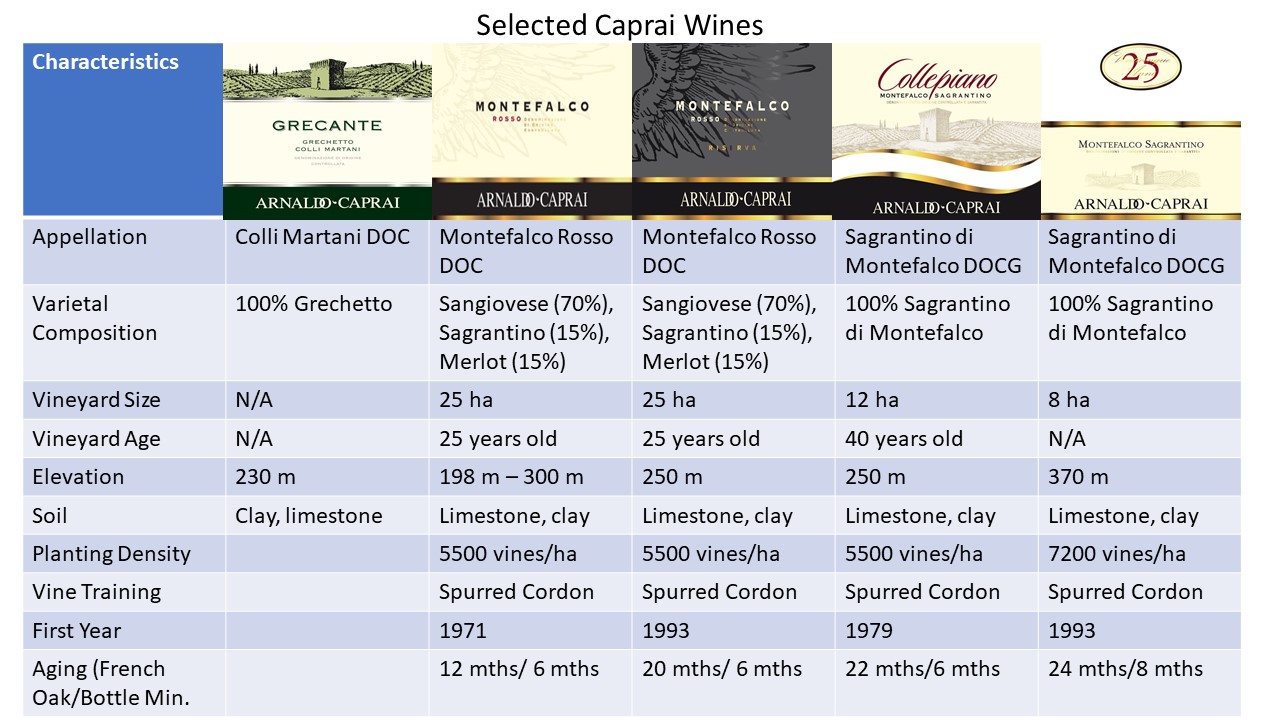
The chart below shows the wines we tasted at the WPW event, the sources of the grapes, and the aging method for each.


We tasted the 2018 Grechetto Grecante as we milled around the bar. The wine was perfumed, floral, waxy and with yellow fruit on the nose. Herbs, a bitterness, textured and mineral on the palate. The minerality and texture combined to restrain the fruit flavors. Interesting mix of acidity, bitterness, and minerality. Textural intensity diminished with time.

The 2015 Montefalco Rosso showed herbs and violets on the nose, along with a slight nuttiness. Red fruits, medium body, and a peppery finish. The Riserva version of this wine had more of an obvious barrel note on the nose as well as shoe polish, spice, and sweet red fruit. Bright on the palate. Rich red fruit. Medium-bodied. Spicy, long, herby, mineral finish.

Sweet dark fruit and spice were the characteristics that I noted for the nose of the 2013 Sagrantino Collepiano. Smooth and round on the palate. Not as intense and structured as the 2008 we had sampled offline at the bar. Pleasant, rich, and open.

The final wine in the lineup was the 2013 Sagrantino 25 Anni. The initial bottling of this wine -- 1993 -- was a commemoration of the winery's 25th anniversary. The wine was the result of "in-depth research and careful clonal selection of Sagrantino's best grapes" and was awarded Gambero Rosso's Tre Biccheri upon release. The version that we tasted showed deep red fruit and a beautiful bouquet on the nose. Concentrated, with a hint of match flint, vanilla, baking spices, and mango. Structured dark fruit on the palate along with pepper, herbs, and good acid levels. Persistence of pepper gives way to texture. Long, spicy, bitter finish.

********************************************************************************************************
I have visited the Paolo Bea estate in Montefalco and am a fan of his wines. Caprai wines stand in stark contrast to the Paolo Bea wines in that they have a more modern feel. The key here is the difference in winemaking between the two estates.The Caprai wines are aged for up to two years in French oak barriques and then up to an additional 6 months in bottle. Paolo Bea red wines, on the other hand, are aged for 1 year in stainless steel, 2 years in 20- to 30-hl oaken barrels, and then an additional 2 to 4 years in bottle.

Both wines are reflective of their winemakers' visions.

©Wine -- Mise en abyme

Saturday, February 22, 2020

Mapping the DOC sparkling wines of Le Marche (Italy)

The rugged environment of Le Marche provides a landscape that is less suitable for agricultural pursuits than is the case in neighboring Tuscany, Umbria, and Abruzzo, for example. The Apennine range forms the internal border of the region and descends almost to the Adriatic Sea, with arable land and living spaces confined to the river valleys and the coastline. The climate in the region is temperate, with a continental feel inland and Mediterranean along the coast.

At 878,000 hl of wine produced in 2018, Le Marche ranked 13th among Italian regions. Its calcareous soils provide optimal residence for Sangiovese, Trebbiano, Verdicchio, and Montelpuciano, among other varieties.

Given the length of its coastline, seafood is a key part of the Marchian diet. And the diet elevates the importance of white wine in the region, with the Verdecchios from Castelli di Jesi and Matelica having pride of place. Wine from the Pecorino grape is also growing in stature.

Below is a map of the sparkling wines of Le Marche.


Some observations:
  • Most of these wines are, given their 85% minimums, in effect, varietal sparkling wines
  • Most of the wines are made from indigenous rather than international varieties. The varieties of note are Aleatico, Biancame, Verdicchio, Maceratino, Passerina, and Vernaccia Nera
  • Most DOCs allow both Metodo Classico and Charmat production
  • A total of three red sparkling wines are produced in the region: Pergola DOC Spumante; San Ginesio DOC Spumante; and Vernaccia di Serrapetrona DOC Spumante.
Now let us turn to some of the most noteworthy sparkling wines from the region.

Vernaccia di Serrapetrona DOCG
This wine has been described as an "idiosyncratic sparkling red wine produced from the local Vernaccia Nera." This territory was granted DOC status in 1971 and elevated to DOCG in 2003. It is one of the smallest classified zones in Italy with only 20 ha of vineyards and 5000 cases produced. Vineyards must be sited between 450 and 600 m elevation.

Other than the fact that it is a sparkling red wine, Vernaccia di Serrapetrona is also unique in its production method: three fermentations. The first fermentation involves up to 60% of the handpicked grapes. The remaining 40% is dried on straw mats and added to the wine in the following January for the second fermentation. After resting for a few months, the wine is placed into pressurized containers where it is fermented using the Charmat method.

The result of this process is "an intensely aromatic wine displaying a raspberry red color, aromas of strawberries and cranberries, a hint of spice, firm tannins and bright acidity,"

Verdicchio dei Castelli di Jesi DOC and Verdecchio di Matelica DOC
These are the two DOCs that are the temples to Verdicchio, with the former being more revered than the latter. The sparkling wines from both regions require a minimum of 85% of the Verdicchio grape and can be made using either the Metodo Classico or Charmat methods.

The grapes for Verdicchio dei Castelli di Jesi are grown in the hilly areas around the town of Jesi, an area endowed with calcareous clay and limestone-rich soils. The area is blessed with a relatively dry maritime climate with persistent gentle onshore (morning) and offshore (afternoon) winds providing defenses against fungal diseases such as grey rot and mildew.

The Verdicchio di Matelica vineyards are located further inland in more of a continental climate but with soils akin to its compatriot. Vineyard orientation in Matelica is east-to-west, a situation unique to that DOC. A total of 740 ha of vineyards are planted at 400m - 500m elevation.

In his Forbes article on Italian sparkling wines, Tom Hyland identified the Colonnara Tradition Brut as one of the best examples of Verdicchio sparkling wine that he has tasted. The wine, he says, "... offers subdued herbal notes in the finish, along with bright pear and melon fruit."

In that same article, Hyland spoke favorably of a number of Verdicchio/Chardonnay cuvées:
  • Poderi Mattioli Dosaggio Zero -- vintage-dated blend that is aged 48 months on its lees
  • Umani-Ronchi Extra Brut millesimato -- 65% Verdicchio, 35% Chardonnay
  • Umani-Ronchi La Hoz -- 80% Verdicchio, 20% Chardonnay. The Verdicchio is aged in steel while the Chardonnay is aged in mid-sized oak barrels. The wines are aged on lees for 48 months.
*********************************************************************************************************
Sparkling wines are produced in nine of the 20 Le Marche DOC(G) regions but, given its ubiquity and regional importance, the one that you encounter in the wild will most probably be Verdicchio-based.

©Wine -- Mise en abyme