Monday, March 16, 2020

The "Cutting Edge" of Spanish Wine: Bodegas Mustiguillo Finca Terrerazo 2015

Spanish winemakers, beginning in the 1980's, began to focus on the more powerful, fruity wines that the market was rewarding. That is no longer the case, according to Pedro Ballesteros Torres, with the latest trends being:
  • Diversification and re-creation in Rioja and Jerez
  • New, emergent wine regions dislodging former leading lights
  • Grape varieties other than Tempranillo competing in the market place
  • An impressive range and quality of white wines
  • An emphasis on authenticity, freshness, and balance
  • Organic and biodynamic vineyards. 
Wines from Spain has identified eight wines that it sees as being at the vanguard of this movement: Tajinaste Blanco 2018Quinta da Muradella Blanco 2015Edetària Selecció Blanc Vinyes Velles 2016, Conde de los Andes Rioja Blanco 2016, Guimaro Finca Meixemann 2017, AN/2 by Anima Negra 2017, Bodegas Mustiguillo Finca Terrerazo 2015, and Parés Baltà Hisenda Miret 2017.  In this post I will cover the Bodegas Mustiguillo Finca Terrerazo 2015.

The Vineyard
Bodegas Mustiguillo Finca Terrerazo is made from Bobol grapes sourced from El Terrarazo, the estate's single-vineyard site. El Terrarazo was granted Vino de Pago status -- the highest level in the Spanish appellation system -- in 2010.

Spanish wine appellation system
(Source:https://www.winescholarguild.org/)

Vino de Pago requirements are as follows:
  • The site must be a single vineyard
  • The vineyard must be owned by the estate producing the wine
  • The vineyard must fall within a registered DO
  • The vineyard must demonstrate unique characteristics that make it worthy of accessing that status
El Terrerazo is one of 19 Vino de Pagos and the first in the Communidad Valenciana. Its geographic location is indicated by the two red circles in the map below and its characteristics in the chart immediately following.


As would be expected of a "vanguard-wine" estate, Bodegas Mustiguillo ticks a number of boxes in terms of the Spanish wine trends identified by Pedro Ballesteros Torres:
  • New emergent wine region (Utiel-Requena)
  • Grape varieties beyond Tempranillo (Bobol)
  • Organic and biodynamic vineyards (Organic)
  • Winemaking emphasis on authenticity, freshness and balance (Bobol; move away from American oak in earlier vintages to French oak for more recent ones).
As regards farming practices, El Terrarazo is certified organic, employing cover crops such as mustard, radish, legumes, and Mediterranean spices between rows. The Gobelet-trained vines are not irrigated.

The Bobal Cultivar
Bobal is a red variety indigenous to the Utiel-Requena region of Valencia. It is the second most planted red grape variety in Spain and, while traditionally used as a bulk wine, has recently been gaining serious attention as the basis for quality wines.

The vine is vigorous and productive, with long, trailing shoots which are normally trained as a low bush. Being of the region, it is resistant to extremes of weather and disease.

The branches are medium-large and compact with an angular cone shape. The must is high in colorant, tannins, and polyphenols while the finished wine tends to be fruity, low in alcohol, and high in acid.

Winemaking and the Wine
The grapes are hand-harvested and placed into 15-kg boxes (The first-order selection occurs here). The selected grapes are transported to the cellar where they are de-stemmed and sorted prior to a gentle crushing. Wines from each parcel are fermented in separate 35 Hl or 50 Hl French oak tanks using house yeasts. Fermentation -- with gentle punch-downs -- occurs over a 9-day period followed by an 11-day post-fermentation maceration, followed, in turn, by a 5 - 8 week malolactic fermentation with batonnage.

The wine is aged for 14 months in a mix of small (225 L and 550 L) and large (30 Hl and 50 Hl) French oak barrels after which they are blended and bottled without stabilization or filtration.


Notes: Waxy, red fruit, perfumed, and a resin character on the nose. Black/red fruit on the palate. Flat and non-complex. Soft tannins.


©Wine -- Mise en abyme

Thursday, March 5, 2020

The DOC sparkling wines of Italy's Lazio region

Lazio, the second most populous (5.9 million people) and second largest economy (170 Billion Euro GDP) of Italy's 20 regions, boasts Rome -- Italy's largest city -- as its capital, the same role it fulfills for the country as a whole. Rome is the center of Italian political -- seat of Government and Parliament -- and religious -- home of the Vatican -- life.

The economy of Lazio spans agriculture (wine grapes, fruits, vegetables, olives), craft, animal husbandry, fishing, and a limited industrial sector but fully 73% of its working population is employed in the services sector supporting government offices and corporate HQs. Tourism associated with the Roman and Etruscan (along the Northern Tuscany border) civilizations is also an important contributor to the economy of the region.

Lazio is comprised of mountains (26.1%), hills (54%), and plains (19.9%) and is, according to Vinous' Ian D'Agata, uniquely suited to viticulture:
  • Mild climate
  • Rich and varied geological mix of soils (well-drained volcanic soils prevalent)
  • Marine breezes
  • Adequate rainfall
  • Pronounced diurnal temperature shifts
  • Plethora of high-quality native grape varieties.
But, until recently, the region has only been known for light white wines suited to immediate consumption. Quality-focused winemakers have, within the last two decades, sought to improve the image of the wines by pursuing a lighter, crisper style. The main grape varieties planted in the region are Malvasia (30%) and Trebbiano (28%).

The chart below shows the DOC regions which specify requirements for the production of sparkling wines within their appellations.


Some observations:
  • Nine of the 30 DOC(G) regions have specifications for the production of sparkling wine
  • There is only one case (Circeo DOC and Chardonnay) where an international variety is included in the specifications; otherwise, all indigenous varieties 
  • There is some clustering of production in the regions to the southeast of Rome
  • For the most part, the specifications do not call for dominant-variety blends
  • The Trebbiano variety is the most widely utilized variety in Lazio sparkling wines.

©Wine -- Mise en abyme

Tuesday, March 3, 2020

Anima Negra's AN/2 2017 (VT Mallorca): A Wines from Spain Vinos de Vanguardia

The Balearic Islands, the autonomous division of Spain located off its east coast, are, due to their excellent climate, sandy beaches, and natural beauty, one of Europe's most popular holiday destinations.

The Balearic Islands (Source: Wikipedia)

But wines are also made there, with Mallorca, the largest of the islands, the source of one of the Cutting Edge Wines so designated by Wines from Spain. I report on that wine --AN/2 -- in this post.

Winemaking in the Balearic Islands has a very long history, a history which was upended, as was the case for many in Europe, by the onset of the Phylloxera debacle. The ravages of the French vineyards meant that they had to look to other sources for fruit; and grape-growing in the Balearics expanded rapidly to meet this new demand. Balearic Island vineyards were decimated when the louse made landfall in the islands in 1891, causing a widespread shift to non-vine agricultural crops among the growers.

Even the resolution of the phylloxera issue did not result in a return to grape-growing in the Balearics; instead, grapes were grown only for local consumption. In the 1990s, however, a number of local winemakers decided to improve the quality of wine produced in the islands (Catavino) and, in furtherance of that goal: planted international varieties to complement the local varieties; enhanced irrigation systems; and introduced stainless steel and oak barrels for fermentation and aging.

Grapes are grown on all three of the Balearic Islands but the most vinously significant is Mallorca. The chart below shows the distribution of appellations among the islands and illustrates that the only regional DOs are in Mallorca.


Of relevance, given the wine that we are evaluating, is the fact that VT Mallorca covers wine made at any place on the island.

The map below shows the location of Anima Negra, the producer of AN/2, just outside the town of Felinatx.


The winery was founded in 1994 by Pere Obrador and Miguelàngel Cerdá. It currently owns 70 ha of vineyards and controls the fruit from 30 ha of old vines owned by local growers. These dry-farmed vineyards adhere to biodynamic practices.

AN/2 is a blend of old-vine Callet (65%), Mantonegra-Fogoneu (20%), and Syrah (15%). The grapes were manually harvested and placed into 10-kg boxes fro transport to the winery where they were manually and optically selected on the sorting table.

The grapes were fermented by indigenous yeasts in stainless steel tanks and then macerated for 17 days. Post-maceration, the wine was transferred to barrels (80% French barriques, 20% American oak) for a year's worth of aging (The barrels are 35% new, with the remainder being between one and three vintages old.). The wine is then aged for an additional 6 months in bottle before release onto the market.


The 2017 wine showed red fruit, spice, baking spice and a tree-bark, resinated character on the nose. Broad and unfocused. Easy-drinking on the palate. Simple. Fruity and brambly. The least favorite of the wines I tasted on this day.

©Wine -- Mise en abyme

Wednesday, February 26, 2020

Trailblazer and Evangelist: Marco Caprai and Sagrantino di Montefalco

The Sagrantino grape has a history in its native Montefalco that stretches back 400 years but that extended history did not translate to renown. That is, until Marco Caprai appeared and, by dint of his industry and collaborative efforts, propelled the wine and the region into the foreground in Umbria and Italy, and into the minds and hearts of consumers worldwide. Caprai came to West Palm Wines (WPW) in Tampa recently to share his journey and a selection of his wines.

Marco Caprai

Marco is currently the Managing Director of Armando Caprai, wine venture of the industrial group of the same name. His father, Armando, bought a 2-ha property in Umbria  in 1971 and began making wine. Marco studied Political Science in school but, at the age of 21, it was time for him to join the family business. As he said, rather than go into the fashion or textile arms of the business, he opted to manage the winery, beginning that effort in 1988.

Soon after taking charge of the estate, Marco set his sights on establishing the flailing Sagrantino as the foundational wine of the region. He collaborated with the University of Milan to launch the Sagrantino Project in 1989 and, after intensive studies and experimentation, and gaining the support and cooperation of other regional players, he attained the successes manifested in the wine and the region of today.

The Sagrantino grape was introduced into the area in the 15th century by Franciscan monks who used it for liturgical purposes. The grape is famously rich in polyphenols, resulting in a wine with a deep purple color, full body, structure, and with a capacity for long life.

The Region
The grape can be found in both DOC and DOCG wines. The map below shows the location of the DOC region (granted in 1979 and covering parts of the municipalities of Bevagna, Giano dell'Umbria, Gualdo Cattaneo, Castel Ritaldi, and all of the municipality of Montefalco) and the DOCG region (granted in 1992 and with similar distribution as the DOC region). The DOC and DOCG regions are shown in the heart of the map, within the broader Colli Martani region.

Source: kasteelwijnen.com

The area has a continental climate with average annual rainfall of 700 mm. The gently sloping hills that are a feature of the growing area support vineyards at elevations ranging between 220 m and 472 m a.s.l. Aspects are varied, resulting in a range of micro-climates.

The DOC wines are a Blanco (Grechetto -- min 50%; Trebbiano Toscano -- 20 - 35%; and Trebbiano Spoletino -- 0 - 30%) and a Rosso (Sagrantino -- 10 - 15%; Sangiovese -- 60 - 70%; and other red grapes -- 15 - 30%).The DOCG wines are made from 100% Sagrantino grapes  and can be either dry or Passito. The grapes for these wines have a limited production and are characterized by small bunches, thick skins, and high polyphenol content.

The characteristics of the grape allows for partial drying (as in the case of the passito wine) and long aging. In the case of the passito wine, the grapes are carefully selected and left out to dry for approximately two months after which they are pressed and the must fermented with the skins.

As regards the DOCG wines, yields for the dry wine are 52 hl/ha and 28 hl/ha for the passito. Both wines must be aged for a minimum of 33 months, with a further requirement of minimum 4 months bottle aging. The dry wine must be resident in oak for a minimum of 12 months. The DOC wine requires 12 months aging.

The Vineyards
Marco had by this time increased the family's vineyard holdings from the original 2 ha to 149.7 ha, 89 of which was planted to vine. The farm is cultivated sustainably with grass planted between rows, limitations on the use of pesticides, CO2-emission monitoring, vineyard biodiversity, and adherence to sustainable social and environmental practices.

The Wines
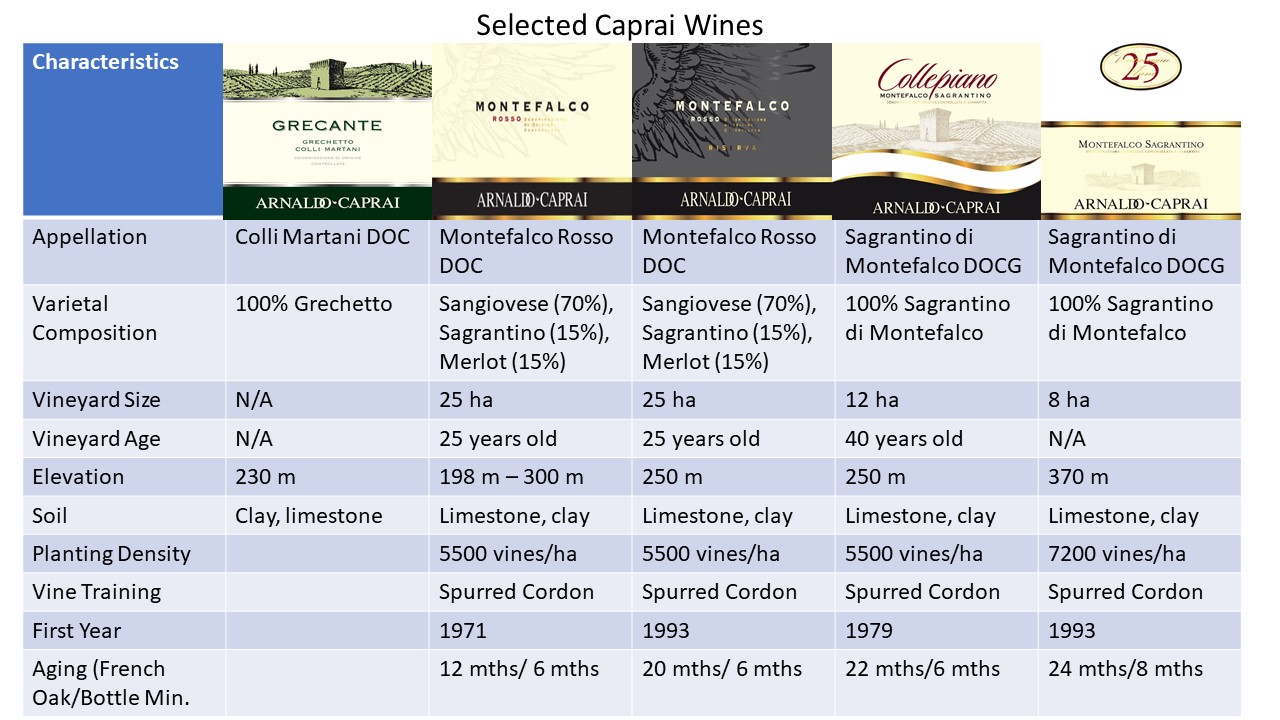
The chart below shows the wines we tasted at the WPW event, the sources of the grapes, and the aging method for each.


We tasted the 2018 Grechetto Grecante as we milled around the bar. The wine was perfumed, floral, waxy and with yellow fruit on the nose. Herbs, a bitterness, textured and mineral on the palate. The minerality and texture combined to restrain the fruit flavors. Interesting mix of acidity, bitterness, and minerality. Textural intensity diminished with time.

The 2015 Montefalco Rosso showed herbs and violets on the nose, along with a slight nuttiness. Red fruits, medium body, and a peppery finish. The Riserva version of this wine had more of an obvious barrel note on the nose as well as shoe polish, spice, and sweet red fruit. Bright on the palate. Rich red fruit. Medium-bodied. Spicy, long, herby, mineral finish.

Sweet dark fruit and spice were the characteristics that I noted for the nose of the 2013 Sagrantino Collepiano. Smooth and round on the palate. Not as intense and structured as the 2008 we had sampled offline at the bar. Pleasant, rich, and open.

The final wine in the lineup was the 2013 Sagrantino 25 Anni. The initial bottling of this wine -- 1993 -- was a commemoration of the winery's 25th anniversary. The wine was the result of "in-depth research and careful clonal selection of Sagrantino's best grapes" and was awarded Gambero Rosso's Tre Biccheri upon release. The version that we tasted showed deep red fruit and a beautiful bouquet on the nose. Concentrated, with a hint of match flint, vanilla, baking spices, and mango. Structured dark fruit on the palate along with pepper, herbs, and good acid levels. Persistence of pepper gives way to texture. Long, spicy, bitter finish.

********************************************************************************************************
I have visited the Paolo Bea estate in Montefalco and am a fan of his wines. Caprai wines stand in stark contrast to the Paolo Bea wines in that they have a more modern feel. The key here is the difference in winemaking between the two estates.The Caprai wines are aged for up to two years in French oak barriques and then up to an additional 6 months in bottle. Paolo Bea red wines, on the other hand, are aged for 1 year in stainless steel, 2 years in 20- to 30-hl oaken barrels, and then an additional 2 to 4 years in bottle.

Both wines are reflective of their winemakers' visions.

©Wine -- Mise en abyme

Saturday, February 22, 2020

Mapping the DOC sparkling wines of Le Marche (Italy)

The rugged environment of Le Marche provides a landscape that is less suitable for agricultural pursuits than is the case in neighboring Tuscany, Umbria, and Abruzzo, for example. The Apennine range forms the internal border of the region and descends almost to the Adriatic Sea, with arable land and living spaces confined to the river valleys and the coastline. The climate in the region is temperate, with a continental feel inland and Mediterranean along the coast.

At 878,000 hl of wine produced in 2018, Le Marche ranked 13th among Italian regions. Its calcareous soils provide optimal residence for Sangiovese, Trebbiano, Verdicchio, and Montelpuciano, among other varieties.

Given the length of its coastline, seafood is a key part of the Marchian diet. And the diet elevates the importance of white wine in the region, with the Verdecchios from Castelli di Jesi and Matelica having pride of place. Wine from the Pecorino grape is also growing in stature.

Below is a map of the sparkling wines of Le Marche.


Some observations:
  • Most of these wines are, given their 85% minimums, in effect, varietal sparkling wines
  • Most of the wines are made from indigenous rather than international varieties. The varieties of note are Aleatico, Biancame, Verdicchio, Maceratino, Passerina, and Vernaccia Nera
  • Most DOCs allow both Metodo Classico and Charmat production
  • A total of three red sparkling wines are produced in the region: Pergola DOC Spumante; San Ginesio DOC Spumante; and Vernaccia di Serrapetrona DOC Spumante.
Now let us turn to some of the most noteworthy sparkling wines from the region.

Vernaccia di Serrapetrona DOCG
This wine has been described as an "idiosyncratic sparkling red wine produced from the local Vernaccia Nera." This territory was granted DOC status in 1971 and elevated to DOCG in 2003. It is one of the smallest classified zones in Italy with only 20 ha of vineyards and 5000 cases produced. Vineyards must be sited between 450 and 600 m elevation.

Other than the fact that it is a sparkling red wine, Vernaccia di Serrapetrona is also unique in its production method: three fermentations. The first fermentation involves up to 60% of the handpicked grapes. The remaining 40% is dried on straw mats and added to the wine in the following January for the second fermentation. After resting for a few months, the wine is placed into pressurized containers where it is fermented using the Charmat method.

The result of this process is "an intensely aromatic wine displaying a raspberry red color, aromas of strawberries and cranberries, a hint of spice, firm tannins and bright acidity,"

Verdicchio dei Castelli di Jesi DOC and Verdecchio di Matelica DOC
These are the two DOCs that are the temples to Verdicchio, with the former being more revered than the latter. The sparkling wines from both regions require a minimum of 85% of the Verdicchio grape and can be made using either the Metodo Classico or Charmat methods.

The grapes for Verdicchio dei Castelli di Jesi are grown in the hilly areas around the town of Jesi, an area endowed with calcareous clay and limestone-rich soils. The area is blessed with a relatively dry maritime climate with persistent gentle onshore (morning) and offshore (afternoon) winds providing defenses against fungal diseases such as grey rot and mildew.

The Verdicchio di Matelica vineyards are located further inland in more of a continental climate but with soils akin to its compatriot. Vineyard orientation in Matelica is east-to-west, a situation unique to that DOC. A total of 740 ha of vineyards are planted at 400m - 500m elevation.

In his Forbes article on Italian sparkling wines, Tom Hyland identified the Colonnara Tradition Brut as one of the best examples of Verdicchio sparkling wine that he has tasted. The wine, he says, "... offers subdued herbal notes in the finish, along with bright pear and melon fruit."

In that same article, Hyland spoke favorably of a number of Verdicchio/Chardonnay cuvées:
  • Poderi Mattioli Dosaggio Zero -- vintage-dated blend that is aged 48 months on its lees
  • Umani-Ronchi Extra Brut millesimato -- 65% Verdicchio, 35% Chardonnay
  • Umani-Ronchi La Hoz -- 80% Verdicchio, 20% Chardonnay. The Verdicchio is aged in steel while the Chardonnay is aged in mid-sized oak barrels. The wines are aged on lees for 48 months.
*********************************************************************************************************
Sparkling wines are produced in nine of the 20 Le Marche DOC(G) regions but, given its ubiquity and regional importance, the one that you encounter in the wild will most probably be Verdicchio-based.

©Wine -- Mise en abyme

Saturday, February 15, 2020

Count me in as a Timorasso (white wine from Piemonte's Colli Tortonesi DOC) believer

The recently revived Timorasso cultivar has been described by Kerin O' Keefe (one of the leading Italian wine experts) as "one of the most exciting wines coming out of Italy right now" and "boasts more depth, body and complexity than many Italian whites." Berry Bros and Rudd, a historical UK wine retailer, tags the wine as "one of the most exciting autochthonous grape varieties to surface in recent years." I have seen these and many other laudatory comments regarding the Timorasso wine so I purchased a bottle of Vigne Marina Coppi Fausto 2011 in order to conduct an independent evaluation.

According to stradacollitortonesi.com, the Timorasso variety is a part of the ampelographic heritage of Liguria, Piemonte, Lombardia, and Emilia Romagna and is assumed to have originated somewhere between Liguria and Piemonte. The characteristics of the variety are shown in the chart below.


In addition to the above, it is known that the variety thrives in poor soils and sites with good ventilation and exposure. It prefers altitudes above 350 m. The thick skin protects it against disease and weather.

The grape was on the verge of extinction in the 1980s when Walter Massa, of Vigneti Massa, encountered a few vines in his vineyard and began experimenting with them. He was so pleased with the initial results that he begun searching out vines in neighboring vineyards. As time went by, neighboring producers noted his success and began producing the wines also. Today there are 20 producers bringing Timorasso wines to market and associated vineyards have grown from 3 ha in 2000 to 150 hectares today.

Timorasso wine is certified for production in the 40 communes around Tortona Hill that comprise the Colli Tortonesi DOC.


Timorasso can be deployed in Colli Tortonesi DOC as follows:
  • Bianco -- any proportion; min 10% alcohol
  • Bianco from subzone Terra di Libarna -- minimum 60% Timorasso plus OANWG (other authorized nonaromatic white grape); min 11% alcohol
  • Varietal Timorasso -- mimimum 95% Timorasso plus OANWG; 12% alcohol; minimum 10 months aging
  • Riserva -- 12% alcohol; min 21 months aging
  • Spumante from subzone Terra di Libarna -- minimum 60% Timorasso plus OANWG; min 11.5% alcohol; can range from extra brut to extra dry; made via Charmat method.
The wine I selected for my Timorasso exploration was the 2011 Fausto from Vigne Marina Coppi. The winery is shown in the map above as being located in the town of Castellania. Climate in this area is continental, with significant diurnal temperature variation (positive for acidity retention) and very low precipitation.

The vineyards are located in a natural amphitheater halfway up the hillside, protecting the vines from the harsh north winds. The soils underlying the vineyards are lime-rich sedimentary marls with strata of grey-blue Sant'Agata marls that are 30% sand, 50% clay, and 15% lime.

Fruit for this particular wine are drawn from the Gabetto and Montagnina vineyards. These vineyards are trained Guyot at 5000 vines/ha density. The estate is farmed organically and follows integrated pest management principles.

As regards winemaking, the grapes are soft-pressed and then partially cold-strained off the must. After alcoholic fermentation the wine is transferred to steel tanks for 10 months of maturation inclusive of manual battonage. The wine is aged in-cellar for an additional 6 months after bottling.


This was an exceedingly complex wine, showing different facets based on temperature and residence in the glass. I poured a little into the glass before the wine got to optimal drinking temperature and was assailed with notes of turpentine, pine, sweet white fruit, and minerality, all coming at me in waves. On the palate, salinity, hint of rubber, a piney-mentholated character, and a late-arriving hot-pepper/blackpepper finish. A weighty wine.

As the second pouring, after further chilling, sweet pine, honey dew melon, and white flowers on the nose. A palate-coating character which yields to a mineral blackpepper finish. Lime skin acidity, with acidity intensifying with residence in glass. I paired the wine with a hard cheese and it was a good coupling.

Overall, a sweet floral nose wrapped in a herb overcoat. With passage of time, a metallic, cupric note appears on the palate. Settles in as a weighty Carricante. Closest wine that I have had to this character is an aged Benanti Pietra Marina (Not saying that it is a Pietra Marina. Nothing is. Just saying that it brings it to mind).

Excellent wine. I cant wait to examine other producer offerings.

©Wine -- Mise en abyme

Friday, February 14, 2020

Aaron Pott (Mt. Veeder, Napa Valley) and his wines show why they are the talk of the town

I recently had the pleasure of tasting a selection of Aaron Pott wines at an Alfond-Inn event organized and hosted by his Florida Distributor, Terroir Selections. Pott, numbered among the most respected American winemakers, and a winemaking consultant of some repute, easily and effectively led us through the highlights of his career, grapegrowing and winemaking philosophies and practices, and a tasting of the wines. I report on that tasting in this post.


Pott, proprietor, along with his wife Claire, of Pott Wine, possesses one of the most well-balanced resumes of any US winemaker alive today. He holds to a strong conviction that the best Napa wines made were those produced during the 1970s and early 1980s and that winemakers have lost their way since. His goal is to make wines akin to those wines of yore.

The charts below show the wealth of experience, expertise, and customers that Pott has accumulated over the years and that have served to inform his venture at Pott Wine.


Table 1. Partial list of Huis Clos former and current consulting clients
Fisher Vineyards Seven Stones Perliss
Krupp Brothers St Helena Winery Somnium
Quixote Winery Adler Deutsch Vineyard AErena Wines
Blackbird Winery Greer Wine Resolute Wines
Bello Family Vineyard Martin Estate
¿Como No?

Pott bottles a total of eight wines, sourcing grapes from the estate (three labels) and purchased fruit from Napa Valley vineyards that meet his specific requirements. The various fruit sources are shown in the figure below.


In his presentation Pott was lighthearted, informative, and comfortable in his own skin. In responding to a question on farming practices, he described himself as a defrocked biodynamic farmer in that the vineyards are farmed organically but he also uses a number of biodynamic techniques. He loves Cabernet Franc -- thinks it is one of the most alluring of the Bordeaux varietals -- but it is tough to find good sites for Cabernet Franc in Napa. His property is on the flank of a volcano: buds out earlier than most and is much cooler in the summertime.

As regards winemaking, the Viognier, the estate's only white wine, is hand-picked and whole-cluster pressed. The grapes are fermented (using indigenous yeasts) and aged in Italian terra cotta amphorae which were hand-crafted in Tuscany by the Manetti family.

All of the red wines are treated similarly except for the duration of the post-fermentation maceration.Grapes are hand-picked and placed into small baskets for transport to the cellar. Once there, they are de-stemmed, selected, optical-sorted, selected and then placed into small bins which are transported by fork lift to open-top fermenters. The grapes are gravity-fed into those containers. Fermentation is facilitated by indigenous yeasts, with manual punchdowns of the caps during the process. After a 30- to 45-day post-fermentation maceration, the wine is gravity-drained to French oak barrels for aging.

And now, the wines.


The 2018 Pott 20 m3 Viognier Estate Chateauneuf du Pott shows apricot, green herbs, and restrained Viognier florals on the nose. Rich and creamy on the palate with yellow fruit and a heavy, lingering minerality. Good acid level and a bitter finish.

The 2017 Pott Napa Valley Cabernet Sauvignon was constructed from the wine remaining after all of the estate and single-vineyard wines have been made. There is a lot of Cabernet Franc and Merlot in this wine. In 2017 they experienced single-digit humidity in the vineyards and the Merlot became dehydrated and minty so was placed into this wine. Red fruit, chocolate, and mint on the nose and lean red fruit on the palate. Smooth tannins.

The 2017 Pott Kaliholmanok Kicu'me/Ballard Vineyard Spring Mountain Napa Valley showed plum, blackcurrant, herbs, bell pepper, chocolate, mint, cedar, and fudge on the nose. Lean, but not austere, on the palate with blueberries, and mint chocolate. Lenghty, balanced finish.

The site in Stags Leap from whence the 2017 Pott Actaeon Cabernet Sauvignon is sourced is unusual in that AVA in that it is from an east-facing, hillside vineyard. In addition, the diurnal temperature variation can be as much as 70 degrees. These two factors combine to ensure good acid retention in the finished wine. This wine was elegant. Black and red fruit and tobacco on the nose. Balanced on the palate with a hint of iron. Round, full, and creamy with good acidity.

The 2017 Pott Space and Time is a blend of Cabernet Franc and Cabernet Sauvignon which is aged in 50% new and 50% 2-year-old French oak and is only racked once during the 18 - 20-month aging period. Violets, jasmine, and dark fruit on the nose. Medium-bodied with silky tannins. Balanced.

The final wine in the lineup was the 2017 Pott Incubo Cabernet Sauvignon. This wine is 98% Cabernet Sauvignon with the remainder Cabernet Franc. Rust, intense dark fruit, violets and herbs on the nose. Creamy, with palate-coating richness. Lengthy finish.


This was an excellent tasting with the wines showing well and the winemaker more than living up to expectations in terms of expertise and knowledge-dissemination.


©Wine -- Mise en abyme