Saturday, February 15, 2020

Count me in as a Timorasso (white wine from Piemonte's Colli Tortonesi DOC) believer

The recently revived Timorasso cultivar has been described by Kerin O' Keefe (one of the leading Italian wine experts) as "one of the most exciting wines coming out of Italy right now" and "boasts more depth, body and complexity than many Italian whites." Berry Bros and Rudd, a historical UK wine retailer, tags the wine as "one of the most exciting autochthonous grape varieties to surface in recent years." I have seen these and many other laudatory comments regarding the Timorasso wine so I purchased a bottle of Vigne Marina Coppi Fausto 2011 in order to conduct an independent evaluation.

According to stradacollitortonesi.com, the Timorasso variety is a part of the ampelographic heritage of Liguria, Piemonte, Lombardia, and Emilia Romagna and is assumed to have originated somewhere between Liguria and Piemonte. The characteristics of the variety are shown in the chart below.


In addition to the above, it is known that the variety thrives in poor soils and sites with good ventilation and exposure. It prefers altitudes above 350 m. The thick skin protects it against disease and weather.

The grape was on the verge of extinction in the 1980s when Walter Massa, of Vigneti Massa, encountered a few vines in his vineyard and began experimenting with them. He was so pleased with the initial results that he begun searching out vines in neighboring vineyards. As time went by, neighboring producers noted his success and began producing the wines also. Today there are 20 producers bringing Timorasso wines to market and associated vineyards have grown from 3 ha in 2000 to 150 hectares today.

Timorasso wine is certified for production in the 40 communes around Tortona Hill that comprise the Colli Tortonesi DOC.


Timorasso can be deployed in Colli Tortonesi DOC as follows:
  • Bianco -- any proportion; min 10% alcohol
  • Bianco from subzone Terra di Libarna -- minimum 60% Timorasso plus OANWG (other authorized nonaromatic white grape); min 11% alcohol
  • Varietal Timorasso -- mimimum 95% Timorasso plus OANWG; 12% alcohol; minimum 10 months aging
  • Riserva -- 12% alcohol; min 21 months aging
  • Spumante from subzone Terra di Libarna -- minimum 60% Timorasso plus OANWG; min 11.5% alcohol; can range from extra brut to extra dry; made via Charmat method.
The wine I selected for my Timorasso exploration was the 2011 Fausto from Vigne Marina Coppi. The winery is shown in the map above as being located in the town of Castellania. Climate in this area is continental, with significant diurnal temperature variation (positive for acidity retention) and very low precipitation.

The vineyards are located in a natural amphitheater halfway up the hillside, protecting the vines from the harsh north winds. The soils underlying the vineyards are lime-rich sedimentary marls with strata of grey-blue Sant'Agata marls that are 30% sand, 50% clay, and 15% lime.

Fruit for this particular wine are drawn from the Gabetto and Montagnina vineyards. These vineyards are trained Guyot at 5000 vines/ha density. The estate is farmed organically and follows integrated pest management principles.

As regards winemaking, the grapes are soft-pressed and then partially cold-strained off the must. After alcoholic fermentation the wine is transferred to steel tanks for 10 months of maturation inclusive of manual battonage. The wine is aged in-cellar for an additional 6 months after bottling.


This was an exceedingly complex wine, showing different facets based on temperature and residence in the glass. I poured a little into the glass before the wine got to optimal drinking temperature and was assailed with notes of turpentine, pine, sweet white fruit, and minerality, all coming at me in waves. On the palate, salinity, hint of rubber, a piney-mentholated character, and a late-arriving hot-pepper/blackpepper finish. A weighty wine.

As the second pouring, after further chilling, sweet pine, honey dew melon, and white flowers on the nose. A palate-coating character which yields to a mineral blackpepper finish. Lime skin acidity, with acidity intensifying with residence in glass. I paired the wine with a hard cheese and it was a good coupling.

Overall, a sweet floral nose wrapped in a herb overcoat. With passage of time, a metallic, cupric note appears on the palate. Settles in as a weighty Carricante. Closest wine that I have had to this character is an aged Benanti Pietra Marina (Not saying that it is a Pietra Marina. Nothing is. Just saying that it brings it to mind).

Excellent wine. I cant wait to examine other producer offerings.

©Wine -- Mise en abyme

Friday, February 14, 2020

Aaron Pott (Mt. Veeder, Napa Valley) and his wines show why they are the talk of the town

I recently had the pleasure of tasting a selection of Aaron Pott wines at an Alfond-Inn event organized and hosted by his Florida Distributor, Terroir Selections. Pott, numbered among the most respected American winemakers, and a winemaking consultant of some repute, easily and effectively led us through the highlights of his career, grapegrowing and winemaking philosophies and practices, and a tasting of the wines. I report on that tasting in this post.


Pott, proprietor, along with his wife Claire, of Pott Wine, possesses one of the most well-balanced resumes of any US winemaker alive today. He holds to a strong conviction that the best Napa wines made were those produced during the 1970s and early 1980s and that winemakers have lost their way since. His goal is to make wines akin to those wines of yore.

The charts below show the wealth of experience, expertise, and customers that Pott has accumulated over the years and that have served to inform his venture at Pott Wine.


Table 1. Partial list of Huis Clos former and current consulting clients
Fisher Vineyards Seven Stones Perliss
Krupp Brothers St Helena Winery Somnium
Quixote Winery Adler Deutsch Vineyard AErena Wines
Blackbird Winery Greer Wine Resolute Wines
Bello Family Vineyard Martin Estate
¿Como No?

Pott bottles a total of eight wines, sourcing grapes from the estate (three labels) and purchased fruit from Napa Valley vineyards that meet his specific requirements. The various fruit sources are shown in the figure below.


In his presentation Pott was lighthearted, informative, and comfortable in his own skin. In responding to a question on farming practices, he described himself as a defrocked biodynamic farmer in that the vineyards are farmed organically but he also uses a number of biodynamic techniques. He loves Cabernet Franc -- thinks it is one of the most alluring of the Bordeaux varietals -- but it is tough to find good sites for Cabernet Franc in Napa. His property is on the flank of a volcano: buds out earlier than most and is much cooler in the summertime.

As regards winemaking, the Viognier, the estate's only white wine, is hand-picked and whole-cluster pressed. The grapes are fermented (using indigenous yeasts) and aged in Italian terra cotta amphorae which were hand-crafted in Tuscany by the Manetti family.

All of the red wines are treated similarly except for the duration of the post-fermentation maceration.Grapes are hand-picked and placed into small baskets for transport to the cellar. Once there, they are de-stemmed, selected, optical-sorted, selected and then placed into small bins which are transported by fork lift to open-top fermenters. The grapes are gravity-fed into those containers. Fermentation is facilitated by indigenous yeasts, with manual punchdowns of the caps during the process. After a 30- to 45-day post-fermentation maceration, the wine is gravity-drained to French oak barrels for aging.

And now, the wines.


The 2018 Pott 20 m3 Viognier Estate Chateauneuf du Pott shows apricot, green herbs, and restrained Viognier florals on the nose. Rich and creamy on the palate with yellow fruit and a heavy, lingering minerality. Good acid level and a bitter finish.

The 2017 Pott Napa Valley Cabernet Sauvignon was constructed from the wine remaining after all of the estate and single-vineyard wines have been made. There is a lot of Cabernet Franc and Merlot in this wine. In 2017 they experienced single-digit humidity in the vineyards and the Merlot became dehydrated and minty so was placed into this wine. Red fruit, chocolate, and mint on the nose and lean red fruit on the palate. Smooth tannins.

The 2017 Pott Kaliholmanok Kicu'me/Ballard Vineyard Spring Mountain Napa Valley showed plum, blackcurrant, herbs, bell pepper, chocolate, mint, cedar, and fudge on the nose. Lean, but not austere, on the palate with blueberries, and mint chocolate. Lenghty, balanced finish.

The site in Stags Leap from whence the 2017 Pott Actaeon Cabernet Sauvignon is sourced is unusual in that AVA in that it is from an east-facing, hillside vineyard. In addition, the diurnal temperature variation can be as much as 70 degrees. These two factors combine to ensure good acid retention in the finished wine. This wine was elegant. Black and red fruit and tobacco on the nose. Balanced on the palate with a hint of iron. Round, full, and creamy with good acidity.

The 2017 Pott Space and Time is a blend of Cabernet Franc and Cabernet Sauvignon which is aged in 50% new and 50% 2-year-old French oak and is only racked once during the 18 - 20-month aging period. Violets, jasmine, and dark fruit on the nose. Medium-bodied with silky tannins. Balanced.

The final wine in the lineup was the 2017 Pott Incubo Cabernet Sauvignon. This wine is 98% Cabernet Sauvignon with the remainder Cabernet Franc. Rust, intense dark fruit, violets and herbs on the nose. Creamy, with palate-coating richness. Lengthy finish.


This was an excellent tasting with the wines showing well and the winemaker more than living up to expectations in terms of expertise and knowledge-dissemination.


©Wine -- Mise en abyme

Friday, February 7, 2020

David Ramey and Aaron Pott: A brief comparison of the career trajectories of these American winemakers

David Ramey and Aaron Pott are numbered among the most respected American winemakers and both craft some of the most sought-after domestic wines (primarily Chardonnays for Ramey and Cabernet Sauvignons for Aaron). I recently wrote a post based on a tasting of Ramey wines here in Orlando and, in that document, presented a timeline of developments in his career. I recently had the pleasure of attending a tasting of Aaron Pott wines -- led by him -- and constructed a similar timeline as part of my reporting.
Author with David Ramey (left block) and Aaron Pott

A few common threads caught my attention, leading to me stacking the two timelines up for comparison purposes. The result is shown below.


Some observations:
  • Both men did collegiate work at UC Davis, David gained a graduate degree in Enology in 1979 and Aaron an undergraduate degree in 1990
  • Aaron did eventually gain a graduate degree, circa 1997, but in Viticulture and from a University in Burgundy
  • Early experience to French powerhouse winemakers: Moueix in the case of Ramey and Rolland and Lafon for Pott while he was Assistant Winemaker at Newton Vineyard
  • They both did stints on the Right Bank of Bordeaux: Ramey two short spells with Moueix in 1979 and 1989; Pott six years as the winemaker at Tropolong-Mondot and then La Tour Figeac.
  • Ramey has much more domestic winemaking experience in the part of his career that preceded ownership of his own shop while Pott added to his international experience (France, Italy, Chile) by becoming Beringer's "Flying Winemaker."
  • Ramey has now owned his own business for 24 years. He primarily uses purchased fruit. Pott has been crafting his own wines for 13 years and uses a mix of estate and purchased fruit. In addition, Aaron helms a flourishing and well respected consulting business (Huis Clos; see below).
  • Both of their winemaking philosophies and practices draw heavily on their French experience.

Table 1. Partial list of Huis Clos former and current consulting clients
Fisher VineyardsSeven StonesPerliss
Krupp BrothersSt Helena WinerySomnium
Quixote WineryAdler Deutsch VineyardAErena Wines
Blackbird WineryGreer WineResolute Wines
Bello Family VineyardMartin Estate
¿Como No?


©Wine -- Mise en abyme

Wednesday, February 5, 2020

The DOC sparkling wines of Umbria, Italy

Umbria, one of the smallest of the Italian regions, lies almost dead center on the peninsula and is the only region that does not border on a body of water or a country.

Italian regions map with Umbria as the beating heart of the boot
(Source:sottasoprainc.blogspot.com)

Umbria lies in the cultural and vinous shadows of its northwestern neighbor Tuscany but is renowned in its own right for its lush, rolling hills, its hilltop villages (Assisi, Perugia, Orvieto, Spoleto, Todi, Spello, Gubbio), and unique historic towns.

Assissi

Author and spouse in Umbria

Grapegrowing at Carmine Estate

Looking down on the great Umbrian Valley from the hills 
above Cannara

Umbria's main business activity is agriculture, with olive oil, truffles, sunflowers, and wine grapes as the primary offerings.

The Umbrian climate is continental; cold, rainy winters and dry summers. This climate is modified by the waters of Lake Trasimeno in the area west of Perugia.

Geologic processes through the ages have resulted in the following soils distribution in Umbria:
  • Alluvial sediments and debris along major river valleys
  • Gravels, sands, and clays deposited during the Pliocene and early Pleistocene
  • Marly deposits during the Oligocene - Miocene
  • Stratigraphic Umbria-Marche deposits from the Jurassic-Miocene
  • In the southwest, volcanic deposits from the eruptions of the Vulsino volcano.
This distribution is illustrated graphically in the figure below.

Schematic geologic map of Umbria.
Blue = Limestone; Gold = Sandstone rocks;
 Yellow = Inter-mountain basins; and
Purple = Volcanic complexes (Source:
Andrea Moti, researchgate.net)
Between 600,000 and 800,000 hl of wine is produced annually, a total that is 1/3 of Tuscany's production and places the region 14th or 15th of the 20 Italian regions. The region is known for its white wines (18% of its wines are from the Orvieto DOC) from the Trebbiano and Grechetto varieties but its only two DOCGs (Sagrantino di Montefalco and Torgianno Rosso Riserva) are red wines made from the Sagrantino and Sangoiovese varieties, respectively. Sangiovese represents 22% of the vine plantings while Trebbiano and Grechetto come in at 17% and 13%, respectively. Most of the vineyards are planted on terraces that have been cut into the hillsides.

As shown in the chart below, Umbria has six sparkling wine DOCs distributed over its surface area.


A few observations:
  • None of the major Umbria DOC/DOCGs (Sagrantino de Montefalco DOCG, Torgiano Rosso Riserva DOCG, and Orvieto DOC) produce any sparkling wine
  • A small number of varieties (six) have been formally designated by name for the production of sparkling wine. Only Valle d'Aosta (one) and Liguria (three) have fewer identified sparkling-wine-designated varieties
  • A preponderance of the international varieties have been designated as raw material for sparkling wine production in Umbria. Only Spoleto DOC -- of the six sparkling wine DOCs identified in the chart above -- does not specify, by name, one of the international varieties for use in the production of its sparkling wine.
  • Three of the sparkling wine DOCs are located in the north of the region, one in the middle, and two in the south.
  • Two Metodo-Classico-only DOCs and one Charmat-only DOC. The remaining four DOCs allow a mix of both production methods
  • The Spoleto DOC wine could have been designated a varietal sparkling wine.
******************************************************************************************************
In this post I have continued on my path to identify and map each sparkling wine DOC/DOCG in Italy. To date I have completed the mapping of Northern Italy as well as Toscana and Umbria (herein) of Central Italy. My next effort will identify the sparkling wines of Marche.


©Wine -- Mise en abyme

Saturday, February 1, 2020

Spanish wines on the cutting edge: Ribeira Sacra's Guímaro Finca Meixemán 2017

What is the new face of Spanish wines as the modernist movement retreats? According to panelists in a seminar titled Wines on the Cutting Edge, a part of Wines from Spain's Great Match Miami (November 5, 2019), it is a movement to different and unusual wines and areas.

I have covered the cutting-edge whites (Tajinaste Blanco, Muradella Blanco, Edetària Selecció Blanc Vinyes Velles, and Conde de los Andes Rioja Blanco) in prior posts and will now turn to the reds, beginning with Guímaro Finca Meixemán 2017. In this post I will discuss the wine region, the producer, the variety, the vineyard, the wine, and the tasting.

The Region
The subject wine is produced in Amandi, one of the five sub-regions of the Galician DO Ribeira Sacra. While Galicia is primarily know for its white wines, Ribeira Sacra is known for its reds; and, especially, its Mencia.


Winemaking in Galicia originated with the ancient Romans and those traditions were upheld during the Middle Ages by the monks who resided in the still-evident monasteries. This religious history is captured in the DO name -- Ribeira Sacra -- which translates to Sacred Shore. But this winemaking tradition collapsed with the Italy-wide movement from farms to cities in the last century, resulting in the loss of know-how and varieties.

Riberia Sacra attained its DO in 1996. Its approximately 1200 ha (2965 acres) hugs the the contours of the Miño and Sil rivers prior to their convergence and the transit of the surviving Miño into Portugal,. The landscape is dominated by steep slopes and river canyons with some vineyards resident on 50-degree slopes. The steepness of these slopes require "heroic" farming a la Mosel and Liguria.

Source: https://ribeirasacra.org/
While the Galician climate is considered Atlantic, Riberia Sacra's remove from the coast renders it continental: long, warm summers and cold, wet winters. Soils here are well-drained slate and granite.

Spanishwinelover.com observes that: "... Ribeira Sacra seems to have ticked off all the boxes to become a top player: breathtaking landscapes with dizzying vineyards; a great array of local grape varieties in the process of being recovered; the complexity derived from the diversity of soils, exposure, and elevations; and a generation of terroir-driven, quality-focused producers determined to leave behind the attitudes and short-sighted views of yesteryear."

There are some challenges, however:
  • Removing a single ha of traditional vineyard, including stone walls and a railing system to transport harvest cases uphill, costs between 80,000 and 100,000 euros. Solution is potentially to replace stone walls with soil terraces
  • Villages are empty
  • Difficult to hire people; once hired, they need to be trained.
The Producer
The Guímaro farm, 8 ha in size, is located in the village of Sober in Ribeira Sacra's Amandi sub-region. The farm has been in the family for ages and has historically operated a mixed agricultural regime. Grapes were sold in bulk until Luis Buitrón signed on as winemaker and encouraged the family to bottle some of the wine on the estate. Luis was also instrumental in the wine education of young Pedro Rodriguez, family scion, taking him to visit wineries in other regions in Spain as well as in France and Italy.

Pedro is the grower today but his parents still work in the vineyards. The vineyards are south-facing  and resident on the slate soils just above the River Sil.

Pedro was introduced to Raúl Pérez, the famed Bierzo winemaker, in the early 2000s. The advice that he imparted resulted in Pedro:
  • Reducing Mencia yields
  • Eliminating the use of chemicals in the vineyard
  • Paying closer attention to plot-exposition
  • Re-claiming old-fashioned winemaking methods
    • Wild yeast fermentation
    • Foot-treading in open-top vessels
    • Stem inclusion
    • Working with low sulfur
    • Aging in used barrels.
Pedro's stewardship has yielded "some of the most distinctive and age-worthy wines being produced today on the Sacred Banks."

Pedro is currently moving towards organic certification and is also planting heirloom grape varieties at high elevations in Amandi.

The Variety -- Mencía
The Mencía grape variety is principally found in the northwest of Spain in the DOs of Bierzo (where it has the greatest renown), Ribeira Sacra, Monterrei, and Valdeorras. A total of 9000 ha of vines across those regions are devoted to the variety.

Mencía had historically been dismissed as an indifferent local table wine -- "astringent, pale, and forgettable" -- planted as it was on unsuitable soils. The true capability of the variety was brought to the fore by Alvaro Palacios's successful revitalization efforts in Bierzo and Galicia in the 1990s. Replanting the grape on more suitable hillside schist soils yielded a more concentrated, profound, and elegant wine.

Mencía is a thick-skinned blue grape which ripens early. It is susceptible to botrytis and mildew and will lose its acidity if picked outside of its ripeness window. Picking late also results in increased alcohol levels in the finished wine.

In a discussion on one of the Guildsomm Discussion Boards, James Vercoe spoke to change in Mencía tannin structure as you move inland in Spain.
The wines of Ribeira Sacra are the lightest and most elegant with a gentle schist like (sic) minerality of cold rocks with a gentle tannin but still shows the classic soy character of Mencía (but perhaps more toned down than the more continental regions). The Valdeorras wines are a touch fuller and more deeply marked with amaro-astringency -- I always think of a whole rose bush; the pretty red florals  with the sapid astringent stems. In Bierzo the tannin is nutty and ripe and the most pronounced. Here it is the most continentally influenced region and the wines can handle a touch more oaking ... think fuller wines with more plum fruit and less floral ...
The Wine
The grapes for the Guímaro Finca Meixemán 2017 were grown on a 1.2 ha namesake plot which sits between 400 and 450 m on southeast-facing slopes. The vines here are 70 years old.

The grapes were subjected to partial whole cluster fermentation with foot treading. After a lengthy maceration, the wines were aged for 13 months in used 225 liter French oak barrels.

Notes: One of the panelists indicated that 2017 was a hot, concentrated year. Deep red fruit on the nose with a hint of tomato and talcum powder. Elegant. Not overbearing on the attack but seems to form a comfortable, soothing resting place on the palate. Strawberries and cherries with a mineral texture. Young and tight but filled with promise.


Another panelist indicated that this wine would cost $30 at retail.

**********************************************************************************************************
Mencía wines are gaining critical acclaim as "... one of the country's most exciting and original red wines ... rapidly making a name for itself with wine lovers across the world ..." And high on the list of recommended producers and wines is Guímaro Finca Meixemán.


©Wine -- Mise en abyme

Wednesday, January 29, 2020

Constructing the wines of Martin Woods Winery (McMinnville, Oregon)

The high quality of the Martin Woods' wines, as tasted at Swirlery, set me on a mission to elaborate the environment and the processes that yielded these sterling wines. In my first post on the topic, I reported on the pedigree of the vineyards from which the grapes are sourced. In this post I investigate the construction of the wines that we tasted.

Evan Martin, winemaker/owner at Martin Woods

Lineup of the wines we tasted

The tools and techniques employed in constructing the wines are displayed in the table below. It should be noted that, with two exceptions, the wines are all single-vineyard; a key focus of the estate.


Techniques/Practices Employed in the Construction of the Martin Woods’ Wines Tasted at Swirlery

Wine Press Vessel Fermentation Aging  (Mths) Barrel Type Barrel Size (L) Barrel Age (Years) Lees
Willamette Valley Chardonnay 2018 (Yamhill (55%) and Havlin (45%) Whole Cluster Oregon Oak Indigenous yeasts
11
Oregon Oak 228, 400
7-8
Stirring
Eola-Amity Hills Chardonnay 2017 (Willakia) do. French, OR Oak do.
9
French, OR Oak do. N/A No stirring
Havlin Vineyard Pinot Noir 2017

1.5 ton open-top fermenters; 20% whole cluster/whole berries  Ind. yeasts; 17 days on skins; pumpovers & punchdowns 22 (12 on lees) French (50%) & OR (50%) oak 228 (< 5% new)

Yes
Hyland Vineyard Pinot Noir 2017

1.5 ton open-top fermenters; 20% whole cluster/whole berries Ind. yeasts; 15 days on skins; pumpovers & punchdowns
10
French (50%) & OR (50%) oak 228, 400

Yes
Jesse James Vineyard Pinot Noir 2017

1.5 ton open-top fermenters; 20% whole cluster/whole berries Ind. yeasts; 17 days on skins; pumpovers & punchdowns 18 (12 on lees) French (50%) & OR (50%) oak 10% new 2 - 10 Yes
Havlin Vineyard Gamay Noir 2017

1.5 ton open-top fermenters; 35% whole cluster/whole berries Ind. yeasts; 14 days on skins; pumpovers & punchdowns
9
French oak
228
8
Yes
Walla Walla Valley Cabernet Franc 2017 (Seven Hills Vineyard and McClellan Estates

1.5 ton open-top fermenters; 100% destemmed Ind. yeasts; 16 days on skins; pumpovers & punchdowns 18 (11 in barrel and 7 in Flextanks)


3 - 4 Yes


1.5 ton open-top fermenters; 50% whole cluster Ind. yeasts; 16 days on skins; pumpovers & punchdowns 18 (11 in barrel and 7 in Flextanks)


3 - 4 Yes


1 ton closed-top fermenters; 100% carbonic Ind. yeasts; 5 weeks for carbonic; pumpovers & punchdowns 18 (11 in barrel and 7 in Flextanks)


3 - 4 Yes

White Wines
The Martin Woods' Chardonnays are whole-cluster-pressed, barrel-fermented and barrel-aged on the lees. They are unfined and lightly filtered.

Whole-Cluster Pressing
According to Dawson Raspuzzi, whole-cluster pressing is employed in the making of high-end white wines. During this process the entire grape bunch is pressed very gently to release the juice. The resulting product, if the process is done properly, produces a more delicate and less astringent wine due to limited contact with those areas (skins, seeds, stems) with the highest tannin concentration. In addition to its textural contribution, whole cluster pressing increasing the juice/solids ratio as the stems facilitate the complete draining of the press cake.

Alcoholic Fermentation in Oak Barrels
According to Ibern-Gomez, et al*., "Fermentation in oak barrels leads to wines with much more complex sensory properties, largely attributed to the phenols extracted from oak wood."

In a study on barrel-fermentation of white wines (S. Herjavec, et al., The quality of white wines fermented in Croatian Oak, Food Chemistry, 100, 2007), the authors stated thusly:
One of the practices used to intensify the aroma and flavor characteristics of white wines is to ferment the must in oak barrels, and Chardonnay is one of the most suitable varieties for this. Wines produced by fermentation and maturation in oak barrels have different flavor characteristics to those which have undergone barrel maturation only after fermentation in stainless steel. One reason for this is that actively growing yeasts are capable of transforming volatile flavor components, extracted from oak wood, into other volatile metabolites.
This metabolite transformation results in what Zac Brown, Winemaker at Alderlea Vineyards, describes as "better integration of the oak and softer mouthfeel when compared to a white that is finished and then transferred into oak barrel to age."

Oak Aging
Wine is aged in wooden barrels to: (i) enhance its flavor, aroma, and complexity through transfer of substances from the wood to the wine; and (ii) allow gradual oxidation of the wine.

In the first instance, many of the wood's native aromatic compounds, as well as the aromatic compounds created during seasoning and toasting, are absorbed, and integrated, into the wine, thus contributing to wine richness and aromatic complexity. As noted by Dr. Murli Dharmadikari, common descriptors of oak-aged wines are oaky, vanilla, smoky, toasty, spicy, and coconut.

In terms of gradual oxidation, wine loss from barrels amount to approximately 2% per year, resulting from the fact that water and ethanol are smaller molecules and will diffuse into the wood and, ultimately, escape as vapor.  If the air in the cellar is dry, more water is lost and the wine is more concentrated in terms of alcohol.  If the environment is too humid then more alcohol is lost, reducing the ethanol content in the remaining wine.  This loss of liquid opens up a space between the wine surface and the barrel which the winemaker generally "tops up" in order to prevent oxidation and acetic spoilage.  During this "topping-up" process, small amounts of oxygen are dissolved in the wine.  Oxygen is also introduced into the wine during winery operations such as filtering and racking.

The oxygen which is now in the wine reacts with resident phenolic compounds in a manner such that: (i) tannins are softened (polymerization and precipitation as well as tannin-polysaccharide combinations); (ii) complex aromas develop; and (iii) there is improvement in the wine's body and mouthfeel.  It should be noted here that the tannin resident in the wine at this time is the oak tannin absorbed from the barrel (30% from the innermost four millimeters of wood).

In the aforementioned Herjavec, et al., study, the authors found that the sensorial characteristics of barrel-aged wines were modified, due to the wood-derived compounds. These wines manifested roundness in taste with a complex retro nasal aroma." Barrel toast also affected flavor perception: aging in medium-toast barrels yielded a smoky, roasted, and raw oak flavor while light toast resulted in a more fruity aroma.

Cooperage
The oak used in the maturation of alcoholic beverages fall into one of three species: Quercus alba, Quercus robur, and Quercus sessilis.  Q. robur and Q. sessilis, and their respective subspecies, are European white oaks while Q. alba is the source of 45% of the white oak lumber produced in the US.  American oak used in barrel production is sourced from Kentucky, Missouri, Arkansas, and Michigan but there is no apparent regional distinction.  European oak, on the other hand, may have designations which reach all the way to the forest from which the oak originated.  For example, French oak from the department of Alliers may be sourced from a forest named Tronçais.

It should be noted that Martin Woods utilizes Oregon Oak in its elevage, a practice I had not previously encountered. Subsequent research has shown that this oak species (Quercus garryana) has characteristics and chemistry similar to European oak and "if very well seasoned the resulting wine might benefit substantially rather like one of the features  of French oak" (http://www.oregonbarrelworks.com/Oregonoak.html). Martin Woods restricts the use of new oak to 5% or less.

Lees Aging
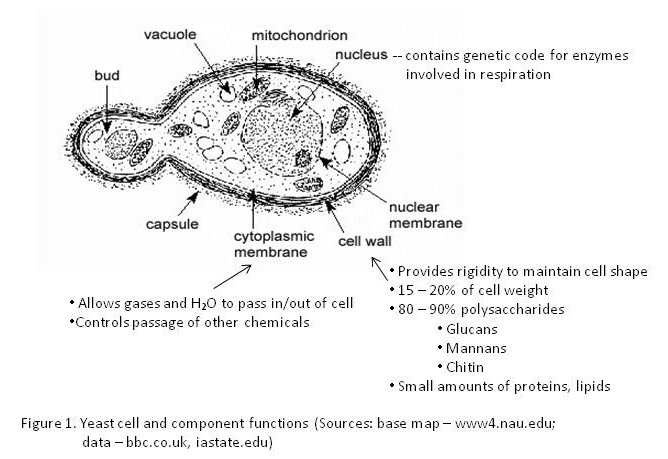
Murli Dharmadhikan (Yeast Autolysis, extension.iastste.edu) defines yeast autolysis as "... self-destruction of the cellular constituents of a cell by its own enzymes" following its death. Figure 1 below shows the component parts of a healthy yeast cell while Figure 2 shows an overview of the process  -- autolysis -- that occurs once that yeast cell has consumed all of the available nutrients and dies. At a high level, autolysis encompasses (i) the degradation of intracellular materials and (ii) degradation of the cell wall.


The detailed autolysis process is shown in Figure 3 below. The yeast extract, product of the degradation of intra-cellular material, is confined to the cell until such time as the cell wall becomes porous enough to allow the material to seep out. It should be noted that degradation and compound creation continues outside the degraded cell walls.

Figure 3. Details of yeast autolysis
The lees-aged wine is enriched by the compounds released during the constituent-degradation process.
Red Wines
There is no pre-fermentation cold soak nor is any sulfur added anywhere in the processing. The red wines are mostly whole-cluster-fermented for 14 -17 days with indigenous yeasts in open-top fermenters after which they are transferred to cooperage for elévage. The exception is the Cabernet Franc which is fermented differentially in both closed and open-top fermenters. The benefits that accrue to the white wines from oak usage in elévage are relevant here also.

Whole Cluster Fermentation
Paul Adams (SevenfiftyDaily) identifies the following benefits from whole-cluster fermentation:
  • Influences the tannin character of the wine (due to stem inclusion)
  • Less intense color but the color that is there is more stable in that it is bound with the tannins
  • Provides air space among the grapes and creates channels for juice to flow and circulate
  • Helps dissipate the heat created by fermentation.
There is no pump over or punch downs for 7 - 10 days thus allowing carbonic maceration.  There is one punchdown per day after this initial period.

Carbonic Maceration
In this method of vinification the grapes are hand-picked in whole bunches and placed serially into the fermentation tank.  The weight of the most recently placed grapes causes the lower bunches to burst and the juice that is released begins to ferment.  The carbon dioxide that is released during this process causes in-berry fermentation and the production of brightly colored, low-tannin wines with a characteristic fruity flavor. 

********************************************************************************************************
Over two posts I have described the sources of the grapes and the winemaking process of Martin Woods Winery. Both elements are of the highest order and clearly explain the quality that the final product displays. The practices are in line with the best winemaking are in line with the best in Burgundy and is innovative in its extensive use of Oregon Oak in fermentation and elévage.

©Wine -- Mise en abyme