Friday, December 13, 2019

David Ramey on his wines: A Seminar and Lunch organized by Augustan Wine Imports

David Ramey, based to a large extent on his groundbreaking work with California Chardonnays, is held in high regard by consumers, reviewers, and peers. Writing in Vinous, Antonio Galloni stated: "In my mind, Ramey is one of the top wineries in the US." Stephen Brook sees Ramey as one of California's best and most respected winemakers (Decanter 3/2015).

I was first exposed to David and his wines a little over 10 years ago (while a student at a now-defunct wine education school) where he delivered a Masterclass that blew the attendees away. I became a fan that day and became even more committed when I found that his wines improved nicely with cellar time.

 More recently, I was invited to a Ramey Wine Cellars Seminar and lunch organized by Augustan Wine Imports and held at The Capital Grille (International Drive, Orlando, FL).

Attendees at the Lunch and Seminar


Prior to our tasting the wines, David spoke at some length about his history, philosophy, and vitivinicultural practices.

David Ramey

The timeline below provides an overview of his winemaking activities.


Ramey owns Westside Farms but sources most of the needed grapes from vineyards in "the finest growing locations in California's premier wine regions." A map of the sources for Ramey Wine Cellars (as well as David's second project -- Sidebar Cellars --) are shown in the two charts following.


To make great wines, he said, he takes chances after harvesting his grapes at the last possible moment.Today David is best known for his groundbreaking work with native yeasts and bacteria, barrel fermentation, sur lie aging, fining, and non-filtration. These practices result in a California style that is "richer, more lush, and silky smooth."

During our tasting of the Rochioli Vineyard Chardonnay, David began to wax poetic about the DIAM cork. He did not go into any great detail but I went online and found an interview that he did with Stephen Tanzer in July 2017 on said topic. Some of the key takeaways of that conversation are as follows:
  • Corks are the most important variable in the aging process of the wine
    • Any difference in bottle variation results from the cork
    • Red wines are better able to hide the results of oxidation than is the case for white wines
  • Differing amounts of aging between bottles vinified, aged, and bottled together is the result of different amounts of oxygen let into the bottle by the cork
  • He began working experimentally with DIAM corks back in 2009 and after 5 years of tests found:
    • Uniformity of oxygen ingress into the bottle
    • DIAM protects the wine better than do natural corks
    • No extractables from the DIAM cork into the wine.
Today Ramey produces 35,000 cases annually and sells those wines in all 50 states and 35 countries.

The Tasting
The tasting was bookended with Sidebar wines: the 2017 Sidebar Sauvignon Blanc, High Valley as the Reception wine and the 2016 Sidebar Old Vine Zinfandel, Russian River Valley as the accompaniment to the dessert course. The Chardonnay flight was comprised of three wines, one a non-vineyard-designate from the Russian River Valley and one each from the Ritchie and Rochioli vineyards. The red flight was comprised of a 2016 Russian River Valley Pinot Noir, a 2016 Ramey Claret, and a 2014 Ramey Annum Cabernet Sauvignon.

As shown in the chart titled Sidebar Cellars Grape Sources, the grapes for 2017 Sidebar Sauvignon Blanc are sourced from the Brassfield Estate in Lake County's High Valley AVA. The grapes were whole-cluster pressed and the juice fermented with native yeasts in stainless steel tanks (40%) and old oak barrels (60%). Malolactic fermentation was restricted. The wine was aged sur lie in the fermentation vessels for 4 months before release on the market.

Notes: This wine is high-toned and perfumed on the nose with notes of lemon-lime, herbs and bark. Open on the palate with lemon and lime flavors and minerality. Austere. Drying finish.

The 2016 Ramey Russian River Valley Chardonnay is made with grapes drawn from Martinell Laughlin (28%), Dutton Perry Ranch (19%), Dutton Sebastopol (14%), Dutton Mengle (13%), Westside Farms Block 3 (13%), Dutton Mill Station (11%) and Rochioli Allen (2%). The grapes were whole-cluster pressed and then fermented with native yeasts in French oak barrels (François Frères and Taransaud Beaune). There is no separation of pressed and free-run juice. Full malolactic fermentation with native bacteria. The wines are aged sur lie with weekly bâtonnage for 12 months (95% in 25 new French oak and 5% in concrete egg). The grapes were fermented and aged separately and blended just before bottling. The wines were fined for clarity and bottled without filtering.

Notes: Apple-pear and sweet ripe fruit on the nose. Thick and rich on the palate with a slight bitter note. Good acid level. Long finish.

A warm winter and wet spring in 2015 resulted in smaller crops and smaller, concentrated berries in the Russian River Valley. The 2015 Ramey Ritchie Vineyard Russian River Valley Chardonnay and the 2015 Ramey Rochioli Vineyard Russian River Valley were both subjected to the same winemaking regime as was the Russian River Valley Chardonnay except that only Taransaud barrels (20% new) were used and the aging was extended to 20 months.

Notes: The Ritchie Vineyard was more restrained than the Russian River Valley Chardonnay. Sweet white fruit, green herbs and an oiliness on the nose. Rounder on the palate with a drying minerality. Lengthy finish. The Rochioli was sweet, rich, and oily on the nose. Rounder but less intense and lighter-bodied on the palate than the Ritchie. Mineral. Most elegant of the Chardonnays tasted. Round and balanced. I loved this wine.

David Ramey and the author

The 2016 Ramey Russian River Valley Pinot Noir was sourced thusly: 52% from De La Montanya; 28% from Bucher Vineyard Tory Block (Pommard); and 20% Bucher Vineyard North (Dijon 777). The wine was aged sur lie (with monthly bâtonnage) in 49% new French oak for a total of 14 months. The wine was subjected to light egg-white fining prior to bottling without filtration.

Notes: Pinot nose. Rich, red fruit. Sweet strawberry and cherries. Elegant on the palate. Red fruit with long, slightly bitter finish.

The 2016 Ramey Claret, a Bordeaux blend, was aged for 12 months in 13% new French and American oak barrels.

Notes: Broad. Red fruit, green bean, and sugar cane, baking spices on the nose. Thick, rich, sweet fruit on the palate. Long finish.

The 2014 Ramey Annum is 75% Cabernet Sauvignon and 25% Cabernet Franc. Aged sur lie with bi-monthly bâtonnage for 24 months in new French oak.

Notes: Black currant, blueberries, mint, chocolate, baking spices, and cigar box on the nose. Red and black fruit on the palate along with earth and herbs.

The grapes for the 2016 Sidebar Old Vine Zinfandel was co-harvested and co-fermented. The juice was fermented with native yeasts and the resulting wine aged sur lie in neutral oak barrels for 7 months.

Notes: Black fruit, cinnamon, licorice and cherry on the nose. Fruit flavors and spice on the palate. Drying finish.


This was a wonderful event. Thanks to Augustan Wine Imports for organizing and also extending me an invite. David's dynamism and expertise in topics wine-related is unsurpassed in these United States. His wines are well-made and stay around for the long-haul. While Burgundy continues to battle with premox, Ramey's Chardonnays remain untroubled and unaffected by this phenomenon.

I bought the Rochioli Vineyard Chardonnay and the Russian River Pinot Noir at the conclusion of the event.

©Wine -- Mise en abyme

Thursday, December 12, 2019

The DOC sparkling wines of Friuli-Venezia Giulia

Friuli-Venezia Giulia, the most north-eastern of the Italian wine regions, is bounded by Austria to the north, the Gulf of Trieste to the South, Slovenia to the east, and the wine region of Veneto to the west. The region's location, as well as its history, has endowed it with a richness of diverse cultural influences. I explore its sparkling wines in this post.


Friuli-Venezia Giulia DOC
The Friuli-Venezia Giulia landscape can be divided into four major areas: (i) the mountainous region to the north which includes the Carnian and Julian Alps with peaks in excess of 2000 meters; (ii) a hilly area that is south of the mountains and along the Slovenian border; (iii) the central plain which is characterized by poor soil which has been made fertile through irrigation; and (iv) the coastal flatlands which is low and sandy to the west of the Isonzo River and rocky to its east.

In general, Friuli-Venezia Giulia has a humid, temperate climate which varies according to the landscape; areas to the north experience an alpine continental climate while those in the south experience a Mediterranean climate.  The Alpine system protects the region from icy north winds but air movement from east to west causes low pressure systems which can bring summertime hailstorms and thunderstorms.  Being open to the Adriatic, the region experiences Sirocco winds which can bring heavy rainfall.

The climate is modified by the presence of the Adriatic Sea and the Alps resulting in warmer winter temperatures and cooler summer temperatures.  Mean temperature in the summertime is 22.8℃ (73℉) and mean rainfall is 1524 mm (60 inches). Vineyards to the north and east lie above the level of the fog that flows in occasionally from the Adriatic and this allows the grapes to take advantage of the increased hang time to promote phenolic ripening.  The diurnal shift is somewhat mitigated by maritime influences closer to the coast.  There is a constant breeze known as "la bora" flowing in from the Adriatic and this provides great air flow in the vineyards as well as serving as a deterrent to fungal outbreaks.

The soil in the region is calcium-rich marl and sandstone in hilly regions and clay, sand, and gravel elsewhere.

The region is noted for small, high-quality, family-run vineyards producing fresh, rich, fruity, textured wines from a large number of indigenous and international varietals. In 2010, Friuli-Venezia Giulia production represented 2.6% of all Italian wine production.

Prosecco DOC
The Prosecco DOC was first awarded in 1969 and was restricted to wines produced in the Conegliano-Valdiobbadene region.  Growers felt that the brand was under attack by "imitators" using just the grape variety and moved to isolate those competitors by changing both the rules and the venue of the game.  Prosecco growers agitated for, and gained regulatory acceptance of: (i) extension of the Prosecco DOC to cover all of Friuli-Venezia-Giulia and approximately two-thirds of Veneto; (ii) promotion of the original Prosecco DOC to DOCG status; (iii) changing the name of the source grape from Prosecco to Glera; and (iv) restricting the use of the name Prosecco only to Glera sparkling wines produced within the delimited zones.  The growers felt that these actions would serve to protect their territory, the brand, and the quality of Prosecco.  The regulations authorizing these actions came into law in 2009.

The Grape(s)
Prosecco is primarily made from the Glera (formerly Prosecco; also known as Prosecco Bianco and Proseko Sciprina) grape variety, a native of northeast Italy which has been used to produce wines since Roman times.  This late-ripening, thick-skinned variety has greenish-yellow berries which evolve to a yellow-gold color as the grapes ripen.  The grapes are high in acid and have a white peach aromatic profile, qualities which render them eminently suitable for the production of sparkling wines.

Glera is primarily used in the production of fizzy and sparkling wines but there are a few examples of still Glera wines around.  In addition to Glera, Prosecco wines can contain as much as 15% of other grape varieties.  The most oft-used supplements are Verdiso, Branchetta, Perera, Glera Lunga, Pinot Bianco, Pinot Noir, Pinot Grigio, and Chardonnay.

Prosecco DOC Production Area
Prosecco DOC wines are authorized for production in Friuli-Venezia-Giulia and Veneto (provinces of Treviso, Belluna, Padova, Venezia, and Vicenzia).  Within the broader Prosecco DOC, there are two sub-zones: DOC Treviso Prosecco and Prosecco di Trieste. These sub-zones cover Prosecco made within these two provinces and wines made therein can so indicate on their labels.  Prosecco wines made in other provinces cannot carry the province name on the labels.


Source: prosecco.it


Prosecco Rosé
This is a new addition to the lineup and is viewed as having the potential to provide a significant sales boost to the Consorzio members who have been suffering the effects of the Coronavirus pandemic. The requirements for the new entrant are as follows:
  • Glera base blended with 10 - 15% Pinot Nero
  • Max yields 18 tons/ha for Glera and 13.5 tons/ha for Pinot Nero
  • from Brut Nature to Extra Dry
  • Prise de mousse must happen in vat according to the Charmat Method for a minimum of 60 days
  • Commercialization allowed fro January 1st following harvest
  • Labels must be vintage-dated (millesimato) with a minimum of 85% of the fruit coming form the stated vintage.
Delle Venezie DOC
This region specializes in the production of Pinot Grigio in an area spanning the totality of Friuli-Venezia Guilia, Veneto, and the Trento province of the autonomous Trento-Alto Adige region. The raisons d'etre of this expansive region are (i) proximity and (ii) pedi-climatic affinity. The wide plain between the Adriatic Sea and the Po River has been "developed over centuries by deposition of both calcareous and coarse material and gravel and sand" and also has good drainage capability.

The proximity to the Alps results in a cool and windy climate which contributes to high acid retention in the grapes, a characteristic of the wines. Water is limited but is sufficient for a regular ripening of the grapes.

The region experiences significant diurnal temperature variation:
A marked night-day temperature change during the ripening of the grapes ... enhances and maintains the aromatic outfit of the grapes ... this perfume, combined with the acidic framework, allows ... fresh and aromatic sparkling wines.
The sparkling wines must be tank-fermented and must contain no more than 32 g/L of residual sugar.

This DOC became functional with the 2017 vintage, replacing the IGT of the same name. The IGT which it supplanted will be known as IGT Trevenezie henceforth.

©Wine -- Mise en abyme

Thursday, December 5, 2019

The DOC sparkling wines of Trentino-Alto Adige

I have embarked on a process to map and document the sparkling wines of Italy but have found it prudent to do so on a region-by-region basis. I began that journey with the sparkling wines of Piemonte and continue here with the sparkling wines of Trentino-Alto Adige.

Alto Adige is one of two provinces which constitute the autonomous Trentino-Alto Adige region in north Italy. Trentino is the southern portion of the region and, centered around the city of Trento, is classically Italian. Alto Adige, centered around the city of Bolzano, is bordered to the north and east by Austria, to the west by Switzerland, to the southeast by Veneto, to the south by Trentino, and to the southwest by Lombardy. Alto Adige was a part of the Austro-Hungarian Empire prior to World War I and was known at that time as South Tyrol (Südtirol). At the end of the war Italy came into possession of Südtirol and changed the name to Alto Adige as a part of the integration process. Its Germanic roots are reflected in the fact that 70% of the population speaks German today.

The map below shows the sparkling wine regions of Trentino-Alto Adige. A discussion of each region follows.


Alto Adige DOC
I have written about the broader Alto Adige DOC elsewhere.

According to suedtirolersekt.it, "As a result of its overall climatic conditions, the abundance of microclimates, and the composition of the soils between the Alpine mountain landscape and Mediterranean valley soils, Alto Adige is virtually ideal for the production of sparkling wines." The key characteristics (as identified by the source) are as follows:
  • Locations from 500 to 1000 m
  • Abundant sun during the day
  • Cool temperatures during the night
  • Warm soils rich in minerals
  • Base wine varieties (Pinot Blanc, Pinot Noir, Chardonnay) with an affinity for the characteristic soils.
The sparkling wine is made using the Metodo Classico and utilizing Pinot Bianco, Pinot Noir, and Chardonnay grapes and is characterized by full fruit aromas, a mineral-rich acidity, a savory character, and sleekness.

The sparkling wine producers are:
  • Kettmeirs
  • Arunda Winery
  • Von Braunbachs
  • St. Paul's Winery
  • Martini
  • Cantina Kaltern
  • Meran Winery.
Trento DOC
Trento DOC is the specific appellation for sparkling wine produced in the Trento portion of Trento-Alto Adige and was the first specified sparkling wine region after Champagne. As is the case in Alto Adige, the wine is made using the Metodo Classico.

Trentino terroir is similar to that of Alto Adige even though it is 150 m lower down the valley. The DOC stretches for 800 ha over 74 municipalities with elevations ranging between 100 and 800 m.

Its climate is modified by the peaks and ridges which protect the region from the elements. A cool breeze from the mountains minimizes the exposure to rot and fungal diseases. Two winds blow on the area north of Lake Garda from March to September: a north-to-south morning wind and a south-to-north afternoon wind. 

The two major growing areas are Val di Cembra and Valle dei Laghi with the former being narrower, with more volcanic soil, and showing greater effects of elevation. The latter is closer to Lake Garda and shows more of a Mediterranean climate. The soil is a stony limestone in the upper reaches with moraine deposits lower down.

Chardonnay and Pinot Noir  dominate the vineyards but Pinot Meunier and Pinot Bianco are also present. Chardonnay does better at higher altitudes with sun exposure (provides the backbone) while Pinot Noir enjoys lower, less sunny altitudes (imparts body). Producers source grapes from multiple areas and will blend wines from warmer and cooler sites.

According to Kerin O'Keefe, the sparkling wines of this region show "pronounced aromatics, elegance, and bright acidity." Two producers that she recommends are Ferrari (2010 Perlé Nero Extra Brut Riserva) and Rotari (2011 Flavio Brut Riserva).

Approximately 7,500,000 bottles of sparkling wine are produced in this region annually.

Delle Venezie DOC
This region specializes in the production of Pinot Grigio in an area spanning the totality of Friuli-Venezia Guilia, Veneto, and the Trento province of the autonomous Trento-Alto Adige region. The raisons d'etre of this expansive region are (i) proximity and (ii) pedi-climatic affinity. The wide plain between the Adriatic Sea and the Po River has been "developed over centuries by deposition of both calcareous and coarse material and gravel and sand" and also has good drainage capability.

The proximity to the Alps results in a cool and windy climate which contributes to high acid retention in the grapes, a characteristic of the wines. Water is limited but is sufficient for a regular ripening of the grapes.

The region experiences significant diurnal temperature variation:
A marked night-day temperature change during the ripening of the grapes ... enhances and maintains the aromatic outfit of the grapes ... this perfume, combined with the acidic framework, allows ... fresh and aromatic sparkling wines.
The sparkling wines must be tank-fermented and must contain no more than 32 g/L of residual sugar.

This DOC became functional with the 2017 vintage, replacing the IGT of the same name. The IGT which it supplanted will be known as IGT Trevenezie henceforth.


©Wine -- Mise en abyme

Tuesday, December 3, 2019

Tasting selected Corte dei Venti (Sant'Antimo, Montalcino) wines at a Terramia (Altamonte Springs, FL) tasting dinner

Clara Monaci, owner/winemaker of the Montalcino property Corte dei Venti -- Court of Winds -- visited Central Florida a couple of weeks ago and displayed her wares at two of my "home" locations: West Palm Wines in Tampa and Terramia in Altamonte Springs. I was torn: Terramia's event was scheduled to be a wine dinner while West Palm Wines event was a Masterclass; Terramia is 15 minutes from my home while West Palm Wines is a little removed, requiring  a lengthy drive on a Friday afternoon. I made a reservation at Terramia but still kept West Palm Wines as an option; that is, until they sold out the event. Terramia it was.

I was greeted at Terramia by its Manager, James Pretell, who ushered me to my seat. I was very pleased to see that I would be spending the evening with the Magnos, near and dear friends. Shortly after my arrival, I was introduced to Clara by Maurilo Purpura, the importer representing her wines. Clara had a bright smile and exuded warmth. She spoke no English but quickly saw that I had an above-average interest in her wines so she enlisted Maurilio and her daughter to translate her explanations of the estate and its wines.

Clara Monaci (owner/winemaker at Corte dei
Venti) and Maurilio Purpura
Table mates

Corte dei Vini is located in the Montalcino Sant'Antimo sub-region on the south-facing slopes of the similarly named hill. The current ownership line stretches back to 1943 when the Pieri family bought the Piancornello farm. The estate is 8 ha in size with 5 ha devoted to grape vines (2.8 to Brunello) and 3 ha to olive groves.

The chart below shows the positioning of the Sant'Antimo sub-zone within the Montalcino region and the location of Corte dei Venti within the sub-zone. Sant'Angelo is the hottest and driest of the Montalcino sub-zones but that is somewhat modified by the constant winds blowing through the vineyards.


Grapes for the wines are rigorously selected during the course of the manual harvest. Fermentation/maceration is conducted in small stainless steel tanks after which the wines are transferred to large oak vessels for malolactic fermentation and aging. The estate's wines are as follows:
  • Sant'Antimo -- a blend of Sangioveses grosso, Cabernet Sauvignon, Merlot, and Syrah
  • Rosso di Montalcino -- 100% Sangiovese Grosso
  • Brunello di Montalcino
  • Riserva -- produced only in special years.
The beginning flight of the tasting dinner paired a 2018 Guidobono Roero Arneis (not a Monaci wine) with a Millefoglie Warm Lobster dish. The dish was memorable, the wine was not.

Millefoglie Warm Lobster

The second course was the 2017 Corte dei Venti Rosso di Montalcino paired with a Portobello Gratinato.
Portobello Gratinato, House-Made Salsiccia


This wine was subjected to a 14-day post-fermentation maceration before transferral to 20-25 hL Slavonic oak tanks for 12 months of aging. The wine was bottle-aged for an additional 4 months. Two thousand and fourteen was noted for a lot of rain across Italy with negative effects accruing to grape crops in some area. Such was the case for the Corte dei Venti with the result that some of its 2014 Brunello di Montalcino was declassified and added to the 2017 Rosso.

On the nose, red fruit, breadnut, spice, and wax. Red fruit and great texture on the palate. Good length finish. An easy-drinking wine but lovely. I liked.

The third course was the Gragnano Paccheri and Short Rib Ragu paired with the 2012 Sant'Antimo Rosso DOC. The wine was subjected to the estate's standard fermentation process and then macerated for 12 days before aging for 12 months in 500 L French tonneaux.


Herbs, sweet red fruit, blue fruit, and spice on the nose. Red fruit and a slight green note on the palate. Void in the mid-palate.

The 2012 Brunello di Montalcino was paired with Costato di Vitello dish.

Costata Di Vitello, Funghi Selvatici, Calvados

The wine was macerated for 24 days before aging for 3 years in in 20 - 25 hL Slavonic oak barrels It was further aged in bottle for 8 months before release on the market.

For me, this wine and the Rosso di Montalcino were the best on offer that night. This wine was fine-boned and elegant. Floral, with jasmine, rose, fudge, and butterscotch on the nose. Red fruit and great acidity on the palate. Long, mineral finish.

Author, Clara, and Rosario (Terramia owner)

The wine that I thought would be the cream of the crop did not live up to my expectations. The 2012 Riserva spent 40 months in large Slavonic oak barrels and then 12 months in bottle but did not hit it out of the park. Prunes, stewed fruit, mahogany, and rose petals on the nose. Broad and unfocused on the palate with an unsatisfactory finish.


The importer had a bifurcated strategy in selling the wines to the customers at the two events. At the Terramia event, the wines could only be bought by the case; one of the first wine dinners where I have seen that approach. I was finally able to get them to sell me half a case of one of the wines that I liked. At West Palm Wines, on the other hand, attendees at that event were able to buy at the bottle level. Furthermore, West Palm Wines offered the wines -- by email -- to non-attending customers the following week at a per bottle price so I was able to eventually buy the wines I wanted at the levels I wanted.

Maybe I will understand this approach with the passage of time.

©Wine -- Mise en abyme

Friday, November 29, 2019

The DOC(G) sparkling wines of Piemonte

I have been contemplating the construction of an Italian Sparkling Wine Map -- akin to the one I developed for France -- for a while. Every time I sat down to begin the effort, though, I would retreat into a corner, cowed by the vast amount of data that exist and the paucity of real estate on which to model same. After continuously banging my head against the wall, I came to the conclusion that the only way forward -- in order to be as comprehensive as I wanted to be -- was to attack the problem in bite-sized chunks; that is, one region at a time. To that end I have put together the Sparkling Wines of Piemonte map shown below. One look at this map will alert the reader as to the impossibility of capturing the entirety of Italian sparkling wine production on a single chart.


While the region is best known for its Nebbiolo grapes, and the resulting Barolo and Barbaresco wines, the above map shows that many of the appellations provide frameworks for the production of sparkling wine. In most of the cases, the dominant DOC variety serves as the source material. If the producer does desire to do so, he/she could also utilize the much more forgiving Piemonte DOC for sparkling wine production.

The map shows the designation under which sparkling wine is produced in each region and specifies the mix of allowed varieties and their relative proportions. The map also illustrates which wines are made via the Charmat Method and which use the traditional Champagne Method. The Champagne method utilizes re-fermentation in the bottle to produce its bubbles while the Charmat method accomplishes that goal in the following manner:
At the conclusion of alcoholic fermentation, the base wines are assembled into batches and pumped into large, sealed tanks (autoclaves) for the secondary fermentation. Sugar and yeast are added to the tanks and the consumption of the sugar by the yeast results in the Carbon Dioxide that gives the sparkling characteristic to the finished wine.  This method of sparkling wine production is called the Italian (because it was first demonstrated as industrially viable by an Italian, Martinotti) or Charmat (the name of the Frenchman who refined the process such that it became feasible for large-scale industrial production), or Martinotti-Charmat method.  It is felt that this method preserves the aroma of the grapes yielding fruity, floral wines. This second fermentation can run between 20 days and 3 months after which the wine is bottled.
Selected Piemonte sparkling wines are discussed below.

Asti DOCG
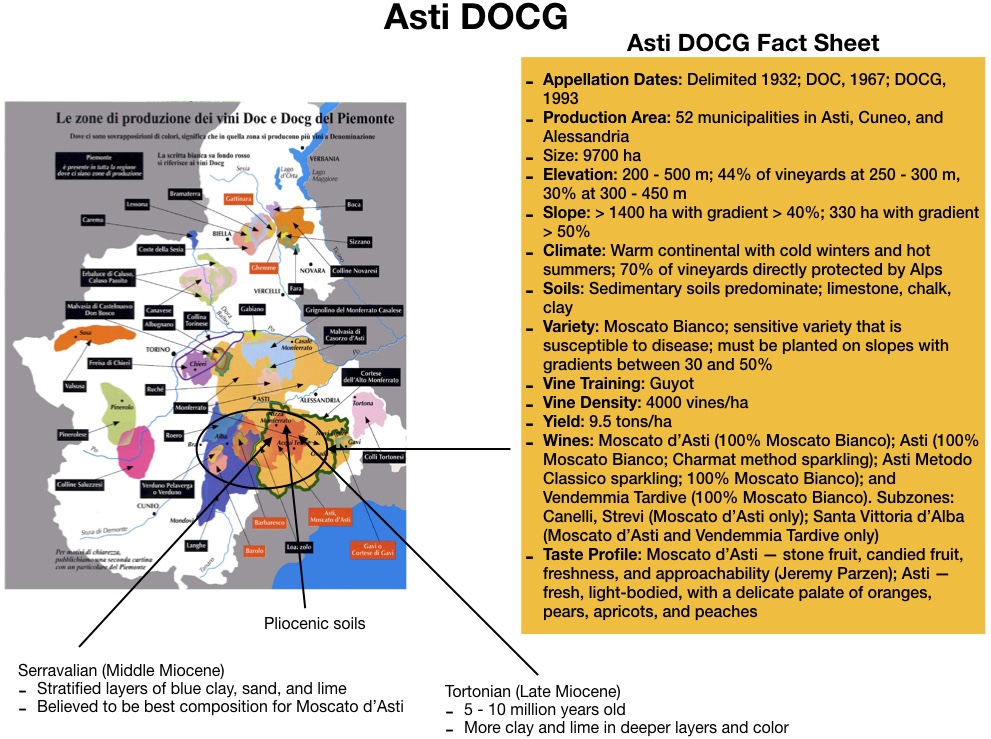
Asti DOCG is by far the largest sparkling wine appellation in Piemonte with 9700 ha under vine in 52 municipalities stretching across the provinces of Alessandria, Asti, and Cuneo. Most Asti production is via the Charmat method but, as the map shows, there is a designation for Asti Metodo Classico. The Moscato Bianco grape is used as the raw material for the Asti wine.

Muscat is a large family of grapevines characterized by a unique "muscat" flavor. Moscato Bianco is the primary member in that it is grown in every Italian region and is the key component in at least 13 DOC(G) wines (Moscato d'Alessandria and Moscato Giallo are also very important members of the family.). All red Muscat varieties are directly related to Moscato Bianco which, in addition, has parent-offspring relationships with the two Moscato's mentioned previously as well as Moscato di Scanzo, Moscato di Violetto, and Moscato Rosa.

Outside of Italy, Moscato Bianco has long been cultivated in many temperate European countries. Within Italy, it is mainly associated with Piemonte. In the 16th century, it was widely planted in Asti Alessandria, and Cuneo, with the most important centers of production being Canelli, Santo Stefano Belbo, and Loazzolo. A Moscato d'Asti Consortium was initially formed in 1932, two years prior to the formation of the similar Barolo organization.

The key details of Asti DOCG is presented in the chart immediately following.


The Metodo Classico wine is produced using the Champenois method but the stars in this region are the Asti and Moscato d'Asti wines, both made using the Charmat method. The Charmat method is preferred, not only because of its lower cost of production and quicker-time-to-market, but also due to its ability to preserve the primary aromas of the variety through the process. The Asti production process is illustrated below.


Alta Langa DOCG
Alta Langa -- DOC in 2002, DOCG in 2011 -- is the new kid on the sparkling-wine block but the combination of its terroir, traditional Champagne varieties, traditional production method, skilled growers, and savvy producers bode well for the future.

The Alta Langa DOCG is spread over 142 communes in the provinces of Alessandria, Asti, and Cuneo. Given the geographic scope of the region, one encounters a variety of climates, exposures, elevations and soil types. In general, the soil is a mildly fertile calcareous clay marl.
Source: altalangadocg.com

Growers in the region have looked enviously at Champagne since the early 1800s. So much so that the Counts of Sumbay planted Chardonnay and Pinot Noir vines with an eye to making a Champagne-like sparkling wine. The chart below summarizes the history of the effort to make a Metodo Classico wine in Piemonte.


Vineyards are required to be planted at 250 m and above on the region's steep, terraced hillsides. Allowed varieties are Pinot Noir and Chardonnay and other non-aromatic grapes. Planting density is a minimum of 4000 vines/ha with the vines trained using the low espalier system and pruned traditional Guyot and spurred cordon. The maximum allowed yield is 11,000 kg/ha.

The Alta Langa producers -- 27 currently -- do not grow enough fruit to meet their needs but that gap is bridged with fruit from 80 growers who own their land and are guaranteed producer-payment for their grapes and labor.

The above two Piemonte sparkling wines would be the ones that most American consumers would encounter domestically.

Gavi/Cortese di Gavi DOCG
Villa Sparina Metodo Classico is produced at the Villa Sparina Resort and Winery, located in Monterotondo, the heart of Piemonte's Gavi DOCG. The facility was founded by the Moccagatta family in the 1970s. The location of the winery is shown in the following slide.


The estate sits on 100 ha, 70 of which are dedicated to grapes for the production of Gavi and Barbera.

Monterotondo is a cru for the Cortese grape of Gavi, the grape that is the basis for the Villa Sparina Metodo Classico Brut. The grapes are grown in vineyards resident at 250 - 300m altitude with mainly south and southwest exposures and soils of clay and marl. The vines are trained Guyot and are planted 4000 vines/ha density.

The grapes for the base wine are fermented in stainless steel tanks over a 3-week period. Second fermentation is carried out in bottles with the wine spending 36 months on its lees.

The wine had an initial breadfruit nose upon opening which gave way to a sweet white flower/fruit, citrus, citrus skin, pineapple and a steadily increasing pepper spice. Peach on the palate with a lemony-lime acidity. Medium weight, not as crisp as I prefer. Sparing, emaciated bubbles. Mineral persistence -- chalky clay -- on the palate. Short finish. The taste profile falls somewhere between a Franciacorta and a Prosecco; shaded towards the Prosecco end of the spectrum.

©Wine -- Mise en abyme
Saturday, November 23, 2019

On the cutting edge of Spanish wines: Quinta da Muradella's Muradella Blanco (DO Monterrei)

Panelists in a seminar titled Wines on the Cutting Edge -- one of the events that comprised Wines from Spain's Great Match Miami (November 5, 2019) -- proposed eight wines they viewed as fitting that description (as it relates to Spanish wines). The panel tasted and discussed four whites and four reds and I will report on each in individual posts. I covered Tajinaste's Blanco in a previous post and cover Quinta da Muradella's Muradella Blanco herein.

Panelists from left to right: Allegra Angela, Sommelier and
Beverage Director, Mandarin Oriental; Daniel Toral, Sommelier,
Florida Wine Company; Mia Van de Water MS, Eleven Madison
Park; and Michael Schacter, Editor of Spanish and South American
Wines, Wine Enthusiast (Panel Leader)

DO Monterrei
Quinta da Muradella is located in Galicia's DO Monterrei, which takes its name from the medieval castle which dominates the area.


Monterrei Castle

The DO falls within the Douro River Valley (as most of its vines are planted in the valleys along the Tamega River, itself a tributary of the Douro) and has two sub-zones (Slopes of Monterrei and Monterrei Valley) and three growing districts (Pazo de Monterrei, Oimbra, and Tamaguelos).

The climate is continental, warm and dry during the summer and very cold in the winter. The mountain ranges proximate to the DO, combined with its distance, limits the moderating influence of the Atlantic Ocean. The rain-shadow effect -- caused by the mountains -- limits annual rainfall to 23 inches, less than 1/4th the 93 inches experienced by Rais Baixas, a DO that is closer to the ocean.  During the ripening period, the area experiences 20-degree diurnal temperature variation.

Elevations in the DO range between 300 and 900 m.

There are three major soil types in the DO:
  1. Slate and Schist
  2. Granitic and sandy -- low pH soils resulting from the erosion of granitic rock
  3. Sedimentary.
Soil composition will vary depending on altitude.

Aromatic white varieties (Godello, Treixadura, Dona Blanco, Albarino) comprise 67% of all plantings.

Quinta da Muradella
Jose Luis Matteo, the owner and winemaker at the estate, has been described by Julia Harding MW (writing in Jancisrobinson.com) as a "skillful and intuitive winemaker." For his part, Jose Luis pursues "wines with fresher notes, mixed wines that reflect the balance of the vineyard and have ... good acidity." It should be noted that that is a challenging endeavor, given the Monterrei climate.

Jose Luis began making wine in 1991 to sell to patrons in his father's shop. Today he owns 14 ha and rents and borrows an additional 10 ha. A total of 36 small plots are spread across various elevations, aspects and soil types. Vineyards are managed as biodynamic but are certified organic, with head-pruned vines planted at 8000/ha.

Muradella Blanco
The Muradella is 100% Treixadura, a Galicia native that is naturally low in acidity and develops high sugar levels. It is generally used as a blending grape to mitigate the racy acidity of the the other whites actively utilized in the region. Its flavor profile includes citrus, apple, pear, and stone fruits.

The vines for this particular wine are 21 years old and reside on quartz soils. The fruit is placed -- 50% whole cluster, 50% whole berry -- into stainless steel tanks where they macerate for 48 hours. The first half of the fermentation (indigenous yeasts) is conducted in the stainless steel tanks after which the material is transferred into 3-year-old, 600 L barrels for completion of fermentation. The wine remains in barrel for 8 to 10 months before decantation into stainless steel tanks for another 12 months of residence. The wine is not filtered prior to bottling.

The 2015 Muradella Blanco had a textured nose: oyster shells, waxy minerality, and fennel. Savory on the palate with herbs and spices in abundance. Seashell flavor. Acidity not as bright as I would have liked. Chalky mineral finish.


The panelists felt that this wine would go well with shellfish. And they priced it at around $80.

This is a cutting-edge wine because of the treatment of this relatively obscure varietal by the "deft, light-handed winemaking of a skillful and intuitive winemaker."

©Wine -- Mise en abyme

Monday, November 18, 2019

Spanish wines on the cutting edge: Tenerife's Tajinaste Blanco

For the last two decades of the prior century, European winemaking was consumed with the  traditionalist versus modernist battles, a pre-occupation which did not avoid the Spanish industry. The modernist movement in Spain is encapsulated in Sarah Jane Evans MW description of new-wave Riojas:
What set the new-wave Riojas apart was their densely colored, super-concentrated character, which won new fans who liked bold, fruity reds. These wines were the result of a new focus on the vineyard, including specific clonal studies ..., reduced yields, fermentation in small, separate lots and aging in French oak. ... They were released after a shorter time in barrel and bottle.
Writing in The World of Fine Wines, Mike Steinberger, sees the modernist movement in retreat as a result of: changing sensibilities; global economic crisis; a renewed passion for the authentic, the local, the natural; and the waning influence of previously influential wine critics.

What is the new face of Spanish wines as the modernist movement retreats? According to panelists in a seminar titled Wines on the Cutting Edge, a part of Wines from Spain's Great Match Miami (November 5, 2019), it is a movement to different and unusual wines and areas.


The Wines on the Cutting Edge masterclass was helmed by Michael Schacter, Wine Enthusiast's Editor of Spanish and South American Wines. Other panelists were: Allegra Angela, Sommelier and Beverage Director, Mandarin Oriental; Daniel Toral, Sommelier, Florida Wine Company; and Mia Van de Water MS, Eleven Madison Park. The group tasted and discussed four whites and four reds that they considered as being on the cutting edge of Spanish wine. I will cover these wines individually beginning herein with the Tajinaste Blanco.


First, some background.

Tenerife is the largest island in the Canary Island archipelago, seven Atlantic-Ocean islands held under the Spanish flag. These islands were formed as a result of a mantle plume hotspot acting on the African plate as it wends its way to Morocco. The easternmost island -- Lanzarote -- emerged from the sea 20 million years ago while Hierro, the westernmost, was formed only 1 million years ago. Tenerife is dominated by El Teide, at 3,718 m (12,200 feet), the tallest mountain in Spain.

Tenerife's climate is tropical but is moderated by the mountain and the moisture-laden clouds brought to the area by the trade winds. These clouds are blocked by the mountain, depositing the moisture on its northern face and foothills.

Tajinaste Winery -- named after a flower that grows on the island -- is located in the valley at the foot of the mountain. The winery falls within the boundary of the DO Valle de la Orotava, a 400-ha appellation that spans the villages of La Orotava, Los Realjos, and Puerta de La Cruz. The winery is managed by Augustin Garcia Farrás, a Bordeaux-trained winemaker and scion of a family that has been making wines on Tenerife since the second decade of the 20th century. The winery owns 3 ha in the DO -- with the oldest vines planted since 1914 -- but, in addition, rents 9 ha under 25-year contracts and buys grapes from an additional 16 ha.

Vines on the estate are trained in the traditional braided-strand method (see pic below) wherein vine branches are braided together in large bunches of multiple strands:
  • Vine lengths range between 3 and 15 m
  • Allowed branches to be moved easily leaving the earth below free for the planting of other food crops
  • Evolved due to space constraints on the island.
Source:escapementmagazine.com

The wine under consideration -- Tajinaste Blanco -- is a blend of 90% Listan Blanco an 10% Albilo Criollo, the latter adding acidity to the wine. Listan Blanco is a white cultivar with "modest aromatic intensity" and is "crisp and  lively with lemon-lime and green apple flavors." One half of the fruit for this wine is grown at 500 m with the remainder grown at 250 m.

Listan Blanco (Palomino) cultivar

The grapes are harvested manually and placed into 15 kg boxes for transport to the winery. In the winery they are subjected to a 12-hour cold soak prior to a 8-day fermentation in stainless steel tanks and new French and American oak barrels (15%). The wines are aged in their fermentation vessels for 2 months before blending and bottling.


The 2018 Tajinaste Listan Blanco showed lime peel, lemon peel, turpentine, and guava on the nose. Brisk, clean, and zesty on the palate with tamarind flavors and minerality. A herb-laden aftertaste. Not an overly complicated wine. Can be drunk on its own but will pair well with seafood and white meats. This wine ranges between $20 and $22 at retail.

This wine is on the cutting edge because of one of the qualities identified by Mike Steinberger: a renewed passion for the authentic, the local, the natural.

  • This wine is made from a grape that is best known for its role in Sherry but it handles its leading role in this environment with flair
  • The vines used to grow these grapes have been around since 1914
  • The vine training system is just as old and it is sexy as hell
  • A current love for volcanic wines (see, for example, Zoltan Szabo's Volcanic Wines wherein, by the way, this winery is profiled)
  • Due to the volcanic soils, this area is Phylloxera-free and the vines own-rooted.

Yeah, I would say a cutting-edge wine. And a value-based one at that.

©Wine -- Mise en abyme