Tuesday, September 11, 2018

Fontodi's Flaccionello della Pieve: A vertical tasting (1995 - 2015)

Besides its DOCG, Vin Santo, and Gran Selezione wines, Chianti Classico is also known as the birthplace of the now-famous Super Tuscans. The Super Tuscan wines grew out of producer frustration with earlier iterations of the wine laws which prevented them from making wines that were 100% Sangiovese, or removing the allowed white varieties from the wine. Some producers made these types of wines anyway but they could only be called table wine under existing laws. These wines were so finely made, and widely accepted, however, that the laws were modified such that a new level -- IGT -- was created above the table wine to support their initiatives. The current instance of the Chianti Classico wine laws would allow many of the Super Tuscan wines to be labeled as Chianti Classico but many producers continue to retain the IGT label and the success that they have enjoyed as standalone brands.

Such is the case for Fontodi and its vaunted Flaccionello della Pieve, a 100% Sangiovese wine made in an international style. Wine Watch (Ft. Lauderdale, FL) recently held a tasting of selected vintages of the wine produced between 1995 and 2015. I report on that tasting in this post.


The Estate and the Wine
The Fontodi estate sits on 130 ha of land -- 70 of which are planted to vines -- just south of the village of Panzano, itself located in the commune of Greve in Chianti. The estate, which includes vineyards that have been operational since the days of the Roman Empire, was purchased by Dino Manetti in 1968 and his son Giovanni came aboard in 1979 (Prior to their involvement in the winery, the Manetti family produced and sold terracotta amphorae.). Giovanni took over the running of the business in 1980.

Panzano, the estate's home village, sits at one end of  ridge which divides the valleys of Pesa and Greve. On the Pesa side, the land falls away from the crest of the ridge in a number of amphitheater-like structures, the largest of which is called Conca d'Oro (golden shell). It is upon this south-facing, sun-drenched amphitheater that the Fontodi vineyards reside.


Source: fontodi.com
Vineyards on Conca d'Oro are planted at altitudes between 350 metres and 450 metres. The Chianti Classico climate is continental, with long summers and cold winters. Annual rainfall ranges between 700 and 800 millimeters and occurs primarily in the spring and late autumn. Conca d'Oro day-night temperature differentials are enhanced by its elevation.

The soil is a mix of flaky shale, galestro (crumbling schistous rock), and some limestone albarese.

Vineyard practices are focused on sustainability. The estate is certified organic with an end goal of becoming fully biodynamic (24 of 25 wineries in Panzano are either organic or biodynamic).

The Flaccionello label was launched by the estate in 1981 as a 100% Sangiovese (IGT) made in an international style. Grapes are hand-harvested and fermented in stainless steel tanks using indigenous yeasts. The wine is subjected to a post-fermentation maceration (with punch downs) of 3 - 4 weeks, upon completion of which it is transferred to barrels for malolactic fermentation and aging.

Eric Guido (Morrell Wine), in a piece titled The Evolution of Flaccionello, points out a number of changes in the Flaccionello production process over the years:
  • Fruit source -- the fruit for this wine was originally sourced from a vineyard named Flaccionello della Pieve. Beginning with the 2001 vintage, and subsequent to the purchase of some additional prime vineyard property, the decision was taken to make the wine as a blend of the best fruit across the estate's vineyards.
  • Aging regime -- Prior to 1990 the wine was aged for 1 year in 50% new oak. Beginning in 1990, the estate began a gradual shift to today's practice: 24 months aging in 100% new oak from the Troncais and Allier forests.
The Tasting
Early birds were treated to bottomless Franciacortas as we hung around the bar and engaged in pre-tasting banter. During the time that we were at the bar, all of the wines to be tasted were poured into our glass, giving them some exposure to oxygen prior to the actual engagement. The wines included in the tasting were: 1995 Felsina Fontalloro (don't ask me) and 1995, 1996, 1999, 2000, 2005, 2007, 2009, 2014, and 2015 Flaccinellos.


With the exception of the Fontalloro and the 2000 and 2014 Flaccinello, the wines presented extremely well with a red fruit-herb-tobacco character as a through line. There was a dividing line in the tasting at the 2005 vintage where the wines became more youthful in nature and the fruit subsumed some of the tertiary characteristics. My favorites of the night were the 1995 and 2005 but the consensus picks were the 1999 and 2007.

Tasting Notes
The 1995 Felsina Fontalloro presented dried red fruit, rose petals, and dried herbs on the nose. Flat and dried out on the palate. This wine did not persist well in the glass as an additional pour later in the evening revealed a much livelier character.

The 1995 Flaccionello was more robust on the nose than the Felsina but not as aromatic. Deeper, darker, more concentrated fruit. Elegant on the palate. Lean but powerful. Citrus and burnt orange and a lengthy finish. I loved this wine.

The 1996 Flaccinello showed red fruits and a nuttiness on the nose. A beautiful fruit note on the palate. Elegant. Lengthy finish. High-toned.

Roses, tobacco, and dried herbs on the nose for the 1999 Flaccinello.  Rich and concentrated. Spicy, lengthy finish.

The 2000 also showed herbs and roses on the nose. Big, broad-based fruit. Most developed of the wines tasted up to this time. Browning. Drink now or forever hold your peace.

The 2005 showed red fruit, wet tobacco, and a perfumed nose. Bright on the palate with a slight puckering. Sandy, spicy, and beautiful fruit. Lengthy finish.

The 2007 showed tobacco, smoke, and rich red fruit on the nose. Tobacco, red fruit, and a youthfulness on the palate. Lengthy, grippy finish. Long life ahead.

Red fruit, tobacco, herbs on the nose for the 2009. Herb-infused fruity finish.

Herbs, green bark, somewhat unyielding on the 2014 nose. Mushrooms and red fruit on the palate. Not as impressive as the foregoing.

The 2015 exhibited power. Plum, licorice, herbs, and smoke on the nose. Spicy and structured on the palate. A drying finish.

©Wine -- Mise en abyme

Sunday, September 9, 2018

Les Bessards, Le Méal, and L'Hermite: The top climats in Northern Rhône's Hermitage AOC

Variations in soil type, combined with elevation differentials, have resulted in a number of distinctive planting zones (climats) within the Northern Rhône's Hermitage AOC. The variations in soil type are reflected in pH differences (almost neutral at Les Bessards and 8.5 at Le Méal) and this, according to Jean-Louis Chave, "provides one of the most simple arguments in favor of blending the wines from different climats" (Livingstone-Learmonth). With two exceptions (Chapoutier's Le Pavillon and Delas' Les Bessards), the leading red wines of the region are multi-climat blends.

Truly understanding the wines of the region requires a familiarity with the characteristics of the individual climats. We begin that effort with a review of the three most important: Les Bessards, Le Méal, and l'Hermite (drawing primarily from John Livingstone-Learmonth's The Wines of Northern Rhône). The geographical scope of the three zones is outlined in red below.

The three most important climats in Hermitage encircled in red.
(Underlying map sourced from tenzing.com)

Les Bessards
Les Bessards is 'the beating heart" of Hermitage, its biggest and best climat. This south-facing climat starts out flat in its lowest reaches and steepens markedly with increasing altitude. The soil story here is granite -- in varying forms of decomposition. The locals divide the climat into three zones based largely on the composition of the granite in each (see map slice below).

Approximate allocation of sub-climat boundaries and
soils distribution (underlying map slice a screen shot
from tenzing.com)

Les Bessards is primarily a Syrah site. The table below shows the main growers and the characteristics of the wines they produce.

Table 1. The role of Les Bessards in leading Hermitage red wines
Producer/Wine Climat Role Wine Character
Chapoutier/Pavillon Source “the Bessards granite gives a rigorous, mineral impact in its wines — there is a tension in the wine from the granite.”
Delas Main contributor “… complexity is the principal characteristic of our Bessards cuvée. Its richness sits well on a thoroughbred structure …”
Jaboulet/La Chapelle 1/4th “… the finesse in their Bessards Syrah comes from the rotted granite …”
Chave/Hermitage Foundation wine “… our essential climat — you cannot make a Grand Hermitage without it … the frame around which we work; no granite — no long life.”
Source: Derived from The Wines of the Northern Rhone.

Delas produces Marsanne wines from a 1-ha plot at the bottom of Les Bessards. The soil here has some granite stones but is "more vegetal, deeper soil than elsewhere" in the climat.

Le Méal
This is the second ranked of the three great Hermitage climats and is a "perfect counterpoint" to Les Bessards:
  • Les Bessards is oriented verticallly while Le Méal is oriented horizontally
  • Les Bessards soil is all about granite while there are a multiplicity of soil types at Le Méal
  • Le Méal is hotter than Les Bessards
  • Largely due to the two preceding points, Le Méal produces "open, warm-structured Syrahs" versus the brooding and severe wines of its counterpart.
This south-facing climat is one of the steepest in the AOC, starting out flat and then rising quickly to its maximum height of 240 m.

The soil is comprised of light-colored glacier stones and loose soils of silt and sand from Tertiary era alpine glaciers. The stones radiate the sun's heat resulting in higher temperatures than in Les Bessards. Unlike the pH-neutrality at Les Bessards, the soils at Le Méal are alkaline. The soil difference between the two results in redder fruit being produced at Le Méal.

The soils at lower elevations contain a little more clay and are richer as a result. They are suitable for both red and white grapes.

The main producers in this climat are as follows:
  • Jaboulet -- largest holder (6.8 ha); product from this climat is the core contributor (25% - 50%) to the producer's La Chapelle
  • Chapoutier
  • J-L Chave -- provider of flesh to Hermitage
  • Sorrel -- Le Gréal (fruit from Le Méal combined with some Greffieux fruit)
  • Bernard Faurie -- Le Méal
Chapoutier finds the wines of this climat to be "... very silken, full of ripe fruits" while Livingstone-Learmonth sees them as "... gloriously sumptuous, rich wines that can hold animal and meat undertones stemming from the natural heat" of the location.

L'Hermite
L'Hermite runs across the top of the Les Bessards and Lé Meal climats and, in one area, has a penninsula-like out-jutting that temporarily separates the two.

There is a mix of soils in this climat -- granite, crumbling granite, loess, and alpine detritus -- resulting in sudden changes in soil composition even in vineyard rows. The figure below shows the soils distribution and the grape varieties by soil type.


The dominant influence on L'Hermite are the loess and alluvial stones of its central and eastern portions. These soils can run up to 0.5 m in depth. The alluvial stones (galets) aid fruit ripening. "I would place L'Hermite as one of the three best white wine sites at Hermitage -- those that give the most luscious, ripe Marsanne fruit from mature vines ..." (Livingstone-Learmonth). Jean-Louis Chave sees L'Hermite as a site for white wines of "balance and finesse."

Syrah vines are planted on granite and alpine glacier residues. "L'Hermite's red wines always carry freshness and spice, ... In some vintages, there can be a lot of maturity, but still a sound acidity. Its tannins are usually quite tight and vivacious" (Jean-Louis Chave in The Wines of the Northern Rhone).

In addition to Chapoutier and Chave, the Cooperative and Guigal also grow fruit in this climat.

©Wine -- Mise en abyme

Friday, August 31, 2018

Hermitage AOC (Northern Rhône): An overview of the physical and built environments

Digress (a progressive, hip, Orlando-based wine retailer) recently paired up with Progress Wine Group (a regional Distributor) to present a tasting of Domaine Jean-Louis Chave's wines from (primarily) the Hermitage and St Joseph AOCs of the Northern Rhone. I will report on the tasting but, as is my wont, will first provide some background on the subject zones, beginning with Hermitage.

I have previously treated the construction of the Rhone wine region landscape. With the exception of the Croze-Hermitage and Hermitage AOCs, all of the Northern Rhone appellations are located on the right-hand-side of the river, clinging precariously to the steep metamorphic or granitic slopes of the Massif Central.


Beginning at Saint-Vallier, the Rhone cut its way through the metamorphic rocks and basement granite, providing right-bank-style soils on the left bank between Saint-Vallier and Tain-l'Hermitage. The Hermitage appellation encompasses the granite of the Hill of Hermitage plus some of the upper-terrace strata.

"This is a place of wine pilgrimmage. The birthplace of Syrah. I can think of few appellations with such an emotional draw ..." So said Jamie Goode (wineanorak.com) in describing the hill of Hermitage. As the source of hallowed wines from revered producers such as Domaine Jean-Louis Chave, Chapoutier, Delas, and Jaboulet, the AOC is held in high esteem by winemakers, collectors, and sommeliers the world over.

Hermitage's 137 ha is spread over three communes: Tain-l'Hermitage, Crozes-Hermitage, and Larnage. The vineyards are south-facing and, thus, protected from the north winds except for the plateau around Maison Blanche and L'Homme and the "out-jutting" at Varogne.

The Hermitage Hill from the heights of Tournon-sur-Rhône.
By David.Monniaux - Own work, CC BY-SA 3.0,
https://commons.wikimedia.org/w/index.php?curid=3618243

Elevation on the hill ranges from 126 m at the lowest point to 344 m at the summit. Elevation changes is reflected in the wines as a 1º loss in alcohol for every 100 m elevation gain. Planting density is also affected by elevation with the highest and steepest slopes planted at 10,000 vines/ha and lower slopes at 7,000 vines/ha.

James Lawther MW (Understanding Hermitage, Decanter, 3/132/04) arranges the Hermitage soils into three classes: the western granitic band (separated from the Massif Central by the cutting force of the river); the high terraces in the center and east (formed as the river worked towards its present-day course); and the mid and lower terraces (containing alluvial material deposited by the Rhône). The various soil types found in the AOC are shown in the chart below.


Variations in soil type, combined with elevation differentials, has resulted in a number of distinctive planting zones (climats) within the broader AOC. These climats -- and characteristics of a subset -- are presented in the chart below.


The primary grape varieties planted in the AOC are Syrah (red), Marsanne (white), and Rousanne (white). The red wine (76% of the region's production) can contain up to 15% of the primary white grape varieties.

The 5 largest landholders on the hill farm 80% of the available land. The table below idedntifies those producers, the size of their estates, their prestige label, and the climats from which grapes for those labels are sourced.

Producer
Size (ha)
Label
Les Bessards
Le Méal
L’Hermite
Les Greiffieux
Chapoutier
32.5
Le Pavillon
X


Monier de la Sizeranne
X
X

X


Cave de Tain-l’Hermitage
32
Gambert de Loche
X
X
X


Paul Jaboulet Ainé
25
La Chapelle
X
X

X


Domaine Jean-Louis Chave
14.5
L’Hermitage*
X
X


Delas
10
Les Bessards
X


Marquise de la Tourette
Mostly


*8 climats in the blend


©Wine -- Mise en abyme

Friday, August 24, 2018

Ulysse Collin: Great Grower Champagne from the Val du Petit Morin

As was the case for Chartogne-Taillet, Robert Walters (Bursting Bubbles) mentioned Ulysse Collin in his survey of the Great Growers of Champagne but did not go into detail about the estate and its wines. As I did in the Chartogne-Taillet case, I will address that shortcoming in this post.

Ulysse Collin farms 8.7 ha of vines divided between the Val du Petit Morin (4.5 ha) and Côte de Sézanne (4.2 ha) zones of the Côte des Blancs sub-region of Champagne (In a recent post, I gave my reasons for deviating from the Peter Liem organizing schema in this sub-region)

Val du Petit Morin (green oval) and Côte de Sézanne's
positioning in the Côte des Blancs sub-region
of Champagne (Source: champagne.fr).

The Val du Petit Morin (referred to as Cotéaux du Morin by Peter Liem in Champagne), gets its name from the river that runs through the area in an east to west direction. Soils on the northern bank are chalkierthan soils to the south and are very well suited to growing Chardonnay. The soils on the southern shore are richer in clay and are better suited to the growth of Pinot Meunier. The valley floor is populated with marshes and forests thus the vineyards are located on the gentle slopes of the tributaries.

Côte de Sézanne is characterized by alternating plains, vineyards, swamps, and forests. The climate is the mildest in the Côte des Blancs. Annual rainfall averages 620 mm. There are higher amounts of clay in the chalk soils of Côte de Sézanne than in Val du Petit Morin, with increasing intensity the farther south one goes.

Olivier Collin is the proprietor of Ulysse Collin. His family owned 4.5 ha in the village of Congy in Val du Petit Morin but had leased it out to Pommery. After apprenticing with Jacques Selosse between 2001 and 2003, Olivier was inspired to launch his own estate and did so upon regaining control of the Pommery vines at the end of the lease. Olivier gained control of another 4.2 ha from his Grandmother's estate to bring his ownership total to 8.7 ha. The distribution of Ulysse vineyards is shown in the figure below.


Olivier practices a mix of organic and conventional farming in order to give him the flexibility to intervene if the occasion warrants it. Vineyard practices include:
  • Ploughing ("To plough the soil encourages biological activities for oxygen, water, temperature and fungus" -- Olivier Collin)
  • Powdered sulfur to combat odium
  • Organic insecticides used against ver de la grappe (tiny caterpillar that eats the berries and causes gray rot)
  • Mildew is fought with chemical compounds
  • Organic compost is added to the soil as needed.
The estate's winemaking is "as natural and non-interventionist as possible." Grapes are harvested and pressed manually. The first and second issue from the press are pumped into vats and stored separately for settling. The juice is fermented with indigenous yeasts with both alcoholic and malolactic fermentation taking place in 3-to-6-year-old barriques.

The first- and second-press wines are aged separately for 1 year after which they are blended. According to Olivier, the first press provides backbone and structure while the second adds strength and richness. There is no fining or filtration. Twenty to forty percent of each year's wine is held back for a reserve wine.

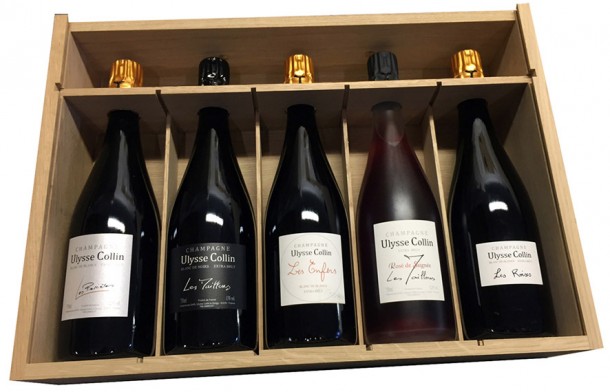
Peter Liem describes Ulysse Collin as "the foremost champion of the Coteaux du Morin," making "... ripe, richly expressive single vineyard wines" from the vineyards shown above. The range of wines are shown below.

Ulysse Collin champagne box
Source: lemiebollicine.com

According to Liem, the Rosé de Saignée is a vibrant, energetic wine, full of concentrated red-fruit flavor (1.7 g/l dosage); the Les Pierrières is a sleek elegant wine, marked by a smoky, spicy minerality (1.7 g/l dosage); the Les Roises is a richer more powerful wine than the Les Pierrières (1.7 g/l); the Les Maillons is a robust, full-bodied blanc de Noirs (2.4 g/l dosage); and the Les Enfers is a sleek, vividly fruity wine (1.7 g/l dosage). The Rosé de Saignée spends 24 - 36 months on its lees; all other wines spend 36 months on the lees.

©Wine -- Mise en abyme

Thursday, August 16, 2018

Peter Liem's case for a single grouping for the Val du Petit Morin, Côte de Sézanne, Vitryat, and Montgueux Champagne zones is weak

In his best-selling book Champagne: The Essential Guide to the Wines, Producers, and Terroirs of the Iconic Region, Peter Liem unveiled a new and unconventional schema for the Champagne sub-regions. I have been adhering to this schema in my exploration of the "Great Growers" of Champagne but find myself in opposition to his classification covering the areas Coteaux du Morin (Val du Petit Morin), Côte de Sézanne, Vitryat, and Mongueux. I clarify my opposition in this post.

The Union de Maisons de Champagne schema has historically been the lens through which the Champagne region has been viewed. In this schema, the four growing zones mentioned above have been included in the Côte des Blancs sub-region. Liem has grouped them together (shown in the graphic below) because, he says, they are new plantings.


As Liem describes it, the vineyards of Champagne were decimated, sequentially, by the Phylloxera epidemic, the First World War, and economic depression, and The Second World War. Prior to the Phylloxera infestation, the region was home to 60,000 ha of vineyards, almost double today's 34,000 ha. Following the conclusion of WWII, interest in the Champagne region was rekindled and large scale replantation was begun. By the 1960s and 1970s that interest begun to extend to the zones under discussion; zones which "had lain fallow for the last half century."

According to Liem:
Today, these viticultural areas are established, yet there are still fewer grower-producers in these regions than in others, with growers selling most of their grapes to houses or cooperatives. This means that it's still early days yet for deciphering the characteristics of the soil, climate, and exposure unique to these southern and eastern parts of the Champagne region.
Based on the foregoing, (i) there is no clearly definable reason for breaking these zones out from the UMC schema nor (ii) is there a clearly credible rationale for grouping them together.

As it relates to the geology of the region, the slow sagging of the Paris Basin caused an upthrusting of ancient geologic formations at the outer perimeter with each formation exhibiting as a concentric, outward-facing escarpment. In the case of Champagne, the escarpment is comprised of sands, marls, and lignitic clays of the Tertiary period capping chalk from the upper Cretaceous and, below Chalons, clays and sands of the lower Cretaceous.


The soils in the defined Champagne region is not monolithic, however. The Côte de Bars region of Champagne has Kimmeridgian soil of the same construct as the soils that underpin the vineyards of Chablis and Sancerre. In the Aisne region the upper Cretaceous has dipped into the Paris Basin  and the soil is comprised entirely of Tertiary clays and sands. In the area below Chalone -- referred to as wet Champagne -- the poor-permeability clays and sands of the lower Cretaceous period are dominant. The Champagne soils distribution is illustrated graphically below.


The chart above shows that Coteaux du Morin and Côte de Sézanne have source soils that are similar to the core Côte des Blancs and the broader Champagne while Montgueux and Vitryat seem to reside on a soil that is unique to the region. And Liem notes this in his book:
The Campanian chalk found in the Côte des Blancs or the Côte de Sézanne is what Champagne is famous for, but the chalk found here in Vitryat is different, hailing from the earlier Turonian Stage ...the chalk in Montgueux is Turonian, like the chalk in Vitryat.
While these zones are warmer, and do contain higher levels of clay than the soils of the more northerly vineyards, they are similar to the Côte des Blancs in the primacy of Chardonnay.

In summary (i) there is no clearly definable reason for breaking Coteaux du Morin (Val du Petit Morin), Côte de Sézanne, Vitryat, and Mongueux out from the UMC schema nor (ii) is there a clearly credible rationale for grouping them together. If pressed, I could agree to Montgueux and Vitryat, given their southerly locations and unique soil type, being joined in a separate zone. I do not see any benefits accruing from such a scheme, however.

©Wine -- Mise en abyme

Thursday, August 9, 2018

The roles of soil minerals and cation exchange capability (CEC) in meeting the nutrient requirements of the grapevine

Adequate amounts of the appropriate nutrients are required to support proper growth of the grape vine, fruit development, and fruit maturity and those nutrients are obtained from the soil by the plant.  The table below shows the mineral requirements of the vine plant, the role of each mineral, acceptable ranges of each mineral in the soil, and the impact of mineral deficiency on the vine.

Source: Compiled from LGRGP.org and others

Mineral Sources
Rocks
The earth is made up of varying proportions of the 90 or so naturally occurring elements but, according to Alex Maltman (Vineyards, Rocks, & Soils), four of these -- oxygen at 48%, silicon at 28%, aluminum at 8%, and iron at 6% -- are responsible for 88% of its composition. In most geological materials, these elements combine to form minerals -- "a naturally occurring combination of specific elements that are arranged in a particular repeating three-dimensional structure or lattice" (opentextbc.ca, Minerals and Rocks).

Lattice structure of the mineral halite. Atoms of sodium alternate
 with atoms of chlorine in all three dimensions
 (Source: opentextbc.ca)

In order to effect the above bond, the sodium atom yielded one of its electrons to the chlorine atom, attaining a positive electrical charge as a result. Atoms which experience a change in the number of electrons are known as ions. An ion with a positive electrical charge, resulting from the loss of an electron, is called a cation. An atom with a negative charge, the result of gaining an electron, is called an anion. The bond that is formed as a result is referred to as a stable compound (Maltman)

In nature, minerals are found in rocks "and the vast majority of rocks are composed of at least a few different minerals." The picture below shows a piece of granite and its constituent minerals.

A close-up view of the rock granite and associated minerals
(Source: opentextbc.ca)

The figure below shows a typical soil profile.

Source: http://www.westone.wa.gov.au

Jackson (Wine Science: Principles and Applications) stipulates that (p. 245) "... the mineral content of soil is primarily derived from the parental rock substrate." The figures below show the weathering of rocks into minerals.


Source: geology.csupomona.edu

Decaying Organic Material
Jamie Goode (Rescuing Minerality) contends that the bulk of soil mineral content comes "from decaying organic material, not decomposed rock and it is microbial activity in the soil that affects the ability of soil to break down organic matter into mineral ions that can be used by the plant." Maltman agrees with Goode: "... in practice, it's the humus that's more important, indeed essential."

According to Schwarcz and Schoeninger (Stable Isotope Analysis in Human Nutrition, Yearbook of Physical Anthropology 34, pp. 293-321), almost 100% of exchangeable nitrogen is found in the atmosphere or dissolved in the world's oceans and is transferred from these environments into the biological system through the processes illustrated in the figure below.  Grape vine plants receive their nitrogen through this terrestrial nitrogen cycle.

Source: http://tolweb.org/notes/?note_id=3920

Cation Exchange
Soil-based nutrients are resident either in the soil solution (water and dissolved minerals in the soil pores) or in the soil matrix (mineral particles and organic matter).  Two problems present themselves, however: (i) the concentration of nutrients in the soil solution is low and (ii) the nutrients resident in the soil matrix are immobile.  Plant roots have developed adaptions to allow growth into the soil matrix and capture of the nutrients needed for metabolic activity (Dr. Paul Schreiner, USDA-ARS) and we will discuss these later.

Most of the mineral nutrients that the vine needs are cations so the soil's cation exchange capacity (CEC) is a major enabler of  it's nutrient acquisition. The positively charged mineral ions bind loosely to the clay and humus colloids in the soil and these minerals are released in exchange for hydrogen ions secreted by the vine roots. (Clay minerals act as harbors for nutrients because the positive ions of the nutrients are trapped by the negative charge of the clay minerals.  The abundance and types of minerals determine whether the clay is classed as low- or high-CEC.). The ion that makes the strongest link with the clay is the hydrogen ion "... and its almost as though the vine knows this! The vine's metabolism can prompt its roots to pump out hydrogen ions into the soil water, which then dislodges the other ions held on the clays, thus making them available to the vine roots" (Maltman). This concept is illustrated in the figure below.

Illustration of the cation exchange between
vine roots and surrounding soil particles
(Source: bio1903.nicerweb.com)

Roots have developed a number of physical and chemical adaptations to allow them access to an immobile nutrient set resident in the soil matrix (Dr. Schreiner).  The first adaptation is the root size and structure.  The vine plant deploys an always-growing, three-part root structure to meet its needs for anchoring, water- and nutrient-acquisition, nutrient storage during plant dormancy, and hormone production.  As it relates to nutrition, the plant deploys quick-growing, short-lived roots close to the surface to aid in moisture collection and primary roots for nutrient uptake (The woody roots (anchoring and transport) take up limited amounts of nutrients due to the presence of a waxy coating designed to keep ions in.).  According to UCDavis, about 60% of a vine plant's root structure is located within two feet of the surface but individual roots can grow as deep as 20 feet depending on soil permeability, water table levels, and rootstock variety.

Source: bccs.bristol.ac.uk

The second adaptation is the formation of symbiotic relationships with arbuscular mycorrhizal fungi (AMF), a non-specific fungi which extends its apparatus beyond the plant's zone of influence in order to retrieve minerals such as Phosphorous and Zinc and, in return, utilizes plant-derived carbon for its growth and reproduction.  Both the plant and fungi benefit from this relationship.

A third adaptation is the ability to secrete protons, organic acids, and enzymes and release these into the surrounding soil in order to increase the solubility -- and absorbability -- of certain ions.

Nutrient Transport
In order to effect nutrient transfer, the roots of the plant has to be in direct contact with the soil matrix and the nutrients have to be delivered to the root surface.  Nutrients reach the root surface in a combination of three ways: interceptionbulk flow, and diffusion.

Source: baileybio.com

Only a small fraction of the plant's nutrient needs are met by interception.  In this case, as the root grows into new areas, it displaces nutrients resident in the soil matrix.  Once on the root surface, the nutrients transit through the root's plasma membrane using available ion-selective channels.  The transfer is effected as the ions flow from areas of high concentration to areas of low concentration.

Bulk flow is the movement of nutrients towards the root as a result of transpiration water uptake. Water enters a vineyard through precipitation or irrigation and that water either runs off, flows to levels beyond which it can be accessed by the vine plant, or remains in the rooting zone where it is available for the plant's use.  The plant uses water as an internal distribution vehicle (in addition to other functions) and facilitates this by expelling water through pores (stomata) in the leaves.  As water is transpired from the leaves, replacement water is drawn in at the roots.  This replacement water moves undiluted nutrients to the root surface but also carries dissolved nutrients into the roots as a part of its transit. Nitrogen is the nutrient most frequently acquired by the roots in this manner.

Source: talktalk.co.uk

Diffusion is the mechanism whereby nutrients move toward the roots as a result of agitation caused by the concentration gradient that develops near the root surface as a result of nutrient uptake. Phosphorous and Calcium are the nutrients most susceptible to this type of capture.

In addition to the above mechanisms, as mentioned previously, the plant can utilize AMF to reach beyond its depletion zone in order to bring Phosphorous to the root interface.

©Wine -- Mise en abyme

Saturday, August 4, 2018

Larmandier-Bernier: Great Grower and "one of the finest estates in the Côte des Blancs"

Sophie Larmandier (Larmendier-Bernier) and Robert Walters (Bursting Bubbles) both refer to Pierre Larmandier (Proprietor, Larmendier-Bernier) as the Monk of Vertus, "... not only for his devotion to great wine, cheese, and charcuterie ... also for a certain ascetic, almost puritanical element of his personality that reminds us of the monastery ... And there are the wines that he produces ... wines of great purity, monuments of restraint that are one more nod to the monastic." Peter Liem (Champagne) refers to the estate as being one of the finest in the Côte des Blancs. I explore the estate and its wines in this post.

The 15-ha estate is comprised of vineyards in the Premier Cru village of Vertus and the Grand Cru villages of Cramant, Chouilly, Oger, and Avize. The vineyard plots average 33 years and are planted to Chardonnay (85%) and Pinot Noir. The various Larmandier-Bernier terroirs are illustrated in the chart below.


Larmandier-Bernier had a history as two separate estates stretching back to the French Revolution but came together as a single entity with the marriage of Philippe Larmandier and Elisabeth Bernier in 1971. Pierre, the current proprietor, was away at school when his father died but his mother insisted that he complete his studies before coming back and taking control of the enterprise. He returned in 1988.

Prior to Pierre taking the reins, Larmandier-Bernier operated in a "traditional" fashion. Once he took control, however, he began moving the company in a different direction, influenced, in part, by the work of Anselme Selosse and his wife's aversion to the widespread use of chemicals in Champagne vineyards. The chart below shows estate practices pre-Pierre and how those have been altered during the course of his stewardship.


The key to the Larmandier-Bernier wine is the ability to harvest fully ripe grapes. Walters sees this ability being driven by:
  • Biodynamic viticulture
  • Balanced yields
  • Minimal fertilizers
  • Precise pruning 
  • The nerve to wait.
According to Larmandier-Bernier, its recipe for high quality grapes is:
  • Old vines
  • Working the soil (The estate feels that ploughing promotes deep roots and facilitates healthy soils)
  • Moderate yields
  • No fertilizers
  • Mature grapes picked by hand.
After harvesting, the grapes are brought to the cellar where they are gently pressed (bladder press) to release the purest juice possible. Each cru is vinified separately (using indigenous yeasts) in one of several fermentation vessels: small Austrian oak, large Austrian oak, stainless-steel tanks, or enamel-lined stainless steel tanks. The wines undergo malolactic fermentation and are held on the lees (with some stirring) until blending/bottling.

The wines are bottled in the July following the harvest and are then taken down to the cellars for aging. The Larmandier-Bernier portfolio of wines are shown below.


In addition to its cuvées, Larmandier-Bernier produces two still wines: (i) Vertus - a Pinot Noir made from old Vertus vines. This wine is macerated for 12 days and aged in cask for 18 months. (ii) Cramant Nature -- Chardonnay from the Cramant vineyard which is barrel-fermented and aged for 18 months.


©Wine -- Mise en abyme