When I left you last, we had arrived at Sugar Mill Restaurant and had made our way to the seating area for Joy's Birthday dinner. I broke off the narrative at that time due to concerns about the length of the piece. This new post allows us to continue on a clean sheet of paper.
After Parlo and Joy had completed the tablescape, Joy assigned seats by placing name tags adjacent to each setting. Four members of our party had still not arrived but we went ahead and took our assigned seats anyway. The server responsible for our table introduced herself, the Assistant Server, and the Wine Steward and then distributed food menus. Joy wanted me to select the wines so she motioned the Wine Steward in my direction.
The wine list was professionally bound in green leather and the pages were laminated. I flipped through the pages quickly to size it up, saw that it merited careful study, and so went back to the beginning to give it the attention it deserved. This was not a hipster-Somm wine list. It was very traditional, with representative brands from the world's major wine regions. It also had a number of labels that I did not recognize from providers with whom I was otherwise familiar. The pricing was high. For example, a Veuve Cliquot Yellow Label can be bought in most US restaurants for between $90 and $160; at Sugar Mill it was $280. But, it is a high-end restaurant in a country which sees wine as a luxury item and taxes it as such. Pricing notwithstanding, the presence of a modern wine cellar, and the dialed-in wine list, were early indicators that I was in for a treat that evening.
So, I was in the position of ordering wines for the table but Joy was paying the bill. Keeping that in mind, I muted my natural tendencies and ordered a 2014 Oyster Bay Sauvignon Blanc from NZ for the white and the 2011 Lapostolle Cuvee Alexander Cabernet Sauvignon from Chile for our red.
The initial wine service was excellent and those high standards were maintained throughout the course of the evening. It was especially satisfying to receive Victoria and Albert's and Enoteca Pinchiorri levels of wine service in the Jamaican hills. The wine steward (Eric Facey) brought the bottle to my seat, presented the label to ensure that he had brought what i had ordered, opened the wine after receiving my approval, and poured at the perfect level into my glass for me to taste (By the way, the glassware was truly befitting of a high-end, wine-friendly restaurant.). After I nodded approval, he went to the female diners and asked if they were drinking whites. If they were, he carefully and professionally poured the appropriate amount into the glass. He then went around the table again, picking up the men this time. Once he had poured every other diner, he topped my glass up to a similar level. Once that bottle was finished, he brought me a new glass so that I could taste, and approve of, the second bottle prior to its deployment in the field. And so on and so on.
Eric provided superb service and had an excellent tableside manner. The Sauv Blanc that he served up exhibited papaya, guava, and sweet white fruit notes, bright acidity, and a dusky, sour finish.
The missing members of our party still had not shown up (truly working on island time) but we had stalled for as long as we could. The show had to commence. I signaled to the Assisitant Server and he began to circle the table with a basket containing breads (wheat, bean, Rosemary), Bami (a cassava flatbread), and Festival (slightly sweet corn meal fritter) and accompanying condiment choices (Escovitch Sauce, Olive Oil, Pumpkin Cream Cheese).
The food menu (which we had been perusing over this period) ran to two pages and the food choices presented therein were described as "Simply Contemporary Caribbean." It contained all of the meat choices you would expect to find in a high-end international restaurant except that these offerings would be enhanced by "all of the Caribbean's rich influences" and "mouth-watering melange of flavours." Regular menu offerings were supplemented with a number of announced specials.
I ordered a Seafood Chowder as my first course. It was built around a seafood and mixed-vegetables puree thickened with cornstarch. It was served at the perfect temperature. It was of a medium texture and pretty tasty. The Sauv Blanc soared on these wings. Parlo ordered a Romaine Heart Salad which was garnished with a Creamy Garlic Plantain Sauce, Jerk Cashew Nuts, and Breadfruit Croutons. I had to taste it whether I wanted to or not. It was excellent.
The missing guests showed up around this time and we were, of course, very understanding about the fact that they had missed the bus at Paul's home and were on the order of 1 hour late for the start of dinner. They had a lot of catching up to do because the wine had already begun to fuel the conversation. We were feeling good about where we were, why we were here, the quality of the food we had had so far, and the excellent service. It was all good. And darkness was beginning to fall, yielding the added magic of dining under the stars.
The Assistant Server showed up again, this time with an Eggplant Bruschetta palate cleanser, compliments of the Chef.
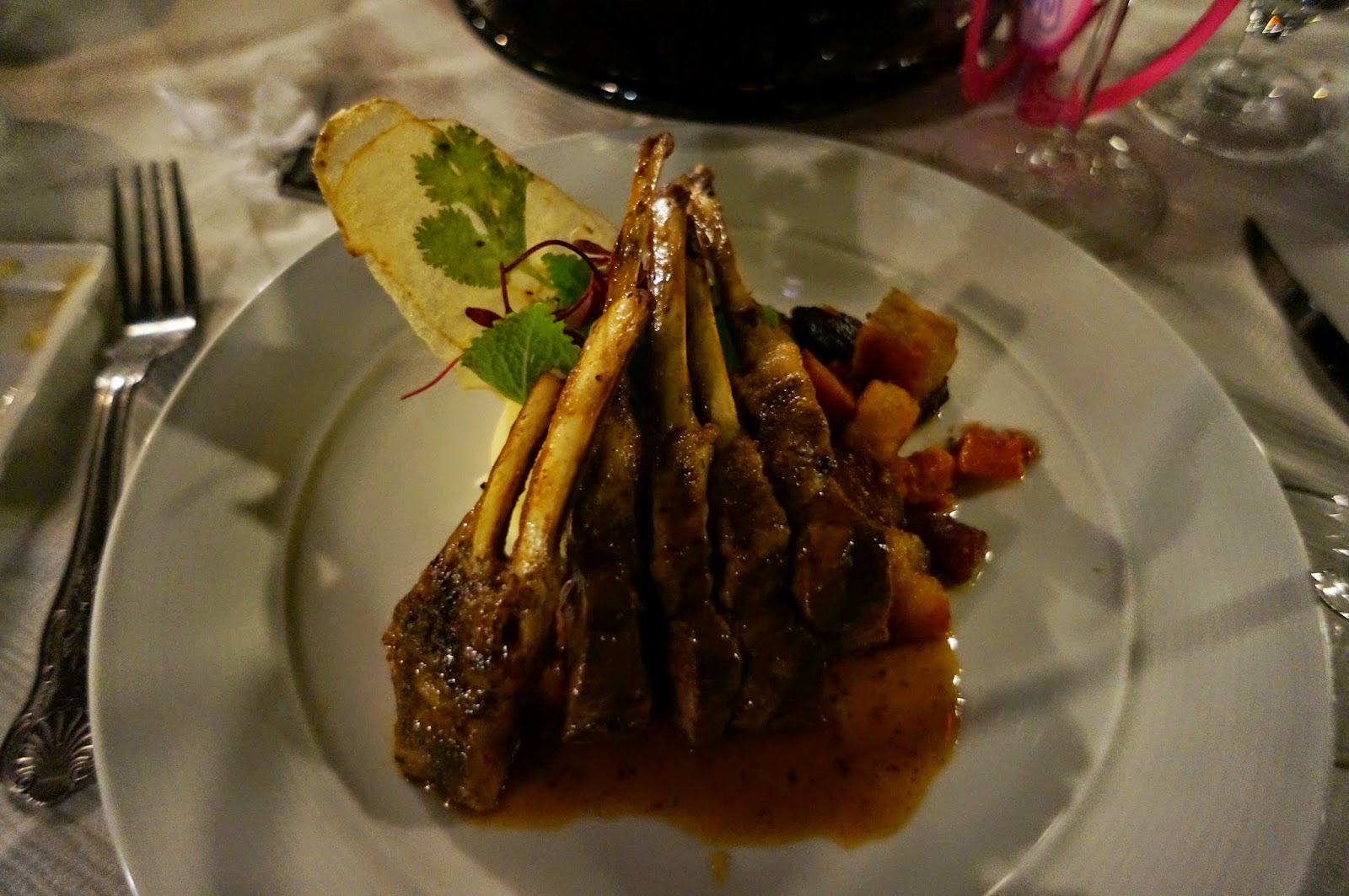
For my main course I ordered the Rack of Lamb. My tablemates (who were all born in-country) fell out laughing saying that I would be getting Rack of Goat. I asked the Server to check with the Chef as to the source of the Lamb and she came back saying Australia. Medium-rare please. When delivered, the Lamb was accompanied by Homemade Mashed Potatos and Roasted Vegetable Chunks (Carrots, Turnips, Sweet Potatos). Awesome texture, taste, and temperature. Paired admirably with the Cabernet Sauvignon, a dark, fruity red with vanillin notes, a spiciness, drying tannins and a saline aftertaste.
The restaurant had filled up around us by this time (remember we had started relatively early). Most of the patrons were probably from the Half Moon hotel proper or from other area hotels. A number of children were dining at tables with their families. A low-key, two-piece band entertained us with some Jamaican "oldies."
But this was about Joy's birthday so they brought the cake out (she is not 7 years old). After she blew the candle out, she made a touching little speech: how lucky she was to have friends who would come all the way here to share this night with her; how loved she felt; how perfect things had been for her so far; how late her son was for the event (No she did not say the latter. I was editorializing). After which a few of us got up and told her how great she was; how much we appreciated her; and , especially, how much better the food and wine tatsed with her picking up the tab. And shade like that. After which Noel (her husband) got up and delivered a sermon (and the guy is not even a preacher). Waiter, my glass is empty.
After all the speechifying and hugging, I repaired to the wine cellar for a tour (The others repaired to the bar to resume consumption.). The cellar was not Pinchiorian or Tailleventian in size or scope but it was home to a representative sample of First Growths and other leading wines of the world. The wines were comfortably nestled in oversized slots in an appropriately chilled environment. The Somm proudly guided me from rack to rack showing me what each housed and, from time to time, he would carefully and lovingly extricate a bottle from a rack to show me a particularly important aspect of the holding. It was great and I came away happier and more fulfilled than I had been after many a plastic tour.
I joined the others at the bar. The night was still young by our standards.
©Wine -- Mise en abyme
Thursday, January 22, 2015
Wednesday, January 21, 2015
Second Day of the Jamaica North Coast Birthday Bash
The first day of the Birthday Bash was awesome in its own right but the second day dialed it all the way up to 12. We did not return directly to the house after leaving Mongoose in the wee hours of the morning. Paul claimed hunger so we drove further east into the Pineapple Place section of Ocho Rios to a late-night establishment called Remicki's Gun Court. This place is the "holeyest" of holes-in-the wall and older than Methuselah. It opens its doors for business when other god-fearing establishments are closing theirs. When hole-in-the-wall restaurants get together, they speak about this place in hushed tones.
At Gun Court, the patrons are separated from the staff by iron bars and steel wires and transactions are conducted through a small opening in this barrier. The place was bereft of customers at that hour in the morning and most of the menu items had long been dispatched. We purchased from what they had available and groggily consumed it. I cannot tell you what I ate or how it tasted. It was time to go to bed.
Paul and Debbie had mumbled something about walking when we woke up but I did not think it would happen. I knocked on their bedroom door at 7:15 and they did get up. Miracle of miracles. We walked for an hour and fifteen minutes and then came back to the house and had breakfast (Paul normally hires two local "chefs" to prepare the meals that we eat at the house.). After breakfast we went to the pool to pass the time until our early evening dinner at Half Moon's Sugar Mill Restaurant in Rose Hall.
We spent about three or so hours at the pool drinking, listening to music, dancing, swimming, laughing. You know, having fun. Then it was time to head back to the ranch to prepare for the evening's festivities.
The objective of the weekend was the celebration of Joy's birthday. Joy was born in Kingston but now lives in White Plains, NY. Her initial thoughts were to host the celebration in Las Vegas but, after some discussion, she changed it to The Rock. The high point of the weekend was supposed to be dinner at Sugar Mill Restaurant, selected because it was thought by many to be the finest pure restaurant on Jamaica's North Coast. A total of 16 people were participants in the core celebrations with larger numbers attending the informal gatherings at our base of operations. Because the hotel was 45 minutes away, and the group so large, Paul had arranged for a bus to transport us to and fro. Six of us were staying at the house with the remainder at neighboring hotels. Those who were staying off-property were expected to meet us at the base at 5:00 pm so that we could comfortably make our 6:00 pm dinner reservation.
Half Moon, named for the crescent-shaped, two-mile-long beach that serves as the interface between the property and the Caribbean Sea, is one of the world's leading resorts, providing, as it has been since its founding in 1954, high-quality amenities and services to its guests. I have stayed at the property in the past and have taken advantage of its immaculate golf facility and on-property Italian restaurant. I have not, however, ever eaten at its Sugar Mill Restaurant which is located across the street and east of the main property, proximate to the golf clubhouse. I was looking forward to seeing what this restaurant had to offer.
All of the expected riders did not show up on time and after milling around for a while we decided that they would have to find their own way to the restaurant. We were on our way.
After a 45-minute ride, we arrived -- mellowed-out, yet fortified, by the two bottles of Champagne we had consumed along the way -- at the sign indicating the entry to Sugar Mill. We drove past the clubhouse on the right and on up the hill to the restaurant. The initial vista was stunning. A water-wheel to the right of the restaurant instructed as to the origin of it's name. The restaurant was arrayed to the left of the water wheel with an expansive outdoor seating area strikingly positioned to its left. Stepping through the main entrance of the restaurant, we entered a foyer with a bar hanging off to its left and a wine cellar to its right. We passed through a second doorway into a larger dining hall which itself debouched into additional dining areas to its left and right. The left entryway led to the outside dining area that was our final destination.
I will pick up the narrative of the actual restaurant experience in my next post as this one is already longer than I would like.
©Wine -- Mise en abyme
At Gun Court, the patrons are separated from the staff by iron bars and steel wires and transactions are conducted through a small opening in this barrier. The place was bereft of customers at that hour in the morning and most of the menu items had long been dispatched. We purchased from what they had available and groggily consumed it. I cannot tell you what I ate or how it tasted. It was time to go to bed.
Paul and Debbie had mumbled something about walking when we woke up but I did not think it would happen. I knocked on their bedroom door at 7:15 and they did get up. Miracle of miracles. We walked for an hour and fifteen minutes and then came back to the house and had breakfast (Paul normally hires two local "chefs" to prepare the meals that we eat at the house.). After breakfast we went to the pool to pass the time until our early evening dinner at Half Moon's Sugar Mill Restaurant in Rose Hall.
We spent about three or so hours at the pool drinking, listening to music, dancing, swimming, laughing. You know, having fun. Then it was time to head back to the ranch to prepare for the evening's festivities.
Half Moon, named for the crescent-shaped, two-mile-long beach that serves as the interface between the property and the Caribbean Sea, is one of the world's leading resorts, providing, as it has been since its founding in 1954, high-quality amenities and services to its guests. I have stayed at the property in the past and have taken advantage of its immaculate golf facility and on-property Italian restaurant. I have not, however, ever eaten at its Sugar Mill Restaurant which is located across the street and east of the main property, proximate to the golf clubhouse. I was looking forward to seeing what this restaurant had to offer.
All of the expected riders did not show up on time and after milling around for a while we decided that they would have to find their own way to the restaurant. We were on our way.
After a 45-minute ride, we arrived -- mellowed-out, yet fortified, by the two bottles of Champagne we had consumed along the way -- at the sign indicating the entry to Sugar Mill. We drove past the clubhouse on the right and on up the hill to the restaurant. The initial vista was stunning. A water-wheel to the right of the restaurant instructed as to the origin of it's name. The restaurant was arrayed to the left of the water wheel with an expansive outdoor seating area strikingly positioned to its left. Stepping through the main entrance of the restaurant, we entered a foyer with a bar hanging off to its left and a wine cellar to its right. We passed through a second doorway into a larger dining hall which itself debouched into additional dining areas to its left and right. The left entryway led to the outside dining area that was our final destination.
| Joy (birthday girl) and Noel (hubby) |
I will pick up the narrative of the actual restaurant experience in my next post as this one is already longer than I would like.
©Wine -- Mise en abyme
Monday, January 19, 2015
Day 1 of a Jamaica North Coast birthday bash
Walking through the Arrival and Departure halls at Montego Bay's (Jamaica) Sangster International Airport, one is treated to the sight of throngs of tourists either flushed with anticipation (arrivals) or looks of dread (no pun intended; reluctant "departers"). But one does not encounter anywhere near these numbers of tourists in the towns and villages that dot the country's enthralling, fun-delivering North Coast. Why? They are "imprisoned" behind the walls of the all-inclusive hotels, having a great time, I am sure, but a "time" that could have been even better if it had been adequately spiced with the appropriate amounts of unmanaged, free-form island flavor. We went down to the North Coast last weekend to celebrate a friend's birthday and I share some of that local flavor in this post.
Attendees at the birthday bash converged on the North Coast from New York, Orlando, Cayman Islands, and Kingston and Ocho Rios in Jamaica. The Orlando contingent (four of us) took a JetBlue flight from MCO and de-planed at Sangster in a little over 90 minutes. Depending on time of arrival, and congruency with European flight arrivals, getting through Jamaican immigration and Customs can be a bear (timewise) but, on this occassion, we waltzed through officialdom and out to the pickup area in less than 1 hour. Our practice is to have a Beef Patty and Red Stripe beer at the Snack Shop just outside the exit from the Arrival Hall but Paul's (our host for the weekend) brother was already waiting so we loaded up and headed out.
From Montego Bay we headed east along the North Coast Highway towards our final destination in Priory. But a trip from the airport would be incomplete without a stop at a roadside Jerk Center, the Jamaican equivalent of a highway rest stop. At these centers you can dine on local delicacies (Jerk everything, Oxtail, fish, Curried goat, shrimp, soups, etc.), drink the ever-present Red Stripe beer (plus other beers and alcohol), and take advantage of the bathroom facilities. Our new favorite Jerk Center is Ultimate, located in the town of Discovery Bay. It is safe, with great food and a wide array of beverages, clean facilities, excellent service and frequented by friendly locals and the occasional small tourist bus. We bought platters of Jerk Chicken, Jerk Pork, Bami (cassava flatbread), and Festival (corn bread fritters) and chased them with Red Stripe and Grey Goose Vodka. The party was underway.
After the "snack" and drinks at Ultimate, we traveled to Paul's home in Priory to welcome friends, chat, drink some more, and prepare for the evening ahead.
At around 10:00 pm, we headed out to Ocho Rios, one of the top North Coast towns. On our prior trip to Jamaica, we had discovered a cute restaurant/bar/nightclub named Mongoose and we were headed there to see if it would live up to the memories. My wife and I had contracted with a promoter for a live variety show as a surprise for Joy (the birthday celebrant), said show to be performed at the club.
The club was not as busy as on our prior visit (a Saturday night) and most of the patrons present were occupying outside seating. A beautiful long table had been set up on the inside for our party so we sat, ordered drinks, and listened to the DJ while waiting for our show to begin.
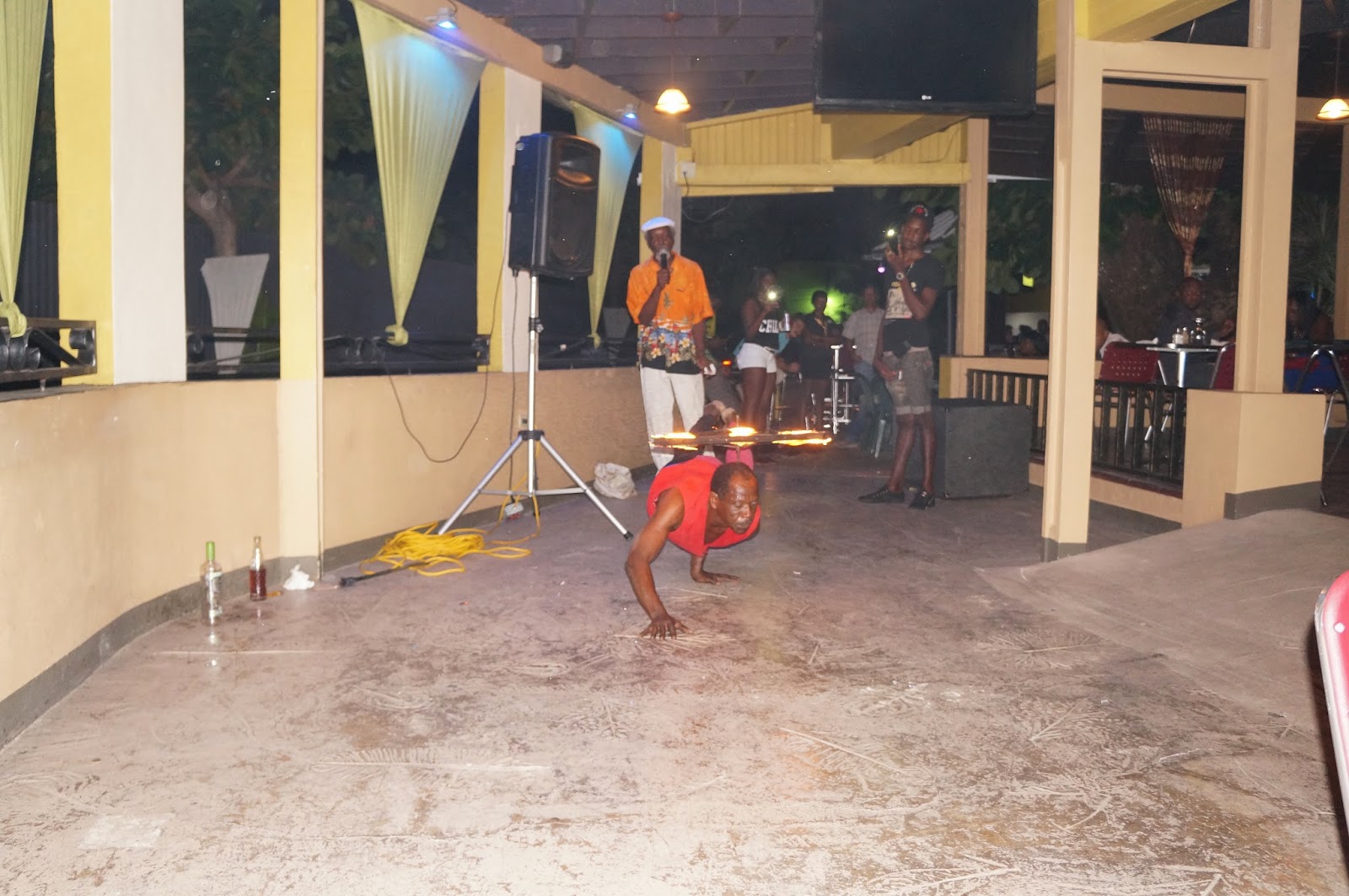
And what a show it turned out to be. Folk dancers, fire-eaters, balancing acts, limbo dancers, broken-bottle repulsers, and a local Reggae artiste. And all this for Joy. And the other patrons who now streamed inside. And for the passers-by, who occupied every vantage point with a view into the space.
But a great time was had by all. Joy was ecstatic. At the conclusion of the show we turned to dancing and cajoled, bribed, and begged the DJ to play until the wee hours of the morn. We left the club at 4:00 am. First day in the history file.
©Wine -- Mise en abyme
Attendees at the birthday bash converged on the North Coast from New York, Orlando, Cayman Islands, and Kingston and Ocho Rios in Jamaica. The Orlando contingent (four of us) took a JetBlue flight from MCO and de-planed at Sangster in a little over 90 minutes. Depending on time of arrival, and congruency with European flight arrivals, getting through Jamaican immigration and Customs can be a bear (timewise) but, on this occassion, we waltzed through officialdom and out to the pickup area in less than 1 hour. Our practice is to have a Beef Patty and Red Stripe beer at the Snack Shop just outside the exit from the Arrival Hall but Paul's (our host for the weekend) brother was already waiting so we loaded up and headed out.
From Montego Bay we headed east along the North Coast Highway towards our final destination in Priory. But a trip from the airport would be incomplete without a stop at a roadside Jerk Center, the Jamaican equivalent of a highway rest stop. At these centers you can dine on local delicacies (Jerk everything, Oxtail, fish, Curried goat, shrimp, soups, etc.), drink the ever-present Red Stripe beer (plus other beers and alcohol), and take advantage of the bathroom facilities. Our new favorite Jerk Center is Ultimate, located in the town of Discovery Bay. It is safe, with great food and a wide array of beverages, clean facilities, excellent service and frequented by friendly locals and the occasional small tourist bus. We bought platters of Jerk Chicken, Jerk Pork, Bami (cassava flatbread), and Festival (corn bread fritters) and chased them with Red Stripe and Grey Goose Vodka. The party was underway.
After the "snack" and drinks at Ultimate, we traveled to Paul's home in Priory to welcome friends, chat, drink some more, and prepare for the evening ahead.
At around 10:00 pm, we headed out to Ocho Rios, one of the top North Coast towns. On our prior trip to Jamaica, we had discovered a cute restaurant/bar/nightclub named Mongoose and we were headed there to see if it would live up to the memories. My wife and I had contracted with a promoter for a live variety show as a surprise for Joy (the birthday celebrant), said show to be performed at the club.
The club was not as busy as on our prior visit (a Saturday night) and most of the patrons present were occupying outside seating. A beautiful long table had been set up on the inside for our party so we sat, ordered drinks, and listened to the DJ while waiting for our show to begin.
And what a show it turned out to be. Folk dancers, fire-eaters, balancing acts, limbo dancers, broken-bottle repulsers, and a local Reggae artiste. And all this for Joy. And the other patrons who now streamed inside. And for the passers-by, who occupied every vantage point with a view into the space.
But a great time was had by all. Joy was ecstatic. At the conclusion of the show we turned to dancing and cajoled, bribed, and begged the DJ to play until the wee hours of the morn. We left the club at 4:00 am. First day in the history file.
©Wine -- Mise en abyme
Wednesday, January 14, 2015
Book Review -- Shadows in the Vineyard: The True Story of the Plot to Poison the World's Greatest Wine
The over-reach on this book begins with the subtitle. There never was a plot to poison the world's greatest wine. Rather, there was a plot (foiled) to extort money from Domaine Romanée Conti (DRC) by threatening to poison a portion of its Romanée-Conti vineyard. But maybe I am being too picky. Let's move on.
I have had wines like this book before and the term generally used to describe them is "did not deliver," precis for "great nose, did not deliver on the palate." This book has mesmerizing cover art and a "come hither" title for wine and crime buffs alike but falls far short in the fulfillment arena. As a matter of fact, this book leaves itself open to accusations of "false advertising" or "baiting and switching." It could have (should have?) been more appropriately titled: (i) An ode to Aubert de Villaine; or (ii) The Life and Times of Aubert de Villaine; or (iii) The History of Burgundy. But definitely not the title and subtitle under which it went to market.
The book purports to tell the story of the plot to poison the DRC Romanée-Conti vineyard (based on the intent rather than the subtitle) but there is no there there. Of the 274 pages of text directed at the reader, approximately 43 pages have anything at all to do with the story on offer. And those pages are distributed like oases in the desert across the full span of the book:
The book falls victim to the disease of trying to extend an article into a book. The author apparently wrote an article for Vanity Fair on the topic post its occurrence and then someone had the bright idea to further capitalize on the buzz by writing a book about it. But the story did not merit a book. It was too simple. A small-time crook devised a plan to extort money from DRC. DRC reported it to the police. The police set up a sting and caught the guy who had enlisted his ne'er-do-well son to assist him in tagging the vines in the vineyard. The crook hung himself in his prison cell before trial. There. That's it.
The remainder is a classic example of Lee-Daniels-The-Butler Syndrome: let's pack everything about the broader topic (in this case Burgundy) into the pages regardless of its bearing on the core story. Chapter 1 is a paen to Aubert de Villaine (He probably was too embarrassed to complete that gooey, cloying, obsequious mess); Chapter 3, a look back into the life and times of the Prince de Conti in the 1755 timeframe; Chapter 4, young Aubert and his grandfather; and so on and so on. And the presentation of this extraneous material did not even conform to some sort of organized plan. There was a lot of unceremonious jumping back and forth between periods and people and between perspectives and storytellers. There probably was some good stuff somewhere in there but I could not get over the feeling of being conned long enough to discover/enjoy it.
Two passages in the book, in the author's own words, are indictments against the concept of a book on this topic. The first was the quote that the crime was "far less nefarious than anyone had ever imagined" and the second was the statement that upon conclusion of the effort, the detectives involved in the case felt "full of emptiness." Not elation, emptiness. The same feeling that I had upon completion of this book.
I read this book. You don't have to.
©Wine -- Mise en abyme
I have had wines like this book before and the term generally used to describe them is "did not deliver," precis for "great nose, did not deliver on the palate." This book has mesmerizing cover art and a "come hither" title for wine and crime buffs alike but falls far short in the fulfillment arena. As a matter of fact, this book leaves itself open to accusations of "false advertising" or "baiting and switching." It could have (should have?) been more appropriately titled: (i) An ode to Aubert de Villaine; or (ii) The Life and Times of Aubert de Villaine; or (iii) The History of Burgundy. But definitely not the title and subtitle under which it went to market.
The book purports to tell the story of the plot to poison the DRC Romanée-Conti vineyard (based on the intent rather than the subtitle) but there is no there there. Of the 274 pages of text directed at the reader, approximately 43 pages have anything at all to do with the story on offer. And those pages are distributed like oases in the desert across the full span of the book:
- Chapter 2: pp 21 - 34
- Chapter 9: pp 129 - 139
- Chapter 11: pp 167 - 170; 178 - 183
- Chapter 13: pp 197 - 198
- Chapter 16: pp 237 - 246; 253 - 258.
The book falls victim to the disease of trying to extend an article into a book. The author apparently wrote an article for Vanity Fair on the topic post its occurrence and then someone had the bright idea to further capitalize on the buzz by writing a book about it. But the story did not merit a book. It was too simple. A small-time crook devised a plan to extort money from DRC. DRC reported it to the police. The police set up a sting and caught the guy who had enlisted his ne'er-do-well son to assist him in tagging the vines in the vineyard. The crook hung himself in his prison cell before trial. There. That's it.
The remainder is a classic example of Lee-Daniels-The-Butler Syndrome: let's pack everything about the broader topic (in this case Burgundy) into the pages regardless of its bearing on the core story. Chapter 1 is a paen to Aubert de Villaine (He probably was too embarrassed to complete that gooey, cloying, obsequious mess); Chapter 3, a look back into the life and times of the Prince de Conti in the 1755 timeframe; Chapter 4, young Aubert and his grandfather; and so on and so on. And the presentation of this extraneous material did not even conform to some sort of organized plan. There was a lot of unceremonious jumping back and forth between periods and people and between perspectives and storytellers. There probably was some good stuff somewhere in there but I could not get over the feeling of being conned long enough to discover/enjoy it.
Two passages in the book, in the author's own words, are indictments against the concept of a book on this topic. The first was the quote that the crime was "far less nefarious than anyone had ever imagined" and the second was the statement that upon conclusion of the effort, the detectives involved in the case felt "full of emptiness." Not elation, emptiness. The same feeling that I had upon completion of this book.
I read this book. You don't have to.
©Wine -- Mise en abyme
Sunday, January 11, 2015
Jacques hits a homer
Jacques has finally hit a home run. As a matter of fact, a series of home runs. You will remember Jacques as my friend from the Hamptons who comes down from on high every two years or so to teach us Boonesville residents what "real" wine drinking is all about. You will also remember that his prior campaigns have been more Napoleon-at-Waterloo than Alexander-at-Issus. His first foray ran hard aground on the rocks of TCA while his second sunk into the depths of faded glory.
But this guy is nothing if not persistent and, right on schedule, I received an email from him detailing when he would be in the area and wondering if we could get together to share some bottles he had in tow. I quickly agreed to set up a dinner because, his wines notwithstanding, he is a fun and wine-knowledgeable guy and I like spending time with him. Plus, the wines he mentioned in the email sounded promising. The dinner was set for Eddie V's, one of Orlando's landmark dining spots, on Friday, January 9th. I invited Ron and Bev to join us for the evening.
We were the first to arrive and that gave us time to ice down a bottle of Jacques Selosse Initial such that it would be ready for consumption when the others arrived. Ron and Bev arrived next. Hugs and kisses all around. We had not seen each other since New Year's Eve. The Selosse was cracked open and we began doing what we do best. We have never met a Selosse that we did not like. And this one was no exception. Bright acidity, sour golden apple, and bread. Like pulling on an old robe.
Jacques and Allison showed up around this time with Jacques lugging a cardboard box under one arm and a wooden box under the other. We tried doing the greeting thing all around but the boxes kept getting in the way. Finally he deposited the cardboard box onto the floor and handed the wooden box to me. "I brought this for you," he said. I accepted the box (it had the size and appearance of a magnum container) and placed it on top of my wine bag. By this time the waiter had poured Champagne for Jacques and Allison and we all clinked gleefully and drank.
After his initial taste of the Champagne, Jacques turned to me and asked that I open the box that he had brought for me. Upon its opening, the box revealed a 1973 Bollinger Champagne which had been shipped in 1981 to celebrate the wedding of Prince Charles and Lady Diana. I thought this a very nice gift and placed it gently back into its container. Nice, thoughtful start Jacques. Disarming.
The first still wine that we tasted was a 2008 Drouhin Montrachet. I had brought this wine to four previous events and had taken it back home because we had not gotten around to it. I was not going to be denied this time. This one was first out of the gate. It had a rich, oily nose with notes of walnut and unthreshed rice. Great texture with lemony-lime flavors and lime rind. Fresh and balanced with a nice long finish. A hint of tannins. Jacques thought that it was reminiscent of the 2004 vintage. This paired well with the yellow tail sashimi with the robustness of the wine complementing the light soy sauce that accompanied the fish.
Our Burgundy flight was the flight of the tattered labels but the bottle contents were stellar. The 1971 Confuron Bonnes Mares was contributed by Ron while Jacques offered the 1980 Clerget Chambolle-Musigny. And they were both home runs. The Bonnes Mares exhibited ripe Pinot fruit, tobacco, and dried wort. Earthy cherry, mushrooms, and a savory character. Fresh, with a late-arriving spiciness. The earthiness of the wine provided an awesome pairing with our potstickers. The Chambolle was elegant on the nose but, initially, had a less-than-round mouthfeel and short finish. Classic Pinot fruit. Fresh and lively on the attack. Savory with dry tamarind. With more extended residence in the glass the dry tamarind flavor became lusher, the mouthfeel began to flesh out, and the finish lengthened. Pomegranate seed note on the finish.
Our next three wines were Barolos: a 2000 Monfortino that I brought and a 1989 Fontanafredda Vigna La Delizia and 1971 Prunotto brought by Jacques. The Conterno was young with plum, tar, earth, tobacco, and vanilla. Freshness, savoryness, and a long, tannic finish. Fifteen years on this wine is still a baby. Two of the greatest Barolo vintages in the '80s were 1988 and 1989 and Vigna La Delizia is one of Fontanafredda's most prestigious crus. This bottle represented both the vintage and the cru exceedingly well with tobacco, balsamic, and truffle notes accompanying elegant tannins. The Prunotto had road tar and a nuttiness on the nose and was sharp, rich, and balanced on the palate. Lengthy finish. Two more homers for Jacques.
He was now on a roll. We had to restrain him because he kept popping in to that bottomless cardboard box and coming out with gem after gem. He was giddy with joy. In order to give him a chance to recover his composure, Ron opened a 1998 Rayas, a 2000 Soldera Riserva, and a 1961 Ausonne. Rayas continues to be the flagship of CdP from our perspective. This wine had lifted aromatics with a Pinot-like nose. Sapodilla and kiwi fruit, blackpepper and tobacco. Ron felt that the Soldera was more open and less structured than the 95 vintage which he had had recently. He saw this wine as having clean ripe cherry and strawberry fruits with tea leaf, tobacco, and spice notes. Burgundian. Silky and elegant on the finish. The Ausone (Ron's notes) had a nose of red fruits, plum, cedar, sweet tobacco, and graphite. This was drinking well at 54 years of age, showing the classic and elegant character of the label and vintage.
Jacques quickly brushed these wines off the table and re-asserted himself. He had been waiting for this day for 6 years and he was not going to let anything, anybody, or anyother wine get in his way. He had decanted a mag of 2000 Quinault L'Enclos and he waved imperiously towards the waiter to have it brought over. Given our preference for older Bordeauxs we were a little apprehensive about this wine (It was paired with our New York Strip course) but Jacques could not be contained. This was truly his night. The L'Enclos was a phenomenal closer. Tobacco, anise, blackberries, and chocolate on the nose with herbs, leather, and great acidity on the palate, closing with a long, intense finish.
By this time all of the patrons in the restaurant had long gone. As had most of the staff. A beaming, bright-eyed Jacques did not want to leave the arena. This was vindication for him. This was what he had been coming here for years to accomplish. He was not going to let loose of this moment quickly. If at all. The few remaining staffers were trying to shepherd us towards the door but Jacques was having none of it. "Have these kids never heard of basking," the look on his face seemed to say. Triumph. Triumphant. Oh well. I guess I'll have to live with it.
©Wine -- Mise en abyme
But this guy is nothing if not persistent and, right on schedule, I received an email from him detailing when he would be in the area and wondering if we could get together to share some bottles he had in tow. I quickly agreed to set up a dinner because, his wines notwithstanding, he is a fun and wine-knowledgeable guy and I like spending time with him. Plus, the wines he mentioned in the email sounded promising. The dinner was set for Eddie V's, one of Orlando's landmark dining spots, on Friday, January 9th. I invited Ron and Bev to join us for the evening.
We were the first to arrive and that gave us time to ice down a bottle of Jacques Selosse Initial such that it would be ready for consumption when the others arrived. Ron and Bev arrived next. Hugs and kisses all around. We had not seen each other since New Year's Eve. The Selosse was cracked open and we began doing what we do best. We have never met a Selosse that we did not like. And this one was no exception. Bright acidity, sour golden apple, and bread. Like pulling on an old robe.
After his initial taste of the Champagne, Jacques turned to me and asked that I open the box that he had brought for me. Upon its opening, the box revealed a 1973 Bollinger Champagne which had been shipped in 1981 to celebrate the wedding of Prince Charles and Lady Diana. I thought this a very nice gift and placed it gently back into its container. Nice, thoughtful start Jacques. Disarming.
The first still wine that we tasted was a 2008 Drouhin Montrachet. I had brought this wine to four previous events and had taken it back home because we had not gotten around to it. I was not going to be denied this time. This one was first out of the gate. It had a rich, oily nose with notes of walnut and unthreshed rice. Great texture with lemony-lime flavors and lime rind. Fresh and balanced with a nice long finish. A hint of tannins. Jacques thought that it was reminiscent of the 2004 vintage. This paired well with the yellow tail sashimi with the robustness of the wine complementing the light soy sauce that accompanied the fish.
Our Burgundy flight was the flight of the tattered labels but the bottle contents were stellar. The 1971 Confuron Bonnes Mares was contributed by Ron while Jacques offered the 1980 Clerget Chambolle-Musigny. And they were both home runs. The Bonnes Mares exhibited ripe Pinot fruit, tobacco, and dried wort. Earthy cherry, mushrooms, and a savory character. Fresh, with a late-arriving spiciness. The earthiness of the wine provided an awesome pairing with our potstickers. The Chambolle was elegant on the nose but, initially, had a less-than-round mouthfeel and short finish. Classic Pinot fruit. Fresh and lively on the attack. Savory with dry tamarind. With more extended residence in the glass the dry tamarind flavor became lusher, the mouthfeel began to flesh out, and the finish lengthened. Pomegranate seed note on the finish.
Our next three wines were Barolos: a 2000 Monfortino that I brought and a 1989 Fontanafredda Vigna La Delizia and 1971 Prunotto brought by Jacques. The Conterno was young with plum, tar, earth, tobacco, and vanilla. Freshness, savoryness, and a long, tannic finish. Fifteen years on this wine is still a baby. Two of the greatest Barolo vintages in the '80s were 1988 and 1989 and Vigna La Delizia is one of Fontanafredda's most prestigious crus. This bottle represented both the vintage and the cru exceedingly well with tobacco, balsamic, and truffle notes accompanying elegant tannins. The Prunotto had road tar and a nuttiness on the nose and was sharp, rich, and balanced on the palate. Lengthy finish. Two more homers for Jacques.
He was now on a roll. We had to restrain him because he kept popping in to that bottomless cardboard box and coming out with gem after gem. He was giddy with joy. In order to give him a chance to recover his composure, Ron opened a 1998 Rayas, a 2000 Soldera Riserva, and a 1961 Ausonne. Rayas continues to be the flagship of CdP from our perspective. This wine had lifted aromatics with a Pinot-like nose. Sapodilla and kiwi fruit, blackpepper and tobacco. Ron felt that the Soldera was more open and less structured than the 95 vintage which he had had recently. He saw this wine as having clean ripe cherry and strawberry fruits with tea leaf, tobacco, and spice notes. Burgundian. Silky and elegant on the finish. The Ausone (Ron's notes) had a nose of red fruits, plum, cedar, sweet tobacco, and graphite. This was drinking well at 54 years of age, showing the classic and elegant character of the label and vintage.
Jacques quickly brushed these wines off the table and re-asserted himself. He had been waiting for this day for 6 years and he was not going to let anything, anybody, or anyother wine get in his way. He had decanted a mag of 2000 Quinault L'Enclos and he waved imperiously towards the waiter to have it brought over. Given our preference for older Bordeauxs we were a little apprehensive about this wine (It was paired with our New York Strip course) but Jacques could not be contained. This was truly his night. The L'Enclos was a phenomenal closer. Tobacco, anise, blackberries, and chocolate on the nose with herbs, leather, and great acidity on the palate, closing with a long, intense finish.
By this time all of the patrons in the restaurant had long gone. As had most of the staff. A beaming, bright-eyed Jacques did not want to leave the arena. This was vindication for him. This was what he had been coming here for years to accomplish. He was not going to let loose of this moment quickly. If at all. The few remaining staffers were trying to shepherd us towards the door but Jacques was having none of it. "Have these kids never heard of basking," the look on his face seemed to say. Triumph. Triumphant. Oh well. I guess I'll have to live with it.
©Wine -- Mise en abyme
Wednesday, January 7, 2015
Tavel AOC (Southern Rhone): Terroir, wine production, wines
The wine producers of Tavel have no reservations as to which is the premier Rosé producing region in France.
And while that sentiment is not universally shared, it is widely acknowledged that Tavel stands alone as a Rosé-only AOC and is, without a doubt, the most famous wine of that style in the land. I traveled with a group of fellow bloggers to Tavel and Chateauneuf-du-Pape on a DWCC2014 Pre-Conference Press trip and continue my observations herein with a report on the region's non-soil terroir components, winemaking, and wines. The region's soils were covered in a previous post.
Location
The vineyards of Tavel AOC are located 15 km NW of the Avignon mainly in the municipality of Tavel with a small portion in the town of Roquemaure, both in the departèmant of Gard.
The vineyard was originally planted by the Greeks, extended by the Romans, and, until the French Revolution, maintained by churches and Abbeys. The vineyard reached a peak of 800 ha in 1868 but was devastated by Phylloxera shortly after and did not attain that size again until 1977.
In 1936, Tavel became one of the first winemaking regions (the others being Arbois, Chateauneuf-du-Pape, and Cassis) in France to be granted AOC status.
Climate
Tavel's climate is Mediterranean-influenced with hot, dry summers (average temperatures of 22 ℃) and 2700 hours of sunshine per year. Summer and winter (average temperature 7.3 ℃) alike are moderated by two strong north-to-south winds called Mistral and Tramontane. The Mistral is called La Bise at the beginning of its journey down through the Rhone Valley where, upon reaching Provence, it lays claim to its more notorious nomenclature. The Mistral blows for approximately 158 days per year with 100 of those days experiencing winds of 60+ kph. Both the Mistral and Tramontane clear the atmosphere and dry out the leaves and grape bunches after summer storms.
Average annual rainfall is 700 mm with an average of 201 mm in the summer and 503 mm for the remainder of the year. While this amount of rainfall may be sufficient in other wine regions, the free-draining soils that are a characteristic of Tavel ensures that the soil moisture will flow rapidly to the underlying clay layers or into the cracks in the limestone bedrock. In order to gain access to these potential water sources, the vine roots will have to dive deep.
Soils
Treated previously
Vineyards
Vines are planted on one of the the three soil types described previously with a maximum planting density of 4000 vines/ha and space between vines of >2.25 meters. The dominant training systems are the older Gobelet and the newer Royat Cordon. Gobelet is used for untrained vines and provide the advantages of (i) better resistance to wind and drought and (ii) less sensitivity to wood disease. The disadvantage is less exposure of the leaves to the sun's rays. Royat Cordon is used for wire-trained vines and has the primary advantage of increasing the amount of the canopy exposed to the sun's rays with the resultant increase in color, tannin, sugar, aromas, and berry sanitary conditions. Gobelet systems are restricted to a maximum of 2 buds/spur and the Spurred Cordon to a maximum of 6 spurs/vine and two buds per spur.
In the cases where a vineyard is moving from a Gobelet to Royat Cordon system, it is allowed two years to make the transition. During the transition period, the Double Guyot training system is allowed.
Varieties
Tavel wines are blends and the allowed grape varieties are divided into two classes: main and accessory (http://agriculture.gouv.fr/IMG/pdf/AOC_SOMM47-2.pdf): The main varieties are (in alphabetical order) Bourboulenc, Cinsault, Clairette, Grenache, Mourvèdre, Picpoul, and Syrah. The accessory varieties are Calitor and Carignan. The deployment of these varieties into the blend are curtailed as follows:
Wine Making Process
A composite of the Tavel winemaking process is illustrated in the figure below.
Wines
After tasting selected Tavel wines at the Guildsomm tasting and on the DWCC Press trip, I can characterize them as follows:
In the near future I will attempt to compare the Tavel Rosés to those of Provence.
©Wine -- Mise en abyme
And while that sentiment is not universally shared, it is widely acknowledged that Tavel stands alone as a Rosé-only AOC and is, without a doubt, the most famous wine of that style in the land. I traveled with a group of fellow bloggers to Tavel and Chateauneuf-du-Pape on a DWCC2014 Pre-Conference Press trip and continue my observations herein with a report on the region's non-soil terroir components, winemaking, and wines. The region's soils were covered in a previous post.
Location
The vineyards of Tavel AOC are located 15 km NW of the Avignon mainly in the municipality of Tavel with a small portion in the town of Roquemaure, both in the departèmant of Gard.
![]() |
| Source: technoresto.org |
In 1936, Tavel became one of the first winemaking regions (the others being Arbois, Chateauneuf-du-Pape, and Cassis) in France to be granted AOC status.
Climate
Tavel's climate is Mediterranean-influenced with hot, dry summers (average temperatures of 22 ℃) and 2700 hours of sunshine per year. Summer and winter (average temperature 7.3 ℃) alike are moderated by two strong north-to-south winds called Mistral and Tramontane. The Mistral is called La Bise at the beginning of its journey down through the Rhone Valley where, upon reaching Provence, it lays claim to its more notorious nomenclature. The Mistral blows for approximately 158 days per year with 100 of those days experiencing winds of 60+ kph. Both the Mistral and Tramontane clear the atmosphere and dry out the leaves and grape bunches after summer storms.
Average annual rainfall is 700 mm with an average of 201 mm in the summer and 503 mm for the remainder of the year. While this amount of rainfall may be sufficient in other wine regions, the free-draining soils that are a characteristic of Tavel ensures that the soil moisture will flow rapidly to the underlying clay layers or into the cracks in the limestone bedrock. In order to gain access to these potential water sources, the vine roots will have to dive deep.
Soils
Treated previously
Vineyards
Vines are planted on one of the the three soil types described previously with a maximum planting density of 4000 vines/ha and space between vines of >2.25 meters. The dominant training systems are the older Gobelet and the newer Royat Cordon. Gobelet is used for untrained vines and provide the advantages of (i) better resistance to wind and drought and (ii) less sensitivity to wood disease. The disadvantage is less exposure of the leaves to the sun's rays. Royat Cordon is used for wire-trained vines and has the primary advantage of increasing the amount of the canopy exposed to the sun's rays with the resultant increase in color, tannin, sugar, aromas, and berry sanitary conditions. Gobelet systems are restricted to a maximum of 2 buds/spur and the Spurred Cordon to a maximum of 6 spurs/vine and two buds per spur.
In the cases where a vineyard is moving from a Gobelet to Royat Cordon system, it is allowed two years to make the transition. During the transition period, the Double Guyot training system is allowed.
Varieties
Tavel wines are blends and the allowed grape varieties are divided into two classes: main and accessory (http://agriculture.gouv.fr/IMG/pdf/AOC_SOMM47-2.pdf): The main varieties are (in alphabetical order) Bourboulenc, Cinsault, Clairette, Grenache, Mourvèdre, Picpoul, and Syrah. The accessory varieties are Calitor and Carignan. The deployment of these varieties into the blend are curtailed as follows:
- The proportion of all Grenache should be greater than 30%, but less than 60%, of the blend
- The proportion of each main grape variety should be less than or equal to 60% of the blend
- The proportion of each accessory variety should be less than or equal to 10% of the blend.
Variety Contribution to Tavel Wines
Cultivar
|
Contribution
|
Syrah
|
Powerful aroma of red fruits
|
Mourvèdre
|
Color and aromatics; freshness; structure; ageability
|
Cinsault
|
Aromatic elegance
|
Clairette
|
Unctuousness and depth; flowery aromas; spiced notes of dried fruits
|
Grenache
|
Balance and strength
|
Bourboulenc
|
Fresh flowery tones
|
Carignan
|
Tannin, color, and fruit; elegance; structure; hint of bitterness
|
Picpoul
|
Finesse; flowery flavors
|
Calitor
|
Extremely rare
|
Sources: vin-tavel.com; Rolf Bichsel, Tavel: The People and the Wines, Féret, 2011
Vineyard Management Practices
Tavel wine production is split between the Cooperative (45%) and 34 private producers each of whom, on average, controls 15 ha of land. According to Kelly McAuliffe, a US-born Sommelier who provided technical leadership on behalf of the Tavel Vintners Association, the region's growers are moving rapidly away from vanilla viticultural science and towards management practices such as organic, biodynamic, and integrated vineyard management. The table below provides a composite of the vineyard management practices of a number of the wineries we visited plus those whose wines I had tasted as a part of a Guild of Sommeliers Tavel-CdP tasting I had attended in Miami earlier in the year
Vineyard Management Practices
Tavel wine production is split between the Cooperative (45%) and 34 private producers each of whom, on average, controls 15 ha of land. According to Kelly McAuliffe, a US-born Sommelier who provided technical leadership on behalf of the Tavel Vintners Association, the region's growers are moving rapidly away from vanilla viticultural science and towards management practices such as organic, biodynamic, and integrated vineyard management. The table below provides a composite of the vineyard management practices of a number of the wineries we visited plus those whose wines I had tasted as a part of a Guild of Sommeliers Tavel-CdP tasting I had attended in Miami earlier in the year
Period
|
Cultural Practice
|
Action
|
Fall - Winter
|
Pruning
|
|
Fertilization
|
Add small quantities, when needed, of Potassium, Magnesium, and
Nitrogen
|
|
Reconstitute hummus by grinding pruned vine branches and working into
soil with cut leaves
|
||
Add natural compost
|
||
Spring through Harvest
|
Grass Control
|
Tilling and hoeing
|
Chemical weed killers (less and less annually)
|
||
Grape Moth Control
|
Use of pheromones to make it difficult for male moths to find
partners
|
|
Downy/Powdery Mildew Control
|
Copper or sulfur spray
|
|
May
|
Shoot Thinning
|
Remove shoots to aid air flow
|
July
|
Green Harvest
|
Drop fruit in order to focus vine’s resource production and
allocation
|
Leaf Culling
|
Pull leaves in order to improve micro-climate
|
|
Irrigation
|
If survival of plot at stake
|
|
September
|
Pre-Harvest
|
Remove damaged or less-ripe bunches that could affect overall quality
|
Wine Making Process
A composite of the Tavel winemaking process is illustrated in the figure below.
Wines
After tasting selected Tavel wines at the Guildsomm tasting and on the DWCC Press trip, I can characterize them as follows:
- Variable in color with hues from salmon to deep strawberry
- Possessing higher extract than any Rosé I had tasted previously
- Higher levels of alcohol than Rosés I had tasted previously
- Redolent of ripe strawberry and raspberry fruit
- Possessing moderate acidity
- On the palate, intensity, power, spiciness, and in, many cases, a vinosity that is not characteristic of Rosé wines that I have previously experienced.
In the near future I will attempt to compare the Tavel Rosés to those of Provence.
©Wine -- Mise en abyme
Sunday, January 4, 2015
The soils of Tavel AOC (Southern Rhone), the Rosé wine region
Tavel, illustrated by the red oval in the map below, is at once the solitary Rosé-only AOC in the French appellation system and (maybe because of that fact) the country's most famous Rosé. I visited the region as part of a DWCC2014 Pre-Conference Press Trip in October and will be sharing my experiences beginning with this post's discussion of the soils of the region.
The Tavel AOC encompasses the vineyards in the communes of Tavel and Roquemaure, with said vineyards planted on one of three distinct soil types: sandy, Lauses, or smooth pebbles.
Sandy Soils
The lowest part of the macro-vineyard is located on sandy soils dating from the Miocene and Pliocene eras (Jacques Fanet, Great Wine Terroirs, UCP, 2004). The sea, which had covered the region during the Cretaceous period, returned during the Miocene and Pliocene periods leaving thin deposits of clay and sands at the bottom of the slope (James Wilson, Terroirs, 1998; musee-boissons.com). The ancient Tavel vineyards were located on these sands which possess the following characteristics (Rolf Bichsel, Tavel: The People and the Wines, Feret, 2011):
Lauses
This type is comprised of shallow soil covered with stone tiles mixed with red clay on a limestone bedrock. Heavy machinery is used to break up the top layer (60% limestone rocks). At 30-cm depth, 90% of the soil consists of rocky debris and marly limestone supplemented by a few pockets of clay. Bedrock begins at 60 cm and is comprised of solid limestone with slight cracking.
This area is 300 ha in size and is the hardest of the Tavel soils to cultivate. It is the most arid and poorest with the paucity of surface or near-surface water and nutrients driving the vines to create deep and extensive root systems (Bichsel).
Grapes grown on this soil produce wines that have (Bichsel):
Smooth Pebbles
Throughut our visit to Tavel and Chateauneuf-du-Pape, the team had recurring discussions as to the proper nomenclature for the polished stones synonymous with this region. Many members of the team, especially the American bloggers, could not bridge the gap between the images conjured up in their minds by the word pebble and the actual size of these stones.
According to musee-boissons.com, in the Villafranchian period (1.9 to 1.8 million years ago), powerful rivers with immense force were generated by the melting glaciers and pushed the rocks in their path for hundreds of kilometers, polishing them along the way until they became the smooth pebbles found in Tavel, Lirac, and Chateauneuf-du-Pape today. In Tavel, these pebbles are found in an area of the vineyard called Vallongue, an integral part of the Villafranchian terraces that stretch from Chateauneuf-du-Pape to Nimes (Bichsel).
Seventy-five percent of the subject soil consists of these large, rounded pebbles which can range in size from 10 to 40 cm in diameter. The pebbles are, generally (Bichsel):
Wines made from grapes grown in this soil are powerful and vinous, exhibiting great body, alcoholic strength, and structure (Bichsel).
Further posts in this series will detail the remaining terroir aspects of Tavel AOC as well as its viticulture and viniculture before switching to a similar treatment of the Chateauneuf-du-Pape AOC.
©Wine -- Mise en abyme
![]() |
| Source: technoresto.org |
The Tavel AOC encompasses the vineyards in the communes of Tavel and Roquemaure, with said vineyards planted on one of three distinct soil types: sandy, Lauses, or smooth pebbles.
Sandy Soils
The lowest part of the macro-vineyard is located on sandy soils dating from the Miocene and Pliocene eras (Jacques Fanet, Great Wine Terroirs, UCP, 2004). The sea, which had covered the region during the Cretaceous period, returned during the Miocene and Pliocene periods leaving thin deposits of clay and sands at the bottom of the slope (James Wilson, Terroirs, 1998; musee-boissons.com). The ancient Tavel vineyards were located on these sands which possess the following characteristics (Rolf Bichsel, Tavel: The People and the Wines, Feret, 2011):
- Poor in organic matter
- Visible portions consist of yellow, acid, decarbonated coarse sand and pebbles from the surrounding Villafranchian terraces
- Clay at 30-cm depth
- Bedrock (compressed Pliocene sands and non-decarbonated limestone sands) at 60-cm depth.
Lauses
This type is comprised of shallow soil covered with stone tiles mixed with red clay on a limestone bedrock. Heavy machinery is used to break up the top layer (60% limestone rocks). At 30-cm depth, 90% of the soil consists of rocky debris and marly limestone supplemented by a few pockets of clay. Bedrock begins at 60 cm and is comprised of solid limestone with slight cracking.
This area is 300 ha in size and is the hardest of the Tavel soils to cultivate. It is the most arid and poorest with the paucity of surface or near-surface water and nutrients driving the vines to create deep and extensive root systems (Bichsel).
Grapes grown on this soil produce wines that have (Bichsel):
- High minerality
- Finesse
- Low yields
- Fruity aromas.
Smooth Pebbles
Throughut our visit to Tavel and Chateauneuf-du-Pape, the team had recurring discussions as to the proper nomenclature for the polished stones synonymous with this region. Many members of the team, especially the American bloggers, could not bridge the gap between the images conjured up in their minds by the word pebble and the actual size of these stones.
According to musee-boissons.com, in the Villafranchian period (1.9 to 1.8 million years ago), powerful rivers with immense force were generated by the melting glaciers and pushed the rocks in their path for hundreds of kilometers, polishing them along the way until they became the smooth pebbles found in Tavel, Lirac, and Chateauneuf-du-Pape today. In Tavel, these pebbles are found in an area of the vineyard called Vallongue, an integral part of the Villafranchian terraces that stretch from Chateauneuf-du-Pape to Nimes (Bichsel).
Seventy-five percent of the subject soil consists of these large, rounded pebbles which can range in size from 10 to 40 cm in diameter. The pebbles are, generally (Bichsel):
- Smooth and silky
- Reddish and ochre in color
- Mixed with whole blocks of stone and quartz sands
- Range in depth from 5 and 15 meters
- Flanked, intermixed, or covered with more recent strata of alluvial soil.
Wines made from grapes grown in this soil are powerful and vinous, exhibiting great body, alcoholic strength, and structure (Bichsel).
Further posts in this series will detail the remaining terroir aspects of Tavel AOC as well as its viticulture and viniculture before switching to a similar treatment of the Chateauneuf-du-Pape AOC.
©Wine -- Mise en abyme
Subscribe to:
Posts (Atom)


.jpg)
.jpg)
.jpg)
.jpg)