Wednesday, November 13, 2013

Bodegas RODAs winemaking process #DWCC13

At its founding, the RODA owners wanted to produce wines that people could enjoy. They wanted to respect the indigenous grape varieties but did not want to do the same things that the other Rioja producers were doing. The wines that they produced should be enjoyable, but with long life, and should always have the landscape over the oak. The winemaking philosophy held that the company would do best if they created wines that exhibited both freshness and fruitiness and had softly integrated tannins. The wine should have no structure and should not exhibit much oak.

The process by which such a wine is made is illustrated below.

Sources: Compiled using information from roda.es and conversations
with Augustin Santolaya, RODA Managing Director.


©Wine -- Mise en abyme

Tuesday, November 12, 2013

Bodegas RODA: The viticultural environment #DWCC13

So I got a little carried away on my last post and did not deliver on my promise to discuss the RODA vineyards. I will rectify that situation in this post.

After the episode with the divining rod, Augustín turned once again to a topic that he had touched on briefly during the overview that he had provided at the winery: the climate in Rioja and its impact on RODA wines. As shown in the graphic below, Rioja is influenced by three climatic streams which, "... play off each other unpredictably, causing a different vineyard to respond differently from one year to the next." According to Augustín, a key aspect of understanding Rioja is understanding these climatic effects and each ones relevant dominance from year to year.

Sources: Underlying map from wildnature.blogspot.com; data from
discussion with Augustin Santolaya of Bodegas RODA.

There is some discrepancy as to the number of hectares of vineyards currently controlled by RODA. During our visit, Augustín specifically said that the enterprise controlled 120 ha of vineyards, of which 70 ha was owned. The RODA website (roda.es/en/vineyards/eco-systems.html), on the other hand, states that 150 ha (370 acres) is controlled, with half being owned and the other half owned by wine growers with whom they have a variety of arrangements.

Regardless of size, these vineyards range over 28 separate ecosystems (each characterized by RODA-established altitude, soils, and climate-condition parameters) primarily sited in Rioja Alta but also encompassing portions of Rioja Baja. Vineyard altitudes range between 380 and 650 meters and are inclusive of sand, clay-limestone, clay, and gravel soils. According to Augustín, the soils in Rioja Alta are primarily limestone, clay, and sandstone while the old terraces formed by the river has a top layer of sand and a deep layer of argillaceous soil. Rioja Baja has sandy soils over a limestone pan. In the area that we visited, Augustín described that soil type as "thinly stratified soils derived from sandstone layers." Soils lower down the slope may have a different coloring but the derivation and characteristics are the same.


RODA grows Tempranillo, Graciano, and Garnacha varieties on old vines. Old vines are preferred because (roda.es):
  • They produce a balanced yield
  • Depth of roots and volume of soils covered render them less susceptible to the effects of drought or excessive rainfall
  • They result in greater complexity of fruit and the resulting wine.
In practice, only fruit from vines that are older than 30 years are selected for RODA wine. Fruit from vines that are between 15 and 30 years old are put into the wine called Sela while fruit from vines younger than 15 years old are sold off.


One of the winery's guiding philosophies is that its wines are created in the vineyards and, as a result, the utmost care is taken to ensure the production of high-quality grapes therein. The winery is a fervent believer in, and practitioner of, organic and sustainable viticultural practices. A summary of the Bodegas' viticultural practices is provided below.


©Wine -- Mise en abyme

Monday, November 11, 2013

RODA winery visit (Haro, La Rioja): Preamble #DWCC13

The next stop on our tour was a discontinuity. The wineries we had visited to date could be characterized as Rioja-traditional -- (i) they had been around for a long time and (ii) they use primarily American oak in their winemaking. Bodegas RODA -- our next stop -- would be different. In its exclusive use of French oak, it is the poster-child of modern Spanish winemaking.

We were welcomed at RODA by Augustín Santolaya, Managing Director, Sara Fernández, Export Sales Director, and Víctor Charcán, Export Sales Director.


As we walked from the entranceway into a more central portion of the property, we encountered a young man in a white lab coat sitting in a chair and manually de-stemming grapes. Surely, this was not the vaunted RODA sorting table. We cast questioning glances at the RODA team and Augustín laughingly explained that the young man was selecting grapes to be used in an ongoing climate-change-related Tempranillo research study. The research requires separate, small-batch fermentation of samples and this was the first step in the process.


At this point I should mention that Augustín does not speak any English but that that in no way curbs his exuberance and enthusiasm, or dulls the impact of his oratorical skills, when he is communicating to an English-speaking audience. He looked us in the eyes, said his piece(s), and then left it up to the interpreters to get his points across. Richard and Sara tried their hands at this but it was the sonorous tones of Victor that truly brought the elegance and depth of his words to life.

As we would come to find out later, Augustín is the son and grandson of vine growers and lives in a vineyard. He has been making wines since he was a child. He has degrees in Agricultural Engineering, Vinegrowing, and Enology and is a Professor at the University in Rioja. In addition to the foregoing roles, he looks after his family's properties and also owns a vineyard consultancy. In 1982 RODA was one of the projects that he was consulting for and, after speaking with the owners, he fell in love with the project. He has been with the company ever since. As time went on he became more involved with the enology and administration of the company -- extending beyond his viticultural role -- and when it was determined in 1998 that someone had to take on the management of the enterprise, the team volunteered him for the job.

After walking for a bit, Augustín stopped and signaled for us to gather around. The vintage was almost completed, he said, except for a single parcel of Garnacha that remained unharvested. This vintage represented the 25th year since RODAs founding by its current owners Mario Rottlant and Carmen Daurella, both of whom came to Rioja with the intent of creating one of the world's iconic wines. The initial name of the enterprise was Bodegas el Carado but that was later changed to RODA, the combination of the first two letters of both their surnames.

Augustín continued speaking for a few more minutes, giving us a broad overview of the enterprise, and then we set off to explore the environment in greater detail; first the vineyards and then the cellars. This post will cover vineyard-related issues.

I travelled to one of the RODA vineyards in Augustín's car along with Robert (McIntosh. Conference co-founder, tour organizer, and guide) and two other bloggers. Of course we were treated to a live commentary as we went along. As soon as we disembarked, Augustín launched into a discourse which I will paraphrase (on the basis of Robert's translation). Apparently Augustín uses divining (dowsing) rods for subsurface detection (I assume of water but he did not specify) but a set of recently installed, high-capacity electricity transmission lines were "messing up" his magnetic field. I was honestly more upset by the fact that the relatively ugly structures supporting the lines had despoiled such a beautiful landscape where grape vines had previously stretched out to the hills otherwise unencumbered. I asked whether landowners had fought to prevent this from happening and he looked at me with sympathy. I obviously did not understand how things worked in these here parts. Of course they had protested. But while they were off protesting, the permitting was rushed through by the interested parties and the despoiling structures were erected almost overnight. And they had messed up his magnetic field to boot.


He went to the trunk of his car and retrieved two L-shaped, copper-colored rods which he grabbed by the short ends of the L, pointed them away from him, and made a bee line for one of the vineyard rows. The rods held their positions as he walked, but as soon as he got below the lines, they both made a sudden, crazy move to the left; while his clenched fists remained pointing straight ahead. This was some weird stuff. I switched around the camera on my iPhone to see if I could see the whites of my eyes. I couldn't. They were too bloodshot from my being continuously over-served. Robert was a trooper. He stayed close to the action, kept a stiff upper lip, and kept on translating.  In order to experience the effect himself, Robert took the rods, positioned them as Augustín had done, and retraced our steps down the vineyard row. The rods reacted similarly once he got under the transmission lines. Based on the foregoing, I will recommend that Augustín explore other areas for unhindered dowsing.


Darn. I had promised to talk about vineyards in this piece but my pen got away from me. Oh well. Next time.


©Wine -- Mise en abyme

Friday, November 8, 2013

Tasting the Cune wines: Press Trip, Haro, Rioja #DWCC13

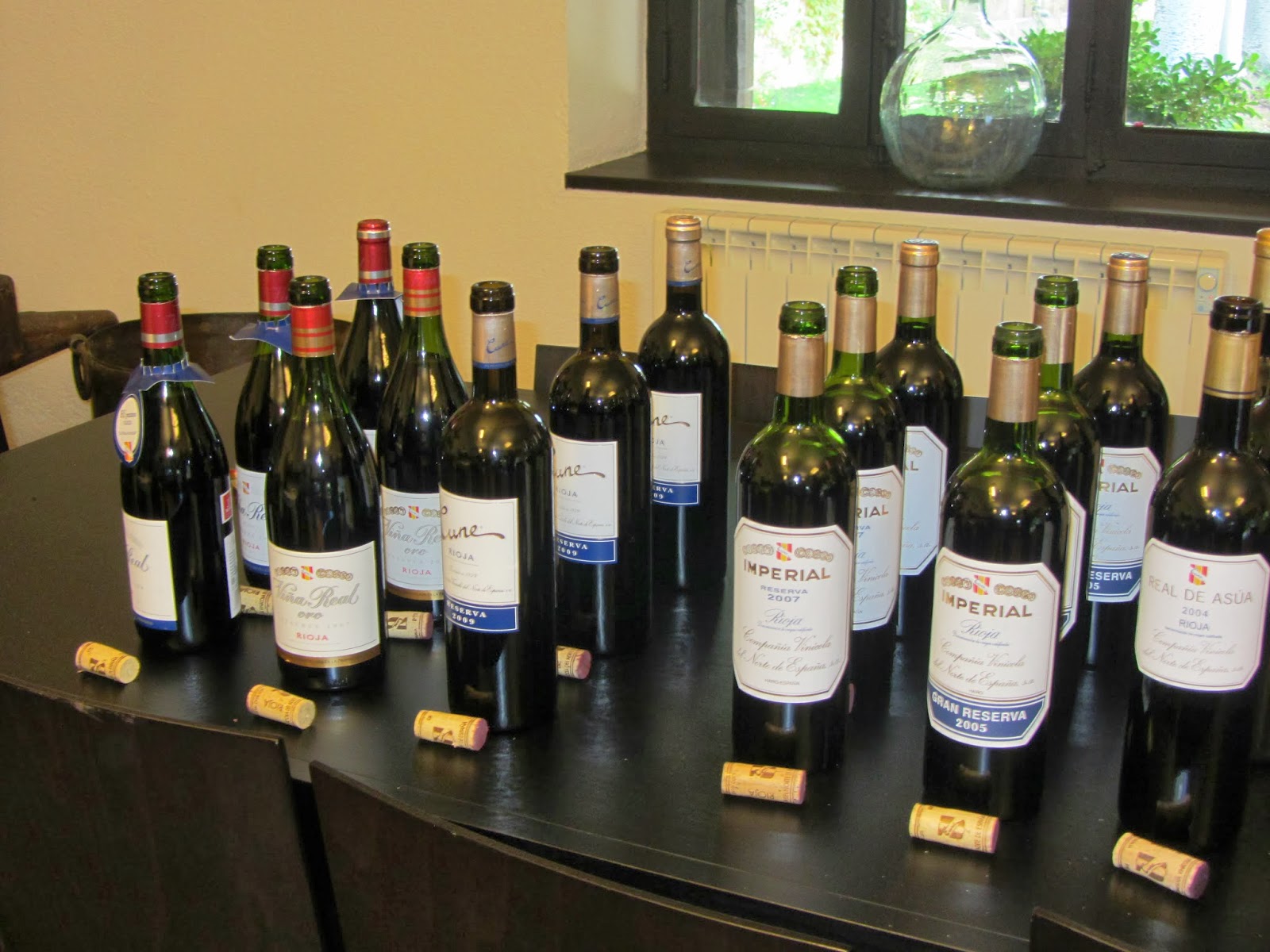
In my previous post I detailed the Wine Bloggers' tour of the Cune winery in the Station District in Haro. At the conclusion of the tour, we were led to the tasting room where we were joined by the other Maria, the winemaker. The wines which were tasted at this sit-down session follow.


Monopole 2012: Made from Rioja Alta Viura fruit. Fermented in temperature-controlled, stainless steel tanks. Light golden color. Florality along with aromas of pineapple, pear, apple, and green papaya. Refreshing on the palate with citrus notes. Easy drinking.

White 2011: The White label is only two years old and features barrel-fermented Viura juice. The grapes are cold-macerated for 6 to 8 hours prior to a light press after which the juice is fermented in new American and French oak barrels for 15 to 20 days. The wine rests on its lees -- with occasional stirring -- until it is racked off prior to bottling. Coffee and petrol aromas. Muted flavors. Spicy. Medium tannin and acidity.

Cune Rosada 2012: Made from Rioja Alta Tempranillo grapes which are kept at low temperature in stainless steel tanks for 24 - 48 hours before the juice is extracted. Fermentation occurs over an 8-day period. Strawberry color. Red berry and cherry confection aromas and flavors. Red fruit and fruit rollups. Reeks of carbonic maceration. Fresh and refreshing. Nice and easy does it.

Viña Real Crianza 2009: Blend of Rioja Alavesa fruit that is picked from bush vines that are planted on limestone and clay soils. The must is fermented in stainless steel tanks and then placed in American and French oak casks for malolactic fermentation. On the nose, richness, plums and other black fruits, vanilla, baking spices and sweet tobacco. Red fruit on the palate. Good levels of acidity. No rough edges. Persistent. Silky tannins. Balanced. Excellent wine.

Viña Real Reserva 2007: Hand-picked Rioja Alavesa grapes from low-yielding plots are macerated prior to alcoholic fermentation in stainless steel tanks. The wine is aged in American and French oak casks for 2 years prior to bottling. Herbs, dried thyme, forest floor, tea, baking spices. Bright red fruit. Late-arriving tannins. Elegant with a full, round mouthfeel.

Viña Real Gran Reserva 2005: Tempranillo-dominant blend made from high-quality grapes sourced from Viña Real's Rioja Alavesa vineyards. Fermented in stainless steel tanks with frequent pump-overs. Malolactic fermentation in American and French oak barrels. Racking and egg-white fining prior to bottling. Black fruits, leather, baking spices, vanilla, and cigar box. A little bit of jamminess on the fruit. Brighter than the Reserva. Silky tannins. Elegant.

Cune 2009: 18-month maturation in French and American oak post alcoholic and malolactic fermentation. Black fruits, tar, baking spices, and cinnamon. Oiliness. A little bit of VA. Red and black fruits on the palate. Tamarind.

Imperial Reserva 2007: Grapes sourced from vineyards around the village of Villalba in Rioja Alta. Fermentation in oak vats and stainless steel tanks. Matured in new and used American and French oak for 2 years followed by an additional 2 years in bottle. Violets, olives, plum, licorice, tar. Round on the palate with supple tannins. Great acidity. Persistent. Elegant and balanced. Long, sour finish with a little bit of heat.

Imperial Gran Reserva 2005: Grapes sourced from 20-year-old vines in Villalba and Haro. Low-yielding, bush-pruned vines. Cold maceration followed by cold-temperature fermentation and malolactic fermentation. Matured in American and French oak prior to bottling. Black fruit, tar, violets. Darker and heavier than the Reserva with grippy tannins. Can keep for decades.

Real de Asúa 2004: Grapes from low-yielding old vines from the best vineyards in Villalba and Haro are subjected to double selection and then fermented in oak vats. Post-fermentation maceration for 5 weeks with pump-overs and punching down of cap. Aged in 100% French oak barrels for 10 - 18 months. This wine is made in a more modern style. Penfolds Grange nose. Mint, eucalyptus, chocolate, coffee, leather, cigar box, tobacco. Structured.


©Wine -- Mise en abyme

Thursday, November 7, 2013

Cune winery visit (Haro, Rioja): The tour #DWCC13

I struggled to get out of bed on this, our first full day in Haro. We had had great visits with Bodegas' Gomez Cruzado and Ramón Bilbao over the course of the previous afternoon/evening and had capped those off with a late-night "tasting" session in the hotel lobby. I dragged myself downstairs about 5 minutes before we were scheduled to depart and quickly guzzled down a stabilizing coffee.

We were visiting the Cune winery this morning and, as they were located in the station district, we would be walking. The air was brisk so we set a like pace and arrived at our destination in fairly short order. We had arrived a little early so, while Robert tried to organize things with the Cune officials, we waited around; initially in the courtyard and then indoors in a pre-tour waiting area.

After the passage of some time, we were approached, and welcomed by, Marta Echavarri, the PR Manager, who informed us that the two Marias, the Marketing Director and the Winemaker, would be joining up with us during the course of the tour. And could we begin now, please. As she was speaking to us I could not help but notice this gigantic metal key (of the type sported by medieval jailers in the movies) in her hand. Its use became apparent later but, until then, I was a little concerned.

Marta began by telling us that the Centenarian wineries were all located in this area because of the old train station. The train allowed the wineries to connect with Bordeaux for shipping wine out and shipping barrels in during the time when the Bordelaise were fully engaged in their battle with Phylloxera.

According to Marta, Cune was founded by two brothers -- Raimundo and Eusebio Real de Asúa -- in 1879 and, at the time, was registered as Compania Vinicola del Norte de espana (CVNE). Due to a publishing error, however, the initials CUNE, rather than CVNE, was used in some documents and, given the way the former rolls off the tongue, it came into popular use.


Since its establishment in 1879, the company has expanded by founding additional wineries (Viña Real in 1920 and Viñedos del Contino in 1973) and adding labels under existing winery umbrellas (e.g., Monopole (1915), Imperial (1920), Real de Asúa (1994) under Cune). The table below captures the full extent of the CVNE wines.
  
 
CVNE owns over 600 ha of vineyards but this only meets the grape crush needs of Viñedos del Contino and 50% each of the needs of Cune and Viña Real. The remaining needs are met by procurement from long-term growers.
 
We walked out of the reception building and across a courtyard to the Real de Asúa cellar which is named in honor of the founders and serves as the production center for the Imperial and Real de Asúa lines. The end-to-end operations of the cellar are depicted herein.


About 20 years after Cune's founding, the architectural practice of Gustave Eiffel (Yes, that Eiffel) designed an 800-square-meter, column-free cellar which is today called the Eiffel Cellar and serves as the Real de Asúa barrel room. The structure currently houses about 400 American and French oak barrels of between 2 and 5 years of age.


Our next stop was the "cemetery," a series of underground caves where 500 bottles of each Cune vintage is stored. Entrance to the crypt is via a heavy metal door which is opened, with difficulty, by the large metal key of which I had spoken previously. We left the relative light of the cellar and entered into this dark, dimly lit, warren of narrow passageways with moss- and mold-shrouded bottles deposited in alcoves off the passageways. Stifling and claustrophobic but intersting to see, and hear about, some of the old vintages. Most of the bottles are stored sans labels with the labels applied when they are retrieved for use. The bottles in the cemetry are not for sale. Rather, they are used for special events and tastings at the winery and around the world.


This concluded the winery tour and also coincided with the arrival of Maria, the Marketing Director. One of the shortcomings of the tour was that Marta had to defer a number of questions to the arrival of the two Marias. While that is fine, a lot of questions are also generated from the actual presentation and the quality/number of questions are directly correlated to the depth and quality of the presentation.

I will cover the tasting portion of the visit in a subsequent post.


©Wine -- Mise en abyme

Wednesday, November 6, 2013

The "Earnest One": Night 1, Haro, Rioja #DWCC13

I have never met a wine blogger who trudges up to his/her room after a long day of tramping through vineyards and tasting barriques of wine. Never happens. Well, ok. The ones who respect themselves, and the mission, will go back to their rooms and dutifully write up their notes and/or blog posts. These are the serious ones. They are in the game to succeed. Not us. Robert had talked earlier about going into town when we got back from Ramon Bilbao but it was late when we returned so we would have to entertain ourselves. So we commandeered a small room off the hotel lobby and settled in for the long haul.
 
Image of Hotel Arrope, Haro
Source: rioja.on-map.net

We started out with drinks from the bar and conversation aimed at settling all of the world's outstanding issues. A fair bit into the conversation we encountered the Earnest One, a blogger who became "earnester" and "earnester" with the passage of time and the consumption of alcohol.

The bartender did not have our staying power and he soon fell by the wayside (and closed the bar down as he fell away) so Roger went to his room and retrieved two bottles of "tide-over" wines. I considered doing the same but I only had my one bottle of 2004 Togni which I had brought for the "Bring your own Bottle" festivities. I had not looked at the bottle since arriving in Spain as I had taken 4-hour delays at both Atlanta and Madrid and the suitcase-encased wine had pased that time on the tarmac. I did not want to know how it had fared. And I definitely did not want to find out in a small group. The anonymity of the BYOB setting seemed tailor-made for my first reveal (By the way, this wine was beautiful when I did open it at the BYOB.). But first I had to escape the earnest one as we were visiting Cune early in the morning.


©Wine -- Mise en abyme

Tuesday, November 5, 2013

Vineyard and Winery visit with Bodegas Ramón Bilbao (Haro, Rioja) -- #DWCC13

Our introduction to Haro and Rioja winemaking had gotten off to a splendid start with Bodegas Gomez Cruzado. At the end of that visit, we headed back to the hotel to meet up with the Bodegas Ramón Bilbao team. We knew that they had planned activities above and beyond the tour and dinner as they had requested shoe and shirt sizes for each participant weeks before our arrival in the country.

Bodegas Ramón Bilbao was founded in 1924 by a grape grower and wine trader named Ramón Bilbao Murga. The winery was held in the family until 1966 and was converted to a corporation in 1972. The corporation was acquired by Grupo Diego Zamora in 1999.

We were picked up at the hotel in four 4-wheel drive vehicles and, on our way to the vineyards, collected Doug Frost MS/MW and the two individuals who had missed the bus from Bilbao earlier in the day. At one point on the journey we stopped to view the ribbon of the Ebro River in the distance and to discuss aspects of the local soil. According to Rodolfo Bastida, our tour leader (and Managing/Technical Director of Ramón Bilbao), the soil is sandstone above the river -- he called it the "mother rock" -- and sedimentary, sandy soil close to the river.


Ramón Bilbao sources grapes from its own vineyards (75 ha over seven vineyards) as well as from high-quality growers in the region. Upon our arrival at the Haro vineyard, we were issued gloves, grape shears, and jackets and led into the field to pick grapes. The bunches were cut and placed gently into brown crates that were provided for this purpose. This exercise was designed to place us into the shoes of the workers who harvest grapes on a regular basis. It was hard work and our pace would require two years to clear the berries from the vineyard. When we had picked a "suitable" amount of grapes, we were told to stop. The crates with grapes were placed into the back of a pickup and, after turning back in our gloves and shears, we reboarded our vehicles for transit to the next stop on the experience tour.


After a short drive we came to a stop behind the tour leader's car and disembarked. Just off the road we saw a large stone slab with a number of carved indentations. We were told that this was a 14th-century-era stone vat which would have been used by small growers of the time. According to the PR Manager, wine was an important source of calories in that period and small growers would have owned vineyards of 1.5 ha on average. Grapes would have been picked by hand and then transported to these vats where the juice was extracted by treading. The juice would then be transported to the winery in sheepskins for fermentation. Given a lack of skin contact, only whites and rosés were made using this process. In many cases the juice would have been mixed with honey and spices.


The grapes that we had picked were placed into the largest indentation of the vat and we were -- after being issued rubber boots -- invited to tread them. After a few team members had taken turns doing so, a small portion of the resulting juice was strained into a bottle and offered to us to taste. I was otherwise engaged. The Ramón Bilbao team had used this same method to make some wine prior to our arrival so that we could taste for comparison. One of the wines was placed in bottle after 4 days fermentation and had about 6% alcohol. The other was fermented to completion and had alcohol levels of about 10%. The fully complete wine had, at best, a cranberry color.


The guys who missed the bus


At the end of this demonstration we headed to the winery. Our visit occurred in the midst of harvest in Haro so, as was the case for all of the wineries we visited, we were able to see the facility in full production mode. The Technical Director took glasses into the tank room and drew wines that had been fermenting for 1, 2, 5, and 10 days and had us taste them. The same-day ferment tasted like sweet grape juice while the 5-day ferment had a deeper color, was less sweet, and the acidity was more apparent. This wine had about 6% - 7% alcohol. The 10-day ferment had an even greater progression.


Ramón Bilbao stores 17,000 barrels on premises. Sixty percent of the barrels are American oak with the remainder being French oak. According to Rodolfo Bastida, micro-oxygenation of the wine is the most important contribution of the oak barrel to the winemaking process. He sees more flavor resulting from the use of American oak but greater micro-oxygenation resulting from the use of French oak.


We left the production area and went to a tasting room to sample selected wines. The first wine tasted was a 2012 Albarino from a sister label Mar de Frades. This wine had floral notes accompanying lime, lemon, citrus rind, tropical fruits, and burnt orange. Spiciness and minerality on the palate. Slight bitterness on the finish.

The first Ramón Bilbao label tasted was the 2008 Reserva, a blend of 90% Tempranillo and 10% Graciano and Mazuelo which is aged in American oak. Red fruit, baking spices, tar, and olives. Tar and spice prominent on palate. Moderate length on the finish. The 2006 Gran Reserva had red fruit, baking spices, shoe polish, and mahogany. Almost flabby. The 2010 Vinedos de Altura is 50% Garnacha and exhibits geranium, violets, red fruits, cinnamon, clove, and tar. Clove and cinnamon on the palate. A simple wine.

The 2010 Cruz de Alba is 100% Tinto Fino from Ribera del Duero. This wine is aged in French oak and shows baking spices, vanilla, cassis, and sweet tobacco. Rich red fruit, nutmeg, and spice on the palate. Structured. Excellent wine.

At the end of the tasting, we repaired to the dining room for dinner.


The activities in which we participated at Ramón Bilbao allowed us to observe contrasts in winemaking practices and styles and informed us as to how the differing styles affected the final product. There was the contrast between the use of wine in the 14th century (a source of calories) and its use today. In the 14th century, wine was harvested by hand but, instead of the grapes being transported to the winery for processing, they were taken to the stone vats for juice extraction. That juice was then transported to the winery in sheepskins for fermentation. It was easier to transport the juice to the winery rather than the grapes. Because there was no skin contact, color, flavor, and tannins were left on the floor of the vats. This affected the color, flavor, and longevity of the finished product as seen in our demonstration.

We were then able to taste wines which had been de-stemmed, crushed, and placed in stainless steel tanks where the juice was forced to maintain contact with the skins through pump-overs. Different color and more structure even in the early phases of fermentation.  We then tasted finished wines which had undergone oak aging, allowing us to see the effects of oak on the finished wine. Baking spices, vanilla, and tar flavors and aromas are introduced into the mix as a result.

On behalf of the wine blogging team I would like to thank the Ramón Balboa team for their inventiveness in putting together this comprehensive and innovative program. It yielded beneficial insights. Our heartfelt gratitude.

Great first day in Haro. Can't wait for tomorrow.


©Wine -- Mise en abyme