Wednesday, September 28, 2011

Review of Decanter's Great Port Wine Weekend

Decanter, the leading wine magazine in the UK, implemented a program last year to bring a select group of its readers to top-end Bordeaux estates in order to meet and interact with the winery managers.  The intent of the program was to increase the Decanter value proposition in the eyes of these readers.  This initial effort was extremely successful from the reader's point-of-view (see my review here) and, apparently, from Decanter's  also, because they opted to repeat the effort this year, this time calling it the Great Port Wine Weekend.  This year's event differed from last year's in that it: was held in Portugal's Douro region rather than in France's Bordeaux; extended from Thursday to Sunday, rather than the two days covered by last year's program; was held during harvest so that we could observe and (participate in) the process; had a significant fortified wine (Port) component; had separate vitivinification and maturation aspects due to the structure of the Port trade.

Decanter leveraged its standing and relationships in the wine world to provide its readers with a four-day package that had the leading lights of the Port industry showcasing the leading Port locales in an encompassing, breathtaking fashion.  First, the level and intensity of executive access was unparalleled.  Every single activity in which we participated was led by some combination of Paul Symington, CEO,  Symington Family Estates, Nick Heath, Marketing Director, Taylor Fladgate and Yeatman, Adrian Bridge, CEO, Taylor Fladgate and Yeatman, Dominic Symington, Executive Director, Symington Family Estates, and Ana Margarida Morgado, PR Manager, Taylor Fladgate Yeatman.  For perspective, Symington Family Estates owns Graham's Port, Cockburn's, Dow's Port, Warre's Port, produces 30% of the world's premium Port, and is the largest vineyard owner in the Douro.

This "extreme access" began with an aperitif on the terrace and a private lunch in a private dining room (Both locales affording spectacular views of the the Douro and Porto) at the Yeatman Hotel, both hosted by its dapper Managing Director, Adrian Bridge.  The Decanter team was comprised of 11 readers, Sarah Kemp, Decanter Publishing Director, and Emma Franc, Decanter Events Manager and this was our kickoff meeting.  A glorious start to what would turn out to be a glorious weekend.  Adrian's welcome was very warm and he stayed with us for the duration, a practice to which we became accustomed over the four days.


This was only the beginning, however.  Both Paul Symington and Nick Heath took us on a tour of the Factory House and then hosted us for dinner in this fabulous historical structure.  And this level of executive attention and care continued until Dominic Symington deposited us into the buses that would take us from Graham's Quinto dos Malvedos to the airport at Porto on Sunday evening for our trip back to London.  And every day was chock full of activities.

Nick Heath, Marketing Director, Taylor Fladgate and Yeatman

Paul Symington, CEO, Symington Family Estates


Over the course of the four days we met the winemakers at Quinta do Vesuvio (a very important Symington Estate in the Douro) and Quinta dos Malvedos (a Graham's property), the viticulturist at Quinta do Vesuvio, and the head of Viticulture for all Symington properties.  The upshot of this level of access was a constant immersion in the history of the region and its families, the viniviticulture of the Douro, maturation processes, soil, climate, the wines of the region, and the difficulty associated with farming here.


As one travels up the Douro River, whether by train or boat, one is struck by the beauty of the terraced vineyards on gently sloping hills which reach at once for the sky and the horizon.  Punctuating these vineyards are patches of scrubland, walnut and olive trees, and granite outcroppings.  The appreciation for the beauty of the landscape is tempered by a mental tip of the hat in recognition of the human effort that was required to transform this inhospitable environment into a setting wherein extreme agriculture could be practiced.  The river, placid as it is, has been known to rise up and break a rib or two of the unsuspecting water-skier.


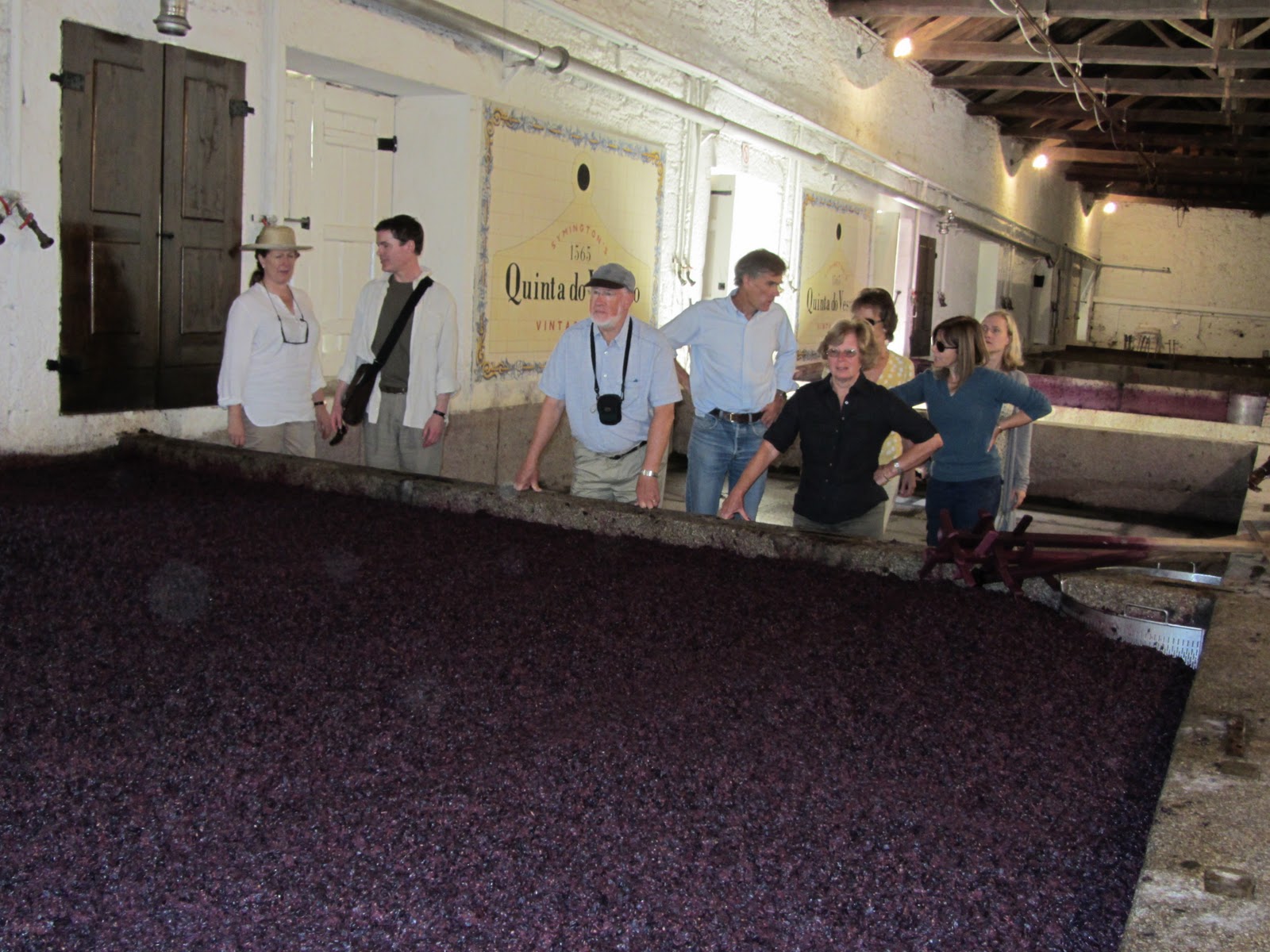
Occurring as it did in the midst of harvest, this trip afforded us the opportunity to observe the winemaking process for the 2011 vintage.  Port is vinified in the upper reaches of the Douro and then shipped downriver for maturation the following spring.  We visited three estates and were able to observe hand-harvesting of the varietals, the transportation of the picked grapes down to the winery, treatment of the grapes prior to crushing, various manual and mechanical crushing methods, fortification of the must, and the temporary storage of the fortified wine in the winery.  We participated in a manual crush but also gained an appreciation for the long hours that vineyard workers put in during harvest.  They are up at the crack of dawn and are picking grapes from 7:00 am until about 4:00 pm and are in the winery stomping grapes (gently) from 7:00 pm until 11:00 pm.




Our accommodations over the four days were an experience in and of themselves and contrasted luxury-living in a port town versus living on a working farm where the nearest convenience store is 40 kilometers away (When you forget to pick up milk on the way home you are not going back.).  The Yeatman Hotel, our place of abode in Gaia, is a new luxury hotel with all of the amenities.  The estate house at Quinta de Vesuvio is two-story, multi-bedroom structure with an attached church and no room-service button but we all jumped at the chance to stay on a working estate during harvest.  And this is not your every day rural farmhouse. It exuded warmth and charm which, in combination with the famed Symington hospitality, made us feel right at home.


We did not want for food or drink on this trip.  Being as close as it is to the Atlantic, fish dominates the Douro menu, with cod (for the most part slightly salted) as the victim of choice (Being a bacalou aficionado, I had no problem with this.).  The meals in the upper Douro were hearty and reminded me somewhat of Tuscan fare in its appropriateness for the land.  Drinks were always at hand either in the form of a tasting, an aperitif, or an accompaniment to a meal.  One popular aperitif is white port and soda on the rocks with a slice of lime and a mint leaf.  Very refreshing.  The meal progression is to first sit around in a circle and have a port-and-soda-fueled discussion before decamping to a nicely laid out table for the actual meal.


This trip was impeccably organized and well-managed on the ground.  I was not privy to the workings of the process but it was obvious that a yeoman Symington logistical effort underpinned the entire program.  Our transportation needs were frequent and varied but the bus, train, or boat was always there; and so were we. The concern for time, and respect for others, was especially evident in the cases where we were being handed off from Taylor's to Symington or vice versa.

If this program had been organized by anyone but Decanter I would have been advising them to get out now.  To quit while they were ahead.  I would have suggested that it would be exceedingly difficult to better  (and, after all, we always expect better) the experience that was afforded this year's participants.  That it would be hard to find partners who are so hospitable and generous with their time; so willing to include us in their family activities.  But after all, it is Decanter of whom we speak.  And it is Decanter to whom we will look next year for another mind-blowing experience.

I will detail the individual elements of our trip in future posts.

Tuesday, September 27, 2011

2009 Beaujolais Tasting: Cru Wines

The press had spoken glowingly of the 2009 vintage in Beaujolais, as had critics and winemakers alike.  Even Andrew McNamara, the Master Sommelier who was leading us in this tasting, had referred to the vintage as the best he had ever seen coming out of Beaujolais.  Yet we were more than of a quarter of the way through the tasting and had not yet encountered any earth-shaking wines.  But maybe our fortunes would change with a shift to tasting the cru Beaujolais wines.  Our experiences in that regard is the subject of this post.


Before we get to the wines, some acknowledgements that should have been covered in my earlier post.  First, the wines were provided by Ron Siegel, John Alport, and the author.  Some of the wines had to be shipped in overnight (given the time of the year and the fact that the tasting was being held in Florida) and the cost of shipping was significantly greater than the cost of the wine.  Secondly, I would like to thank Ron for securing the tasting locale and associated excellent service personnel.

Now back to the wines.  The characteristics of the individual crus were covered in an earlier post as was the tasting order, which flowed from lightest to most robust.  The first cru tasted was the Vissoux Brouilly Pierreux.  On the nose butterscotch, carmel, and raspberry.  On the palate, tart cranberry, raspberry, dusty earth, and a certain spiciness.  Also, some evidence of tannin and texture.

The second wine tasted was the Domaine des Braves Régnie.  This estate is owned by Paul Cinquin and was initially founded by his grandfather.  It was broken up into many pieces as a result of the French inheritance laws but Paul has reconstituted 20+ acres of the original estate on soil that is a mix of sand and clay.  Paul picks his fruit seven to ten days later than his neighbors in order to ensure maximal ripeness.  The wine is unique in Beaujolais in that it is a blend of three distinct vilification methods: thermo (for color and lightness of aromas); pigeage (for extraction of tannins and aromas); and semi-carbonic (for fruit and soft tannins).  The wines are 100% tank-aged and are bottled unfined and lightly filtered.  This wine threw off aromas of bubblegum, red fruit, perfume, game, and earth.  It was fuller-bodied than any wine tasted to this time and was smooth on the palate.  Now we were beginning to cook with gas.


The next wine up was the Damien Coquelet Chiroubles Vielles Vignes.  The label on this bottle was rather unprepossessing, as French wine labels go, but this was one serious wine.  The nose launched us into a lengthy discussion on brett and its contribution to/detraction from wines.  This wine did exhibit some brett on the nose but it was not off-putting.  The wine had great body, asian spices, and a pepperiness to accompany kirsch-liqueur and black-fruit flavors.  It had a long, silky finish.  Impressive.  I have bought a case of this wine post the tasting.

Chateau Thivin Brouilly was the next scheduled wine in the lineup.  This estate has 8.3 hectares of east-, south-, and southwest-facing vineyards on the steep slopes of Mount Brouilly.  The soil is composed of blue stones of volcanic origin.  The estate's vineyard strategies promote natural regulation of pests and diseases, proper soil conditions, and sun exposure and aeration for the hanging fruit.  Grapes are hand-harvested  in whole bunches, macerated for 8-12 days, and aged in oak casks for 6 months.  Tart red fruit on the nose confirmed on the palate along with some minerality and a medium finish.


The wine from the cru of St. Amour was the Domaine des Champs-Grilles Revillon.  This wine exuded sweet, floral notes with a hint of decomposing rose petals.  It was light of body, soft, feminine, and elegant.  It was not as acidic as the crus tasted to date and was endowed with late-arriving tannins which dried out the palate on the finish.

The Pierre-Marie Chermette property that is the source of the Fleurie wine is called Poncie and is a 4.5 hectare, southeast-facing plot on the heights of the cru.  This vineyard was planted 35 years ago on pink granite soil that is rich in mica and quartz.  This wine is meaty and iron-rich on the nose; somewhat reminiscent of a charred grill.  Light on the palate.  Rustic with a non-round mouthfeel.


The contribution from the Juliénas cru was the Domaine Eve and Michel Rey Les Paquelets. The grapes for this wine were sourced from low-yielding vines with an average age of 90 years.  Slightly medicinal on the nose with lots of (good) funk and granite.  Dense on the palate with great texture and a fulsome representation of acidity and tannin.  This was the most Burgundian of the wines tasted that day and earned the designation "wine of the day."  I have since bought a case of this wine.

The next wine tasted was the Jean-Paul Thevenet Morgon.  Jean-Paul Thevenet is one of Beaujolais' most respected growers.  He practices organic cultivation, ferments with natural yeasts, and adds little or no sulfur to his wines.  This particular wine was aged for 6-8 months in aged Romanée Conti oak barrels and is bottled unfiltered.  This wine exudes perfume.  Florality and a little bit of sulfur on the nose.  Spicy and metallic on the palate.


The Jean-Paul Brun Domain des Terres Dorées Moulin-à-Vent had hints of reduction and burnt matches on the nose and was rich, big, and balanced on the palate.  Another victim of my post-tasting shopping spree.

The final wine of the tasting was the Domaine Piron-Lameloise Chenas Quartz.  This wine had lots of fruit on the nose and spice and tannins on the palate.


All in all a wonderful event.  Andrew walked us through the wines in a masterful fashion, imparting nuggets of wisdom along the way.  The cru Beaujolais stood out and have made me a believer; so much so that I have since bought three cases of the standout crus with the intent of tracking their evolution over time.  In my opinion (based on the performance of the wines in this tasting), cru Beaujolais from the 2009 vintage is deserving of your consideration.

Thursday, September 15, 2011

2009 Beaujolais Tasting: Non-Cru Wines

Beaujolais, and, specifically, cru Beaujolais, is an excellent option for the serious -- or the not so serious -- wine drinker, a point that was driven home to me during the course of a 2009 Beaujolais tasting which I hosted at the Capital Grille in Orlando on August 9th.  The objective of the tasting was to explore the breadth of Beaujolais for this much-heralded vintage.  The tasting panel consisted of nine people and we were fortunate to be led in this effort by Master Sommelier Andrew McNamara.  The tasting will be reported in two posts: this one covering the non-cru

Master Sommelier Andrew McNamara and John Alport (Augustan)
Adam Chilvers (Wineontheway.com) and Ron Siegel


 wines and a second covering the cru tastings.

The wine lineup is presented in the table below.  The wines were tasted lightest to heaviest with the sparkling and white comprising the first flight.


In his opening remarks Andrew reminded us that Beaujolais is really a part of Burgundy and that the two regions overlap in Beuajolais' northernmost areas.  Beaujolais wine, according to Andrew, owes its heritage to the religious orders that came into the region and made wine from the indigenous grape, Gamay.  Philip the Bold felt that Gamay was only fit to be served to pigs and livestock and ordered the vines pulled out.  The Gamay vines in Beaujolais were spared that fate and have survived and thrived in the region over the years.

While Beaujolais is a part of Burgundy, in many ways it is Rhone-like, says Andrew.  For example, the soil in many parts of Beaujolais is granitic, a Rhone characteristic.  Second, both Gamay and Syrah are descended from Gouvay Blanc, an ancient varietal originally grown in Central Europe.

With the attention being paid to Beaujolais, a number of producers from outside are beginning to make wines in the region.  Most of the very good Beaujolais wines are still, however, mede by Beaujolais specialists. As we turned our attention towards tasting the wines, Andrew stated that the 2009 vintage was the greatest Beaujolais vintage that he had ever tasted.

The first wine tasted was the Domaine Vissoux Brut Blanc de Blanc.  This winery and its practices have been summarized in a previous post.  


This sparkling wine is 100% Chardonnay from grapes grown on a 2.5 hectare, southwest-facing plot which sits on a limestone-clay soil.  This blend of 2006, 2007, and 2008 vintages has seen very little dosage liqueur and has been aged for 18 months.  The bubbles on this wine appear to be short-lived.  Initial bread aroma with a hint of apricot followed by a more distinct rubber note.  On the palate a short, tongue-coating finish.  Less minerality, alcohol, and yeastiness than a traditional champagne.  I will not be running out to buy this wine anytime soon.

The second wine tasted was the Domain des Terres Dorées Beaujolais Blanc.  This winery and its practices have been summarized in a previous post.  On the nose the wine was fruity,


oily with a beeswax character, herbal with a basil tint, and had grapefruit notes. On the palate grapefruit and lemon rind with good acidity.  This wine was lean and light with a residual bitterness on the palate.  This wine was not well regarded by the tasting panel.

At this juncture the tasting switched to the forte of Beaujolais, wines made from the Gamay grape.  The first red wine tasted was the Domaine Dupeuble Pere et Fils Beaujolais.  This producer ferments the wine using natural yeasts, uses no sulfur, and bottles unfined and unfiltered.  This wine had aromas of bubblegum, fruit, rubber, and cotton candy.  Tart cherry on the palate with a hint of bitterness on the medium finish.

The final non-cru wine tasted was the Mommessin Beaujolais-Villages Vielles Vignes.  The grapes for this wine were sourced from 40- to 80-year-old vines located on granite-schist-limestone hillside plots.  The grapes are handpicked, sorted, and vatted as whole bunches, then bled in search of greater concentration.  The grapes are fermented for 9 days in vats after which malolactic fermentation occurs.  Cherry and bubblegum on the nose.  On the palate a tartness and tannin (some wood, some grape).  A full, richer body with fine-grained tannins.  More character and greater length than any of the preceding wines.  Hopefully a harbinger of things to come.


With the tasting of the Mommessin, folks were lessening the frequency of accusatory glances cast my way.  Up to this point the looks were clearly asking "Why are you wasting our time here today?"  I started to breathe a little easier.  Cru wines up next.

Tuesday, September 13, 2011

Inside the Rosso di Montalcino "No" Vote

"The assembly of producers congregated in the Consorzio del Brunello di Montalcino met this afternoon and rejected the proposal to modify the regulations of the DOC Rosso di Montalcino." So began the brief, two-paragraph press release issued by the Consorzio on September 7th to inform the world that this initiative had been soundly defeated.  The results are now history but what actually transpired in that meeting where the vote was taken?  I have consulted with reliable sources in order to gain some insight into the setting and proceedings and will share those insights in this post.

But first let us revisit the purpose of the vote.  According to Decanter.com, the proposed motion would, if adopted, allow: (i) the inclusion of up to 15% of non-Sangiovese varietals in Rosso di Montalcino; (ii) permit irrigation in the vineyards; (iii) remove regulations stipulating that vines used to source Rosso wines be planted on hills and slopes; (iv) allow for the inclusion of grapes planted below 600m; and (v) broaden the acceptable terrain on which vines could be planted.

Now back to the vote.  The meeting to vote on the motion was held in the Teatro degli Astrusi, the newly refurbished 18th-century structure overlooking the old town hall.


According to my sources, the meeting was initially convened at 2:30 pm but did not proceed due to insufficient attendees.  A second call-to-order was made at 3:30 pm at which time the meeting formally began.  A total of 638 votes were included in the final tally but as the theater only seats 180, the multiple-vote-per-producer system becomes readily visible.  According to Decanter.com, voting rights are tied to producer size with small and medium-sized producers having three votes each and the largest producers having as much as 60 votes, depending on bottle count.  My sources indicate that there were about 150 producers present with some attendees having the delegated authority to vote for absentees.

This was a very important vote for producers.  In addition to the production impacts they would feel, they had to contend with the fact that major wine critics like Jancis Robinson had expressed an opinion on the matter and that Decanter, an important industry magazine, was following the story closely.  The tension that came with all this pressure was palpable in the lead-up to the vote.  But with all of the weightiness of the day one of the hallmarks of the afternoon's activities was civility.  The producers were civil and professional as they went about the afternoon's business; for example, producers socialized freely prior to the start of the meeting even though some had taken very public stands for or against the motion.

As indicated in the picture, the theater has seating capacity in the central hall as well as in the boxes lining the walls above.  The producers sat in these seats while the Consorzio President, Vice President, Director Stefano Campatelli, and two advisors sat on a podium at the front of the hall.  The agenda was presented by the President -- brief, as there was only one topic -- after which the producers launched into a debate of the motion.  The three-hour-long debate was heated but civil.

At the conclusion of the debate, the vote was held.  Voting was by secret ballot.  Each producer was called by name at which time the representative filled out a voting sheet and placed it into a box provided for that purpose.  At the conclusion of the vote producers employed a number of strategies to pass the time as they waited for the results.  Some, including the President, left shortly after the vote was taken. Others stayed in the theater while some hung around outside.  Others simply went for an aperitivo.

The results became known 4 hours and 15 minutes after the meeting had been called to order.  There was no official announcement in the theater but news of the results came trickling out and, as all of who had remained in the theater were on the "no" side, the news was received with relief and glee.  The final count was 465 against (a full 70%) and 210 in favor; a stunning, stinging setback for the President and his agenda.

In a previous post on the Rosso di Montalcino affair I had asked where were the men and women willing to stand against the forces seeking to change this aspect of Montalcino culture.  I now have my answer.  They were in the hall and the box seats of Teatro degli Astrusi on the afternoon of September 7th.  And they made sure that they were counted.  And they made their votes count.

Wednesday, September 7, 2011

The Rosso di Montalcino Affair: Marketing Folly or Cynical Expropriation of a Common Good by a Powerful Few

As the Montalcino producers prepare to vote today on the proposal to change the requirements for Rosso di Montalcino, I could not help but view the exercise as either (i) one of the world's greatest marketing follies or (ii) a cynical expropriation of a common good by a powerful few.  Let's examine the evidence.

The Consorzio as well as Brunello producers have spent enormous sums of money positioning Rosso di Montalcino as the early drinking baby brother of Brunello di Montalcino.  And the campaign has worked.  Ask anyone who is even remotely familiar  with Montalcino about Rosso di Montalcino and they will say "Brunello's baby brother."  That is branding, a marketer's delight.  Companies expend a lot of effort and funds to gain that type of association; and once it is attained, they guard it jealously.  Enter the Consorzio.    Let us assume that they found something wrong with Rosso and determined that the fix needed to be a two- or three-wine solution (ignoring for the moment the question of why we are retaining the original Rosso as part of the solution if it has a problem), you would expect that the brand goodwill would be retained by keeping the relationship between the original product and the original name.  Any new nomenclature would be associated with the new instances of the product.  Not so the Consorzio.  They are proposing to throw out all of the investment in branding by having the name Rosso di Montalcino associated with the new product while the existing product gets a new, needlessly confusing name(s); a senseless elaboration of what it already is.  By the standards of even a first-year marketing student, a colossal blunder.

But is it? Or is it a schema for expropriating that goodwill towards another end? Two lines of evidence point towards this latter explanation.  Franco Biondi Santi had previously been reported as being in favor of the proposal to change the requirements but he clarified his position in later statements to the press.  According to doBianchi.com, Mr Santi had previously been in favor of adding softening wines to Rosso but certain provisions in this proposal took the motion above and beyond that consideration.  According to Decanter.com, the motion would revisit vineyard requirements for Rosso to include removing restrictions of (i) planting on hills and slopes, (ii) plantings below 600m, and (iii) terrain from specified geologic periods.   With these changes, it is no longer about softening up Rosso di Montalcino; it is about bringing the unsaleable Sant'Antimo grapes into the fold. Under those conditions, Mr Santi could not support the vote.

With all producers having a common Rosso in their portfolio, the branding efforts, and the goodwill that accrued as a result, was a common good.  If only a select few of these producers have international varietals to add to a blend, and if that blend now retains the name that has been established in the marketplace, then that common good has been expropriated by a few, leaving the majority to try to explain to the marketplace what this new Rosso di Montalcino Sangiovese or Sangiovese Superiore is.  The net benefit is a negative to the producers left holding the bag.

We keep our fingers crossed.

Monday, September 5, 2011

Parker's "Magical 20": In Search of the Objective Criteria

Robert Parker's announcement of a Bordeaux "Magical 20" chateaux list -- whose wines will be tasted at The Wine Academy of Spain's Wine Future Hong Kong event on November 8 -- is significant in that it has the potential to: (i) cut through the confusion of the existing Bordeaux classification schemes to create a new Bordeaux "super-scheme" which is positioned just after the First Growths;  (ii) creates winners and losers among the chateaux; (iii) exposes a set of wines below the First Growths to the Asian market -- with attendant benefits to the chosen chateaux and price increases to your favorite wines if you are a consumer in other markets; and (iv) kick-start efforts to modernize the outdated 1855 classification scheme.  Given the potential impact, it is important that we understand Parker's criteria for inclusion on this list.  While we await Mr. Parker's revelations, I will attempt to use available data to try to tease out some of these criteria.

In his announcement, Parker stated, "I have chosen estates that produce wines of first growth quality, although technically not first growths.  Consequently, they are under-valued and very smart acquisitions."  Parker will be accompanied at the tasting by representatives from each estate.  The estates, their current classification, and  their respective AOC are shown in the table below.


My first impression in looking at the list is that there are some names that I would have liked to see on here that are not mentioned.  But then again, I am @wineOrl and he is Robert Parker.  He wins.  The list contains 11 chateaux from the 1855 Classification (5 second growths, 3 third growths, and 3 fifth growths), two from the St Emilion classification, and three from the Graves classification (Pomerol properties have never been classified.).  Every meaningful Bordeaux commune is represented in the list with 70% of the properties being left-bank-based.  Of the individual communes, Pauillac, Marguax, and Pomerol, with four chateaux each, are the most represented.  Nothing in this table appears to be list-composition drivers.

Not finding the criteria above, I turned to the release price of each chateau's primary wine.  In that the 2009 release of the wines will be tasted at Wine Future Hong Kong, I wanted to include that year's price in the analysis but I also wanted to look at least five years back so that meaningful analysis and comparisons could be made.  I was able to obtain time-series data on release prices from  genesiswines.com and those data are presented in Table 2 for the years 2004-2009. 


The series includes two exceptional years (2005 and 2009) and two less-than-stellar years (2004 and 2007).  The prices are stated in British Pounds.  In that 2009 was a stellar year, I wanted to compare it against another stellar year and 2005 fit that bill.  The second comparison was the pricing differential between 2008 and 2004.  In the cases where a price range is given, the low end of the range is used.  The comparisons are shown in the last two columns and indicate no correlation between inclusion on this list and 2004-2008 or 2005-2009 price growth so Mr. Parker could not have used these as criteria for composition of the list.  Onward then.

I looked further into areas such as ownership (a mix of owners to include industrialists, families, insurance companies, etc.), consultants employed (Michel Rolland, Stephen Derenoncourt, among others, but not in a suffocating way), and recent quality-focused investments (Cos, Pontet, and Angelus stand out) but no clear commonalities exist that one could point to and say "these are the objective standards for inclusion in the list."

If we have exhausted the possible objective selection criteria, then inclusion on the list must be subjective.  Could Parker scores have been the basis for inclusion? Let us take a look at that.  Table 3 shows Parker scores for each of the chateaux between the years 2004 and 2009 and a calculated average in the rightmost column. In looking closely at


the list, Pontet-Canet, Pape-Clement, and Smith Haut-Lafite show excellent scores in the down 2007 vintage.  On the other hand, Lynch-Bages and Pichon Lalande scored poorly in 2005, a year when even street-corner vendors were making excellent wines.  This is not the first time that Pichon Lalande has received low scores in a good vintage year.  You might remember a similar occurrence in 1990, another stellar Bordeaux vintage. And this begs the question as to why Ducru-Beaucaillou is not on this list.  It had an average score of 94.8 over the highlighted period; better than some of the wines included herein.

The average scores earned by the chateaux range from the low 90s to 96, a non-uniform distribution.  However, according to The Wine Advocate Rating System, a wine scoring between 90 and 95 is "an outstanding wine of exceptional complexity and character"; and all of these wines, save one, fall within that orbit.  But so do a lot of other Bordeaux wines that have more stuffing than Le Gay, for example.  Did they create a list and then stop calling when they got 20 people willing to travel to Hong Kong to participate in the event?  I hope not because this is potentially a guide to the Chinese as to what they should be buying next; and in so doing will create winners and losers among the second-tier Bordeaux players.  It will also have pricing implications for Bordeaux buyers like me.

With all of the foregoing, my biggest concern is the potential for creation of a new "super-second" classification scheme which is both subjective and single-sourced.  All previous Bordeaux classification schemes have come about as a result of group action.  In the case of the 1855 classification of the Medoc, Napolean requested a classification schema and it was developed by the brokers based on chateaux reputation and prices.  In the case of the St. Emilion classification, the Syndicat Viticole had begun considering the idea in the 1930s but held off until 1954 when the Institute Nacional des Appellations d'Origine (INAO) agreed to manage the process.  The Graves classification was implemented in 1953 by a jury appointed by INAO and was approved by the Ministry of Agriculture.  The scheme was updated in 1959 and has survived in that state to the current day.  All of these systems need updating to account for the passage of time (the St. Emilion classification is supposed to be updated every 10 years but the 2006 update had been mired in legal wrangling which has finally been resolved) but, given the implications, I would expect a studied, broad-based effort(s) to be the vehicle for such change given the number of stakeholders.  I fervently hope that Parker's "Magical 20" does not become a de facto Bordeaux classification scheme.

Thursday, September 1, 2011

Central Florida James Beard Nominees Charity Dinner at Cress Restaurant

The patrons of Deland's Cress Restaurant were tickled pink that their hometown restaurant was hosting the inaugural Central Florida James Beard Nominees Charity Dinner and this delight was manifested in the turnout and their enthusiastic embrace of all aspects of the evening's event. 


The event featured a 7-course meal prepared by an all-star cast of Orlando chefs to include Scott Hunnell of Victoria and Albert's, James and Julie Petrakas of The Ravenous Pig, Kevin Fonzo of K Restaurant and Wine Bar, and Chef Hari Pulapaka of Cress Restaurant.  All proceeds from the event benefitted The Coalition for the Homeless of Central Florida and Second Harvest Food Bank of Central Florida.

The event was slated to begin at 6:30 pm and most people arrived on time.  The doors were closed, however, as management and staff continued with their last minute preparations.  When the door was finally opened, it was only long enough to allow one couple through.  Once that couple was placed in pre-assigned seats, another couple was let in, and so on until all seats were filled.  The table settings were gorgeous and menu presentation impeccable.  Once you arrived at your seat, a member of the wait staff came over and introduced him/herself and offered a flute of Heidsick Monopole Blue Top Brut champagne.


Once everyone was seated, the chefs came out of the kitchen to be introduced to the attendees.  Chef Hari opened the proceedings by thanking his fellow chefs and remarking on how impresesed he was with them.  They had shown up two to three hours earlier and had immediately gone about setting up their material.  Things had run so smoothly that they were now helping him in his set up.  Each chef then introduced him/herself and acknowledged the underlying purpose of the evening and how happy they were to be able to participate in this worthy cause.  Chef Hunnell talked about these chefs being at the vanguard of a food and dining movement in Orlando which is aimed at providing residents and guests with an attractive culinary scene.  Chef Petrakis also referenced this culianry movement but expanded its reach all across Florida.  At the conclusion of their comments, the chefs exited stage left and the serious examination of their handiwork commenced.


 T
The first course was an Amuse Bouche composition with contributions from a majority of the chefs: Applewood Smoked Bison with an Apple-Walnut Salad from Chef Hunnell; Blue Fin Tuna and Scallop Tartare with Caviar and Hazelnut from Chef Petrakis; Pickled Deep Creek Ranch Pickled Beef Tongue Reuben with House Kraut, Caraway Gribiche, and Toasted Pumpernickel from Chef Fonzo; and Pasture Prime Farm Milk Fed Ranger Chicken Bisteya with Tikka Masala Ice Cream and Preserved Lemon from Chef Pulapaka.  This was paired with the Heidsick champagne referenced earlier.  


The second course was a Chef Hunnel creation and featured Spanish Octopus, Summer Tomatoes, Arbequina Olive Oil.  It was paired with a 2010 Legado del Condo Albarino Rias Baixas, a Spanish white wine.

The third course, offered by Chef Pulapaka, was a Roasted Local Snowy Grouper, Local Shellfish "Cioppino", and Summer Truffles.  It was paired with a 2006 Domaine GuffensHeynen Macon Pierreclos.


The Intermezzo was Blackberry Blood Orange with an Habanero gel.


Course 4: Oxtail Tortellini, Butter-Poached Maine Lobster, Sunchokes, Lobster Mushrooms.  A Chef James Petrakis offering paired with 2007 Jose Maria da Fonseca Domini Plus Douro, Portugal.

Course 5: From Chef Fonzo, a Braised Lake Meadow Naturals Goat Rib, Goat Belly Confit, House-Made Goat Cheese Pudding, Succotash of Sweet Corn and Summer Beans.  Paired with 2004 E&E "Black Pepper" Shiraz, Barossa Valley, Australia

The sixth course was a cheese composition: Artisanal Cheeses and Accoutrements.  Paired with 2008 Benton Lane First Class Pinot Noir, Oregon


Course seven was a dessert course from Chef Julie Petrakas.  It was a Fig Duo: Creme Caramel, Black Mission Fig Compote, Dark Choclate-Brown Turkey Fig Tartlet, Fig-Cardamon Sorbet.  Paired with Taylor Fladgate Tawny Port 40-Year Old, Portugal


By this time I was truly tuckered out (To be truthful, I had blown my wad long before this.).  This had been a truly formidable array of dishes offered up by chefs at the top of their game.  Two of the dishes/pairings which stood out for me were courses four and five.  Course four was special because I did not initially get the rationale of the pairing given the white sauce-red wine combo.  Hidden under all the white, though, was the oxtail tortellini and the lobster mushrooms and they were more than adequate to support the Portuguese red.  On course five, I have eaten goat in the past but in more of a comfort-food style (Curried goat, for example).  This was my first encounter with this gourmet-style presentation of goat and ... I liked it.  All of the pairings worked well in my estimation with the exception of the Black Pepper Shiraz which had a brackish taste and added nothing to the dish.

Midway during the meal, Bill Budzinski of the Elusive Grape announced an upcoming live auction of seats  at their restaurants donated by the participating chefs.  This announcement lent a further dash of excitement and anticipation to the evening's proceedings.  After the meal was completed, Bill proceeded with the auction.  The first offering seemed to take everyone by surprise because, before you knew what was happening, my table mates had "won" at the opening price.  This did not happen again as people warmed to the proceedings.  The most hotly contested offering of the evening was two seats at Cress Restaurant.  The author's wife became involved in a bidding war with two other tables which was only terminated by having all six of us agree to a joint dinner which would also be attended by Chef and his wife and Bill and his wife.  A welcome relief.

Post the auction, all of the chefs and the kitchen staff were brought out to take a bow.  Chef Pulapaka thanked them for their support and thanked the attendees for thier participation.  The chefs were all very gracious in their concluding remarks.


All-in-all a very successful evening: the event raised $13,500 for charity; the guests had an enervating evening where they went away satisfied and with a feeling of having done something good; the participating chefs seemed to have had a good time; Chef Pulapaka represented his abode and his constituents admirably; and the small kitchen did not in any way restrain the artistry and creative forces of these dynamic chefs.