Showing posts with label Emergent Spanish wine regions. Show all posts

Friday, March 26, 2021

Emergent Spanish wine regions: Jumilla

Jumilla is a 19,000 ha DO in Murcia, a small region on the coast of southeast Spain. Its specialty is wines made from the Monastrell variety (80% of the region's plantings).

Jumilla DO within the broader Murcia wine region. Red oval
highlights Jumilla color scheme (Source: vineyards.som)

The climate here is arid and continental with drought always a threat. When the rains do come, they are very heavy and pose a threat to blossoms and ripening grapes. An elevated central plateau (400 - 800 m elevation) moderates the heat somewhat.

The landscape is composed of wide valleys and plains with sandy or loamy soils prevalent. The volume of lime in the soil is a key aid in moisture retention.

Most grapes are planted on the mountain-enclosed plateau. Ninety-four percent of the grapes are organic.

Why Jumilla as an Emergent Region?
Jumilla has re-invented itself as a producer of modern, fruity red, white, and Rosé wines. Improved vineyard management, and outside investment in new equipment from industry heavyweights in other Spanish regions, have led to a remarkable increase in wine quality. The result is a new generation of "characterful" wines, some organic, and the majority red, in which the rediscovered Monastrell grape is showing promising results in the hands of skilled winemakers.

******************************************************************************************************
The regions identified as emergent by Torres in his initial article are:

©Wine -- Mise en abyme

Thursday, March 25, 2021

Emergent Spanish wine regions: Emporda

Emporda is another of the Torres-identified "emergent" Spanish wine regions.

La Costa Brava, the coastline that runs along Spain's northeastern shore, is best known for its beaches and resorts and less so for the DO Empordà that lies just inland of it. This lack of identity was so palpable that the DO appended the coastline's name to its own in order to elevate its visibility. The name is thus, officially, Empordà-Costa Brava. All of 1826 ha, Empordà is one of Spain's smallest DOs. It gained its classification in 1972.

DO Empordà

The climate in the DO is Mediterranean but the strong Tramontana winds, while aiding in disease- and frost-prevention, can inflict damage on the fruit during the growing season. Average annual rainfall is 600 mm.

The main soil types are sand, slate, and decomposed gravel with the majority being of a sandy texture and with low organic material content. Alluvial soils predominate in the plain while slate and granite predominate in the mountains and mountainsides. Altitudes range from 0 to 260 m.

A majority of vines are in excess of 30-years old and are planted at altitudes of 200m. The bulk of the plantings are Macabeo, Garnacha Blanca, Garnacha Tinta, and Cariñena, with a growing presence of Tempranillo, Cabernet Sauvignon, Syrah, and Merlot. Sixty percent of the region's wines are red, 17% Rosé, 19% white, and 4% dessert.

The area has traditionally been known for a heavy, sweet red wine, made from sun-dried Garnacha grapes, and a Carignan-based Rosé. Recently, however, it has gained a reputation for planting a wide range of local and international varieties and it is their young red wines that are garnering fame for their "expressiveness and surprising quality."

Why Empordà as an Emerging Region?
According to Decanter:
A bunch of young, highly motivated winemakers, fresh from their oenology studies, are busy remaking the ancient terraces and dry stone walls, resurrecting old vines -- principally Garnatxa and Carinyena -- and planting new ones. Their wines have bags of character and a strong sense of place, marked by the Mediterranean and given a good dose of tough love by the Tramontana winds that blast across the mountains from the north stressing and airing the vines in equal measure."
 According to Laura Masramon (lauramasramon.com):
In the 1990s, a group of young wine experts … returned to the farms. Their grandfathers had preserved very old vines, some of which are over a hundred years old. The new generation used these vines and their expertise to create unique, authentic, wine … the young enologists seek to revive the regional varieties to the point of mastering them and understanding them in depth. Thus they obtain wines that express the terroir of the Empordà. They are modern wines but at the same time speak to us of those 2700 years of history.

******************************************************************************************************
The regions identified as emergent by Torres in his initial article are:
©Wine -- Mise en abyme

Wednesday, March 24, 2021

"Emergent" Spanish wine regions: The Canary Islands

The Canary Islands is a group of islands 60 kilometers off the coast of Morocco (at its closest point) which, together, comprise the southernmost of Spain's autonomous regions. These islands were formed as a result of a mantle plume hotspot acting on the African plate as it wends its way to Morocco. The easternmost island -- Lanzarote -- emerged from the sea 20 million years ago while Hierro, the westernmost, was formed only 1 million years ago.

Source: seriouseats.com
The islands are characterized by rugged terrain, a hot and humid climate, potential volcanic activity, and extreme winds. It is one of the most extreme winemaking regions in all of Spain. The image below shows the stone walls which have been erected to guard vines against those extreme winds.

Rock walls protecting the vines from the hot African winds
(Source: cellartours.com)

Counterbalancing those challenges, however, are the abundance of rich volcanic soil and extremely old vines. The Phylloxera louse that ravaged European vineyards never reached the islands so many of the vines there are one hundred years+ old.

Six of the seven islands have been awarded DOs, with Fuerteventura the exception. With the exception of Tenerife, which has five DO zones, the DO in each case is island-wide.

Fully 40% of the agricultural land in the islands is taken up with viticulture and white grapes are the majority. White grapes include Malvasia, Listan Blanco, Gual, Verdello, Forastera, and Albillo, among others. The red grapes are Listan Negro, Negramoll, Tintilla, and Baboso.

Tenerife
Tenerife is the largest island in the Canary Island archipelago. It is dominated by El Teide, at 3,718 m (12,200 feet), the tallest mountain in Spain.

Tenerife's climate is tropical but is moderated by the mountain and the moisture-laden clouds brought to the area by the trade winds. These clouds are blocked by the mountain, depositing the moisture on its northern face and foothills. Temperatures are mild in the north while the south registers little or no rain and intense heat.

Soils are volcanic, with ash and volcanic rock, and a wealth of organic matter, in the north while the south features jable (a white volcanic ash) and clay sandy soils with good water-holding capacity.

Why the Canary Islands as an Emergent Region?
The region is blessed with ungrafted plants and this, combined with the mineral-rich volcanic soil and mountain elevations, lends itself to the production of dry, acid-driven white wines.

******************************************************************************************************
The regions identified as emergent by Torres in his initial article are:

©Wine -- Mise en abyme

Tuesday, March 23, 2021

Emergent Spanish wine regions: Penedès DO

Penedès DO straddles both the Barcelona and Tarragona provinces.

Map of Penedes DO (Source: Penedes DO)

The region is wide and open, covering, as it does, a long strip of land between the sea and the mountains. It is divided into three distinct zones (see map above):
  • Penedès Superior -- the land near the inland mountain range; higher rainfall and larger contrasts between minimum and maximum temperatures; the soil is a mix of limestone, sand, and clay.
  • Penedès Marítime -- the land between the sea and the coastal hills. The climate here is a mild Mediterranean (due to its proximity to the sea) and the soil is a mix of limestone, sand, and clay.
  • Penedès Central -- the plain between Superior and Marítime. The climate is a mix of the two and the soil has the same composition.
The Tramonta wind blows in from France in the winter but is diminished by the Montserrat Range.

White grape varieties are dominant with 4/5ths of the 15,200 ha devoted to their plantings. The white grapes are Xarel.lo (the most widely planted with 7000 ha under vine), Macabeu, Parellada, Chardonnay, Riesling, and Sauvignon Blanc. Red varieties include Garnatxa, Monastrel, Pinot Noir, Syrah, Merlot, Cabernet Sauvignon, Samó, and Ull de Llebre.

Penedès is known for its still wine and its Cavas. In the case of the still wines, most are drunk in the year after bottling. The Cava producers have upped their game by introducing a category (2014) called Classic Penedès which covers traditional and ancestral Cava production with a requirement of 100% organic, 100% Penedès, and 100% Reserva (minimum 15 months aging).

Why Penedès as an Emergent Wine Region?
The region is at the forefront of moving vineyards to organic and biodynamic farming. Beyond that it is not clear why Torres positioned it as an emergent region. Cava has been made there for a while as, have solid white wines. Red wines are ascendant but they are not readily available outside the region. Penedès DO is engaged in the battle for Cava supremacy but that is a battle to carve up an existing cake and I see nothing therein which is "emergent" level.

Parés Baltà Hisenda Miret 2017: A wine from this Emergent Region
Vines were first planted in the area that surrounds the winery back in 1790. Current family ownership stretches back to 1978 when Mr Joan Cuisine took control of the winery.

The enterprise controls five vineyards but the one of interest to us is Finca Cal Miret in the town of Sant Martí Sarroca. The vines are resident on deep, brown agrillaceous limestone soils at elevations ranging between 298 and 325 m and inclines of between 5 and 15%. Varieties planted include Garnatxa, Xarel.lo, Macabeu, Syrah, Merlot, and Muscat.

All of the Parés Baltà vineyards are Demeter-certified biodynamic. Initial studies began in 2010, with the first biodynamic treatments produced, and applied, in 2011. Vineyards are cultivated without the use of herbicides, pesticides, or fertilizers. Sheep provide fertilization material to the vineyards in the period following the harvest. The estate practices green pruning -- to increase air circulation and sun exposure -- and green harvesting -- to increase concentration and character in the remaining grapes.

Hisenda Miret is a 100% Garnatxa wine which is fermented in stainless steel for 3 weeks with thrice-daily punchdowns. The wine is aged for 5 months in new and 2-year-old French oak barrels.


The 2017 edition of this wine showed intense red fruit and a florality out of the glass. It jumps out at you. Complex. The intensity carries through to the palate. The tannin makes its presence felt, as does the acidity. Lengthy finish. I loved this wine.

******************************************************************************************************
The regions identified as emergent by Torres in his initial article are:

©Wine -- Mise en abyme

Sunday, March 21, 2021

Emergent Spanish wine regions: Galicia

Galicia is also tagged by Pedro Ballesteros Torres as and "emergent" Spanish wine region.

Located in the northwest portion of the Iberian penninsula, Galicia is known for cool, moderate temperatures and green, lush, rolling hills. Its five official DOs (Ribeiro, Ribeira Sacra, Monterrei, Valdeorras, and Rias Baixas) are known for crisp, aromatic white wines from Albarino, Loureiro, Torrontes, Godello, Caiño Blanco, and Treixadura.


Galicia (Source: wineandvineresearch.com)
Two of the five Galicia subzones (Monterrei and Ribeira Sacra)  are described in greater detail in the following sections.

DO Monterrei
DO Monterrei takes its name from the medieval castle which dominates the area.


Monterrei Castle

The DO falls within the Douro River Valley (as most of its vines are planted in the valleys along the Tamega River, itself a tributary of the Douro) and has two sub-zones (Slopes of Monterrei and Monterrei Valley) and three growing districts (Pazo de Monterrei, Oimbra, and Tamaguelos).

The climate is continental, warm and dry during the summer and very cold in the winter. The mountain ranges proximate to the DO, combined with its distance, limits the moderating influence of the Atlantic Ocean. The rain-shadow effect -- caused by the mountains -- limits annual rainfall to 23 inches, less than 1/4th the 93 inches experienced by Rais Baixas, a DO that is closer to the ocean.  During the ripening period, the area experiences 20-degree diurnal temperature variation.

Elevations in the DO range between 300 and 900 m.

There are three major soil types in the DO:
  1. Slate and Schist
  2. Granitic and sandy -- low pH soils resulting from the erosion of granitic rock
  3. Sedimentary.
Soil composition will vary depending on altitude.

Aromatic white varieties (Godello, Treixadura, Dona Blanco, Albarino) comprise 67% of all plantings.

Ribeira Sacra
While Galicia is primarily known for its white wines, Ribeira Sacra is known for its reds; and, especially, its Mencia.


Winemaking in Galicia originated with the ancient Romans and those traditions were upheld during the Middle Ages by the monks who resided in the still-evident monasteries. This religious history is captured in the DO name -- Ribeira Sacra -- which translates to Sacred Shore. But this winemaking tradition collapsed with the Italy-wide movement from farms to cities in the last century, resulting in the loss of know-how and varieties.

Riberia Sacra attained its DO in 1996. Its approximately 1200 ha (2965 acres) hugs the the contours of the Miño and Sil rivers prior to their convergence and the transit of the surviving Miño into Portugal,. The landscape is dominated by steep slopes and river canyons with some vineyards resident on 50-degree slopes. The steepness of these slopes require "heroic" farming a la Mosel and Liguria.

Source: https://ribeirasacra.org/

While the Galician climate is considered Atlantic, Riberia Sacra's remove from the coast renders it continental: long, warm summers and cold, wet winters. Soils here are well-drained slate and granite.

Spanishwinelover.com observes that: "... Ribeira Sacra seems to have ticked off all the boxes to become a top player." There are some challenges, however:
  • Removing a single ha of traditional vineyard, including stone walls and a railing system to transport harvest cases uphill, costs between 80,000 and 100,000 euros. Solution is potentially to replace stone walls with soil terraces
  • Villages are empty
  • Difficult to hire people; once hired, they need to be trained.
Why Galicia as an Emergent Region?
According to Jancis Robinson:
... Galicia has been increasingly valued by Spaniards as their one source of fine, often exotically scented, crisp white wines. The top Galician wines, usually made from the Albariño grape, are some of the most sought after in Spain and have a growing following around the world. 
In addition:
  • The complex, age-worthy wines of Valdeorras made from the formerly ignored indigenous variety Godello has been grabbing attention outside the region and the notice of experts such as Jancis Robinson
  • "Ribeiro is building a reputation for fresh, elevated Treixedura-driven wines made from grapes planted on hillside terraces."
  • Spanishwinelover.com observes that: "... Ribeira Sacra seems to have ticked off all the boxes to become a top player: breathtaking landscapes with dizzying vineyards; a great array of local grape varieties in the process of being recovered; the complexity derived from the diversity of soils, exposure, and elevations; and a generation of terroir-driven, quality-focused producers determined to leave behind the attitudes and short-sighted views of yesteryear."
******************************************************************************************************
The regions identified as emergent by Torres in his initial article are:

©Wine -- Mise en abyme

Saturday, March 20, 2021

Emergent Spanish wine regions: Aragon

Aragon is, according to Pedros Ballesteros Torres, an "emergent Spanish wine region."

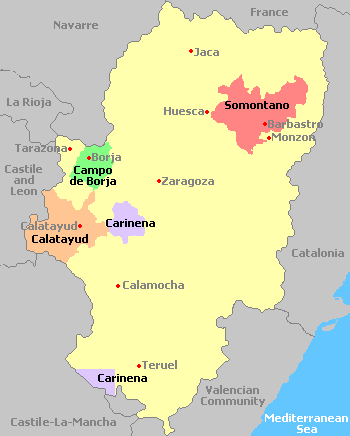
Aragon is a culturally significant autonomous Spanish community which hosts four DOs within the confines of its border: Somontano to the north and Campo de Borja, Cariñena, and Calatayud to the south. The landscape covered by these DOs range from snow-capped peaks in the north, to parched plains in the south, and green hills in between.

Aragon DO
(Source: wineandvinesearch.com)

The climate is continental, with altitude as a key modifier. The Pyrenees and other elevated areas in the north, and some areas in the south, are cooler. Vineyards in these locations are sited at between 500 and 1000 m altitude. Conversely, altitude in the middle of the DO comes in at around 200 m.

The cierzo (north wind) is a strong, dry, and very cold wind channeled by the Ebro River Valley. It mitigates temperatures as well as disease uptake on the fruit or vines.

Soils herein are predominantly chalk and clay.

Until the 1990s, large-scale farming and bulk-wine production were the heart of the Avignonese wine industry; a lot more of the wine is bottled today. Garnacha is the main cultivar planted but there is significant representation from Cariñena and Tempranillo. 

Internal DOs
DO Somontano
DO stautus awarded in 1984. The vines are planted in the terraces of the valleys that lead to the northern part of the Ebro Valley. This zone produces balanced, fruity red wines (a mix of international and indigenous varieties) and crispy, refreshing whites (Macabeo, Garnacha Blanca, Chardonnay, among others). 

DO Campo de Borja
This DO is blessed with a plethora of Garnacha vines, some with serious age. An extreme continental climate with fog from the Ebro River adding humidity.

Production is primarily young red and rosé wines with white wines only 8% of the total. In addition to Garnacha, Tempranillo, Mazuelo, and Cabernet Sauvignon are the red varieties planted.

The wines from this region are "denser, with more fruity aromas and personality than Cariñena wines."

DO Cariñena
This region was awarded DO status in 1932 but has a wine-making history which stretches back to Roman times. It was first officially delimited in 1696. 

The climate is continental, with the extreme temperatures, low rainfall, hail, and cierzo providing a multitude of challenges for the area's growers. Most of its vineyards are located on the Cariñena Plain and its surrounds where the soil is limestone over rock, slate, or alluvial.

Garnacha is the most widely planted red (55%) while Macabeo is the most popular white variety.

DO Calatayud
This region was awarded DO status in 1989.

The climate is continental, with very hot and dry summers, very cold winters, and significant temperature excursions. The climate is mitigated by vineyard altitude: the south-facing slopes of the Sierra de Virgin mountain range can reach elevations of up to 800m. The area can experience frost for over half the year with the attendant threat of vine damage.

The soils are loose and rocky with generous limestone contribution. They are well drained. 

Big, bold reds from Garnacha (75% of plantings) are the region's staple wine. Other red varieties include Tempranillo and Mazuelo. The white varieties are Macabeo, Malvasia, and Chardonnay.

Why Aragon DO as an Emergent Region?
According to spanish-living.com:
Aragon has concentrated on improving its wine production techniques, selecting the grape varieties with an eye to quality and streamlining traditional cultivation methods. The progress that has been made is noteworthy, though more pronounced in some regions than in others.
******************************************************************************************************
The regions identified as emergent by Torres in his initial article are:

©Wine -- Mise en abyme

Wednesday, March 17, 2021

Emergent Spanish wine regions: DO Arribes

Pedros Ballesteros Torres has identified a number of "emerging Spanish wine regions," areas that merit that moniker due to the aggregated effects of:
  • Developments in viticulture and oenology
  • Climate change
  • A resurgence of the perennial value of indigenous varieties
  • A market eager to reward niche identities.
DO Arribes is numbered among this lot. Its 380 ha of vines are planted on the higher, flatter ground and steep terraces facing the Douro and Tormes Rivers and its erosion-legacy plains. 

DO Arribes

The climate in Arribes is Mediterranean, with quality-enhancing diurnal temperature variation. The soil is sandy and shallow with embedded loose granite and quartz pebbles, all resting on a bed of slate. Some rocky outcroppings can be found at various points along the riverbanks.

The red varieties grown here include the the native Juan Garcia, along with Tempranillo, Rufete, Bruñal, Garnacha, and Mencia. Ninety percent of the vines planted are red varieties. White wines are made from Malvasia (the dominant variety), Verdejo, and Albillo.

The red wines are generally single-variety -- and generally Juan Garcia -- but blends are becoming more important with the passage of time. The blend must contain a minimum of 60% of the lead cultivar.

The majority of the vines are trained gobelet due to Juan Garcia's sensitivity to grey rot.

******************************************************************************************************
The regions identified as emergent by Torres in his initial article are:

©Wine -- Mise en abyme

Saturday, May 2, 2020

Emergent Spanish wine regions: Alicante

Pedro Ballesteros Torres, in a 2/2/18 Decanter article on Spanish wine trends, wrote about newly emergent wine regions thus acclaimed based on the aggregated effects of:
  • Developments in viticulture and oenology
  • Climate change
  • A resurgence of the perennial value of indigenous varieties
  • A market eager to reward niche identities.
I have been providing a brief overview of each of these regions as well as detailing the reason(s) why they are considered emergent. I continue herein with a post on  Alicante.

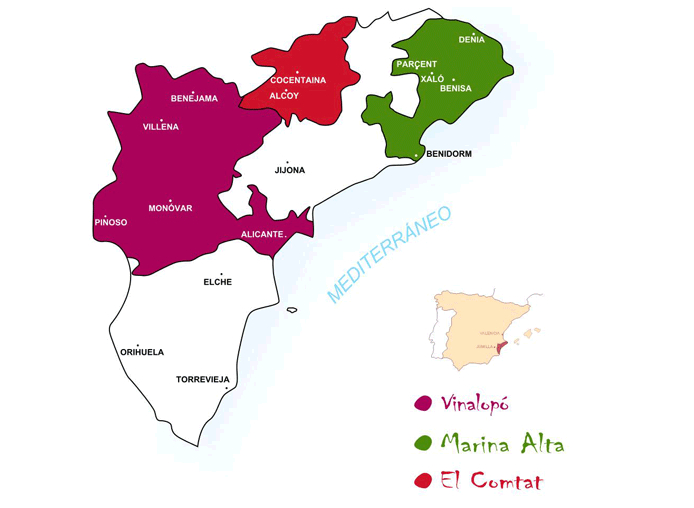
Alicante was awarded DO status in 1957. It is divided into two major zones and the area between:
  • La Marina -- the northernmost region, sited in the coastal area between the towns of Denia and Calpe. The climate here is Mediterranean with annual rainfall of 500 mm. The soil is limestone and the vines are dedicated to the Moscatel grape.
  • Vinalpo -- the southernmost region. Large, more inland section between the towns of Villena and Pinoso. The climate is continental and dry with rainfall of 300 mm/year. Primarily produces red wines from Monastrell. Iconic red is sweet Fondillon made from overripe grapes in the Rancio style.
  • El Comtat -- the area between the two, both in terms of geography and climate. Produces both dry red and sweet white wines.

DO Alicante (Source: goodfoodrevolution.com)

The soil in the region is limestone, with low levels of organic matter, and alluvial material, with some clay, near the coast.

When the DO was established in 1957, the requirements only allowed for Alicante Bouschet, Monastrell, Moscatel, and Bobal. The Moscatel (La Marina district) made delicious fortified and dessert wines, including the famed Moscatel de Alicante.

Why Alicante as an Emergent Region?
Alicante was once known as a region of bulk production and indifferent quality. However, according to Cellar Tours, a new generation of winemakers has come to understand which varieties fit their territories and, as a result, are producing some excellent blends that are more familiar to the world markets. In addition, these producers are also focusing on elegant and fresh reds,

According to BBR, the renovation of the infrastructure and vineyards in the region have helped rehabilitate Monastrell's reputation as it now produces "fleshy, concentrated, complex wines with intense violet and redcurrant notes."

******************************************************************************************************
The regions identified as emergent by Torres in his initial article are:
©Wine -- Mise en abyme

Monday, April 13, 2020

Emergent Spanish wine regions: The Balearic Islands

Pedro Ballesteros Torres, in a 2/2/18 Decanter article on Spanish wine trends, wrote about newly emergent wine regions, areas propelled by the aggregated effects of:
  • Developments in viticulture and oenology
  • Climate change
  • A resurgence of the perennial value of indigenous varieties
  • A market eager to reward niche identities.
The regions identified by Torres as emergent are illustrated in the map below.

Emergent Spanish wine regions

I will provide a brief overview of each of these regions, including the reasons why they are considered emergent, in a series of blog posts beginning today with the Balearic Islands.

The Balearic Islands, the autonomous division of Spain located off its east coast, are, due to their excellent climate, sandy beaches, and natural beauty, one of Europe's most popular holiday destinations.

The Balearic Islands (Source: Wikipedia)

But wines are also made there, with Mallorca, the largest of the islands, the source of one of the Cutting Edge Wines discussed in a previous post..

Winemaking in the Balearic Islands has a very long history, a history which was upended by the onset of Phylloxera. The ravages of the French vineyards meant that they had to look to other sources for fruit; and grape-growing in the Balearics expanded rapidly to meet this new demand. Balearic Island vineyards were decimated when the louse made landfall in the islands in 1891, causing a widespread shift to non-vine agricultural crops among the growers.

Even the resolution of the phylloxera issue did not result in a return to grape-growing in the Balearics; instead, grapes were grown only for local consumption. In the 1990s, however, a number of local winemakers decided to improve the quality of wine produced in the islands (Catavino) and, in furtherance of that goal: planted international varieties to complement the local varieties; enhanced irrigation systems; and introduced stainless steel and oak barrels for fermentation and aging.

Grapes are grown on all three of the Balearic Islands but the most vinously significant is Mallorca. The chart below shows the distribution of appellations among the islands and illustrates that the only regional DOs are in Mallorca.


There are a number of reasons why these islands can be considered as emergent (Cellartours.com):
  • International varieties now appear with increasing frequency across the islands' vineyards
  • Fresher, more aromatic whites are now the mainstay of production
  • A new generation of winemakers are bringing a sense of the importance of terroir to wines and winemaking and are utilizing their best sites to produce wines of class and quality
  • The wines have moved beyond the local tourist market and have begun to make waves on the Spanish mainland.
******************************************************************************************************
The regions identified as emergent by Torres in his initial article are:
©Wine -- Mise en abyme