Showing posts with label Continuum. Show all posts

Wednesday, May 29, 2024

Tasting the first 10 vintages (2005 - 2014) of Pritchard Hill's Continuum plus a 2022 Sentium and a 1980 Robert Mondavi Fumé Blanc

The launch of Continuum represented an attempt to resurrect (in short order) the Robert Mondavi branch of the winemaking family tree. The line from Cesare, founder of the Mondavi winemaking tradition, ran through his sons Robert and Peter. Robert was pushed out of the family-owned Krug Winery and founded Robert Mondavi Winery. This family winery was partially lost to the Market and fully lost when bought out by Constellation in 2004. "The sale of the company left the family wealthy but adrift." Peter, on the other hand, retained Krug as a family business -- one of his proudest achievements -- and has passed it on to his sons Peter Jr. and Marc. 

For the Robert Mondavi branch, the world would be unbalanced if wine was not being produced on their side. They had the funds coming out of the sale to Constellation and the requisite winemaking know-how. It was up to Robert's kids, then, to uphold the family honor. And so they did, with Tim and his sister launching the Continuum label.

I have previously discussed the pedigree and operations of the estate and will, herein, recount a recent tasting of its first 10 vintages.

The charts below provide background material on the estate, its wine blends, grape sources, and wine production environment.


The tasting was organized into the following flights:
  1. 2022 Sentium, 1980 Mondavi Fumé Blanc -- White wines
  2. 2005, 2006, and 2007 Continuum -- No Merlot and fruit sourced from Constellation vineyards
  3. 2008 and 2009 Continuum -- Transition in fruit source from Constellation to Pritchard Hill
  4. 2010 and 2011 Continuum -- All fruit from Pritchard Hill but not all Estate-grown
  5. 2012, 2013, and 2014 Continuum -- All Sage Mountain Vineyard fruit.
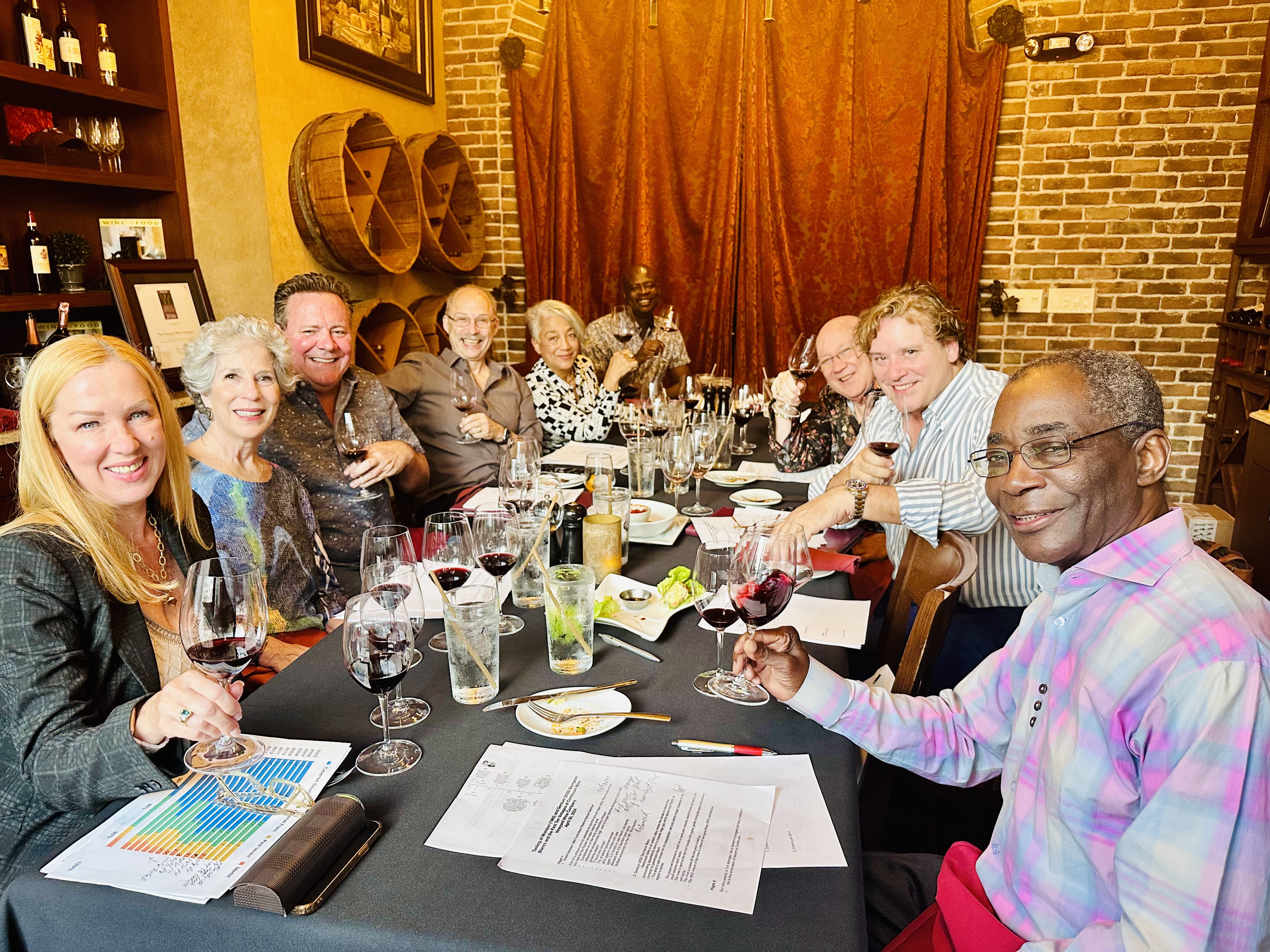
The Tasting Team. From left, clockwise,
Caryn Reiker, Laurie Levin, Matthew Martin,
Fred Wittenstein, Carol Lopez-Bethel, Al Archibald,
Richard Cohen, Sean Charles Hall, and the Author

Flight 1: 2022 Sentium and 1980 Robert Mondavi Fumé Blanc
It was thought that these Mondavi Family bookend wines would serve as perfect lead-ins to the main event. The Fumé Blanc was Robert Mondavi’s first hit wine and here was his granddaughter Chiara seeking to recreate that magic by releasing a Sauvignon Blanc through the Continuum vehicle.

These wines are both primarily Sauvignon Blanc but the similarity ends there. Chiara sourced her grapes from Mendocino County and fermented them in small lots in equal parts concrete, neutral French oak barrels, and small stainless steel vessels. The 2022 edition of this wine was aged for 9 months on the lees with regular, gentle stirring applied throughout fermentation and aging. The wine was racked off the lees and blended with 7% Semillon prior to bottling. 

The wine was disappointing. Perfumed nose of sweet white fruit which carried through to the palate in an unflattering manner. No attack and a flaccid finish. 

Just 13 years removed from its launch vintage, the Robert Mondavi 1980 Fumé Blanc Reserve Special Selection is a wine that demands your full attention.

This vintage is considered one of the most outstanding in Napa, reflecting “the exceptionally high acid-to-sugar balance developed” during the growing season. The wine experienced 7 hours of skin contact with 7% of the blend barrel-fermented and 46% aged in contact with the lees. The wine was aged for 12.5 months in new French oak barrels and blended with 5% Semillon post-aging. These specific bottles were part of a unique wine kit selected for the first (1981) annual Napa Valley Wine Auction.

This wine was spectacular from the get go and improved with residence in the glass.

The wine had a rich golden brown color. On the nose, carmelization, beeswax, figs, mint, tangerine, and orange rind. Bright acidity initially with almost a crystalline affect at the palate rear. Lemon flavor along with green and dried herbs

After some time in the glass, dried tamarind, hot pepper, and used bourbon barrel. A long, bitter, metallic finish. After additional time, Tokaji-like effect without the sweetness. Absolutely stunning wine.


Flight 2: 2005, 2006, and 2007 Continuum
The 2005 exhibited chocolate-covered red fruit and silky tannins while the 2006 showed dark fruit, tobacco, leather, and spice. An elegant wine which presented a step up from the 2005.

The 2007 was a crowd pleaser: Red and black fruit, lavender, cassis, spice, forest floor, and graphite. Balanced, with a lengthy finish.


Flight 3: 2008 and 2009 Continuum
The 2008 Continuum exhibited red and dark fruit, minerality, leather, and lead pencil. Concentrated yet balanced. Tannins fully integrated. Lengthy finish.

Rich red and dark fruit on the 2009 along with leather, spice, tobacco, and a florality. Medium body with a savoriness and integrated tannins. Long finish.


Flight 4: 2010 and 2011 Continuum
For the 2010, rich dark fruit, earth and baking spices. Balanced, with a lengthy finish.Dark fruit, plum, graphite, leather on the 2011. Balanced with deep, complex flavors and a long finish.


Flight 4: 2012, 2013, and 2014 Continuum
The 2012 showed dark fruit, chocolate, and graphite enveloped in a tannic shell while the 2013 showed a similar fruit profile accompanied by notes of forest floor, tobacco, graphite, and cassis. This full-bodied wine had a long, tannic finish. The 2014 showed rich dark fruit, leather, earth, baking spices, chocolate, and tobacco. Full-bodied on the palate with aflavor pull-through. Smooth tannins and a long, smooth finish


Post-Tasting thoughts of Selected Participants
Overall the wines were good, not great.  Certainly not for the price. I liked the 06 and 13 best. I went back and forth on the 07.  -- Fred

It was very interesting and informative. I liked the 1980 Robert Mondavi Fumé Blanc and the 2013 Continuum. Of the horizontal I felt it had opened the most. I was surprised that these didn’t have the typical Napa fruit bomb. I got a green olive taste. I think I liked the Sage Mountain Vineyard wines the best. -- Richard

I thought they were great.  Not your typical Cali.  In order: 2013, 2007, 2005.  -- Matt

I like Continuum wine in general. Some tend to be a bit typical big Cali, sometimes a bit too much for me, but also can be a nice accompaniment to steak or lamb, or salts and fats. Definitely a food wine. The ones which stood out the most to me were the 07, which is typically a vintage which I usually enjoy from Cali. I know you said it was at its end, but I actually felt it was young and in need of some air to open it up more. It was improving the longer it was in the glass. I would buy another bottle of that to try over the course of an evening and watch it evolve. 13 is another favorite vintage, so not sure I’m just leaning into my historically favored vintages out of habit, but that 13 was one which lingers on in my mind these days after the tasting as one of the top wines served. I didn’t really take notes, so just going on what I remember from the tasting. If I recall correctly I also liked the 05 vintage, but most definitely the 07, and 13. The 1980 white was interesting in that I rarely get white wine that old. The other white, while I get what they wanted to do with it, it just didn’t really work for me. If it was all there was to drink at some event I could easily quaff it down. Could be good at the beach perhaps, but not one I’d typically purchase myself. 

Thanks again for organizing this. I think the food at the Vineyard paired well with the wines. I need to frequent that restaurant a bit more. 

All in all a good time was had with good wine and good people. -- Sean

Thanks, I thoroughly enjoyed the lineup. My overall favorite of the night was the 1980 Fumé Blanc; remarkably preserved, nuanced and totally interesting. You suggested that it was a stellar year and yet that still doesn't explain all of how it kept its acidity and complexity. Good winemaking, I would guess. I could have sat with it for an hour.  Of the reds, although I did not find the variances by vineyard and blend to be as expansive as expected, they worked together well. The  '07 was the most approachable and easy to drink, I liked  the '09 the best. -- Carol

********************************************************************************************************


Like Carol, even though not a part of the main line of the tasting, I thoroughly enjoyed the 1980 Fumé Blanc. The Continuum's seemed to operate within a defined range of good not great. The wines tend towards balance. Most of the wines in the tasting were purpose-bought but I did not feel the urge to immediately go add the label to my collection.


©Wine -- Mise en abyme

Friday, April 19, 2024

Sentium, a white wine from Continuum

Seeking to establish a throughline from the groundbreaking Fumé Blanc of her grandfather to her current generation, Chiara Mondavi has introduced a Sauvignon Blanc-based wine called Sentium through her father's Continuum vehicle. The vision for this wine pictured a "vibrant, mineral-driven white wine inspired by the family's history as well as the great wines of the Loire."


Fruit for the wine were sourced from "small, family-owned and -farmed old vine vineyards" which shared Chiara's "affinity for nature and organic winegrowing." Such fruit and conditions were discovered in selected vineyards in Mendocino's Redwood Valley AVA.

Fruit source for Sentium

Redwood Valley is an upland valley where the climate is cooler than surrounding appellations due to a coastal ridge gap which allows cool Pacific air currents to penetrate inland. The area is also known for its characteristic red soils which impart character to the region's wines.

Grapes for the wine are hand picked and then gently pressed. The grapes are fermented in small lots in equal parts concrete, neutral French oak barrels, and small stainless steel vessels. The wine is aged on the lees for 9 months with regular, gentle stirring throughout fermentation and aging. The wine is racked off the lees prior to bottling.

The 2022 version of this wine is a blend of Sauvignon Blanc (93%) and Semillon. We will be tasting this vintage during our upcoming Continuum tasting.


©Wine -- Mise en abyme

Monday, April 1, 2024

Continuum: Vineyards and winemaking

In my most recent post I explored the pedigree and genesis of Continuum, the estate founded by Tim Mondavi and his sister and designed to extend the historicity of the Mondavi wine brand. In this post I discuss grape sources and winemaking associated with the enterprise.

The first vintage for Continuum was 2005 and a total of 1300 cases were made. In a good-faith gesture, Constellation had allowed Tim to use grapes from Marjorie's Vineyard -- a block in the famed To Kalon Vineyard -- and Wappo Hills Vineyard in Stags Leap District. The To Kalon Vineyard has been covered here while Wappo Hills has the following characteristics:
  • 400 acres
  • Gravelly clay loam soil
  • Cliffs that reflect the afternoon sun
  • Bay breezes maintain cool morning and evening temperatures.
Tim was negotiating to buy the source plots from Constellation (Linda Murphy, Decanter, 5/30/07) but was unsuccessful and began looking for vines on Pritchard Hill. He eventually bought two contiguous parcels on the Hill:
  • Versant, founded by the former Architect Richard Martin
  • Cloudview, founded by the former Marine Biologist Leighton Taylor.

Pritchard Hill
Pritchard Hill has an unsurpassed pedigree in the annals of Napa Valley winemaking. This highly regarded lieu-dit (55 miles long and 20 miles wide) is located in the Vaca Mountains between Lake Hennessey (northwest) and the Atlas Peak AVA (southeast) with the Oakville AVA on the valley floor to the west. Notable Pritchard Hill wineries include Chappellett, Ovid, Bryant Family, and Colgin.

The areas' vineyards sit at elevations that range between 800 and 2000 feet and, as a result, they are bathed in sunshine while the valley floor is still shrouded in fog. Moderating influences on the climate include a steady breeze blowing up from the valley as well as proximity to the lake. With most of its vineyards west-facing (Colgin is the exception), the region is able to direct every last bit of the sun's rays towards ripening grapes. There is less diurnal shift on the mountain which means that the berries continue sugar production well into the evening hours.

The soils are a red clay loam of volcanic origin which is shallow, thin, and boulder-strewn. In many cases the rocks have to be dynamited to provide material for soil. The thinness of the soil allows for good drainage while its lack of depth places great stress on the vines, yielding small, thick-skinned berries which are endowed with intense flavors.

Sage Mountain Vineyard
The parcels bought by Continuum amounted to 173 acres in size, 38 of which had been planted to vine in 1991 and 1996. Additional plantings post the sale has brought the vineyard size up to 62.85 acres. The vineyard -- now called Sage Mountain Vineyard -- possesses the characteristics shown in the chart below.


Viniculture
Grapes for the Continuum Red are hand-harvested, hand-sorted, and gravity-fed into oak or concrete vessels of varying sizes to include: conical-shaped oak vats; Sonoma Cast Stone tanks; Nomblot egg-shaped tanks; and oak barrels. The wines remain on the lees post-fermentation and prior to the first racking. The wine is aged for 20 - 22 months in 83% new French oak barrels after which it is bottled unfined and unfiltered. The combination of vineyard blocks and fermentation vessels provide myriad blending opportunities at the micro-level.

At the variety level, the first three vintages did not contain any Merlot (see chart below). Once Merlot was added to the mix (2008) we see a reduction in the Petit Verdot contribution but we also see a reduction in the Cabernet Franc contribution. The Cabernet Sauvignon surge persists until the 2014 vintage after which Cabernet Franc begin to make more meaningful contributions to the blend.

The first three Continuum vintages were constructed with fruit sourced from To Kalon and Wappo Hills. In 2008, 71% of the fruit was sourced from Sage Mountain Vineyard. By 2010 all of the fruit was sourced from Pritchard Hill but not exclusively from Sage Mountain Vineyard. In 2011, 98.5% of the fruit was sourced from Sage Mountain Vineyard and that number increased to 100% beginning with the 2012 vintage.

The Mondavi Family had made great wines at Charles Krug and Robert Mondavi Winery. Now Tim had put the pieces in place at Continuum to extend that legacy. We look forward to the tasting to arrive at our independent conclusions as to how he fared in this endeavor.

©Wine -- Mise en abyme

Sunday, March 31, 2024

Continuum: Its pedigree

A small group will be embarking on a Continuum tasting in the near future and I have set myself the task of collecting relevant background material. I will provide these learnings herein in a series of blog posts. 

The sale of Robert Mondavi to Constellation left the family members wealthy but adrift. Michael and Tim had been co-Managing Directors prior to the sale, and Marcia (their sister) had been a partner, but the only family member retained by Constellation was Robert; in the role of Brand Ambassador.

Like their father and uncle before them, Tim and Michael had squabbled the business into a tight spot. The father and uncle had seen individual success once unyoked from the bounds of co-management. Hopefully the same would hold true for Tim and Michael. And they both hastily set about to accomplish that goal.

Although it is not a part of our story, Michael, with the help of his children Rob and Dina, went on to launch Michael Mondavi Family Estate, an entity focused on wines from Atlas Peak and Howell Mountain. He also founded Folio Fine Wine Distribution Partners, an import and distribution business focused on wines from producers such as Frescobaldi, Bruno Giacosa, Masseto, and Palacios Remondo.

Tim is our story because he, along with his sister Marcia, Robert and Margrit, launched Continuum, an estate whose name was meant to evoke memories of the family's ties to wine and an ongoing passion for all it entails. The depth of the estate's pedigree is illustrated in the chart following the picture below. The picture is one that I took at Premiere Napa Valley 2011 and shows Tim discussing Continuum wine in the Barrel Room prior to the wine auction.

Tim Mondavi at PNV 2011


While Tim's later days at Mondavi found him leaning towards more food-friendly wines, Continuum was slated to deliver "delicious, ripe, rich-styled wines" to the market.

But who exactly is Tim Mondavi. He is Robert's youngest son but, in addition:
  • He is the winemaker of record at Continuum
  • He had worked at Robert Mondavi every summer until he joined the winery full-time in 1974
  • His first full-time position at Robert Mondavi was working in the Lab for the winemaker Zelma Long when he was 22 years old.
  • He helped produce the wines at Robert Mondavi until it was sold to Constellation
  • He had been involved in creating the initial Opus One. He helped to blend the first vintage (1979) with the help of the then Mouton-Rothschild winemaker.
I have written extensively about the To Kalon Vineyard and this vineyard not only served as the background music to Tim's growth as a wine professional but also provided a link to his new endeavor. I will explore that link in an upcoming post.


©Wine -- Mise en abyme