Showing posts with label Rioja. Show all posts

Thursday, February 4, 2016

Characterizing Rioja wines: A blind tasting

There is a group of young Somms here in the Orlando area who are at various stages of the Guild Of Sommeliers certification process and have banded together to hone their skills as they pursue higher levels of individual accreditation. From time to time I act as a resource for the group by facilitating focused tastings, allowing the group to do deep dives into a region, variety, or soil type. Our most recent previous exercise was an exploration of the varying instances of Nebbiolo.

Last week we conducted another focused tasting, this time on the wines of Rioja. This tasting was held in the back room of Luma on Park (Winter Park), with approximately 15 people in attendance. In addition to the Somms, I had invited Ron Siegel and Andres Montoya to lend their expertise to the effort.

In that one of the Somms found Rioja wines rather challenging, I decided to conduct the tasting blind. The objective was to see if there were any natural groupings in the offered wines and to identify the characteristics which caused that grouping (if any). Towards that end, the wines were placed into numbered paper bags and were only referenced by number until a global reveal at the conclusion of the tasting. Of the wines tasted blind, six came from my cellar, five were purchased on the day of the tasting, two each were brought by Ron and Andres, and one bottle was brought by Kevin Quijano.

The traffic was brutal that afternoon so we got a late start waiting for some of our colleagues. But it was not wasted time. We whiled the time away first with a 1994 Lopez de Heredia Gravonia Blanco and then with a 1994 Tondonia Blanco. Melissa (Swirlery) felt that the oxidative notes of the Gravonia felt more like a Jura wine, or even a Sherry, while the Tondonia had a richer, nuttier feel, like a black walnut. I like oxidative notes and I like Lopez de Heredia so I was receptive to whatever was in the bottles.


I began the session with a brief overview of the factors that influence the character of a Rioja wine. This presentation was a summary of my detailed treatment of the region.

Tasted blind, the wines seem to fall into five groups which I will characterize as follows: Modern, Faulty, Over the Hill, Other, and Traditional. It should be pointed that while the wines were placed into groups during the tasting, the actual names of the wines within those groups were not revealed until the conclusion of the tasting. Now let us examine the wines within the identified groups.

Modern
The wines falling into the modern grouping are shown in the picture below. The Muga 2009 Seleccion Especial is not pictured here but is a member nonetheless.

Photo Credits: Anne Ryan
Andres characterized the 2009 Marques de Legarda as a wine with a very extracted style with dark mint chocolate and plenty of new oak. It reminded him of a Paolo Scavino Barolo. The 2009 Muga Seleccion Especial was also modern but its extraction, blackberry jam notes, and French oak was reminiscent of a Napa Cab. The 2005 Muga Aro had a very dark color, too much oak, and appeared unbalanced. Ripe fruit and sweet oak. I saw Super Tuscan characteristics while Andrew tagged it as a Cab-based Bordeaux. Melissa agreed with its modernity. The 2005 Capricho and the 2001 Faustino hewed closely to the unfolding story line. Surprisingly for us, the 2004 Castello Ygay showed up in this list. In the blind tasting I had described it as having raspberry notes along with vanilla, coconut and dried herbs and had placed it in the middle between a modern and a traditional Rioja. Andres described it thusly: "fresh-picked raspberries, floral but with high alcohol on the nose. Modern in style (or appeared to be)."


Faulty
The 2005 Cincel Gran Reserva was identified as faulty due to an excess of sulfur on the nose.

Photo Credits: Anne Ryan

Over the Hill
The 2001 Berceo was characterized as "dark, port-like, oxidized, and disjointed."

Photo Credits: Anne Ryan

Other
The Remelluri 2007 (Iron, meaty, potted soil, french oak on nose) and 2006 Coleccion Vivanco Graciano single varietal (Dark, unfiltered. Naphthalene (mothball) on the nose. disjointed, extracted. Reminiscent of an earthy Cab Franc from Saumur-Champigny) were classed as the "other."

Photo Credits: Anne Ryan

Traditional
The wines that were placed into this category were everyone's favorites. While what had gone before was somewhat confusing, the wines that populated this category brought order to the tasting. As soon as you brought the glass up to your nose you knew that these were the aromas and flavors that you had found pleasing in an earlier wine.

Photo Credits: Anne Ryan

The 1994 Rioja Alta 904 was Andres' Wine of the Night! "Gorgeous nose of mushroom, forest floor, pine needle, pickled fruit, beef broth (umami sensation) and great acidity. Drinks like a Gevrey Chambertin!" As shown in the section below, this was also Ron's wine of the night (but for different reasons). 

The 1991 Lopez Heredia Bosconia exhibited coffee, earth, and great integration between oak and fruit. Intense pepper spice, great acidity, and an expressiveness on the palate. This wine was drinking beautifully. Andres tagged it as his second wine of the night: "dried flower, wet earth, forest floor, road tar, lovely aromatics, very Burgundian." 

The Cune Imperial 1994 showed barnyard, cherry, spice, fruit, herbs and flowers. Restrained, subtle, elegant. For Andrew, "Delicate, floral, pinot-noir-like intensity, gravel/mineral, chewy tannins.

Andres found the 1973 Valoria to be surprisingly youthful, exhibiting scorched earth, ripe cherry, and tobacco. Bold. He was extremely surprised at the reveal because he had had this down as a wine from the 90's.

One of the surprises for us all, and not necessarily fitting neatly into this category, was the 2011 Vivanco Maturana Tinta. It had an intense color along with black cherry, olives, and leather on the palate. Balanced. Northern Rhone character. Everyone liked this wine. 

Post-Tasting Thoughts
Ron
I really enjoyed the tasting as it gave me a good perspective of the different styles being made in the region. The wines that were poured represented a good mix of the top producers and their styles. while some showed over-ripe fruit -- and seemed clunky, out of balance, and short of finish -- another style seemed to show a wine that was made in a region such as Tuscany or Bordeaux. Those wines displayed dark colors, primary characteristics, and bell pepper and were made in a modern style including the use of French oak. 

My favorite wine was made in a more traditional style that was elegant, floral, and displayed bright fruits, good acids and had a silky texture. I felt that the wines showed so much better when they had some age on them, usually 10-20 yrs where they had developed complexity and had lost the dominant dill and vanilla flavors associated with American oak.

My top wine of the tasting was the 1994 Rioja Alto 904 which had bright cherry and berry fruits with cinnamon, leather, tobacco, and licorice It was elegant and floral with silky tannins.
My second favorite was the 1991 Lopez Heredia Gran Reserva Bosconio which displayed cherry and strawberry fruits and had an earthy, leather, and blood orange component along with lavender.


I also liked the Il Vivanco Maturana which had a completely different style that reminded me of a Northern Rhone with dark cherry and black olive notes. 

Anne
Tasting through 18 different Riojas was enlightening.  I was fascinated by the uniqueness of each wine--some due to winemaker manipulation and others simply a result of terroir.  Exploring them side-by-side really heightened the observation of the differences between each bottle, and made me quickly realize that Rioja is complex region that has distinctly varied styles.

************************************************************************************************

In my opening remarks to the group I had characterized Rioja wines as shown in the chart below. 


The tasting panel very clearly opted for the classic Rioja style and traditionalism, soundly rejecting the modernist wines that were on offer. The tasting also revealed a few wines that did not fit neatly into any of the above molds and, of those, the Maturana was exceedingly pleasing with the others being eminently forgettable.

©Wine -- Mise en abyme

Monday, November 25, 2013

The Rioja Wine Region -- Revisited

I initially wrote a post on the subject topic on February 8, 2012 but, after my visit to the region as an attendee of the 2013 Digital Wine Communications Conference, and after reviewing excellent articles on Rioja by John Perry (Rioja Terroir: Approaching the concept of terroir in wine, Vrazon, 10/7/13), Quentin Sadler (Oak in Riojan wine: Fundamentals of a style choice, Vrazon, 10/1/13),  and Sarah Jane Evans MW (Vintage Guide to Rioja, Decanter, 11/15/2013), I saw a need to update my original post to reflect my new learnings, as well as to correct any errors that might have been contained in the original.

The Rioja region (named after the Oja River, Rio Oja in Spanish) of Spain, has a winemaking culture dating back to the 9th century and codified into law since 1600 when it became the first Spanish wine region to receive the Denominación de Origen Calcificada (qualified designation of origin) classification. 

With its proximity to France, Riojan wines have long been subject to influence from the Bordelais. This influence became most pronounced when the French rootstock was wiped out by phylloxera causing Bordeaux negociants to seek out alternative sources of supply. This French influence, especially evident in the use of oak, is one of the factors that set Riojan wines apart from other Spanish wines.

Spain is subjected to three climatic influences: Mediterranean, Continental, and Atlantic.  Rioja DOCa, the wine region, is unique in that it lies at the confluence of all three.  Because of ancient plate tectonic activity, Rioja lies in a depression and this allows for a Mediterranean-dominated climate but also allows for the flow of cool Atlantic air, especially in the northwestern portion of the region.  The Atlantic air cools the grapes and provides the diurnal temperature differential that is so advantageous for grape growing. 


Rioja DOCa, falling on both sides of the 142-mile-long Rio Ebro, does not map neatly into the political unit called La Rioja.  Rather, elements of the region spill into the political units of Navarra and Alava. The Rioja wine region is further divided into three sub-regions -- Rioja Alta, Rioja Alavesa, and Rioja Baja -- each one having its own climate and terroir.  


According to Wines from Spain, the soil types vary from calcareous clay in Rioja Alavesa; to calcareous clay, some ferruginous clay, and alluvial soils in Rioja Alta; to ferruginous clay and alluvial soils in Rioja Baja. According to Manuel Ruiz Hernandez (as cited in Perry):
The calcareous-clay soils are ocre-colored soils that comprise stair step terraces running from the Cantabria Mountains to the Ebro River ... The alluvial soils are found in terraces near the rivers that flow from the Sierra de la Demanda Mountains down to the Ebro River ... They comprise flat lands, which are easily worked ... The ferrous-clay soils are found on ridged slopes of low mountains that separate the valleys of these two afore,mentioned rivers. They are reddish or garnet-colored lands which provide for moderately sloped vineyards.
According to cvne.com, the soil in Rioja Alta is rich in iron, limestone and clay along with nutrients deposited in the region by the tributaries of the Ebro River. The alluvial soils are highly permeable with varying water-retention capabilities. Approximately 90% of the wine produced in Rioja is red, with a typical blend of 70% Tinto Fino (local clone of Tempranillo), 15% Garnacha (Grenache), 7.5% Graziano, and 7.5% Mazuelo. These grape varieties are covered in greater detail here.

Oak aging is a key element of Rioja wine production, a practice which, according to Sadler, dates back to the 1860s, a little over 190 years after Murietta and Riscal applied the processes they had learned in Bordeaux to the making of fine wines in Rioja. Due to its ready availability -- and lower cost -- American oak became the wood of choice in Rioja. According to Wines from Spain, "... this concentration on oak aging has sometimes overshadowed other critical factors such as the contribution of the site and the vineyard." Current Rioja rules stipulate that the finished wine must be matured in 225 liter casks or barrels for defined periods in order to be classified accordingly. The aging regime is as follows:
  • Crianza -- Two years aging before release with 12 months in barrel
  • Reserva -- Three years aging with at least 1 year in barrel
  • Gran Reserva -- Five years aging with at least 2 years in barrel.
In today's Rioja, American, French, Hungarian, Slavonian, and Russian oak are utilized in the aging of wine, with the former two dominating. The characteristics of American and French oak are detailed below. Hungarian, Slavonian, and Russian oak are stylistically similar to French oak and are used in small proportions in concert with American oak.

In my travel through the region I have seen a producer alternating American and French staves in the same barrel in order to increase the complexity of the maturing wine. In another case I have seen the use of American oak in the staves and French oak as barrel tops, again in pursuit of increased complexity.

According to Vibrant Rioja, Rioja Alta produces full-bodied, medium-alcohol wines, Rioja Alavesa produces lighter, aromatic wines, and Rioja Baja produces wines that are deeper in color and fruitier in taste. A classic Rioja wine is seen as having elegance and a seductive quality. It exhibits characteristics of tobacco, leather, cedar, leaves, dark fruit, dark chocolate, and cigar box. 

Within the corpus of Rioja winemaking, there is an ongoing debate between the traditionalists and more modern winemakers. As characterized by Sadler, the traditionalists harvest the fruit early from a wide variety of vineyards, ferment after a short maceration period, and then age the wine in barrels according to the wine type. After oak aging, the wine is blended and then placed in bottle for an additional period of aging. The modernist, on the other hand, pays greater attention to the land and matches the grape variety with the soil. Supporting this perspective, Sarah Jane Evans MW sees some of these modernists focusing on "the expression of a single vineyard, and they choose the oak regime to suit the wine not the regulation." Wines of this ilk, according to Ms. Evans, tend to spend between 18 and 24 months in barrel before bottle-rest in a cellar.

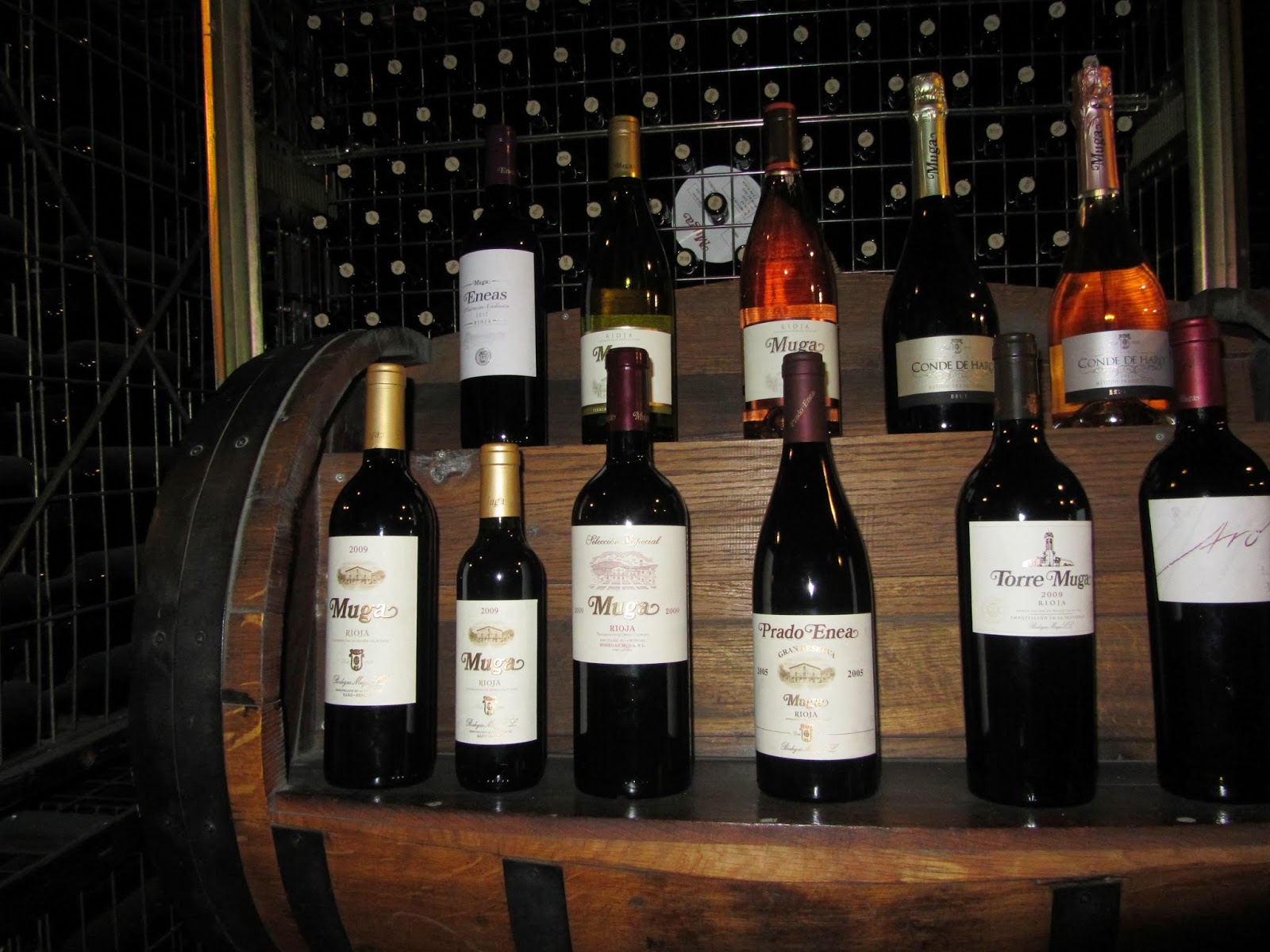
This move to modernity did not arise in a vacuum. Rather it arose in response to consumer tastes shifting in the 1980s to more powerful, fruity wines and the desire of some of the Rioja producers to play in that market space. With the decline in domestic wine consumption brought about by (i) current economic conditions and (ii) by declining wine consumption among Spain's young adults, the foreign, and, especially, the US market, beckons. The result has been that, in many cases, both modern and traditional offerings are resident under a single roof. An example of this trend is Bodegas Muga where the very traditional Prado Enea Gran Reserva resides alongside Torre Muga "a more powerful wine, aged in new barrels of French oak, with more prominent fruit flavors that required less aging before hitting the market." 


©Wine -- Mise en abyme

Friday, November 22, 2013

Constructing the wines of Bodegas Muga #DWCC13

In his 2012 New York Times article on Riojan Gran Reservas (Gentle Soul in a World of Bold, 9/21/12), Eric Asimov noted that, while not among the founding Riojan wineries of the late 19th century, by 1968 Muga had graduated from producing simple wines to its first vintage of the heralded Gran Reserva category. Further, as consumer tastes shifted in the 1980s to more powerful, fruity wines, it responded with Torre Muga, "a more powerful wine, aged in new barrels of French oak, with more prominent fruit flavors that required less aging before hitting the market." In this post I will highlight the process by which these, and other wines in the Muga portfolio, are produced.

But first I have to get you from Bracamontes to the cellar in Haro. In addition to the Cava which I had described, Muga had provided several bottles of the Muga Reserva 2009 for our enjoyment. After my whirl with the Cava, I grabbed an appropriate glass and lit into the Reserva. Right about this time they announced our departure (We were on a tight schedule as we had to meet up with our brethren at Dinastia Vivanco) and one of the Muga employees who had been helping with the service attempted to relieve me of my glass. I opted to keep the glass and its contents. As I was about to board the bus, Ana Muga asked if I wanted to leave the glass behind. I shook my head. No. I held on to that glass like a newborn to a pacifier and, for the remainder of the morning, Ana Muga made sure that there was always something in that glass for me to sup on.

We disembarked at the winery and were ushered through a wood-and-glass-enclosed foyer into an exceptionally well-appointed shop-cum-bar. Of the wineries visited, Muga has the most advanced "Wine Tourism Complex" comprised of a Tasting Room, Wine Shop, Wine Bar, and an Audiovisual Room. In addition, the winery's tower is customer-accessible and provides stunning panoramic views of its surroundings.


Source: bodegasmuga.com


The generalized process for Muga wine production is illustrated below. This process differs for Cavas -- which are lightly pressed and double-fermented, with the second fermentation occurring in bottle; the Rosadas, which are bottled after spending two months in fermentation tanks; and the Blancos, which are barrel-fermented. Grapes undergo two levels of selection, one in the field and the second at the sorting table pictured below.


All oak vessels used are built in-house


Racking
Separating yolks from egg white that will be used
for wine clarification
Earnest, dedicated teacher
Mesmerized students


©Wine -- Mise en abyme

Tuesday, November 19, 2013

Bodegas Muga: Vineyard visit and Cava breakfast (Bracamontes, La Rioja) #DWCC13

This was Thursday morning, the final morning of the final day of what had been, up to this time, a scintillating trip to Haro. We had met a number of the leading lights of Rioja wine production. We had gained a better understanding of the Rioja products and production processes. We had eaten a lot of great food -- and drank some great wines. And we were scheduled to cap all of the foregoing with visits to a Bodegas Muga vineyard and the winery, followed by a trip to Briones to meet up with the broader wine blogger group for a tour of the museum and winery at Dinastia Vivanco. It was going to be a long day for those of us who had just gotten to bed a few minutes before the wake-up call.

Shortly after I had struggled downstairs and checked out, two white passenger vans rolled up to the hotel and two female drivers emerged. They introduced themselves as Ana Muga (granddaughter of the founder) and Ana Lopezcano Lamarian, PR Manager. They loaded us up and we were off to the first stop on our tour.


Bodegas Muga, which was founded in Haro in 1932 by Isaac Muga Martinez and his wife Aurora Caño, owns 251 ha (620 acres) of vineyards distributed across five properties (El Estepal, La Loma, Baltracones, La Loma Alta, and Sajazarre) and controls another 370 acres through agreements with other area winegrowers. According to the Muga website, these mostly south-facing vineyards are located in the foothills of the Obaronses Mountain in the Rioja Alta region on primarily clay and limestone soils.

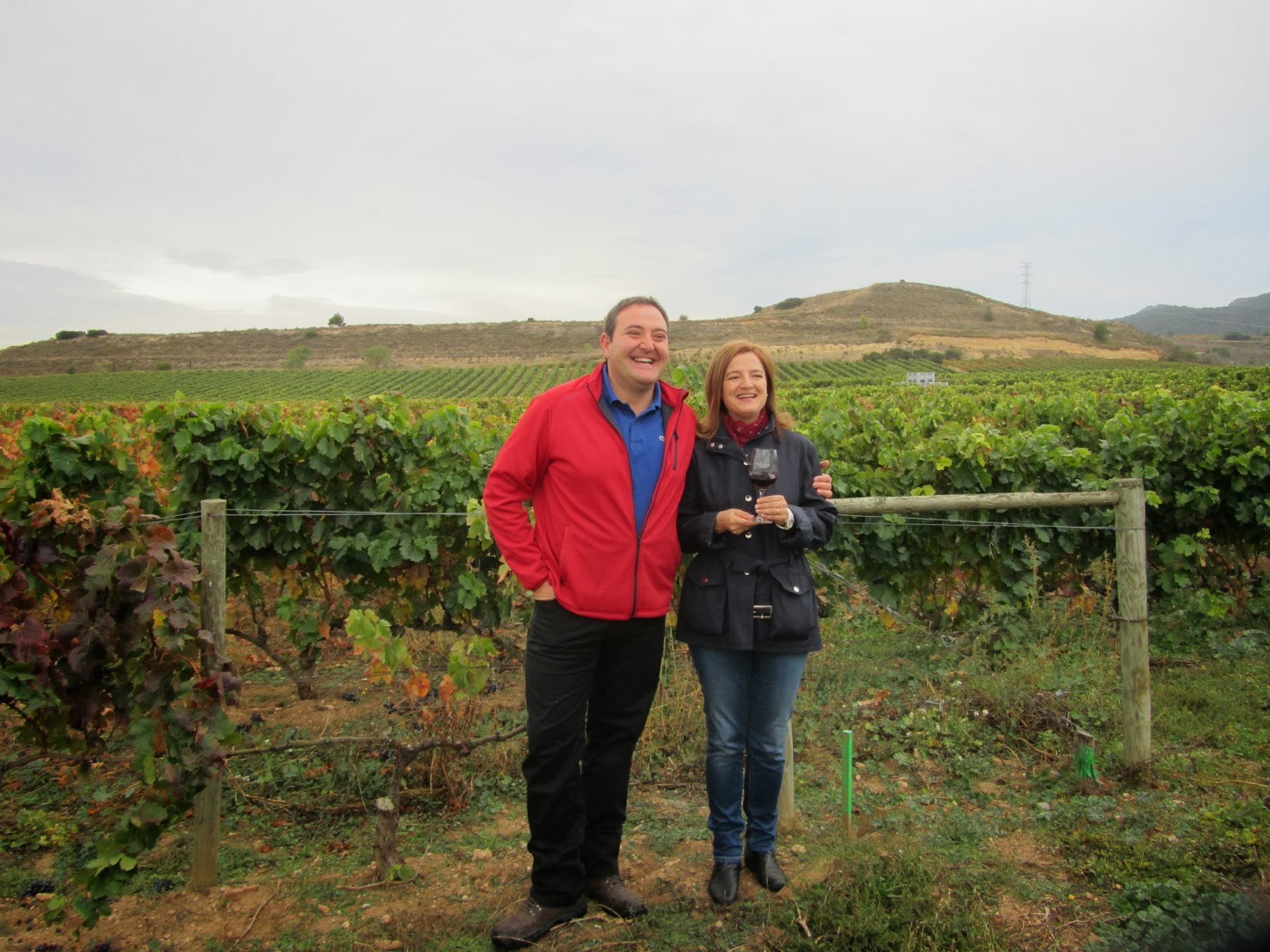
After a short ride, we turned into a road which led to what appeared to be a white barn in the middle of a vineyard. We had arrived at Viña Baltracones (one of the previously mentioned vineyards) where a number of workers were fully engaged in plucking grape bunches from the vines. We pulled up to the side of the barn and was welcomed by the viticulturist who led us into the field, bringing us up to speed along the way. This year had not been an easy year, with uneven ripening across the region and stop-and-start harvesting. The grapes being harvested were Graciano which would be used to add freshness to the Tempranillo. The freshness of the grapes would be preserved by transporting them back to the winery in refrigerated trucks. During the picking process, the workers were also conducting a first-level selection of the grapes.


Doug Frost MS/MW mentally composing his next tasting note


On our way into the vineyard I had seen white smoke rising into the sky from a metal contraption but had taken no further notice of it. On my return to the barn area, I saw that a table had been positioned in front of the barn and that a white tablecloth had been draped over said table. On the table were bottles of Cava, glasses and loaves of chunky bread. The white smoke was emanating from a fire which was being used to cook sausages for our breakfast. I had not planned on this. It was too early to eat something this heavy. Especially with lunch less than two hours away. Oh well.


The Cava served was the Muga Cava Conde de Haro, a blend of 95% Viura and 10% Malvasia sourced from north-facing, high-altitude vineyards located in the same area where the grapes for Prado Enea are grown. These grapes are fermented in large oak casks and sit on the post-second-fermentation lees for 14 months. According to K&L.com, Muga may be the first estate in the Rioja DO to grow, produce, bottle, and age Cava. This Cava was very refreshing with small, tight bubbles, nice acidity, and pear and apple fruit. Its zippiness brought me back to life.


Ana Lopezcano Lamarian and Ana Muga

Umay and his little red book
Robert smiling because he will soon be rid of us
Isaac Muga -- can you hear me now?
It's all good
joie de vivre

After observing the pickers in the field, partaking of a hearty breakfast, and hamming it up for the cameras, we loaded up and headed to the next stop -- the winery.

©Wine -- Mise en abyme

Sunday, November 17, 2013

Old Riojas don't die. They just get better with age #DWCC13

During the course of the lunch at Cune, our hosts popped open a couple of bottles of 1976 Imperial Gran Reserva and they were sublime.


After noting our interest in these wines, the Cune team circulated a list of the aged wines that they had for sale in the wine shop. Suitably impressed, and remembering our paltry fare from the previous night, I bought a bottle of the 1976 Imperial Gran Reserva and a bottle of the 1981 Viña Real Gran Reserva for us to consume at our hotel that evening. I was not going to be caught short again.

We got home very late after the RODA dinner (a long, but phenomenal, event) and repaired to our designated spot, the private lounge that is separated from the bar by the small reception area and elevator bank. The willing participants included Umay, Roger, and me. No Robert. I heard his voice over at the bar so I went over to let him know that we were awaiting his presence ... and he begged off. Weakly. I looked around for other potential victims and spotted Juan Martinez and David Marcos, the team leaders from Bodegas Gomez Cruzado. These guys had given us a tour of their facility -- and fed us -- just the day before. They were surely deserving of this honor. But first, what were they doing in a hotel in the middle of Haro after midnight. I asked them (presumptuous, I know). They had guys out harvesting at that time and had taken a break from receiving grapes to grab a coffee. Never one to drink coffee when wine was available, I invited them to come over and join us in drinking the two old Riojas. After looking at each other hesitatingly, the pull of the wine was irresistible (or they were just too kind to turn us down out of hand) and they followed us back to our enclave.

I began the proceedings by attempting to open the Imperial but the cork was soft and broke into two pieces. Now I like to think that I am pretty handy in recovering cork fragments but my attempt to retrieve the piece left in this bottle ran hard aground and Roger took over. He was able to get the remnant out but some of the detritus fell into the wine. We had no straining or decanting equipment so we powered ahead figuring that we would take care of the bits as we encountered them.


The Imperial 1976 Gran Reserva was light brown in color with caramel highlights. It had an opulent nose with aroma notes of orange liqueur, wet leaves, iodine, tobacco, and hints of floral elegance. Silky on the palate with bracing acidity. Additional dried fruit aromas and flavors contributed significantly to this wines complexity. While not up to the level of the bottle we had had at Cune earlier in the day, the 1976 was a blockbuster.

We next moved to the 1981 Viña Real Gran Reserva This was garnet at the core with an orange rim. A compelling nose with a core of dried red fruit, leather, and tea leaves leading the way to an orange zest. Enticing on the palate with a solid core of fruit, bright acidity, and caressing tannins. Classy and energetic with a long life ahead.


The Gomez Cruzado guys were fully engaged by this time. They were snapping pictures of the bottles and telling tales of bygone years. They did not want the night to end. They conferred with each other in muffled tones and one left and came back shortly with a bottle of 1964 Gomez Cruzado Rioja Gran Reserva Honorable. This was a fantastic bottle of wine and we could not believe that we were having the honor of tasting this bottle with these gentlemen at this hour in the -- now -- morning.

The Honorable had a pale garnet color with an orange rim. It had generous amounts of dried fruits such as apricots and orange zest accompanying tobacco, leather, and sweet spice. There was a consensus that the nose was reminiscent of a good old Tokaji. Graceful and alluring yet exuberant and penetratingly rich. Still fresh and energetic, displaying well-layered flavors lifted by racy acidity. A long, zesty aftertaste.


This was an awesome evening. Great wines and, just as importantly, great and insightful discourse with two leaders of a centenarian winery. We quizzed them at length on a wide range of topics and got the kind of dialog that you can only get at a bar at 3:00 am.


And all this on top of the RODA dinner.


©Wine -- Mise en abyme