Showing posts with label Bartolo Mascarello. Show all posts

Wednesday, September 6, 2017

Tradition in Barolo: A visit to the Bartolo Mascarello cellar

The furniture and photographs of famous intellectuals, musicians, and artists adorning shelves laden with books were the same. Even the tiny sign embedded in the building's exterior near the door was the same. Although Bartolo Mascarello was no longer physically there, his presence was palpable as his petite daughter and only heir sat at the same desk where he had hand painted unique, prized wine bottle labels. In that small room where her father had welcomed clients for decades, Maria Teresa Mascarello opened the door for me onto her private life, if only a little.
So reads the opening paragraph of Suzanne Hoffman's Labor of Love, the seminal work on the wine family women of Piemeonte. And those were the words that rang in my ears as I prepared to enter into that room for my first visit ever to the estate.

I met Maria Teresa for the first time in June of 2016 at the Piemonte launch of Labor of Love.

Maria Teresa Mascarello and the author
at the June 2016 launch of Labor of Love
That was a special moment for me as I had participated in a Galloni retrospective (1958 - 2010) of the estate's wines just a little over a month earlier. At that meeting I had expressed my desire to visit the estate and she had responded with her card and the assurance that I would be welcome. I took her up on that promise during my mid-May-2017 trip to Piemonte. And now we were here.


My primary contact during the setup of the trip was Alan Emil Manley and this is who I asked for when we arrived. We were early so Maria Teresa's secretary sat us at the tasting table to await his arrival. On his arrival he indicated that Maria Teresa would be joining us shortly but he would be getting us started in the meantime.

History
Bartolo Mascarello was founded by Guilio Mascarello -- grandfather of Maria Teresa -- on January 1, 1920. Both Guilio and his father Bartolomeo were associated with the local grower cooperative but, using a 10,000-lire loan from a cousin, a loan underwritten by his father, Guilio left the coop to launch his own cantina. The business expanded in the 1930s with the acquisition of vineyard plots in Cannubi, San Lorenzo, and Rué. It was during this early period that the estate's guiding principles were enshrined in its practices (A Wine Atlas of the Langhe):
  • Wines made from grapes from a number of vineyards in order to drive consistent quality
  • No vineyard selections
Guilio's son Bartolo joined his father in the business after the end of WWII. Guilio died in 1981 at the age of 86 and Bartolo took over the running of the estate. In Bartolo's days, Mascarello blended vineyards, fermented the grapes together, and allowed the resulting wine to mature slowly. Bartolo died on March 12, 2005 and management passed to his daughter Maria Teresa.

In his preliminary remarks at the previously mentioned Mascarello tasting, Antonio Galloni stated that he expected the first flight -- themed "ready to drink" and including the 1995, 2000, 2003, and 2005 vintages -- to clearly exhibit the generational shift from Bartolo Mascarello to his daughter Maria Theresa. During her tenure, the aging time has been shortened, the winery (and the wine) has been cleaner, and they now have the equipment to do proper de-stemming. Maria Theresa got rid of the old barrels, she procured a modern de-stemmer, and the grapes are ripening such that it is easier to separate the Nebbiolo stem from the grape.

Viticulture
By this time Maria Teresa had arrived and she warmly greeted us. Given our lack of the Italian language, it was agreed that Alan would continue the discourse and cantina tour and Maria Teresa would re-join us when we returned to the tasting room.

Today the estate owns 5 ha of vineyards (distributed over four MGAs) and produces between 32,000 and 35,000 bottles of wine, 50% of which is Barolo. The characteristics of the MGAs in which the Mascarello plots are located are shown in the figure below. The characteristics of the individual plots are shown in the figure following.


The estate, according to Alan, is traditional in both its farming and cellar practices. They try to grow balanced fruit rather than going for "super" concentration. Nebbiolo is a vigorous vine and, as such, requires focused canopy and yield management regimes. In the case of canopy management, its utility as a tool in the battle against the effects of global warming also has to be taken into consideration. The vineyard architecture and cultural practices are illustrated below.


Cellar
As we discussed the elements of the cellar, we walked through areas exhibiting very old bottles of wine as well as examples of Bartolo's well-developed and highly regarded wine labels.

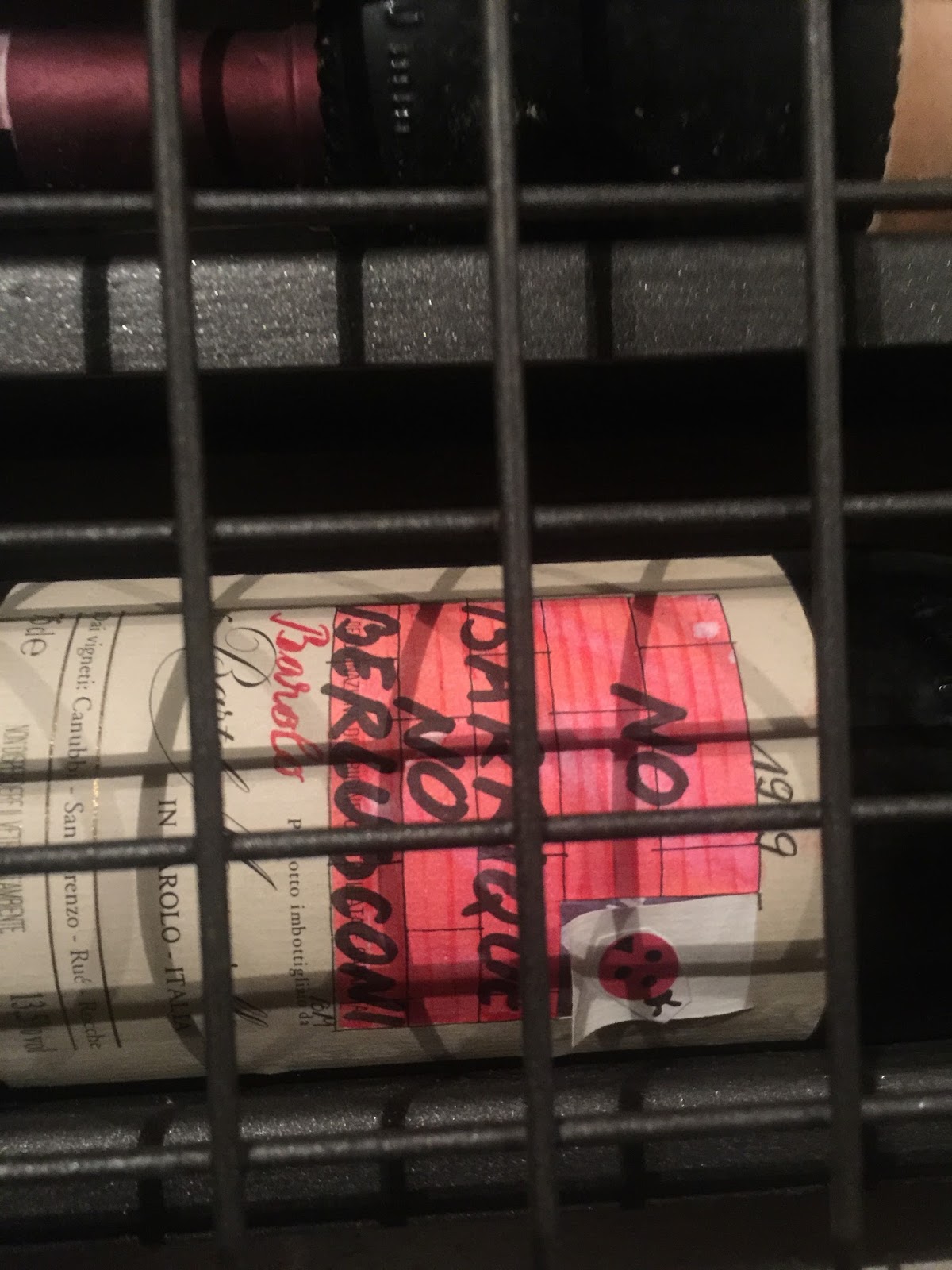

Maria had written an article for Tong Magazine a few years ago in which she described the vineyard and cellar work required to make Barolo in the Mascarello style. I have summarized her writing on the cellar work in the figure below.


The goal, according to Alan, is to make a truly harmonious Barolo. And that task begins with the harvest date: we wait for the skins to tell us when to harvest. Further, there is a strict selection of the grapes that make it into the wine. That selection begins in the vineyard, where imperfect fruit is left on the ground, and continues with a second selection at the sorting table in the cellar.

Fruit from the four plots are mixed in the fermentation vats in a process called "asseblaggio." As the harvest time differs from vineyard to vineyard, recently brought in fruit is added to the mix that is already resident. According to Alan, "the ratios change from year to year as nature gives us different quantities from year to year. What the land gives us becomes our wine. We do not adjust the proportions to keep a constant ratio. For example, in 2012 we had hail only in Rué, and half the fruit was damaged and left on the ground. We simply had less of the Rué fruit in the mix that vintage ..."

The fermentation tanks are fiberglass-lined concrete tanks from the 1940s. The Slavonian oak barrels used in the aging process are changed out every 40 to 50 years. The aging regimes are as follows: Dolcetto and Freisa, 1 year; Barbera and Langhe Nebbiolo, 2 years; and Barolo, 3 years.

Tasting
At the conclusion of the cellar tour we returned to the tasting room to sample the wines. We started with a Barbera 2014. This had been a difficult year with lots of rain. The weather cleared in the last two weeks of September and the first two weeks of October. The best wines of this vintage are excellent. Rose petal, spice, and rusticity on the nose. Good acidity and power.

Alan in the tasting room

Next up was the 2012 Barolo, This is a vintage, according to Alan, that they consider "shy" -- it requires a bit of coaxing. That year was never too hot, never too cool. They had hail in Rué and that is the vineyard that provides structure. Strawberries, honeyed nose, dried flowers, green herbs, sweet talcum powder. Delivers on palate. Fine-grained tannins. Lenghty finish.

Maria Teresa in the tasting room

The final wine tasted was the 2013 Barolo. This was a cool, classic vintage. After 21 days of maceration they terminated skin contact. Alan expects this wine to begin closing down temporarily sometime in the near future. Strawberries and roses. Honeyed nose with a hint of balsamic. Concentrated yet balanced. Lengthy finish. A wine to be aged and for the ages.

Alan and Maria Teresa

As we were going through the wines, Maria Teresa re-iterated the importance of her father's influence in everything that is done on the estate today. This adherence to his teachings is done both to honor him and because it continues to result in excellent wines that appeal to her customers.

Alan was a fount of information and a pleasure to be around if you like diving into the innards of a vat. We truly enjoyed this trip and would like to thank Maria Teresa and Alan for the hospitality and insights.

©Wine -- Mise en abyme

Sunday, May 1, 2016

Bartolo Mascarello Retrospective (1958 - 2010) with Antonio Galloni: Tasting Notes

Bartolo Mascarello: A Historical Perspective, 1958 - 2010 was a tasting event organized by Antonio Galloni's Vinous and held at the 28º - 50º Maddox Street location in London on April 26, 2016. I have provided the background to the event in a prior post and will cover the tasting notes herein. The tasting covered five flights, four of which contained four wines and the last of which contained two wines. Each flight was accompanied by a creation of the 28º - 50º culinary team.


Flight 1: Ready to Drink
This flight included the vintages 2000, 2003, 2005, and 1995 and was paired with a Crab Tortellini (Miso Broth, Spring Onion, Toasted Garlic).

2003
The year had been a hot one with 40 days of temperatures over 40℃. It was thought that the wines would be jammy; but, according to Antonio, this was not the case for Mascarello.

This wine exhibited tar, roses, and red cherry on the nose. Ripe fruit on the palate along with tobacco and tar but a certain reticence on the mid-zone. Not as refreshing as some of the other wines in the flight. In my opinion some vintage effects shone through.

2005
According to Antonio, this vintage was saved by technology. As harvest was approaching, radar showed a 7-day rain front in the offing. Many producers chose to pick early so the tannins on these wines can be aggressive.

Restrained tar and roses along with a cherry component. Not as knife-edged on the palate as I would have liked but balanced. And the fruit carries through to a robust finish.

1995
According to Antonio, made in the older style.

I had tasted this Mascarello vintage three years ago and at that time had described it as having "a bouquet of dried cherry, soy, and sandalwood. Medium length with red fruits, leather, and mushroom." I found the wine at this tasting to be elegant on the nose with evidence of sweet flowers, tar, asphalt, and dark fruits. Intense red fruits on the palate with some stemminess. Dried rose petal, mushroom, and tobacco on the palate. Long sour finish with a drying towards the end.

2000
Antonio had asked that we taste this wine last in the flight, even though it was the first wine listed in the program. He indicated that, by this vintage, we had seen a dramatic transformation in the winery, a transformation that had been ongoing for 10 years. When this particular wine was first released, it was "barnyardy" and that barnyard character mutes the fruit.

Unfocused. Leather, smoke, and faded roses. Perfumed. Hint of sweetness and spice. Earthiness on the palate.

Dish
The bowl in which the Tortellini was presented was too deep and made it difficult to get to the contents. In addition, the broth was salty, a theme in all of the dishes. Nothing special here.


Flight 2: Great Vintages in Barolo


This flight included the vintages 1997, 1998, 1999, and 2001 and was paired with a Pea Risotto (Preserved Lemon, Marjoram, Parmesan Cracker). 

According to Antonio, great vintages in Barolo are considered cooler vintages because Nebbiolo likes the associated long growing seasons and fall diurnal variation. The great vintages experience gradual late ripening into October.

1997
This wine exhibited the classic tar and roses but, in addition, an intense spiciness. Great structure and acidity. No rough edges on the palate. Long sour finish. Best wine tasted so far. Antonio had similar sentiments, remarking on the sensuality, roundness, and harmony of the wine. He thought it was the best wine of the flight.

1998
High-toned rose and tar, dried prunes, phenolic note, dried herbs, cigar, cigar box, leather, and espresso. Unfocussed on palate. Antonio remarked that, while chronologically one year older than the 1997, it was tasting 5+ years older.

1999
Black and red fruits, spice, earth, and leather. Young.  Antonio saw this wine as having a laser-like focus. It had been widely ignored for years. He thinks it is still not yet ready.

2001
Porty with a phenolic note. Dried bark, dried herbs. Fruity on the palate but unfocused but palate delivers beyond the promise of the nose. Not many years ahead. Antonio saw this as having density and weight, spices, clove, and leather. He thought it was good but not great.

Dish
The Pea Risotto was very salty. It was light and airy and only a few salt grains away from being a truly phenomenal dish.


Flight 3: Classic Vintages
This flight included the vintages 1988, 1989, 1998, and 1996 and was paired with a Pan-Fried Cod (Broad Beans, Morels, Lemon Potato, Spring Onion Vinaigrette)

1988
Leads with Grandmas closet followed closely by dried rose petals, tar, and spice. Brightness on palate. Tamarind, spice and light tannins. Antonio got orange peel, quince and spice and remarked on the silky tannins. Lengthy finish. Antonio said this vintage had been highly touted but they age unevenly and never truly developed into a refined wine.

1989
This wine had the mustiness that is a fruit killer. Rose petals, tar, and spice. I did not find this wine appealing. Antonio was even less thrilled. He felt that this bottle was not as good as this wine can be.

1990
Classic nose plus spice. Perfumed. Leather and tobacco. Sensation of sweetness on the palate. Excellent acid levels and long finish. The first of the climate change vintages, according to Antonio, and it was showing well.

1996
Spice and rose petals. Undrinkable due to heavy sedimentation. No additional wine available to replace the junk in the glass. Antonio indicated that, in his view, this was one of the great vintages of the '90s and will be great for another 20 years. My loss.

Dish
The Pan-Fried Cod was salty.


Flight 4: Greatest Four Wines of Recent Vintages
This flight included the vintages 2004, 2006, 2008, and 2010 and was paired with an English Ribeye (28-Day Aged, Bearnaise Sauce)

2004
Tar, roses, green herbs. Young, balanced, focused, round. Sensation of heat. One of the first great vintages that Antonio had reviewed and he sees it as a vintage of incredible pedigree.

2006
Not very expressive on the nose. Cherries. Red fruit on the palate. Tannins present. Rich with a hint of molasses. Long, sour finish. I loved this wine. This, according to Antonio, was a vintage of structured Barolos, masculine and brooding. These wines will be long-lived.

2008
Hints of roses, tar, cigars, tobacco. Antonio saw it as having incredible aromatics and being light and delicate on the palate. He described it as being Pinot-like.

2010
Young. Spice and high-toned red fruits. Not very expressive of traditional Barolo aromas. Structured. Rich. Powerful. Brooding. Antonio considers it the greatest vintage of his time.

Dish
The Ribeye was the best dish plated that night. It was still slightly salty but the meat accommodated it better than any of the other previous dishes could.


Flight 5: Magnum Flight
This flight included the 1986 and 1958 vintages in magnum.

1986
A very special vintage in Piemonte, according to Antonio. This vintage was under the radar. No one had paid any attention to the vintage because of hail. Few producers actually made Barolo in that year. When he speaks to producers who made wine in 1986, they consistently tell him that they prefer the 1986 to the 1985. This magnum was sourced directly from the winery.

Dried rose petals, tar, sauvage, dried herbs, leather, cigar box, and spice. Ripe and lively on the palate. Balanced. Long, sour finish. A beautiful wine. Antonio described it as powerful and pungent.

1958
Antonio thinks that tiis is the greatest wine ever made at Mascarello. The magnum is actually 1.9 L so that it could be used to fill two .750s while leaving the sediment in the wine remaining in the bottle.

Pungent, piercing nose with laser-sharp focus. Tar, roses, cherries, peeled green mangoes, and coriander. Savoriness. Hint of sweetness. Drinking younger than expected.

Used with permission of Vinous Media LLC


This was a great opportunity to taste with, and learn from, one of the notable Barolo experts of our time. And in this regard, the tasting was a success. Antonio's knowledge of the region, producers, and vintages were of inestimable value to the attendees as they worked their way through the wines.

The wines that are on my radar screen coming out of the tasting are 1995, 1996, 1997, and all of the wines in Flights 4 and 5. Of course, the 2010 will not be drinkable for quite a while.

The most disappointing facets of the evening for me was the food and not getting to taste the 1996. There was no standout dish and some of the dishes, in my view were seriously compromised by excessive salt. The glass of 1996 that was brought to my table should not have seen the light of day.

©Wine -- Mise en abyme

Saturday, April 30, 2016

Bartolo Mascarello 1958 - 2010: A Historical Retrospective (with Antonio Galloni)

I am a huge Barolo and Brunello di Montalcino fan and Bartolo Mascarello and Gianfranco Soldera, respectively, are in the top rank of quality producers in those regions. And London, due to its vivacity, culture, food and wine scene, and role as the locus of Europe (and that is not a political statement), is one of my favorite cities in the world. So when Antonio Galloni's Vinous announced back-to-back tastings of multiple vintages of these producers' offerings -- to be held in London on April 26th and 27th -- that was an alignment of all the stars and, hence, a no-brainer for me to sign up.

The first of the two events --- Bartolo Mascarello: A Historical Perspective, 1958 - 2010 -- was a tasting dinner held at the 28º - 50º Maddox Street location. The event was scheduled to begin at 6:30 pm and I was one of the first to arrive. Antonio was still opening wines but Jacquesson Cuvée 738 was available and the Head Sommelier, Louis Dufouleurand, poured me a glass. Accompanying the Champagne was a selection of Charcuterie; Crab Salad, Mango Avocado, and Coriander on Crouton; Mozzarella and Cherry Tomato Bruschetta with Fresh Pesto; and Parmesan and Truffle Arancini.


Crab Salad, Mango Avocado, and Coriander on
Crouton
As the attendees filtered in, I was pleased to recognize a gentleman who had sat at my table in New York City at the Galloni 2010 Brunello di Montalcino tasting. We conversed animatedly for a while. As the room filled, I noted that a number of Americans had crossed the pond to attend the event, one person coming all the way from Los Angeles. At 7:00 pm sharp we were directed to take our seats.

In his opening remarks Antonio mentioned that we would be drinking 18 vintages organized into five flights, each flight with a theme. All of the wines had been sourced from a single owner so provenanace was assured.

He went on to say that Mascarello is a traditional Piemonte producer that had been producing wine in the region for three generations. The first flight -- themed "ready to drink" -- would clearly exhibit the generational shift from Bartolo Mascarello to his daughter Maria Theresa. In Bartolo's days, Mascarello blended vineyards, fermented the grapes together, and allowed the resulting wine to mature slowly. More recently, the aging time has been shortened, the winery (and the wine) has been cleaner, and they now have the equipment to do proper de-stemming. Maria Theresa got rid of the old barrels, she procured a modern de-stemmer, and the grapes are ripening such that it is easier to separate the Nebbiolo stem from the grape.

The two charts following illustrate the viticultural and vinicultural practices of Maria Theresa as she described them in TONG 16.


The flights and themes for the tasting were as follows:
  • Flight 1: Ready to Drink (2000, 2003, 2005, 1995)
  • Flight 2: Cooler Vintages (1997, 1998, 1999, 2001)
  • Flight 3: Classic Vintages (1986, 1989, 1990 1996)
  • Flight 4: Four Greatest of Recent Vintages (2004, 2006, 2008, 2010)
  • Flight 5: Because We Can (My characterization -- 1986 in Magnum, 1958 in Magnum).
I will report on the actual tasting in a follow-up post.

©Wine -- Mise en abyme

Sunday, January 22, 2012

1958 Biondi-Santi, wine of the night: Guest Post by Ron Siegel

The @wineORLs invited Bev, Russell, and me to join them for dinner at Terramia, a Winebar and Trattoria in Longwood, Florida. The food at the restaurant was very good. We ordered a number of small plates so that we could open and taste all of our wines and have them served with each course. @wineORL had said that he had a few Italian gems that he wanted to try and asked that I bring an assortment of wines to flesh out the evening's offerings.

We started off with two Champagnes:

(i) 1980 Lanson Noble Brut ( Ron). This was the sixth bottle of this wine that I have had in the past 6 months and it was drinking beautifully. It had a nose of Crème Brulee and brioche with a touch of green apple, a nice creamy mousse, great acidity, and nice balance.


(ii) 1978 Dom Perignon (Russell). What a nice surprise when Russell pulled this out of his bag. This wine had a nose of lemon curd, tangerine, and a little burnt sugar and a slightly lighter finish than the 1975 Dom but had really nice acidity and freshness on the palate.


Then came the reds:

1958 Biondi Santi Brunello Reserva (@wineORL). This was truly one of the best Brunello’s that I have ever consumed and it was in really good shape. It started off as almost Burgundian (Russell thought more like a Barolo) and was opulent and sexy. It had a nose of cherry, orange peel, and mushroom. On the palate very rich red fruits along with some balsamic and tobacco notes, perfect acidity, and balance. The wine presented as much younger than its years.


1950 Liger-Belair Morey-St Denis (Ron) Nice dark color with a nose of sour cherry and Asian spice. A nice finish with sweet red fruits, along with some soy and Basalmic. A very nice Burgundy.


1995 Bartolo Mascarello Barolo ( Russell). Bouquet of dried cherry, soy, and sandalwood. Medium length with red fruits, leather, and mushroom.

1995 Soldera Brunello Reserva (Ron). This was a very big and old style Brunello with red fruits, tobacco, and roasted nuts. Very rich and thick, saucy texture with some underbrush and spice notes also showing. This will be a killer with some more time in the cellar.

1998 Conterno Barolo Monfortino (Ron) This was a big, rustic, old-style Barolo that could also use more time in the cellar. Russell commented that he had always wanted to try a Monfortino and I do not think this bottle let him down as it had beautiful aromas of dried cherry, tobacco, licorice, and spice box and a long finish.


2001 Cheval Blanc ( Ron) I always bring a Burg and a Bordeaux with me no matter what the theme. A really nice Cheval that is drinking well but will be so much better in 10 years. I really like the 2001 Bordeaux’s and wish that I had bought more of this vintage. Black and red fruits with shoe polish, cedar, and herbs. Very elegant and balanced and a great way to finish the evening.

Another great night of food and wine and lots of fun. As usual, we closed the restaurant. We all agreed that the Biondi-Santi was the wine of the night. I made that choice because of the rarity factor as well as how well it showed for its age.  The Soldera will probably be equally as great in another 20 or 30 years but ... who knows.  The Biondi-Santi was  a real treat.