Showing posts with label reverse osmosis. Show all posts

Tuesday, June 6, 2017

"Bad-Brett" management Part II: Repairing contaminated wines

In Part I of this series on Brettanomyces, I laid out the characteristics of the microbe, the contamination routes, and conventional methods employed in controlling its growth. In that post I also referenced some approaches advanced by Dr. Jamie Goode to fix wines that had been contaminated by Brettanomyces. The chart below summarizes both the "control" and "fix" tactics presented by Dr. Goode in the Somm Journal article cited in the chart.


In his book postmodern winemaking, author Clark Smith posits that "... a revolution is taking place within the winemaking industry. Precepts of the modern winemaking system we were taught in school simply don't support the making of the great wines the market demands, and as a result, some of our most successful winemakers have strayed quite far from conventional dogma." These winemakers are using what Smith calls postmodern winemaking to "... merge all of the wine's flavor into a coherent whole like a well-conducted orchestra producing a unified, soulful voice."

As stated in his book, postmodern winemaking does not seek to throw out all elements of modernity and replace them lock, stock, and barrel with a new canon. Rather, postmodern winemaking uses existing pieces where appropriate and substitutes/adds where necessary. Below I provide a graphic representation of wine production under both the modern and Smith's postmodern schemas. The key extensions of postmodern winemaking are provided in red in the below chart.
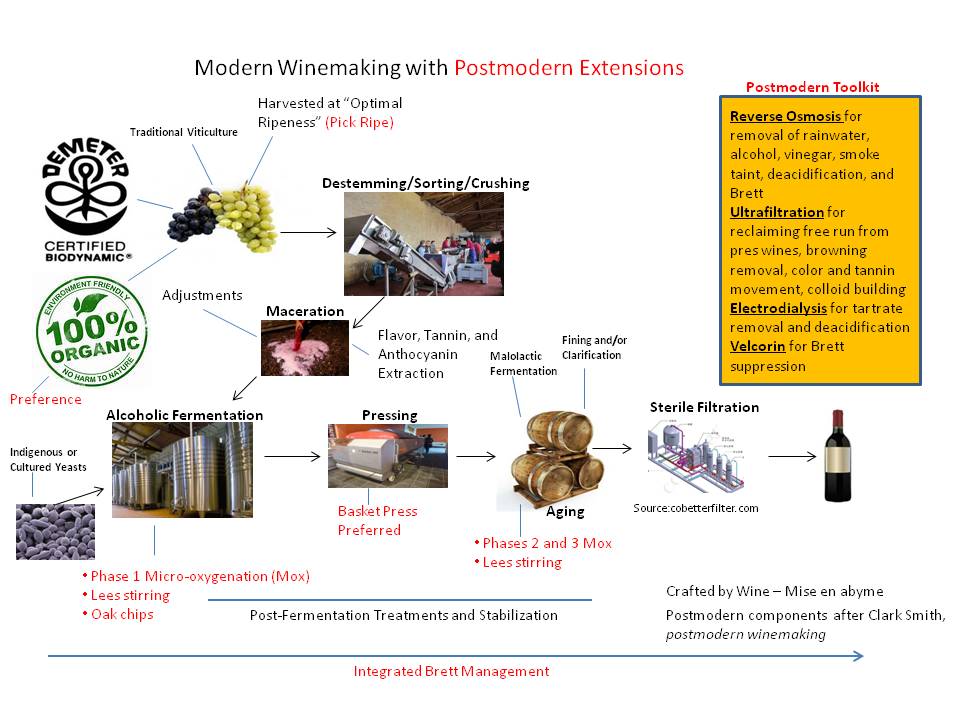

Two things to note in the chart above: (i) towards the bottom, the introduction of the concept of Integrated Brett Management (that will be the focus of Part III in this series); and (ii) the box at the top right which is labeled Postmodern Tookit. Some of the entries in that box map closely to the "fix" tactics proposed by Dr Goode. These Postmodern Toolkit/Fix mechanisms will be the subject of the remainder of this post.

Sterile Filtration
Dr. Goode mentioned filtration as the first option on his list and it is widely viewed as the most effective method of removing Brett cells. In this method, the wine is passed through a .45µ filter which captures any Brett cells in the filter mechanism. Clark Smith is not in favor of this approach to Brett removal:
The focus of postmodern philosophy is the creation and preservation of beneficial macromolecular structure. This structure manifests in wine as colloidal particles sometimes nearly as large as a bacterial cell. The benefits of good structure -- profundity, aromatic integration, and graceful longevity -- appear to be lost in sterile filtration, despite the fact that no tannin material may be retained by the filter. While this lack of residue has convinced some of my colleagues that filtration cannot be harmful to wine structure, I do not concur. My hypothesis is that the action of tight filtration somehow disrupts rather than removes structure.
It should be noted that Clark does not provide any empirical data or prior scientific studies to bolster this hypothesis.

Velcorin
Both Dr. Goode and Clark Smith mention dimethyldicarbonate (DMDC, trade name Velcorin) favorably. This product is a microbial control agent  (produced by Lanxess) that is effective at eliminating a broad range of yeast, bacteria, and molds from wine. The product works by penetrating the cell wall of the offending micro-organism and deactivating enzymes which then leads to the cell's demise. The manufacturer claims that the product has no effect on wine taste, bouquet, or color and breaks down completely into small amounts of CO₂ and methanol. The downside, according to Clark, is that this is a "nasty chemical" and must be handled carefully.

Tangential Flow Filtration
Dr. Goode refers to cross-flow filtration and nanofiltration in his list but Clark places those technologies into a class he calls the Tangential Flow Family of Filtration and they are classified based on the molecular weight of particles that pass through the pores.

Filtration System Application Molecular Weight Range (Daltons)
Crossflow Clarification

200,000 - 500,000
Ultrafiltration

1000 - 200,000

Tannin and Browning Removal 10,000 - 200,000

Protein Removal 10,000 - 40,000

Decolorization 1,000 - 5,000
Nanofiltration

200 - 1000
Reverse Osmosis

50 - 200
Source: Clark Smith, The Crossflow Manifesto, Wine Business, January 2003.

According to Smith, the idea of tangential flow filters developed in the 1960s. One of the major problems with sterile filtration is the fouling of the membrane which occurs when tight pore sizes are used. This fouling prevents the passage of material through the pores. The effective limit of traditional filtration is 0.1µ. Tangential flow filters use the scrubbing action of the flow across the surface of the membrane to keep it clean thus allowing the utilization of ever-smaller pore sizes.

All of the systems mentioned in the table employ the strategy of pumping the wine across the membrane at high velocity. As the wine flows across the membrane it continually scrubs the surface, removing fouling material. The majority of the feed stream does not pass through the filter but is retained upstream and returned to the tank. This stream, called the retentate, contains all of the high-molecular-weight components. The low-molecular-weight material that passes through the filter is called the permeate. A reverse osmosis application is illustrated below.

Reverse osmosis (Source: memstar.com.au)

It should be noted that, of the tangential flow systems mentioned in the table above, reverse osmosis is the only one specifically noted for Brett removal by Clark Smith.

Fungal-Source Chitosan
A Brett-repair technology that was not mentioned by either Jamie Goode or Clark Smith is fungal-source Chitosan. Chitosan is a deacetylated version of chitin, a compound found in the exoskeletons of crustaceans and insects as well as in the cell walls of fungi. According to Olivier Pillet (Chitosan and Brettanomyces: Origin, Impact, and Mode of Action), "the innovation that led to the use of chitosan in oenology is the process for obtaining chitin from a non-animal fungi source, Aspergillus niger." This process provides natural-source chitosan that is both biodegradable and non-allergenic and has been accepted as an oenological process by both the International Organization of Vine and Wine (July 2009) and the European Union (December 2010).

Chitosan has been documented for its antimicrobial properties which depends on the degree of deacetlylation and its molecular weight. Studies have shown that the homogenous incorporation of 4 g/hl dose of the commercial product (No Brett Inside) will "result in the total destruction of the Brettanomyces populations, or, in certain cases, a significant reduction of the contaminating populations" (Pillet).

**********************************************************************************************************
These then are some of the tactical tools that can be employed in the fight against Brett. In my final post in the series I will treat Clark Smith's Integrated Brett Management.


©Wine -- Mise en abyme

Tuesday, February 28, 2012

Ameliorating alcohol-induced wine imbalance

In my post on the role of alcohol in wine balance I indicated that, in addition to unbalancing the wine, an excess of alcohol: makes the wine appear hot; will lead to a reduced perception of wine aroma; and can impart a sense of intoxication to the taster.  The winemaker may address the issue of excess alcohol by reducing the level of alcohol and has three approaches available if that path is chosen: (i) reverse osmosis, (ii) the spinning cone, and (iii) adding water to the wine. Reverse osmosis and the spinning cone are authorized in the U.S by wine regulation 27 CFR 24.248 Processes Authorized for the Treatment of Wine, Juice, and Distilling Materials.  Under this regulation the processes must be conducted at a Distilled Spirits Plant (DSP) or at a bonded winery that is authorized to alternate between a DSP and a bonded winery.

According to howstuffworks.com, reverse osmosis takes place when pressure applied to a highly concentrated solution causes the solvent to pass through a membrane to the lower concentrated solution, leaving a higher concentration of solute on one side, and only solvent on the other.  In the case of high-alcohol wine, the wine is filtered to separate alcohol, water, and volatile compounds from the color and flavor components. The filtered material (permeate in the figure below) is then subjected to a distillation process wherein some portion of the alcohol is removed.  At the completion of this process the remaining permeate material is re-combined with the flavor and color particles that had been filtered out previously and the end result is a lower-alcohol wine than at the beginning.

Reverse osmosis (Source: memstar.com.au)

The spinning cone is comprised of two sets of inverted cones, one fixed against the wall of the steel container, the other set on a rotating rod and parallel to the fixed cones. The wine is fed into the assembly from the top and flows from fixed cone to parallel rotating cone where the centrifugal force spins it out towards the center as a thin film which then falls on to the next lower fixed cone.  This pattern is repeated until the liquid reaches the bottom.  Simultaneously, a low temperature vapor is introduced into the assembly from the bottom and flows up the core stripping volatiles from the thin film on its way up.  This volatile-impregnated vapor flows out of the top of the assemblage and into a condensing system where the volatiles are captured in a condensed liquid form. The cones provide a large surface area for evaporation of the volatiles into the vapor.

In most cases, the wine is run through the system a number of times in order to obtain the required alcohol levels.  On the first pass the vapor may extract the volatilized aromas and flavors and the remaining liquid is run through the cone again at higher temperatures to remove some portion of the alcohol. The aromas and flavors are then added back into the liquid at the end of the process to produce a lower alcohol wine.  Producers will use this method to reduce the alcohol by 1 to 2%.

The third option is hydration of the grape must using water acidulated with tartaric acid.  By using acidulated water, the sugar can be diluted without a concurrent dilution of the acids.  In California wineries, according to Brehm Vineyards, the practice is to use 7 gallons (26.5 liters) of water per ton of grapes in order to lower Brix by one degree.

The best-case situation for a winemaker is that growing conditions yield grapes that produce a balanced wine.  In the event, however, that the wine is unbalanced due to high levels of alcohol, vis a vis acid levels, the winemaker has the above tools available to assist in amelioration of the problem.


© Wine -- The View From Orlando

Monday, February 27, 2012

The role of alcohol in wine balance

Wine balance is one of the important measures of wine quality and attainment of said balance, according to Dr. Bruce Zoecklein (Virginia Tech oenologist), requires the harmonic functioning of each element in the Palate Balance Equation reproduced below. The arrow on the figure following the equation illustrates where balance and alcohol fall within the wine quality assessment framework.

              Sweet ⇄ Acid + Phenolics (Astringency and Bitterness).


Fortunately for wine drinkers, the structure that grape vine plants have evolved for the protection and nourishment of their genetic-material-carrying seeds, also serves as the raw material for the drink of their choice.  At harvest, the vitis vinifera berry has the following composition (Murli Dharmadhikari, Director and Enologist, Iowa State University Extension):
  • Water (70 - 80%)
  • Dissolved solids
    • Sugar (primarily glucose and fructose; 150 - 200 g/L if ripe)
    • Organic acids
    • Phenolic compounds
    • Nitrogenous compounds
    • Aroma compounds
    • Minerals
    • Pectic substances (primary role is cementing plant cells together).
The dissolved solid of interest herein is sugar so we will focus exclusively on that topic for the remainder of this post.

Sugars exist in the grape vine as sucrose (a one-to-one bond of the single-molecule sugars glucose and fructose) and are transported to the berry from the vine where it is metabolized.  As the berry develops (see figure below), the vine-sourced sucrose decreases in volume and is replaced by carbohydrates from surrounding leaves.  Once in the berry, sucrose is separated into its constituent parts by the enzyme invertase.

As the figure below shows, xylem flow (water and nutrients from the roots) to the berry stops shortly after veraison but the flow of nutrients from surrounding leaves (via the phloem) continues through the bulk of the ripening phase.  As the figure shows, the sugar, measured in °Brix (the sugar-content metric used in the US; % sugar by weight), begins to accumulate in the berry post-veraison as sugar consumption declines.  The sugar content at berry maturity can range between 12 and 28% with the optimal level for harvest falling between 19 and 25 Brix.

Grape berry development (Source:www.extension.org)

In a 1966 study, W. Mark Kliewer of UCDavis concluded that the following sugars resided in a mature grape berry: Stachyose, Manninotriose, Raffinose, Melibiose, Maltose, Sucrose, Galactose, Glucose, and Fructose.  With the exception of glucose and fructose, all of the sugars are found in minute amounts and do not contribute in any way to the sensory characteristics of fermented wine. 

Glucose is a 6-carbon-atom sugar resulting from the breakdown of sucrose by the berry and is the first sugar to be broken down by the yeasts during the fermentation process.  There is 5 times more glucose than fructose in the berry at the beginning of the ripening stage but the levels are about equal at the time of harvest due to rapid fructose accumulation in the later stages of berry development.  Through its participation in the development of glycosides, glucose plays a role in the flavors of wine based on the interaction of those glycosides with phenolic compounds such as anthocyanins and terpenoids.  Fructose is twice as sweet as glucose and is a key component in the sweet sensation of wine.  Depending on the time of harvest, the ratio of glucose to fructose in the berry will vary: In an unripe berry, glucose will be dominant; at the ripening stage, the levels will be even; if the grape is over-ripe, fructose will dominate; and if the grape is ripe, the levels will vary depending on whether the variety is high-fructose (e.g., Chardonnay and Pinot Blanc) or high-glucose (e.g., Chenin Blanc and Zinfandel).

Wine is a result of using yeasts (Saccharomyces) in an anaerobic (oxygen-free) environment to convert the sugars from the pressed grape juice into ethanol in the two-step process illustrated in the figure below.  The first step -- glycolysis -- results in the 6-carbon glucose being split into two 3-carbon pyruvate molecules.  In the next step --- alcoholic fermentation - four atoms of oxygen and two atoms of carbon leave the pyruvate, resulting in acetaldehyde which is converted into ethanol.


Alcoholic fermentation (Source: http://alcoholicfermentation.net/

Wine is never fermented completely dry as sugars such as xylose and arabinose survive the fermentation process unscathed.  The amount of alcohol produced as a result of fermentation is directly related to the amount of sugar present in the juice initially.  The conversion ratio is ºBrix x 0.55 = alcohol in wine (Dr. Dharmadhikari).  Residual sugar is the measure of sugar solids remaining after alcoholic fermentation and is stated in g/L.  For dry wines the residual sugar ranges between 0.2 and 0.3 g/L while the measure for sweet dessert wines ranges between 5 and 15 g/L.

In wine, the sweetness of sugar balances out the bitterness of phenols.  Sweetness is perceptible by humans at around 1% of volume but that perception is dependent on the size of the sugar molecule. Both fructose and glucose are single sugar molecules and are perceived as sweet by humans because they fit neatly into the receptors on the tongue.  Carbohydrates, on the other hand, are long chains of sugars, do not fit neatly into the receptors on our tongues, and are not perceived as sweet.

As stated previously, wine balance is viewed as a key indicator of wine quality.  If a wine has insufficient sugar in relation to its acids and phenols, it will present as harsh and acidic and will retard the evolution of flavors in the mouth.  In such a case the winemaker may choose to add sugar (chaptalize) in the form of cane sugar (sucrose in cane sugar is inverted by the enzymes present in the wine and converted into glucose and fructose) or corn sugar (dextrose which will be fermented quickly by the yeasts).

Alcohol adds to the sensation of sweetness in a wine. It also adds a thickness. Too much alcohol and the wine can present as hot, lead to a reduced perception of wine aroma, and can impart a sense of intoxication.  For a winemaker doing business in the US, there is an approximately $.50 difference in the taxes paid per gallon of produced wine if the alcohol level goes beyond 14.001%.  If the winemaker believes that the wine would benefit from de-alcoholization, there are three methods available to him/her: reverse osmosis, spinning cone, and adding water.  These methods will be discussed in greater detail in a subsequent post.

Hopefully the normal grape-growing and alcoholic fermentation process would have produced a balanced wine but if an imbalance were brought about by an insufficiency or excess of alcohol, the winemaker has tools available to address the problem.

© Wine -- The View From Orlando