Friday, June 19, 2020

Winemaking in Armenia

I have documented the terroir and vinous assets that Armenia brings to the table as it launches on this journey back-to-the future of fine-wine production. I discuss its traditional and modern winemaking environments in this post.

The winemaking artifacts found at the archaeological site Areni-1 include large jugs which, the team postulated, had been used for wine fermentation and storage. These clay jars are called karas and have been used in Armenia for that purpose for over 6 millenia.

8th Century BC Urartian Wine Pottery

Traditionally, every household had its own winemaking tools: a raised-edge platform for foot-treading grapes; a catchment basin for the capture of the juice; a "ladel" for transferring the juice from the catchment to the karas; and the karas for fermentation and storage. The karas could be "free-standing," partially buried, or fully buried, depending on the winemaker's needs.

The karas was sealed after being filled and its contents remained viable until opening. Once opened, the wine had to be consumed within 15 days so most openings were set around community events and other large gatherings.

The karas culture was dominant until the institutionalization of industrial winemaking in the Soviet era. With the increased production volumes, consumers could buy wine in the supermarket and avoid the arduous task of making their own. This decline in home winemaking led, in turn, to the demise of the karas-making industry. Karases continued to be used in rural areas umtil the 1990s but that was not enough to sustain the Karas-makers and that skill is, to all intents and purposes, extinct in the country.

Today Armenia is home to 400 indigenous grape varieties (researchers speculate that a lot more existed but have been lost to the ravages of time) of which 31 are employed in the production of wine.

Most of the modern wineries hand-harvest their grapes, select in the vineyard and/or cellar, de-stem, cold soak (in some instances) and ferment in stainless steel tanks (mostly). Zorah is an exception here in that they ferment in large, modern, temperature controlled concrete vats. The concrete vats, it is claimed, allows the wine to breathe -- much as is the case for the karas -- enhancing its complexity, elegance, and depth. Plus it is much easier to clean than the karas.

Wines are aged in stainless steel, karas, French oak, and Armenian oak. A discourse on the latter is in order. Zorah also uses large untoasted casks to help in improving the tannins without overpowering the wine's flavor.

Armenian Oak
Armenian oak barrels, which can be as much as 250 years old, impart unique tastes to the wine. The wood for barrel staves is sourced from forests in Nagorno-Karabakh.

Armenian oak is more intense than French oak due to the comparatively lower humidity in its source forests. It is also darker and less porous. It must be properly handled in order to ensure that tannin levels are controlled.

Oak casks at ArmAs Winery

Given its intensity, Armenian oak requires less time to impart its flavors to wine. It provides intense sweet tones (such as vanilla), spiciness, and a eucalyptus aroma.

Sparkling Wine
Keush produces a methode traditionelle sparkling wine from grapes sourced from ungrafted 60 - 100-year-old vines sited at 1500 - 1800 m in Vayats Dzor province. This, the highest methode ttraditionelle vineyard in the world, is planted to Khatouni, Voskehat, and Areni varieties. The climate is continental and the soils are limestone and volcanic.

The wines on offer are: Origins Brut (60% Voskehat, 40% Khatouni; minimum 22 months on lees); Extra Brut Rosé (100% Areni; minimum 24 months on lees); and Blanc de Blanc Extra Brut (70% Voskehat, 30% Khatouni; 36 months on lees).

Flying Winemakers
A number of internationally renowned winemakers have descended on the region to provide advice and counsel to the fledgling industry. Michel Rolland, for example, is the Consulting Winemaker at Karas, an enterprise focused on making wines from Syrah, Montepulciano, Ancellota, Petit Verdot, Cabernet Franc, and (for one of its four labels) Areni and Khndokhni.

Paul Hobbs is a part of a venture -- Yacoubian-Hobbs --which produces two 100% Areni wines and a white blend. All of the wines are fermented and aged in stainless steel tanks except for the Sarpina Areni which is aged for 7 months in French oak.
********************************************************************************************************
Neolithic humans living in the Caucusus manipulated the wild grape Vitis sylvestris to create the wine grape Vitis vinifera, and used it as source material in the systematic production of wine. Archaeological and written records show that Armenia was a major player in these proceedings but faded into the background until its re-emergence as a key brandy producer for the Soviet Union.

The fall of the Soviet Union brought about the demise of the Armenian wine industry but it also provided an opportunity to return to a position where artisanal, high-quality wine was the winemaker's objective; and a number of winemakers have embarked on that journey.


©Wine -- Mise en abyme

Wednesday, June 17, 2020

Wherefore art thou Armenia? Shining a light on a historic wine region

The scientific consensus is that the roots of viticulture lie deep in the soils of the Caucusus region; yet none of the countries that make up that historic region are players in the today's wine world. Georgia, Armenia, Turkey, and Iran, for example, all feature prominently as sources of historical viticultural artifacts but, except for Georgia, are all shrinking violets at the wine dance. I will take a look at the stories behind these fade-outs, beginning, in this post, with Armenia.

The Armenia of yore was associated with Urartu, a Kingdom which saw its heyday during the 9th and 8th Centuries BC. Inscriptions from that time show the Urartan kings referring to Armenia as "the land of the vineyards" (Smithsonian Magazine).

Up until 1915, Greater Armenia included much of today's Eastern Turkey; and Mount Ararat lay at its center, rather than within the Turkish borders. According to the Book of Genesis, it is on the Mount of Ararat that Noah planted the first vineyard and became the first winelover to become drunk on the fruit of the vine.

Further, as I have pointed out in my post on the origins of viticulture, in 2010, researchers with UCLA and the Armenian Institute of Archaeology and Ethnography unearthed evidence of the world's oldest known winery in the village of Areni in southwestern Armenia. "Beneath a layer of sheep manure inside a cave, the remains of crushed grapes and vessels for collecting and fermenting grape juice, dating to 6100 years ago, were discovered. This proved that humans produced wine systematically 1000 years earlier than thought" (Smithsonian Magazine).

Winemaking equipment consisted of a 2-foot deep vat buried next to shallow, 3.5-foot-long basin made of hard-packed clay with elevated edges. This suggests foot-treading of grapes with the juice from the trampled grapes drained into the vat where it was left to ferment. The wines at Areni-1 were stored in jars post-fermentation where the cool, dry conditions of the cave resulted in perfect wine cellaring conditions. Traces of a grape used in red wine production today were found on pot sherds at the excavation site providing a new link between ancient and modern wine production (Smithsonian Magazine).

So, clearly, Armenia had a historical winemaking pedigree. No less a person than the historian Herodotus reported that, even though Assyria grew grapes and made wine, Babylon purchased wine from Armenia.

Winemaking in Armenia fell of the radar screen until 1887 when the merchant Nersis Tairov established the first wine and cognac production plant in the former Erivan fortress. The venture was sold to the Russian manufacturer Shustov in 1898.

In the modern era, Soviet rule almost erased traditional winemaking from Armenian culture. The Soviet emphasis was on specialization and quantity over quality and, from the 1930s through the 1990s, Armenian winemakers were directed to produce fortified wines and brandies rather than the traditional  Armenian table wines.


It was not until the late 1990s that we began to see a resurgence in Armenian winemaking.


Armenia is a landlocked country that is 29,700 sq. km in size. Its wine reflects the country's exceptional terroir:
  • It has some of the highest grape-growing elevations in the northern hemisphere
    • Altitudes range between 420 and 1750 m; some smaller vineyards are at 2000 m
    • Results in a high concentration of polyphenols in the grapes
      • Lends the wine a higher structure and an elegance similar to the wines from Northern Italy
  • Extreme continental climate breeds grapes with high acidity
  • Diverse microclimates 
    • Hillsides and valleys
    • Mostly southern, southeastern, and some eastern aspects
  • Rich volcanic soils; some sedimentary and sandy rocks.
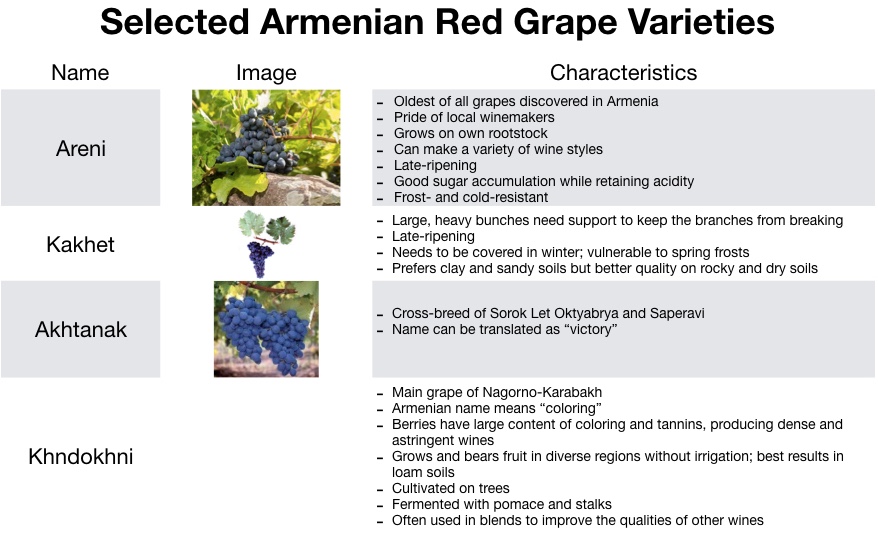
The Armenian terrain is mostly mountainous, with more than 90% of the country sitting at elevations in excess of 1000m. The country's major winemaking regions are illustrated in the chart below while the important white and red grapes are shown in the charts immediately following..


I will continue with winemaking in my next post.

©Wine -- Mise en abyme

Tuesday, June 16, 2020

The ancient roots of viniculture

From its origins in the Near East, vinification had diffused to Egypt and Lower Mesopotamia by 3500 - 3000 BC and to Crete by 2200 BC.  From Crete it migrated to Rome and its colonies and then up the major rivers to Europe and from there to the New World.

In his book exploring the origin of viniculture (Ancient Wine: The Search for the Origin of Viniculture, Princeton University Press, 2003), Dr. Patrick E. McGovern pointed to a number of ancient origin stories and their inability to stand up to even the most elementary scrutiny.  While these apocryphal tales can be easily brushed aside, the field of archaeology has provided some tantalizing clues as to the origin of wine.

According to Dr. McGovern, the modern day wine grape can probably trace its roots back to a climbing vine called Ampelopsis that lived over 500 million years ago.  Isolation -- spawned by the breakup of the super-continent Pangea, desertification, and other natural barriers -- led to today's plant family Vitaceae.  Vitaceae, according to Gyulai et al. (Morphogenetics of Ancient Vitis -- A Genotype Reconstruction), are woody climbers comprising between 13 and 17 genera (subdivisions), inclusive of Vitis, and 700 species.

According to Patrice This et al. (Historical origins and genetic diversity of wine grapes, Trends in Genetics, 2006), the Vitis genus is comprised of 60 inter-fertile species, of which Vitis vinifera L is the only species used extensively in winemaking.  This species, according to This et al., first appeared approximately 65 million years ago and is the only species in the genus that is indigenous to Eurasia.  Two forms of the species still exist in Eurasia and North Africa today: V. vinifera subspecies vinifera (sativa) and V. vinifera silvestris (sylvestris).  Silvestris is the wild form of the species, according to This et al., while vinifera is its domesticated counterpart.

The wild form of V. vinifera can be found today from Portugal to Turkmenistan and from the Rhine riversides to the northern forests of Tunisia. The characteristics of the modern Eurasian wild grape are as follows: astringent; small fruit with many seeds; high acidity; tough skin; and black or dark red color.  Silvestris is also largely dioecious; that is, the male and female reproductive organs are carried on separate flowers (as opposed to hermaphroditic, where the male and female sex organs reside on the same flower thus simplifying the fertilization process).  Research has shown that primitive forms of silvestris were hermaphroditic (Dr. McGovern) and, up to today, between 2% and 3% of silvestris retain that characteristic (Dr. José Vouillamez, Anatolia -- Cradle of Wine? Wines of Turkey presentation).

The sameness of the wild grape stands in stark contrast to the diversity of subspecies vinifera (as of today, almost 10,000 clonal types exist and 99.9% of the world's wine is made from its grapes). According to Dr. McGovern, this "... diversity is recent and the result of choosing traits that are desirable and propagating them by cuttings or routings."  What was the source of these traits?  The literature is unanimous in finding that silvestris, the wild Eurasian grape, was, at some time in the past, taken into cultivation by our forebears and domesticated.  The capability of selecting and propagating traits was, according to Dr. McGovern, unknown to humans of the Paleolithic age.


Doctor McGovern states that while it cannot be ruled out that Paleolithic man did not have some contact with wine -- the Paleolithic hypothesis -- humans living in that era did not have the technology or lifestyle to be credible actors in the domestication of silvestris and vinification of its juice.  He instead points to the Neolithic era as being the most likely answer to the when question.

Writing in Penn Museum's Expedition (The Beginnings of Winemaking and Vinification in the Ancient Near East and Egypt, 39(1), 1997), McGovern et al., propose the Neolithic as being the first period in our annals when all of the requisite conditions for domestication  of the wild grapevine were present simultaneously; a position supported by Yuval Noah Harari in his book Sapiens. The charts below -- constructed from information gleaned from Sapiens -- shows (i) the Agricultural Revolution beginning about 12,000 BC and (ii) the technology and knowhow which make the case for these early farmers being the first systematic winemakers (It should be noted that Harari places manipulation of grapevines much later in the historical cycle than does the archaeological evidence.).


A number of archaeological findings serve to cement the Neolithic as the period within which the grapevine was domesticated and wine made and also allows us to narrow down the answer to the where question.

Hajji Firuz Teppe, an ancient town located in the northern Zagos Mountains of Iran, was the subject of an archaeological excavation in 1968 at which five 2.5 gallon (9 liter) jars were found embedded in an earthen floor along a wall of a Neolithic mud brick building.  Two of these jars had a yellowish residue on the bottom which, after being subjected to infrared liquid chromatography and wet chemical analysis, proved to be a combination of calcium tartrate and terebinth tree resin.  Tartaric acid in the amounts found can only be associated with grapes and the amount of wine that would be housed in the five containers would be much more than required for a single family's use.  Clay stoppers that perfectly fit the openings at the top of the clay jars were found in close proximity to the jars and was assumed to have been used to prevent the contents from turning to vinegar.  These factors led the archaeologists to tag this site as a wine-production facility -- playfully called "Chateau" Hajji Feruz by Dr. McGovern.  As wines in Greece even today are resinated, the assumption is that resin was added to Neolithic wines either as a preservative or for medicinal purposes.

In 2010, researchers with UCLA and the Armenian Institute of Archaeology and Ethnography unearthed evidence of the world's oldest known winery in the village of  Areni in southwestern Armenia. "Beneath a layer of sheep manure inside a cave, the remains of crushed grapes and vessels for collecting and fermenting grape juice, dating to 6100 years ago, were discovered. This proved that humans produced wine systematically 1000 years earlier than thought" (Smithsonian Magazine).

Winemaking equipment consisted of a 2-foot deep vat buried next to shallow, 3.5-foot-long basin made of hard-packed clay with elevated edges. This suggests foot-treading of grapes with the juice from the trampled grapes drained into the vat where it was left to ferment. The below 14th century winemaking facility that I visited during a trip to Rioja illustrates the concept.

14th-Century "crush-pad" in Rioja


The wines at Areni-1 were stored in jars post-fermentation where the cool, dry conditions of the cave resulted in perfect wine cellaring conditions. Traces of a grape used in red wine production today were found on pot sherds at the excavation site providing a new link between ancient and modern wine production (Smithsonian Magazine).

Winemaking artifacts found at Areni-1 (Source: www.si.edu)

According to Patrice This et al., "Uncertainty remains about the place and period of the original domestication ... but archaeological and historical evidence suggest that premier domestication occurred in the Near East."

McGovern takes the position of the Near East as the locale and the Neolithic as the period.  Doctor Jose Vouillamez sees Transcaucasia as the consensus center of origin for botanists, archaeologists, and historians but avers that recent findings in genetics, archaeology, and linguistics point to southeast Turkey between the Tigris and Euphrates Rivers as the point of origin. Sean Myles et al., (Genetic structure and domestication history of the grape, PNAS 2010) only goes as far as claiming a Near East origin for vitis vinifera subspecies vinifera.

©Wine -- Mise en abyme

Friday, June 12, 2020

Erbaluce di Caluso DOCG: Another stellar Piemontese white wine entry

Erbaluce di Caluso DOCG is a wine appellation covering the production of wine from the Erbaluce grape variety grown in 37 communes located in the Piemonte provinces of Torino, Biella, and Vercelli. The region is illustrated in the two maps following.

Piemonte wine region map (Source: winescholarguild.com)

Erbaluce di Caluso DOCG map
(Source:http://www.erbalucecarema.it/en/)

At 188 ha, this is a relatively small appellation. It became a DOC in 1967 and was elevated to DOCG status in 2010.

The soils in the region are remnants of a post-ice-age glacial moraine. The thin topsoils are a mix of clays, pebbles, and shale rich in phosphorous, magnesium, and potassium.

The disciplinaire allows for the production of still, sparkling, and passito wines made wholly from the Erbaluce variety planted in the morainic soils at elevations ranging between 200 and 500 m. Vines must be trained Caluso pergola which dictates 500 m between rows and 5000 vines/ha.

Erbaluce is a high-acid, late-ripening grape of unknown origin. The vine is vigorous and productive, with elongated bunches and bright yellow berries.

The wine I tasted as part of my regular Zoom event was the Cieck Erbaluce di Caluso Vigna Misobolo 2018. The grapes for this wine were sourced from the Misobolo Vineyard which was originally planted in the 1970s. This low-yielding vineyard is rich in mineral salts. It is sited at 320 m on the side of a hill which, with its south and southwest aspects, provides excellent exposure to the sunlight and protection from winter frosts.

The grapes were hand-picked after which the selected grapes were whole-bunch-pressed in order to preserve the fruit character. Pips, stems, and skins were removed post-press and the must cold-fermented in stainless steel tanks. The wines were kept in tank for 5 months before bottling and release on the market.


The wine had a faded green and hay color. Herbs, mint, and sweet fruit on the nose initially. Bright acidity on the palate along with a saline minerality, metallic character, citrus, citrus skin, and heavy excitation of the salivary glands. Some weight, but clean. After some residence in the glass, the edge came off the acidity and the taste was sour citrus fruit, green herbs, minerality, and salinity. I held some of the wine over to the next day and it had become a cross between a Carricante, an Assyrtiko, and a Friulano from Collio: salinity, minerality, and weightier acidity but with the addition of a strong blackpepper character.

This wine is a marked contrast from other Piemontese white wines that I have tasted in the past. Where the international white varieties planted to the south tend to be rustic, and Arneis tends to be somewhat ephemeral (except in cases like Vietti and Giacosa, for example), and the Timorasso hews more towards a Benanti Pietra Marina, this wine is of the land but cries out for the sea.

©Wine -- Mise en abyme

Wednesday, June 10, 2020

Mapping the sparkling wines of Italy: Sardegna

After mapping Champagne and the sparkling wines of France on a single chart, I set my sights on Italy; and quickly realized that this would be a huge task. First, it was not a one-charter and, second, it would have to be addressed from the regional (20 of them) level up. So, with some trepidation, I began this journey in November (2019) with a post on the sparkling wines of Piemonte. And, finally, here I am, with my final post in the series: the sparkling wines of Sardegna.

Sardegna, one of Italy's five autonomous regions, is the second largest island in the Mediterranean. The region's topography is diverse, comprised mostly of hills which are complemented by mountains, plains and coastal areas. The economy has historically been non-industrial with most of the population engaged in agriculture (corn, vines, olives, fruits, vegetables), pastoral farming (sheep, goats, cattle), fishing (tunny, anchovies, lobster), and salt extraction. The government has recently launched initiatives to increase the contribution of tourism and light industry to the region's economy.

Grape-growing and winemaking are less prominent on Sardegna than they are on other Italian regions. As a matter of fact, only a small amount of the available land is dedicated to grape-growing and, as a result, the island has the lowest wine production of any Italian region. This cultural and identity gap with mainland Italy is further illustrated by the fact that the dominant grape varieties are Cannonau (Grenache) and Carignano, two varieties associated with France and Spain.

The soils and bedrock are a mix of granite, limestone, sandstone, minerals, rich clays, free-draining sands, gravels, and volcanic deposits. The vineyards resident on these soils are mostly concentrated on the western side of the island.

The red varieties Cannonau and Cargnano comprise 50% of the island's plantings with another 25% devoted to the white variety, Vermentino. Cooperatives play a very important role in the production of wine on the island.

The below chart details Sardegna's DOC sparkling wines.


Some points of note:
  • Seven of Sardegna's 18 DOCs allow at least one sparkling wine in their appellation
  • Three of the seven appellations are island-wide while a fourth covers 1/3 of the island
  • Only one of the DOCs (Vermentino di Gallura) specifies a metodo classico sparkling wine
  • With one exception (Spumante Bianco in Alghero DOC), all of the sparkling wines are varietal.
**********************************************************************************************************
I have enjoyed this journey and will, in the near future, combine all of the regional posts into a single, overarching post on the sparkling wines of Italy.

©Wine -- Mise en abyme

Tuesday, June 9, 2020

Mapping the sparkling wines of Italy: Mount Etna's Murgo Winery

Writing in a 2019 Forbes article, the wine writer Tom Hyland noted that Sicily produces some fine examples of sparkling wine but, in his estimation, "the finest sparkling wines from Sicily ... are produced by Murgo."

Murgo is the Mt.-Etna-based agricultural estate founded in 1981 on family historical property by the diplomat Baron Emanuele Scammacca del Murgo. I recently spoke to one of his eight sons -- Michele -- about the estate and its sparkling wines. I report on that InstagramLive Chat in this post.

The author and Michele Scammacca
in an InstagramLive Chat

According to Michele, the family can trace its history on the property back to 1860 but the first still wine was not bottled there until 1982 and the first sparkling wine in 1989. Given his father's diplomatic responsibilities, the family resided away from the estate. Michele was the first member of his immediate family to come back to Sicily when he came to the island after finishing school. Today, four of the eight brothers work in the family enterprise which encompasses wine, olive oil, a hotel, and a restaurant.

The 35-ha Tenuta San Michele estate is located at 500 m up on the eastern side of Mt Etna. This area, due to the high levels of rainfall, is well-suited to the growth of grapes for the production of sparkling wine; red wines from this area are less concentrated than red wines from other parts of the mountain. The estate is planted 50% red grapes and 50% white, with Catarratto and Carricante plantings making up the white contingent.

Michele sees Nerello Mascalese as a great grape for sparkling wine production as it can be aged on its lees for a long time. Nerello Mascalese as a sparkling wine is not very interesting if not aged on the lees for a certain period. Given the early drinking requirements of sparkling wines produced using the Charmat method, Nerello Mascalse is not a good fit for this process. In Michele's view, there are too many Charmats in the market for Murgo to compete successfully in that space. They cannot compete, for example, with the ubiquity and low cost of Prosecco.

In response to one of my questions, Michele expressed some reservations as to the use of Carricante in a sparkling wine. In his view, Carricante is a light wine with not enough concentration to meet the requirements of a sparkling wine. Nerello Mascalese has more structure and thus is better suited. In addition, Murgo, as an estate, does not have a lot of Carricante.

Murgo its constantly improving both its product and marketing. When they first started, there was no market for sparkling wine from Etna; now (prior to the lockdown), they are selling 100,000 bottles annually.

In the early days, sparkling wines were only used for special events and celebrations. Now it is being used as an aperitivo. Another of the myths that Murgo's success has debunked is that you can only make Metodo Classico sparkling wines in the north of Italy. Nerello has great compatibility for sparkling wine due, in great part, to its acidity. Some producers in the south have attempted to use Chardonnay in this role but, when picked early, it produces a wine that is soft and round. And softness covers everything -- including terroir -- in a sparkling wine.

Etna is a unique terroir for growing sparkling wine grapes, endowed as it is with volcanic soil plus high elevation. The soil gives high minerality to the wines. There is no limestone in the Etna soils so the wines are lighter, but with great acidity

Murgo produces four sparkling wines: Brut, Brut Rosé, Extra Brut, and Extra Brut Rosé. Grapes for these wines are a combination of estate and purchased fruit. All grapes are hand-picked two weeks prior to maturity (at this time the acidity is high and potential alcohol between 11.2 and 11.5) and transported to the winery where they are pressed (gently) and fermented in stainless steel tanks. The base wines reside in the SS tanks for 7 to 8 months before being placed in bottles for secondary fermentation.

Th Brut wines spend between 1.5 and 2.5 years on the lees while the Extra Brut spends between 7 and 8 years and the Extra Brut Rosé approximately 4 years. The Brut and Brut Rosé are dosed at 4 g/L while the Extra Brut wines are zero dosage.


The Murgo Brut can be drunk in every situation, says Michele. It has the biggest market position of the Murgo wines because of its price and its fruitiness. Italians, according to Michele, prefer fruitiness in their sparkling wines.

The Brut Rosé is very fruity. It can be used as an aperitif but its good structure means that it can also be used with food. Tuna tartare with Brut Rosé is a great pairing.

The Extra Brut presents delicate sensations of evolution, a nice perlage, good balancing with the acidity the softness and the minerality coming from the terroir. Here you can feel the potential of the Nerello Mascalese sparkling wine.

The Murgo wines are more like Trento DOC and Alta Langa DOC sparkling wines, and less like Franciacorta, due to its acidity. Michele personally prefers wines with more acidity.

The vintages that he likes: 2017 for the Brut and Brut Rosé; 2011 for the Extra Brut; and 2014 for the Extra Brut Rosé.


©Wine -- Mise en abyme

Sunday, June 7, 2020

Mapping the Sparkling wines of Italy: Sicilia

Sicily is both Italy's southernmost region and the largest island in the Mediterranean. "Blessed with consistently bright sunshine and reliably moderate rainfall, Sicily's classic Mediterranean climate is ideally suited to the production of wine grapes. The warm, dry climate means that mildews and rots are kept to a minimum, particularly in well-ventilated areas that benefit from coastal breezes. This low disease pressure means that chemical sprays are hardly needed, so much Sicilian wine is produced from organic grapes" (wine-searcher.com).

According to Nesto and di Savino (The World of Sicilian Wine), the island is 15% flat, 60% hilly, and 25% mountainous, a situation resulting from the slow contraction of the vast ocean lying between the land masses of Africa and Eurasia. This contraction, especially over the past 50 years, has pushed up the cretaceous limestone seabed -- formed by a mixture of mud, skeletons, and shells of marine organisms deposited over eons -- to form the mountains and hills that we see today. The below figure summarizes the distribution of parent rock and soils on the island.


Sicily's modern quality wine industry was launched in the 1960s, precipitated by events such as the consulting work of Ezio Rivello, the contributions of Diego Planeta, the rise of family wineries, the influence of Giacomo Tachis (the enologist who had risen to fame through his work with Antinori properties), investments from the North, the rise of Etna, and appellation status for the broader region.

The figure below shows the DOC sparkling wines of Sicily.


In a May 22, 2019, Forbes article on Italian sparkling wines, Tom Hyland stated thusly:
Given that the climate of Sicily is warm, you wouldn't expect sparkling wine to be produced here, but there are some very fine examples. A few producers in the Etna zone are crafting some beautifully rendered metodo classico cuvées, including Planeta, Terraze dell'Etna and Murgo. The wines vary from Planeta's 100% Carricante version to several offerings each from the latter two producers. Terraze dell'Etna produces two offerings of Brut made entirely from Chardonnay, with one being aged on its lees for 50 months, and they also produce two different Rosé Brut, again with one being aged for 50 months on the lees; the rosés are made from 90% Pinot Nero and 10% Nerello Mascalese. ... The finest sparkling wines from Sicily in my mind are produced by Murgo.
Murgo is the Mt.-Etna-based agricultural estate founded in 1981 on family historical property by the diplomat Baron Emanuele Scarammacca del Murgo. I recently spoke to one of his eight sons -- Michele -- about the estate and its sparkling wines and teh entirety of that conversation can be found here.

During a tasting with Salvo Foti, noted Etnean Enologist, I was treated to a 2014 Vinudilice Metodo Classico. This was a stunning sparkling wine but, unfortunately it is not made every year. This wine is made with grapes sourced from Vigna Bosco, a vineyard nestled within the depths of a holly oak forest 1300 meters up on Mt. Etna. The vineyard lays claim to being the highest in Europe. The varieties planted here are Alicante, Grecanico, Minella, and some other unidentified varieties. This is the best sparkling wine I have tasted on the mountain to date: Fresh and attention-grabbing with a mouth-filling mousse and great persistence.

©Wine -- Mise en abyme