Wednesday, November 14, 2012

The risks of sluggish and stuck fermentations when utilizing natural yeasts

I have previously characterized the risks associated with natural-yeast fermentations thusly: (i) stuck fermentations; (ii) yeasts washed off grapes during inclement weather; (iii) spoilage yeast contamination; (iv) lengthy fermentation times; and (v) persistence of negative characteristics.  I have begun a process of exploring these perceived risks in greater detail -- beginning with a recent post on spoilage yeast contamination -- and will continue on that path with the current post on the risks of sluggish and stuck fermentations.

Slow or sluggish fermentation is characterized by low sugar utilization by the attendant yeasts while incomplete (stuck) fermentations occur when a higher-than-desired level of residual sugar remains at the conclusion of alcoholic fermentation (Klaus A. Sutterlin, Fructophilic yeasts to cure stuck fermentations in alcoholic beverages, PhD dissertation, Stellenbosch University, March 2010).  Sluggish or stuck fermentations are the second most significant enological problem faced by winemakers (2003 American Vineyard Foundation survey and 1996 Association for the Development of Wine Biotechnology survey, both cited in Sutterlin 2010) and, with more than 60% of respondents  admitting to having experienced one or both of these problems, the economic costs are perceived as being enormous.


According to Bisson and Butzke (Diagnosis and Rectification of Stuck and Sluggish Fermentations, American Journal of Enology and Viticulture 51(2), 2000), there are four types of fermentations which deviate from the "normal" fermentation profile: (i) sluggish initiation with the rate eventually becoming normal; (ii) normal initiation becoming sluggish; (iii) sluggish throughout the entire process; and (iv) abrupt arrest late in the fermentation.

Bisson and Butzke report that slow fermentation initiation (Type (i) in the foregoing) can occur in both natural and inoculated fermentations and, in the case of natural fermentations, "the sluggish start may simply be due to low numbers of yeasts in the must and not reflect any particular problem other than an initial low biomass."  Based on their research, the authors aver that fermentation will go to completion, depending on juice conditions and the presence of other organisms, with as little as 100 viable Saccharomyces cells/mL present at initiation.

The risk of deficient (< 100 viable cells/mL) Saccharomyces populations leading to a problem fermentation is highest in the earliest portions of the crush.  As crush is prolonged, Saccharomyces bacteria will colonize the winery equipment such that juice and must passing through said equipment will have their levels of Saccharomyces elevated.

In the cases where there are low initial levels of Saccharomyces, holding juice at low temperatures is risky as it (i) encourages the growth of Kloeckera apiculata and (ii) is injurious to the existing Saccharomyces yeasts.  If the Saccharomyces yeasts are able to dominate, the fermentation will proceed to completion; if not, the fermentation will arrest.  It should be noted that the lower the level of the initial Saccharomyces population, the greater the growth requirements of the juice.  Bisson and Butzke estimate that it will take 13 generations to get from an initial level of 100 cells/mL to a typical innoculum level of  106 cells/mL.

According to Malherbe, stuck fermentations can be caused by glucose/fructose ratio imbalance, nutritional limitations of the must (nitrogen deficiency, oxygen deficiency, mineral deficiency, vitamin deficiency), inhibitory substances (ethanol, toxic acids, the effects of sulphites, killer toxins, fungicide/pesticide residues), and a number of physical factors (excessive must clarification, temperature extremes, excessive use of Sulphur Dioxide).  When compared to this range of potential stuck-fermentation causative factors, the risk of low initial yeast population in natural fermentations does not seem that stark.  Bisson and Butzke has shown that fermentation can conclude successfully even beginning with yeast levls as low as 100 cells/mL and if the fermentation continues in a sluggish manner, or gets stuck, it is a biomass rather than a starter problem.  Further, the risk of sluggish initiation is not restricted to natural yeast fermentations.  According to Bisson and Butzke, poor starter culture can lead to sluggish initiation in the case of inoculated fermentations.

To conclude then, sluggish/stuck fermentations is an issue that a winemaker always has to be cognizant off and has to constantly monitor against.  There are many opportunities for this curse to be visited upon the winemaker and one of those cases is at the initiation of the fermentation where it will register as a sluggish start.  Such a manifestation could be apparent whether the fermentation is natural or inoculated.  All things being equal in the biomass, the natural yeast fermentation should right itself and proceed to completion.  There does not seem to be an outsized and determinative risk of stuck fermentations if one practices natural yeast fermentation.  There is an obvious lag phase however, as the yeast levels build up from cellar-entry levels to standard starter inoculate levels.

©Wine -- Mise en abyme

Wednesday, November 7, 2012

Lunch and winery tour with G.D. Vajra: Decanter's Great Piemonte Reader Weekend

Azienda Agricola G. D. Vajra, a winery owned by Milena and Aldo Vaira, produces Nebbiolo, Barbera, and Dolcetto wines in the Barolo commune of the Langhe sub-region of Piemonte. In this post I will discuss our lunch and winery visit hosted by this esteemed estate as a part of Decanter’s Great Piedmont Reader Weekend.

The G. D. Vajra (The family name is Vaira, similar pronunciation as for the winery, with the difference in spelling resulting from a printer's error which the owners retained as the winery name.) vineyards cover 60 hectares and are planted to Nebbiolo at elevations between 350 and 400 meters and Dolcetto and Barbera at lower elevations.  In addition to the vineyards in Barolo (Bricco delle Viole, Fossati, La Volta, and Coste de Vergne) the Vairas have taken over control of the Serralunga d'Alba vineyards (Baudana and Cerretta crus) of Luigi Baudana via a purchase by the Vaira children.  Giuseppe is the winemaker for the wines produced from these vineyards.

We were scheduled to begin the day's events with a lunch at Tra Arte e Quercie (between art and oak trees) in Monchiero with Giuseppe Vaira (of G.D. Vajra).  When we arrived at the destination, we were greeted warmly by Giuseppe in the restaurant courtyard and treated to a short discourse on the area, the restaurant, and our activities for the remainder of the day.  After this sun-soaked introduction, we were ushered into the restaurant for a much anticipated lunch paired with Vajra wines.


The first wine tasted at lunch was the 2011 Langhe Riesling.  According to Giuseppe, 2011 was a warm vintage in Langhe, one that will prove to be exciting because of the incidences of rain and hailstorm.  He saw it as reminescent of the 2008 vintage.  Prior to the 2011 vintage, the Langhe Riesling was called Langhe Bianco.  The vines for this wine were planted 21 years ago and the wine, according to Giuseppe, is notable for its sense of place, its personality, and its ability to pair well with regional foods.  This wine had a lot of tropical notes and was perfumed and floral.  It reminded Giuseppe of a Trocken from Rheingau.  On the palate, lime, a sweet minerality and refreshing, palate-cleansing acidity.  To me, a fruitier version of a JacobsCreek Steingarten Riesling.

Our second course, the Pumpkin Pudding with Cheese Fondue, was paired with a 2010 Dolcetto d'Alba.  The beauty of Dolcetto, according to Giuseppe, is that it can be a difficult teenager so you have to give it extra love.  It needs a good vineyard in order to blossom and needs to be smelled and tasted regularly in the cellar.  It is a reductive wine and has to be racked two to three times more than Barbera.  It is truly a high maintenance wine.  This wine exhibited cherry and blueberry notes which carried through to the palate.  It paired beautifully with the meal which served to extend and expand the weight and reach of the wine on the palate and in the finish.


The Langhe Nebbiolo 2010 DOC was Giuseppe's favorite of the wines we were tasting at lunch.  The wine was made from grapes sourced from young vineyards.  It is not yet focused but its potential is apparent.  Giuseppe described it as ethereal and a perfect pairing for cheeses.  Florality and spicy cherry notes with proto-Barolo tannins and power accompanying a long finish.

The final wine tasted at lunch was a 2008 Barolo Alba, a gentler and more approachable style of Barolo.

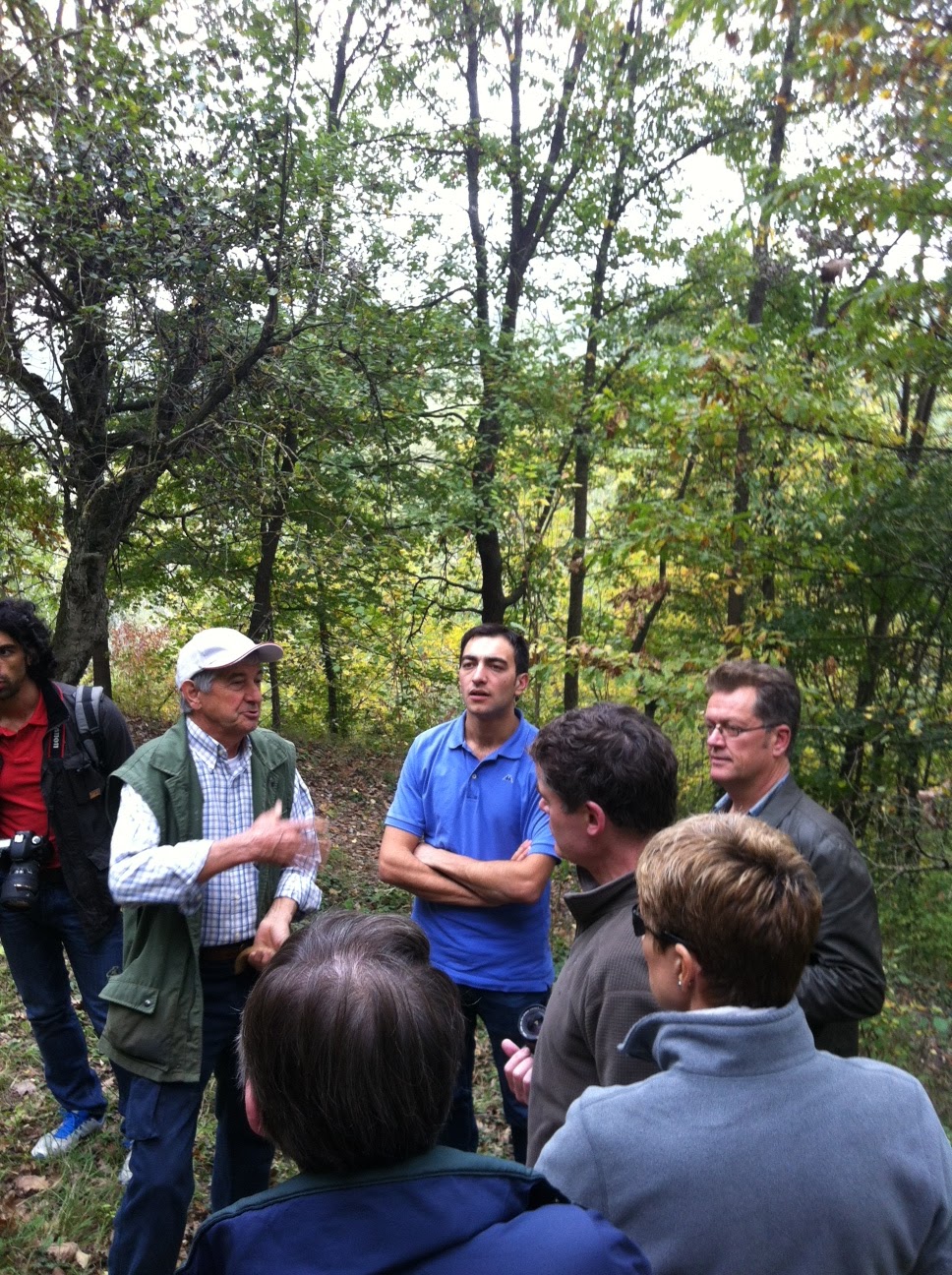
At the conclusion of lunch, we embarked on a truffle hunt in the forest adjoining the restaurant and, following that, travelled to the Vajra facilities for a winery tour and taste-through of the remaining wines in the portfolio.

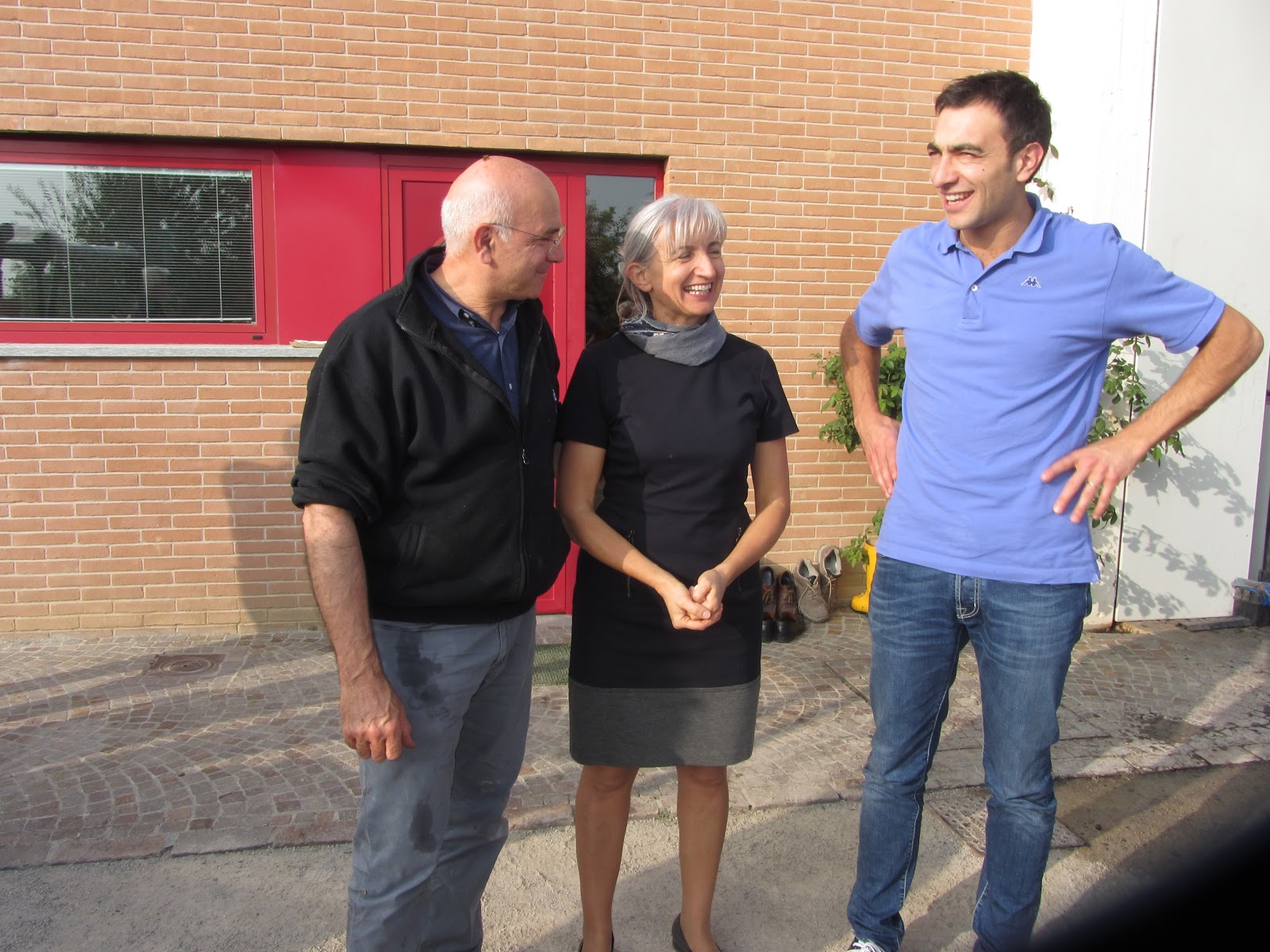
Upon our disembarkation at the winery, we were greeted by Aldo and Milena.  In describing his philosophy, Aldo indicated that he sees the winemaker's task as deriving the greatest harmony possible from the factors at his disposal: terroir; diversity and complexity of soil; and grapes (each variety bringing its own characteristics).  He expressed that being able to interact with customers was a gift and that his greatest disappointment is not knowing each and every pwerson who drinks his wine.  Post our conversation with his parents, Giuseppe referred to his Dad as the creative mind in the business and his Mom as the support structure.


As we toured the facility we learned that Vajra had gained the first organic certification in Barolo in 1971 but had stepped back from that arena in the 1990s.  They farm all of their own vineyards and practice green harvesting in order to ensure high quality in the surviving grapes.  A first sort of the grapes is conducted in the vineyard at harvest.  A table has been placed between the crusher and destemmer in order to allow a sorting for stems and minimal stem effects in the wine.  Top quality grapes make it into the top wines while second level red grapes are bottled as Langhe Rosso.  WInes are subjected to long periods of maceration in stainless steel tanks.


Upon completion of the tour we repaired to the tasting room to complete our immersion in the Vajra wines.  The first wine up was the 2011 Dolcetto d'Alba.  This was the current release of the wine tasted earlier in the day and had similar characteristics.  Grapes for this wine were sourced from southern exposures in the Costa di Vergne and Fossati vineyards.


The 2009 Barbera d'Alba Superiore was sourced from the Bricco delle Viole vineyards blended with grapes from the Bric Bertoni vineyard in Serralunga d'Alba. The wine was macerated for 35 days and then spent 2 years in large casks prior to bottling.  The 2009 vintage in the Langhe resulted in richer wines and this wine was no exception.  It had great aromatic strength with cherries and blueberries dominant.  Minerality and acidity on the palate preceding a spicy, medium-long finish.

The 2008 Barolo Bricco delle Viole exhibits violet florality, rusticity, iron, orange zest, and sweet tobacco on the nose.  Tannic on the palate but elegance shines through.

Cerretta is an up-and-coming, clay-limestone vineyard in Serralunga d'Alba from which 300 cases of the Barolo Cerretta is produced.  This 0.8 ha vineyard was originally planted in 1970 and lies on Serralunga d'Alba's eastern slope.  These wines are fermented partially in oak and partially in stainless steel and are aged in Slavonian casks for 36 months.  The 2008 Barolo Cerretta exhibited violets, cocoa, tar, mint, and chocolate on the nose.  On the palate, depth, complexity, and a long finish.  The 2008 Barolo Baudana, drawn from another famed Baudana cru, is also grown on limestone soils.  This wine had a rustic minerality, violet, tomato, dried tobacco leaf, leather, and sweet tobacco on the nose and elegance on the palate.


All in all a wonderful day.  Giuseppe was a wonderful host and teacher all day and it was a pleasure to observe the lovingkindness that suffuses the entire family as they work towards their objectives.  Wonderful wines.

©Wine -- Mise en abyme

Friday, November 2, 2012

The risk of spoilage yeast contamination during natural yeast fermentations

In a comment on my post on indigenous- versus inoculated-yeast fermentations, reader Ben opined that three of the five disadvantages of natural fermentation that I had listed were "discountable" but that the remaining two provided the basis for an "interesting debate."  Ben's comment has prompted me to provide readers with a fuller discussion of the mentioned disadvantages beginning with the current post on spoilage yeasts as a risk in indigenous fermentations.

Absent an inoculation, all yeasts found in grape must and wine will originate from one or more of the following sources: vineyard, grapes, or winery processing equipment (E.J. Bartowsky, Bacterial spoilage of wine and approaches to minimize it, Letters in Applied Microbiology).  According to Loureiro and Malfeito-Ferreira (Spoilage yeasts in the wine industry, International Journal of Food Microbiology 86, 2003), mature, healthy grapes harbor microbial populations (yeasts, lactic and acetic acid bacteria, filamentous molds) at levels of 103 - 105 CFU/g (colony forming unit -- a measure used in microbiology that indicates the number of micro-organisms present in a water sample (www.legionella.com/cfu)), levels that vary based on environmental conditions (rainfall. temperature, grape variety, the application of chemicals in the vineyard).  Yeasts resident on grape berries tend to congregate in areas where juice might escape (Loureiro and Malfeito-Ferreira).  Wine-associated yeasts are identified in the table below.


As seen from the foregoing, yeasts exist in the vineyard environment and on healthy grapes but, for our purposes, the intersection of yeasts and damaged grapes is of significance.  Grapes can be damaged in any number of ways (hail, birds, etc.) but it is the damage caused by phytopathogenic molds that is of greatest interest.  The effects of these molds on grapes and wine are spelt out in the table below.


Loureiro and Malfeito-Ferreira found a number of ascomycetous yeasts proliferating on grapes damaged by sour rot as well as Zygosaccharomyces spp and other spoilage yeasts such as Dekkera bruxellensis.  In a separate study on sour rot, Berata et al., isolated 17 ascomycetous species from sour-rot-damaged samples and only five from sound grapes.  The most significant find was the presence of Zygosaccharomyces bailii, a species which the authors describe as "acidophilic" and "one of the most dangerous wine spoilage yeasts."  Once introduced, this species was recovered from all of the alcoholic fermentation steps.  The authors conclude that "yeast species from sour rot grapes are an important contamination source of wineries and wines."  Loureiro and Malfeito-Ferreira make much the same argument: "For many of the most important wine spoilage species (Dekkera/Brettanomyces), the main entry to the winery is grapes affected by sour rot."  The consensus, then, is that sour rot is the primary vehicle for wine spoilage yeasts transiting from the vineyard to the winery.  Let us now turn our eyes to the winery environment.

According to Woolford et al., (Genome Survey Sequencing of the Wine Spoilage Yeast Dekkera (Brettanomyces) bruxellensis, Eukaryotic Cell 6(4), April 2007), Brettanomyces bruxellensis is a major microbial cause of wine spoilage worldwide and results in significant economic loss.  The yeast makes "the winery itself a primary habitat surviving in the walls ... interior surfaces of presses and fermentation tanks, or on the wood of barrels."  From these positions the microbe is well situated to "colonize the fermenting must or maturing wine."  Wines infected with Brettanomyces will exhibit aromas of mousiness, wet wool, burnt plastic, horse sweat, or barnyard.  According to the same authors, the severity and frequency of Brettanomyces has been on the uptick as winemaking has trended towads wines with higher levels of residual sugar and that are unsulfited, unfiltered, and aged on lees.

Brettanomyces is exceptionally dangerous because it has all of the characteristics of Saccharomyces cerevisiae (ethanol-tolerant, facultatively anaeorobic, can exist without mitochondrial DNA, ferments preferentially in the presence of high glucose under aerobic conditions) but extend beyond it in that, while slower growing, "it can assimilate a wider variety of carbon choices."  These conditions lead to the following progression in a Brettanomyces-contaminated alcohol fermentation (Woolford et al.):
  • Saccharomyces cerevisiae dominates throughout primary fermentation then is replaced by D. bruxellensis during the maturation phase when ethanol concentration is high and minimal amounts of sugar remain.

It was long thought that Brettanomyces contamination was a result of poor hygiene in wineries but contamination persists even in the face of intensive hygiene efforts on their parts (Renouf et al., Interactions between Brettanomyces and other yeast species during the initial stages of winemaking, Journal of Applied Microbiology 100 (6), June 2006).  The research cited in this post seems to indicate that Brettanomyces can enter the winery through sour rot  and can then take up residence within the facility and contaminate batches of wine essentially at will.  Intensive hygiene efforts can clean up an infected location but re-contamination is potentially just another sour-rot affected batch away.  Vigilance in screening for sour rot would seem to be in the best interest of the winery.

Grape must is nutrient-rich and ethanol poor, a candy store for most micro-organisms.  The longer  those conditions exist, the more non-Saccharomyces yeasts will thrive. With the exception of Brettanomyces, most wine-spoilage yeasts are ethanol-intolerant so the quicker that high ethanol levels are obtained, the less opportuntiy for these micro-organisms to proliferate.  The issue with natural fermentations is that they start slowly and take longer to get up to levels in which S. cerevisiae thrives.  And it is in that period that the fermented wine becomes susceptible to the travails of wine-spoilage yeasts.


The remaining disadvantages of natural wine fermentation will be coverd in a number of upcoming posts.

©Wine -- Mise en abyme

Wednesday, October 24, 2012

Truffle hunting in wine country: Decanter's Great Piemonte Readers' Weekend

This was going to be a high-intensity weekend so there was no time to be messing around.  We were launching the weekend with a lunch at Tra Arte e Quercie (between art and oak trees) in Monchiero with Giuseppe Vaira (of G.D. Vajra) followed quickly by a truffle hunt in a private preserve owned by the restaurant's proprietor.  Decanter had sent us reams of information on truffle hunts (what to wear, psychological and physical preparation prior to the hunt, in-hunt demeanor (end-zone celebrations were prohibited), and the proper way to handle the potato in the event of a "kill") so we were ready for the event.  I felt a twinge of sympathy for the truffles in our target zone because I knew that they were overmatched.  But I will get back to that later.  First let us take a look at exactly what we were hunting.

The white truffle of Alba (tartufo bianco; or trifola d'Alba in the Piemontese dialect) is a mycorrhizal fungi which lives in a symbiotic relationship with a host tree wherein it acquires minerals from the soil and passes them on to the plant and utilizes plant-provided carbon for its own growth and reproduction.  The truffle is generally found in the Langhe, Roero, and Monferrato regions of Piemonte in humid, north-facing internal hill slopes with elevations not exceeding 700 meters and with pH values ranging between 6.6 and 8.5 (simplyflavors.com).  The truffle has an affinity for the trees such as oak, willow, poplar, linden, lime, sweet chestnut, and hazelnut.

The truffle has a distinct aroma (earth, tree roots, and old cheese according to lifeinitaly.com) and is famous for said aroma as well as the taste and perceived aphrodisiac qualities. The desirable qualities of the white truffle, plus declining harvest levels, combine to make this an extremely expensive delicacy with prices ranging to $2000/lb and beyond.  The truffles are harvested by truffle hunters (trifulaus) and their dogs (previously pigs but they are rather unruly) during the "season" which stretches from early October to early December.  The dogs are trained by first being able to find hidden cheese, then cheese hidden in association with truffles, then the truffle only.  The dogs are rewarded for each find with some type of treat.  In the field the dog is more easily dissuaded from destroying the truffle than is a pig.

Back to the hunt.  Ezio is our trifulau.  According to Giuseppe (and the restaurant literature) he is a great truffle hunter who has been pursuing this passion (initially a job) since he was a boy.  He has his own truffle "range" located down the hillside from the elevated position of the restaurant.  Did I mention that Ezio was also the proprietor of Tra Arte e Quercie?  Well he is and after managing the production and serving of our meals, he changed into his great-white-truffle-hunter garb, picked up his divining rod (waist-high shepherd's crook with a metal tip), collected his trusty companion (looked like a golden mutt), gave us all hiking sticks, and strode off into the "jungle."  We were on our way.


As we started down the hill, we were talking loudly and laughing.  Nerves I thought.  We were venturing into the unknown.  Would we prove ourselves equal to the challenge? How would we react when we came face to face with the prey?  Would we stand firm? Or cut and run?  Ezio looked back at us with a disapproving glare and whispered something to Giuseppe.  We were obviouly not hunters.  We would most likely scare the prey away. But no, that was not his biggest concern.  No, you see, secrecy is the thing that is valued most among the trifulau.  If you find a truffle at a particular spot, you will continue to find more truffles at that spot in the future.  If you reveal that spot (inadvertently or otherwise), other hunters will harvest in your stead.  Truffle hunters keep going back to the well. Silently.

Suddenly Ezio stopped and placed his finger to his lips.  He signaled for us to stop walking and talking. I rolled my eyes.  I had been to Disney.  This was going to be the contrived drama scene with some rustling in the underbrush and then we would move on.  But no. It was not that way.  We heard some voices approaching.  How could this be?  We were on private land.  Surely Ezio would jump out and confront these people as they passed about thirty feet below us on a hunt of their own.  But he did not.  As they passed on he indicated that they were poachers and it was best to not let them know that we were there.  He did not want them potentially doubling back and spying on his hunting operation.

After that crisis passed, we continued on our walk to the area where Ezio was going to show us his magic.  In anticipation of our arrival, he had not harvested in this area for two days.  He wanted to improve the chances of our coming out of this hunt with success. When he got to this slightly flatter area, he stretched out his staff in the manner of Moses reaching out to part the Red Sea and the dog went bounding off with her nose close to the ground.  She was nuzzling around in the underbrush in an area defined by the outstretched divining rod.

Suddenly she stopped running around and started urgently nosing a particular spot. Quick as a flash Ezio was kneeling beside her, guiding her head with his hands, exerting a gentle pressure as he sought to ensure that the truffle was not close enough to the surface for the dog to damage it.  He then moved her back from the site, reached into an heretofore unnoticed slit in the back of his jacket, and pulled out a metal claw with a wooden, elongated handle.  He began to clear the underbrush and dig gently into the soil with this implement.  Just prior, he had reached into the pocket of this jacket and retrieved a reward treat which he gave to the dog.  We were silent as we watched the operation. Then Ezio reached into the soil and held up a small dark object between his thumb and forefinger.  He muttered something and then passed the object on to Guiseppe.  Small black truffle, said Giuseppe.  And we all touched it.  And smelled it.  This was our first time.  And it did smell like truffle oil.


And so we continued for another hour or so and our trove grew.  Small black truffles. Small white truffles.  Large white truffles.  I was busy calculating what my take was going to be from this afternoon's book of work.  When Ezio signalled that our work here was done, we jauntily walked back up the hill.  We were in high spirits.  We had confronted the truffle in the wild and had emerged victorious.  And we had Ezio's trophy bag full of victims to prove the point.  As we got to the top of the hill, we stopped at the gate of Ezio's residence.  His daughter-in-law was standing there holding his grandson.  The grandson struggled to be placed on the ground so that he could run over to his grandfather.  The two embraced lovingly and Ezio reached into his pouch, retrieved one of the large, valuable, white truffles and gave it to his grandson.  This 2-year-old kid looked at the truffle intently and then brought it up to his nose and smelt it.  He then passed it back to his granddad.  The cycle renews.

By the way, our reward for the day's work was the opportunity we had to see a master ply his craft. Oh well.


©Wine -- Mise en abyme

Monday, October 22, 2012

The Langhe (Piemonte, Italy) wine region

The third annual Decanter Reader trip (Great Piemonte Reader Weekend) placed a small band of intrepid wine enthusiasts deep into the wilds of the Langhe region to test their resolve and ability to survive an avalanche of information, food, and wines of the region.  This post is intended to provide the lens through which all future posts on the topic should be viewed.

Piemonte is one of the most highly regarded Italian wine regions, a reputation due, in large part, to the stellar wines produced in its Langhe sub-region. The Langhe (tongues of land) is separated from the Roero sub-region by the Tanaro River and is characterized by long, steep-sided hill slopes that are separated one from the other by a series of narrow valleys.


The climate in the Langhe is continental with warm Mediterranean air from the Ligurian Sea moderating somewhat the effects of cold air coming off the Alps to the north.  Weather varies from year to year resulting in appreciable vintage variation.  Hailstorms are an appreciable risk with the potential for associated crop loss.

When the Padano Sea retreated from what is today's Langhe, it left behind layers of clay, calcareous marl, blue marl, tufa, sand, and sulfur-bearing chalk.  This soil is credited with bestowing structure and finesse on the areas full-bodied reds.

The primary grape varieties grown in Langhe are shown in the table below. 


Nebbiolo, the variety used in the region's famed Barolo and Barbaresco wines, is considered Italy's most noble grape.  Its name is thought to derive from the Italian word for fog, a condition which is common in Barolo during the September-October maturation period of the variety. The grape requires the warmest sites in order to ensure full ripening. There is significantly more Barbera planted in Langhe than Nebbiolo. This variety is vigorous, high in acid, and resistant to fungal disease and its retiring aroma (plus acidity) renders it an excellent blending wine. When cropped for quality this grape can show aromas of red fruits, currants, and blackberries.  Dolcetto -- the little sweet one -- is an early ripening variety which is low in acid but high in tannins.  It is however, considered much more approachable than its rich cousins and serves as the everyday drinking wine of the Piedmontese.  This variety is characterized by aromas of ripe blackberries and plums.  Moscato Bianco is a white grape that is the fourth most planted variety in Italy.  Known by a number of names, the resulting wines tend to be fizzy or sparkling and produce aromas of lychee and rose petals.

Barolo DOCG Soils
Barolo wines are produced from Nebbiolo grapes grown on the hillsides to the southwest of Alba in five key communes and parts of five sub-zones.  The substrates of the hills are marine sedimentary deposits that formed in the Miocene epoch (23 - 5 million years ago). These deposits are composed primarily of white- to blue-colored compacted marl and calcareous clay and are more- or less-resistant to water penetration depending on the sand-to-clay ratio.

The Barolo zone is divided into two soil subzones based on the age of the deposits. To the west, the soils around the towns of Barolo and La Morra are composed of a calcareous (limestone-rich) marl with high levels of sand -- referred to as Tortonian (11 - 7 million years ago) -- that yields aromatic, elegant, medium-bodied wines which evolve in the bottle earlier than their counterparts.  The wines from the Barolo commune are thought to be more complex, and broader in texture, than the more perfumed and graceful La Morra wines. 

The Langhian (until the 1960s, Helvetian) soil around the communes of Serralunga d'Alba, Monforte d'Alba, and Castiglione Falletto was deposited between 16 and 13 million years ago. The soils of this zone are mostly calcareous clay marls with little sand content and produces a wine that is more structured and requires longer aging.

Serralunga d'Alba

Serralunga d'Alba is a small, medieval village in the Langhe region of Piedmont that is 7100 meters long, 1800 meters wide at its widest point, sits on a hill 414 meters above sea level, and serves as the eastern flank of the Barolo wine production zone.  According to massolini.it, Serralunga d'Alba is one of only three of the 11 Barolo communes that are contained in their entirety within the production zone (the remaining two are Barolo and Castiglione Falletto).

According to Gambero Rosso (Serralunga Barolo: The unrushable wine; gamberorosso.it), Serralunga d'Alba has "compact, sandstone-based soils dating from the Helvetian period."  These soils are high in sand, limestone, iron, phosphorous, and potassium and, as a result, produce wines that are intense and structured and that need time to mature.

Click here for a detailed map of the Barolo wine-growing region.

Barbaresco DOCG

Barbaresco wines are produced from grapes grown on the steep, pre-alpine hillsides of four small villages located to the northeast of Alba.  The grapes are grown on limestone rich marl soils on south-facing exposures with elevation in excess of 200 meters.  The climate in the Barbaresco growing area is warmer and drier than in Barolo, allowing the grapes to ripen earlier and the resulting wines to be less tannic and more approachable.  Barbaresco wines are known for their rich, spicy flavors and perfumed sweetness.

A summary of the DOCG and DOC wines produced in Langhe is provided in the table below.


©Wine -- Mise en abyme

Thursday, October 18, 2012

The Langhe exposed: Decanter's Great Piedmont Reader Weekend

Decanter’s Great Piedmont Reader Weekend, held in Langhe (Piedmont) from Friday, October 12, to Sunday October 14, was the third in a series of trips designed to take advantage of the company’s position in the industry to expose a small group of its readers to leading proprietors/managers of a selected wine region.  The prior two events were held in Bordeaux and the Duero, respectively, and were both exceptional in their own right.  My prior experiences with Decanter, plus no prior experience with the Piedmont region, convinced me to sign up for this trip.

The scheduled activities for the weekend were: visits to Vajra, Gaja, Poderi Aldo Conterno, and Massolino wineries where we would be led in tastings by the proprietors; lunches and dinners in area restaurants, some hosted by winery proprietors; and a truffle hunt.  Our base of operations was to be the Il Boscareto Resort and Spa.  The Decanter personnel along for the trip were Sarah Kemp, Publishing Director, Emma Jones, Events Manager, and Peter McCombie MW.  I will cover the individual elements of the trip in subsequent posts but my initial, high-level impressions are covered herein.

The weather for the duration of our trip was picture perfect (contrary to pre-trip weather forecasts), with chilly morning mists yielding to bright, sunny days and with temperatures in the low-to-mid 60s.  These clear, bright days afforded clear views of the vineyard-clad slopes of the area; slopes that are bisected by winding mountain roads connecting turreted-hilltop town to turreted-hilltop town.  And, through it all, vineyards claiming various aspects of the multitudes of slopes in their mad dash from hilltop prominence to the valleys below.  The pleasant temperatures were also a boon during outdoor activities such as truffle hunting, vineyard walks, and winery facility tours (extensive in the Gaja case).


Beyond my gratitude for the weather, and the beauty of the Langhe scenery, I would also like to acknowledge the kindness and generosity of each of the proprietors whom we visited.  Our visit coincided with harvest in the Langhe yet these individuals set the time aside (between 3 and 5 hours): to explain the region and their winemaking philosophies and practices; to lead us in tutored tastings of their estate offerings; to host us at lunches (Gaja and Vajra); and to answer any and all questions completely and with an honesty and forthrightness that was truly refreshing.

Giuseppe Vaira
Plus Mom and Dad
Angelo Gaja holding court in the courtyard
Gaja and Gaia
Giacomo Conterno
Franco Massolino
As an example of this generosity, let us take the case of the Gaja visit which occurred on Saturday, October 13th.  First off, the winery does not accept visitors in the normal course of events and, secondly, is closed on the weekend.  Yet both Angelo, family patriarch, and Gaia, his accomplished daughter, were both present to lead us through the day’s activities.  After an architectural tour of the facilities (designed to show how the winery had evolved), and a lesson on the history of the company, Angelo turned the reins over to Gaia to lead us through a tasting of vintage Gaja wines from magnums.  Absolutely phenomenal.  After the tasting, the Gajas hosted us for a lunch wherein a different set of magnums were opened to accompany the meal.  At the conclusion of the lunch we were each given a set of documentation and a magnum of 2004 Gaja Sperss enclosed in a patterned wooden box.  A stunning, unexpected gift that was humbly accepted by each recipient.  Floored us it did.


A feature of the previous Decanter trips had been extended access to leading regional estate proprietors/managers.  This trip did not disappoint in that regard.  We spent 2+ hours with Giuseppe Vaira at a tasting lunch on the first day, followed by a 45-minute truffle hunt (on which he accompanied us), followed by a visit and tour of the Vajra operations during crush – and at which time access was expanded to include his mother, father, sister, and brother – and, finally, capped by an hour-long tasting of the company’s offerings that had not been experienced at lunch.  The Gaja name is one of the most recognized in Italian wine circles and Angelo Gaja has been a tireless advocate of his family’s wines and his region.  We spent an extended period with him and Gaia and I had the distinct privilege of sitting next to him at lunch and to benefit, at a personal level, from his quick wit, sharp mind, and ever-present humor.  He is a storyteller. Giacomo Conterno walked us through an educational tasting of the Aldo Conterno wines (he poured each and every glass) and through the vineyards arrayed in the hills above the winery.  Franco Massolino did much the same, in terms of the tasting, while regaling us with stories regarding the prowess of his aunt at both the bottling and labeling stations in the winery.  The opportunity to listen and learn from practitioners of this art for such extended periods in a concentrated period of time was a very attractive proposition for me.


The team for the Piemonte experience numbered 12 individuals, six of whom had been on at least one of the previous Decanter trips.  It was a fun group that gelled immediately and was, in addition, very respectful of each other’s time, the proprietors’ contributions, and Decanter’s efforts.  The group dynamics and interaction contributed significantly to the success of the trip.
This trip was immaculate in both its conception and execution, with no hitches or hiccups along the way.  I credit Decanter for assembling such a high-powered roster of wineries and enlisting the proprietors in the conspiracy to provide its readers with a host of memorable experiences. Emma (Jones now) was her usual “model-of-efficiency self and excelled at the task of herding cats.  Sarah Kemp descended on us from on high post the lunch on Friday and from then on functioned effectively as the bridge between the team and the proprietors (with all of whom she appeared to have extremely good relations) as well as serving as the fulcrum for many in-team discourses about wine-industry-related issues.

In closing, I must say that this trip was a rip-roaring success.  Decanter once again married its readers’ loyalty, love of wine, and sense of adventure with the food, wines, fabulous accommodations, and people of a leading wine region with the result being a spectacular experience for lucky readers.  I am ready for the next trip to a region that is unencumbered by the weight of our previous passage.

©Wine -- Mise en abyme

Tuesday, October 16, 2012

Rising stars from historic estates: Alessia Antinori and Fiorano

On Monday, October 1, I attended a Winemaker's Dinner hosted by Italian Wine Merchants (IWM) and featuring the wines of Bodegas Chacra (Piero Incisa della Rochetta, winemaker) and Fiorano (Alessio Antinori, winemaker).  I discussed the tasting of the Bodegas Chacra offerings in a previous post and will provide the same treatment for the Fiorano offerings in the current.

The Estate

Fiorano, according to Eric Asimov (as cited in IWM Literature and Sergio Esposito's Passion of the Vine), is an estate located on the ancient Via Appia on the outskirts of the city of Rome and in what is today the Latium (Lazio) wine region of Italy.  The estate had been owned and farmed organically by a somewhat reclusive prince named Alberico Boncompagni Ludovisi who produced wheat, milk, cheese, and wine on the property.  The estate's wine production was initially limited to regional varietials but, in 1946, the prince ripped out the local varieties and replaced them with Cabernet Sauvignon, Merlot, Semillon, and Malvasia Candia, varieties which were non-native and unfashionable in Italian wine-production circles.

Upon the death of the Prince, the estate was caught up in legal wrangling but was eventually inherited by his three granddaughters -- who are also the daughters of Marchese Piero Antinori, head of the famed Florentian wine-producing family -- and they have endeavored to restore it in a manner that reflects operations as they were in the Prince's time.  The goal is to ressurect an organic farm that will produce wine, goats, sheep, and bread.  To date a tank has been built in the former stables and construction has begun on a house.  The current vine inventory stands at four rows each of Cabernet Sauvignon and Merlot.

The Winemaker

Prince Ludovisi managed the vines of the estate to low yields which, in turn, allowed him to produce small quantities of concentrated, intense wines.  These wines were vinified and aged in large, numbered barrels and bottled unfiltered when a customer made a purchase (Alessia relayed to us that buyers were taken into a room where they paid for the wines that they wanted.  They were locked in that room while the money was taken elsewhere and counted.  Upon the Prince's satisfaction, the customer was then taken to another room where the wines that had been bought changed hands.).  The cellar and its contents were covered in a fine white mold which, the proprietor was convinced, contributed to the quality and uniqueness of the wine.  The Prince's consultant in his efforts was the noted traditionalist -- and famed winemaker in his own right -- Tancredi Biondi-Santi.

Alessia is the youngest of the three Antinori daughters.  In her youth she worked harvests at both the Chianti Classico (Santa Christena) and Umbria (Castello dela Sala) Antinori estates and graduated from the University of Milan in 1998 with a degree in oenology and viticulture.  She worked as an oenologist in the family business upon graduation.  Alessio is currently focused on expanding the reach of Antinori's branded products, with especial emphasis on Asia.  The Antinori daughters are working with Renzo Cotarello -- the Antinori wine director -- on the elaboration of the wine-related aspects of the estate, with a goal of eventually producing 5000 bottles each of primary red and white wines and a second-label red wine.


The Wines

The Fiorano Rosso 1988 Botte #30 and the Fiorano Rosso 2010 were paired with a Braised Lamb stuffed Agnolotti with Porcini Velouté.  The 1988 was a blend of Cabernet Sauvignon and Merlot and, according to Alessia, there are only a few more bottles of this wine remaining.  The most striking characteristic of the wine was its youth on the palate when contrasted with the age on the label.  This full-bodied wine exhibited a certain rusticity and red fruits on the nose which was confirmed on the palate to accompany youthfulness and great depth.  'Tis a shame that I probably will not have the opportunity to experience this wine when it develops a few flecks of gray in its whiskers.

Alessia referred to the Rosso 2010  -- a Cabernet Sauvignon, Cabernet Franc, Merlot blend -- as an experiment.  The grapes are grown on 1/5th of an acre at Fiorano and only 250 bottles were made.  Alessia felt that while the wine has the structure of a Fiorano, it lacks its personality.  I felt that the wine was disaggregated and that the elements did not mesh well.  Alessia felt that when this wine comes into its own, it may be the estate's second wine.

The white wines -- Fiorano 1995 #45 Bianco and Fiorano #48 Semillon -- were paired with a selection of cheeses.  These wines had been vinified and aged in large, old casks and bottled upon demand.  They all have oxidative characteristics, both in terms of color and taste, which, according to Alessia, makes them well suited to accompany cheeses.  The wines had a certain earthiness and will be well-suited to the enthusiast who is partial to character-driven wines.

As I said in my previous post, a fulsome night, one that I would have been disappointed to miss.

©Wine -- Mise en abyme