Saturday, June 24, 2023

The Natufians: The culture most likely to have domesticated vitis sylvestris

Given the location (The Levant) and timing (11,000 years ago) espoused in the Dong, et al., study, it is most likely the Natufian Culture that domesticated the progenitor of the major European wine grape varieties.


Prior to Dong, et al., the commonly held belief was that vitis vinifera sprung from a Neolithic Age, Caucasus-region domestication of the wild vitis sylvestris. The Dong, et al., genetic study has shown otherwise.

In previous posts I have reported on the genesis of the study, the vitis sylvestris story, how Dong, et al., established genetic populations, the study team’s case for two simultaneous domestication events, the genetic traits associated with the individual domestication centers, the Levant as the domestication center from which all European grapes originated, and the physical environment in the Levant at the time of the domestication. In this post I highlight the Culture (most likely) responsible for domesticating the Levantine vitis sylvestris.

Kebaran Culture
Since 14,500 BP, people have occupied every eco-zone in the Near East and semi-sedentism was already a settlement pattern among foragers (Bar-Yosef). The inhabitants of the Levant at this stage were of the Kebaran culture and excavations at the Ohalo II site illustrates the settlement-pattern point while also providing the earliest evidence of grape usage within the region.

In the Fall of 1989, the Sea of Galilee dropped to unusually low levels, revealing a submerged prehistoric site several meters away from the shore. The site -- Ohalo II -- included scattered artifacts and remains of huts, hearths, and graves with in-situ Kebaran remains (Kislev, et al.).

Figure 1. Ohalo II site at shoreline of Sea of Galilee
(Source: Kislev, et al.)

Table 1. Materials excavated from Ohalo II.

Tools

Animal Remains

Vegetal Remains

Typical flint tools

Fish 

Wild barley (most prevalent

Bone tools

Tortoise

Wild emmer wheat

Mediterranean shell beads

Birds

Wild almonds


Hare

Wild olive


Fox

Wild pistachio


Gazelle

Wild grape seeds


Deer


A picture of one of the excavated grape pips is shown below. These seeds were identified as belonging to the wild type by the low length/breadth ratio and the short beak. This is the first evidence of wild grapes in Israel.

Figure 2. Grape pip excavated at 
Ohalo II (Source: Kislev, et al.)

According to Kislev, et al., the food remains at Ohalo II "indicate a wide range of plant and animal species used for human consumption. This diversity attests to the broad spectrum economy practiced by the Kebarans."

The team deduced that the site was occupied at least twice a year and assumed an alignment with grass-grain harvesting in Spring and fruit gathering in the late Summer and Fall. The authors characterize thia as a "logistical mobility settlement-subsistence pattern" where "small task-specific expeditions are sent to retrieve food and other resources while the core group remains at one place." The bi-seasonality of plant food use in the same site "can be interpreted as the initial steps towards sedentism and cereal agriculture."

The Kebaran culture (20,000 - 14,500 BP) was, due to the overarching cold, limited to the coastal Levant and isolated oases. The Geometric Kebaran took advantage of climate amelioration to expand into the formerly desertic belt which had become "a lusher steppe" (Bar-Yosef).

Natufian Culture
The Levant was subjected to an abrupt, short, cold crisis around 13,000 BP followed by a period of increased precipitation and warming. This improvement in climate led to an expansion in parkland and woodland and associated food resources. It was in this environment that the Natufian Culture began to gain prominence. Arriving on the scene initially as foragers, the continually improving climate led them to become sedentary -- due to plentitude of food resources -- and establish "a series of Early Natufian hamlets in a delineated homeland." The major characteristics of the Natufian Culture are illustrated in the chart below.
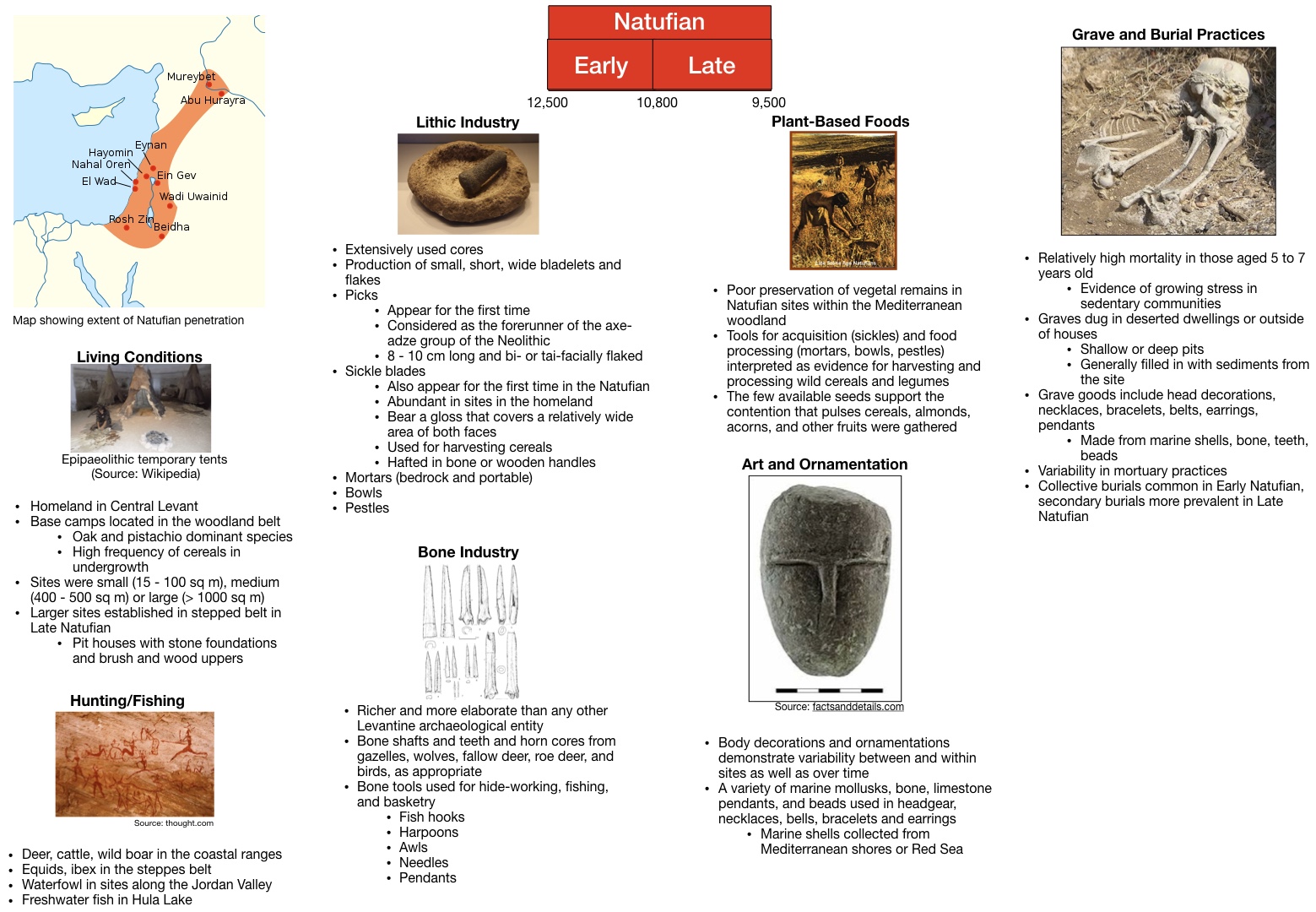

As much of a boon that climate was to the Early Natufian culture, it was a bane in later days. The boon? "Natufian communities practiced intensive and extensive harvesting of wild cereals as part of an anticipated summer mobility pattern." The bane? The cold, dry climate associated with the Younger Dryas (12,800 BP - 11,600 BP) led to a rapid reduction in the size of the lushest vegetation belts and reduction in yields of natural stands of C3 plants such as cereals. This change in conditions  led to changes in organizational strategies to include: reduced sedentism; shifts in settlement locations (abandonment of old sites and establishment of new sites in the steppic zone); experimental plantings; and clearing of patches of land. During this period plant and animal resources were further depleted by the activities of neighboring foragers.

According to Bar-Yosef, the increased population levels that had come with increased sedentism "made any short-term climatic change motivational for human groups to gain control over food resources." Thus, "the first experiments in systematic cultivation most likely occurred during the Younger Dryas."

Keynes was not as supportive of the theory of the Natufians as the first agriculturists: "The older theory on the origins of agriculture that had become a consensus by the late 1980s held that the pressures of the Younger Dryas drove the Natufians to adopt agriculture as a survival strategy ... By the early 2010s, this hypothesis has been rejected by some archaeologists and historians, who see the Natufians of the Younger Dryas as in a transitional stage that was only moving towards agriculture, ... in which they experimented with wild plant cultivation."

It should be pointed out that much of the foregoing discussion is based on domestication of wheat, legumes, etc., and does not involve grapevines. As a matter of fact, while we have evidence of grape consumption in the Kebaran culture, no grape residue has been recovered from any of the excavated Natufian sites in the Mediterranean due to the poor preservation of vegetal remains in the terra rossa soil.

Whether or not the Natufians were the first agriculturists, or just experimenters, the genetic study conducted by Dong, et al., places the domestication of the grapevine squarely within their space-time; and we will run with that.

Post-Younger-Dryas
There was  rapid return of wetter weather post the Younger Dryas and this led to the expansion of numerous lakes and ponds and cultivation of annual crops along the shorelines. The first large villages began to appear (up to 2.5 ha) and they relied on cultivated barley and wheat or "their wild progenitors." According to Bar-Yosef, there is ample evidence to show that the inhabitants of these villages were descendants of local Natufian populations with changes in material culture, social organization, and daily lifeways. "The first manifestation of the cultural change that heralded the Neolithic Revolution is known in the Levant as the Khiamian."

Neolithic farming communities thrived under the favorable climate conditions of the Early Holocene and expanded "along the Levantine Corridor into Anatolia and neighboring regions." This, then, was the first movement of the cultivated grapevine outside of its birthplace. 

The initial movement of the cultivated grapevine
 from the Western Distribution Center (black oval)
into Anatolia (red arrow) with the expanding
Neolithic farming communities.

I will  cover that movement more fully in subsequent posts.

Bibliography
Bar-Yosef, O., The Natufian Culture in the Levant, Threshold to the Origins of Agriculture, Evolutionary Anthropology.
Bar-Yosef, O., and F. Valla, The Natufian Culture and the Origin of the Neolithic in the Levant. Current Anthropology 31(4) January.
Dong, et al., Dual domestications and origin of traits in grapevine evolution, Science, 3/3/23
EurekAlert, Human Mobility and Western Asia's early state-level societies, Max Planck Institute of Geoanthropology, 5/28/20.M. E> Kislev, D. Nadel and I. Carmi, Epipalaeolithic (19,000 BP) cereal and fruit diet at Ohalo II, Sea of Galilee, Israel. Review of Palaeobotant and Palynology, 73 (1992): 161 - 166.
Lord Keynes, The Natufians and the Origins of Agriculture in the ancient Near East, heterodox.economicblogs.org, July 31, 2017.


©Wine -- Mise en abyme

Saturday, June 10, 2023

The domestication of vitis vinifera: The physical environment

According to Dong, et al., two variants of the wild grape vitis sylvestris were simultaneously domesticated in the Caucasus and Western Asia resulting in two variants of vitis vinifera. The Caucasus-sourced vitis vinifera flourished on both sides of the Caucasus Mountains, and even extended into the Carpathian Basin, but had no impact beyond this limited geographical area. The Western Asia domesticate, by a process of elimination, must be the source variety for the bulk of the world's wine grapes. I will explore the environment wherein this variety was domesticated as well as the people who most likely brought sylvestris to heel. I examine the physical environment in this post.

Vitis sylvestris was domesticated in the early part of the Holocene. The physical environment in Western Asia during this time period is illustrated in the chart below.


Dong, et al., did not specify the location of the domestication center within Western Asia but an eyeballing of their placement of the center on the map would seem to place it within the confines of the region called The Levant. The coverage of the Levant is illustrated in the rightmost map below and the blue arrow illustrates the relationship between that region and the Western Asia Domestication Center.


According to Bar-Yosef and Valla, "lines of evidence demonstrate that cold, wet conditions" dominated in The Levant in the late Pleistocene. This was followed by a dry spell in the transition period and a steady increase in arboreal pollen. An increase in humidity is observed for the in the Early Holocene "in the Middle Euphrates Valley in Northern Syria and from the Lower Jordan Valley" (Bar-Yosef and Valla). The paleoclimatic record shows the following (Bar-Yosef):
  • Late Glacial Maximum (20,000 - 14,500 B.P.)
    • Entire region cold and dry
    • Hilly coastal areas enjoyed winter precipitation and were covered by forests
  • 14,500 - 12,800 B.P.
    • Precipitation slowly increased over the entire region beginning at 14,5000
    • More rapid increase from 13,500 B.P. to 13,000
    • Rate peaked around 13,500 in the southern Levant
  • Younger Dryas (12,800 - 11,600 B.P.)
    • Rate of rainfall decreased
  • 11,300 B.P.
    • Increased rainfall returns
      • Very wet early Holocene in the northern Levant and Anatolia
      • Did not reach the previous peak in central and southern Levant
  • Gradual rise in sea level
    • Post the Late Glacial Maximum and until the mid-Holocene
    • Reduced the flat, sandy coastal plain of the Levant by a stretch 5 - 20 km wide and 500 km long.
During the Holocene, The Levant was characterized by a variety of landscapes running between the southern flanks of the Taurus Mountains of Turkey and the Sinai Peninsula:
  • Narrow coastal plains
  • Two parallel continuous mountain ranges with a rift valley in between
  • An eastward-sloping plateau dissected by many eastward-running ravines.
There was marked seasonality, with cold, rainy winters and hot, dry summers being the norm. Two annual patterns of winter storm tracks were observed:
  1. Humidity from the Mediterranean flowed to the southern Levant
  2. Storms arrive from northern Europe and turn to the northern Levant.
There were three vegetational zones (Bar-Yosef):
  • Where annual precipitation exceeded 400 mm/year, Mediterranean woodland and open parkland 
    • Oak-dominated parkland and woodland provided the"highest biomass of food available to humans." Dense oak forests (> 800 mm/year rainfall) maintain a lower biomass than the open parklands
  • Where precipitation was < 400 mm/year, shrub land and steppic vegetation 
  • Arid-type vegetation.

Effect of the Physical Environment on Vitis Sylvestris/Vitis Vinifera
Environmental conditions have marked effects on grape development today and it is quite likely that grapes reacted similarly in times past. It is likely that vitis sylvestris exhibited different characteristics in the cold of the Pleistocene than did vitis vinifera in the warming period of the Early Holocene. As a matter of fact, the last glacial cycle (115,000 - 11,700 years ago) was the scene of one of the most severe vitis sylvestris bottlenecks, driving worldwide population down to between 10,000 and 40,000 vines.

The warming period began with the retreat of the glaciers and the changes in the physical environment highlighted in map 1 above. Just the mere fact of the warming would have positive effects on the grapevine and its product. Warmer temperatures would lead to riper, more palatable grapes (Remember that grapes in this early period were used as a food source as opposed to a beverage.). This riper, more palatable fruit would stand in stark contrast to the potentially harder, greener product that would have been the norm in the colder, drier Pleistocene.

Increased humidity would have led to more vigorous vines and plumper fruit. Grapes would not only be more palatable, they would also be more substantial.

The forest expansion that resulted from the warming would have also been beneficial to vitis vinifera. The grapevine is a climber and more trees represented more growth/spread opportunities for the population. 

*********************************************************************************************************

In my next post I will explore the culture that most likely domesticated the grapevine.

Bibliography
Bar-Yosef, O., The Natufian Culture in the Levant, Threshold to the Origins of Agriculture, Evolutionary Anthropology.
Bar-Yosef, O., and F. Valla, The Natufian Culture and the Origin of the Neolithic in the Levant. Current Anthropology 31(4) January.
humanpast.net, Food around 11,000 BC.

©Wine -- Mise en abyme

Monday, June 5, 2023

Georgia is not the source of all European wine grape varieties; the Levant is

The commonly held belief was that the wild grapevine vitis sylvestris was domesticated at a single point and spread to the rest of the world therefrom. Researchers have named the single-domestication-point hypothesis the "Noah Hypothesis." The hypothesis is illustrated in the chart below where domestication candidate sites are identified and the onward distribution routes of vitis vinifera plotted.


The Dong, et al., study refutes the origin component of the Noah Hypothesis and replaces it with a dual, simultaneous-domestication model.


I now turn to the distribution aspect of the Noah Hypothesis. While the Dong, et al., study does provide for a domestication center in the Caucasus, the result was "... mainly confined to both sides of the Caucasus Mountains, with a limited dispersal into the Carpathian Basin by the northern Black Sea." According to the authors, "... CG2 (ed. The Caucasian domesticate) represents a local domestication effort that had a minor impact on grapevine domestication." The distribution path of CG2 is illustrated in the map below.

Red oval approximates the Caucasus distribution center;
black arrow illustrates the range of the grapevine.

If we take the Dong, et al., argument at face value, the mother of all grapevines originated in the Levant, the Western Asia Domestication Center illustrated above. I will delve further into the region and its inhabitants in upcoming posts. In future posts I will also trace the spread of grapevines ouward from this source point.

©Wine -- Mise en abyme

Wednesday, May 24, 2023

Grapevine domestication: A tale of two centers and selected traits

Dong, et al., (Dual domestications and origin of traits in grapevine evolution, Science, 3/3/23) have postulated, based on their study results, a dual origin for vitis vinifera stemming from simultaneous domestications of distinct vitis sylvestris pairs in separate geographic regions. I have previously described the study origin, the history of the progenitor species vitis sylvestris, and the case for dual domestication. In this post I will provide a contemporaneous look at the proposed domestication centers and identify traits selected during the grapevine cultivation process.

The Domestication Centers
The figure below locates the Western Asia (Syl-E1 to CG1) and Caucasus (Syl-E2 to CG2) domestication centers. 

Grape domestication centers (as per Dong, et al.)

According to the authors, the dual domestications occurred 11,000 years ago. The Little Ice Age had ended by this time and the world was transitioning from the Pleistocene to the Holocene Epoch. 

The Western Asia physical environment was varied, inclusive of highlands, mountain ranges, fertile river valleys, and arid and semi-arid landscapes. Notable geographic features included the Taurus and Zagros Mountains, the Anatolian Plateau, the Levant, the Mesopotamian Plain, and the Jordan River Valley. The Caucasus had a similar distribution of environments but with more prominent mountain ranges. River valleys, such as those hosting the Aras and Kura Rivers, provided conditions suitable for early agricultural development.

The populace of the two centers were mainly hunter-gatherers (hunting, fishing, and gathering), with some early agriculturists. Early farmers likely cultivated wheat, barley, legumes, and flax and domesticated animals such as goats, sheep, and cattle.

It is believed that the Caucasus was inhabited by several indigenous groups but the demographic composition is difficult to determine with any precision. Western Asia, on the other hand, was home to some notable civilizations to include the Natufians (Levant) and the pre-pottery Neolithic cultures of Hassuna, Halaf, and Samarra (Mesopotamia).

Domestication Intent and Thrusts
The authors investigated domestication signatures on the cultivars and found both shared and unique manifestations on the cultivars. Most of the shared signals are on chromosomes 2 and 17, "confirming previous findings that that the selection on flower sexual morphs (sex determination region, SDR), berry skin color (VvMybA gene cluster), and berry development (SDH gene cluster) were of great importance during grapevine domestication." The authors further identified shared domestication genes that possibly serve as foundations for grapevine growth, physiology, fruit set, and resistance to biotic/abiotic stress.

The unique manifestations are exhibited in cases where "the same goals were advanced  by using different aspects of common domestication traits." Some examples of the latter are as follows:
  • Improvement of berry palatability through the reduction of alkaloid biosynthesis (MecghR gene cluster in CG1 and TR2 and SSL gene clusters in CG2)
  • Enhancement of carbohydrate metabolism (SWEET17 in CG1 and PFKFB1 in CG2)
  • Perceived berry desirability (BEAT gene cluster for floral scent in CG1 and UFGT gene cluster for berry color in CG2)
  • Response to environmental stresses (UPL6 in CG1 and WAK in CG2).
According to the authors, "... their findings suggest that the initial cultivations of CG1 and CG2 may have been to serve early humans' caloric and micronutrient needs." And such an observation fits with the economic environment described previously; that is, a landscape populated primarily by hunter-gatherers and fledgling agriculturists.

In that both cultivars were domesticated as food sources, the selection of factors suitable for winemaking exhibited in CG2 "could have been serendipitous, and the practice of winemaking with CG2 ... possibly postdates grapevine domestication."

In my next post I will examine the spread of these cultivars outward from their domestication centers.

©Wine -- Mise en abyme

Monday, May 15, 2023

The case for dual domestication of vitis vinifera, as per Dong, et al.

The recent Dong, et al., study has upended the conventional wisdom of a single-point vitis vinifera domestication somewhere in the Caucasus over 8000 years ago. In a series reporting on the study, I have specified the study origin and the history of vitis sylvestris, the accepted progenitor of vitis vinifera. In this post I cover the study findings as regards the domestication of vitis vinifera.

Vitis vinifera sylvestris (Source: floredusud.com)

According to the Dong, et al., study, the wet climate of the Early Holocene (11,700 - 8300 years ago) expanded the geographic spaces capable of sustaining Syl-E (identified in my prior post as the eastern ecotype of v. sylvestris) and the species rose to the occasion by moving westward, occupying a "large geographic space from Central Asia to the Iberian Peninsula."

I have identified six genetic ancestries for cultivated grapes reported out in the Dong, et al., study -- CG1 to CG6 -- each associated with a specific geographic area. For example, CG1 is associated with Western Asian table grapevines and CG2 with Caucasian wine grapevines. CG1, according to the study, "shares the main ancestral components with Syl-E1" while CG2 shares its main components with Syl-E2. This state of affairs suggests the possibility of two domestication events. Further:
  • CG1 and CG2 maintain the highest genetic diversity of all the CG groups
  • CG1 and CG2 manifest the greatest Linkage Disequilibrium decay among all CG groups
  • CG1 and CG2 are less differentiated from their corresponding wild ecotypes
  • The Akaike information criterion-based phylogenetic selection prefers a dual origin tree model which agrees that CG1 and CG 2 are genetically closer to Syl-E1 and Syl-E2, respectively
  • The population split lines of CG1/Syl-E2 and CG2/Syl-E1 pairs resemble that of Syl-E1/Syl-E2 and differ from those of CG1/Syl-E1 and CG2/Syl-E2 pairs.
These data, according to the study, "collectively support a dual origin of v. vinifera and reject the theory of a single primary domestication center."

Both sylvestris/cultivar pairs (CG1/Syl-E1 and CG2/Syl-E2) separated quickly which, according to the authors, is compatible with a "clean-split" scenario. The authors estimate the median population split time to be ~ 11,000 years ago for both pairs "suggesting that the domestication events took place concurrently around the advent of agriculture."

In that CG1 represents the Western Asian table grapevine, and CG2 the Caucasian wine grape vine, the dual-origin schema advanced herein rejects earlier assumptions that wine grape domestication predated table grape domestication. To reiterate, the data suggest vitis vinifera simultaneous origins in Western Asia and the Caucasus, covering both wine grapes and table grapes.

The implications of the foregoing are mind-blowing. It suggests that Syl-E1 and Syl-E2 had self-selected for characteristics that rendered one more palatable as a food source and the other as a beverage. Further, it means that hunter-gatherers within the regions had been interacting with these ecotypes in their natural habits and habitats for many years prior to the instance of dual selection and propagation of the characteristics embodied in CG1 and CG2.

My next post will highlight how domesticated grapes spread from these points of origin to the major wine regions.


©Wine -- Mise en abyme

Saturday, May 13, 2023

Rewriting the story of ancient grapes: Establishing genetic populations and the story of V. sylvestris

A recently published grapevine genetic study (Y. Dong, et al., Dual domestications and origin of traits in grapevine evolution, Science 379 (6635), pp. 892 - 900, 3/3/23) "has upended the history of how humans first domesticated grapes for winemaking ..." (Melanie Lidman, It's in the DNA, Times of Israel, 3/25/23). I discussed the factors driving this study, as well as its objectives, in a prior post. In this post I describe study preparation efforts, the steps taken to define ancient vine genetic populations, and the stories hidden in the genes of V. sylvestris, the accepted progenitor of V. vinifera.

Data Collection
As discussed in my lead-in post, in 2019 Dr Chen and his lab reached out to colleagues around the world asking them to contribute material towards the study. A total of 3525 samples of genetic material were received at the State Key Laboratory for Conservation and Utilization of Bio-resources of Yunnan Agricultural University. The samples were distributed as follows:
  • 2503 Vitis vinifera, 1022 Vitis sylvestris
    • 3186 from Eurasian germplasm and private collections
      • 2237 V. vinifera, 949 V. sylvestris
    • 339 from previously sequenced samples
According to the authors, the sample population “deferentially included old, autochthonous, economically important varieties to maximize the spectrum of genetic diversity." Lidman asserts that Israel's sample submission "... constituted the largest contingent of wild grapes from a single country, or about 10 percent of the total wild grapes sequenced for the study."

According to Karlsruhe Institute of Technology (KIT),  (scitechdaily.com, Scientists Determine the Origins of One of the World's Oldest Crops, 4/17/23), it contributed "... its globally unique collection of European wild vines and very old medieval species" to the study. It also connected the research team with the Ukraine researchers who had fled Crimea -- along with the vines from the Magarach collection -- after the 2014 Russian annexation.

Data Cleanup
In this phase of the study the team "weeded out clones, mutants, synonyms, homonyms and duplicates," ending up with 2448 grapevines (1604 V. vinifera and 844 V. sylvestris) and 498 distinct genotypes.

Categorization
The team first utilized Principal Component Analysis as a mechanism for determining whether "viticultural region" was a key element in defining grapevine diversity; according to the results of the analysis, it was not.

The team subsequently "leveraged genetic ancestry information from an unsupervised ADMIXTURE analysis" (ed., a method of inferring geographical origins based on an analysis of genetic ancestry) to categorize the core accessions. The findings from this analysis were as follows:
  • The hierarchical clustering of ancestry components identifies four V. sylvestris groups from distinct geographic regions
    •  Western Asia
    •  Caucasus
    •  Central Europe
    • Iberian Peninsula
  • V. sylvestris accessions collected from other regions show admixed genetic structures
  • For cultivated grapevines, six genetic ancestries could designate six distinctive groups, all covering a broad range of geographic regions
    • Accessions with pure ancestries helped to "ascribe" names to these groups
      • CG1 -- Western Asian table grapevines
      • CG2 -- Caucasian wine grapevines
      • CG3 -- Muscat grapevines
      • CG4 -- Balkan wine grapevines
      • CG5 -- Iberian wine grapevines
      • CG6 -- Western European wine grapevines
"The four sylvestris and six vinifera groups formed identifiable clusters in the PCA plots and were thus suitable for population genomic investigations."

The V. sylvestris Story
Based on “genetic ancestries and the occupied ecological niches in the western Eurasia continent, the team designated the V. sylvestris accession from Western Asia and the Caucusus as the eastern ecotype and the accession in Central Europe and the Iberian Peninsula as the western ecotype. The similarities and differences between accessions drive this designation. For example, “both nucleotide diversity and individual heterozygosity show that the western ecotype has significantly reduced variation compared with its eastern counterpart.”

In tracing the sylvestris genetic history, the authors show that the eastern sylvestris (Syl-E in their parlance) flourished in its range from approximately 1.5 million years to 800 000 years ago. The Pleistocene was a time of changing climate cycles, however, and the population experienced a bottleneck between 800,000 and 400,000 years ago.

Illustration of a population bottleneck (Source: alevelbiology.co.uk)

Somewhere between 400,000 and 200,000 years ago there was a divergence in Syl-E, giving rise to Syl-W. According to the analysis, the geographical split which drove the divergence was gradual. The Syl-W grouping experienced its own population bottleneck 400,000 - 150,000 years ago.

The last glacial cycle ran from 115,000 to 11,700 years ago and was characterized by ”global climate trending towards drier and colder conditions.” It was during this period — approximately 56,000 years ago -- that the Syl-E ecotype split into the Syl-E1 and Syl-E2 designates. It was also during this period (approximately 40,000 years ago) that there was a system-wide bottleneck which drove vine population to between 10,000 and 40,000. Syl-W experienced its own divergence, designated by the study team as Syl-W1 and Syl-W2.

In my next post I will take up the tale of V. vinifera, as told by the genes.


©Wine -- Mise en abyme

Monday, April 24, 2023

ChatGPT on the comments on the Kerin O’Keefe article on decanting

I recently posted a Kerin O’Keefe article on wine decanting to my personal Facebook page as well as to the Barolo and Barbaresco Facebook group page. The article elicited strong responses and I thought it would be beneficial to capture them in a blog post for wider sharing.

At the completion of the data collation effort I decided to feed the material to ChatGPT to see how it would handle such a task.

Source: medium.com

I first asked it to summarize the Kerin O’Keefe article and the below was its work product. The prompt for summarization is TLDR followed by the web address of the target article.

Kerin O'Keefe, an experienced wine writer, advises wine enthusiasts to never decant older wines. Decanting can expose the wine to too much oxygen, which can diminish its flavors and aromas. Instead, O'Keefe suggests that you should open the bottle carefully and let the wine breathe naturally in the glass. If you need to remove any sediment, use a fine-mesh sieve or a decanting funnel with a filter. Overall, the goal is to preserve the wine's delicate nuances and characteristics.

Pretty good, I thought. I next prompted it to “Review and categorize the comments and write an article discussing the major items while highlighting the most impactful contributions. The below was its work product. 

The comments above highlight different perspectives on the decanting of wines. Some believe that decanting an old wine, especially a Barolo or Nebbiolo, may cause it to lose its aroma and flavor, while others argue that decanting a wine, young or old, can help improve its taste. Some say decanting depends on the producer, variety, age, and even weather conditions during the vintage. Some decant all young red wine, and others, most "older" red wine, but don't decant very old wine, red or white, unless it's not expressing its varietal character out of the bottle.

Interestingly, most of the comments suggest that decanting depends on the drinker's personal preference and experience. Jamie Pettigrew commented that wine preparation is just another "opinion," while Scott Walker advised letting the wine dictate what to do. Brad Smith said that it's a function of the wine's variety, age, and that specific bottle. Manuel Somohano suggested that decanting an old wine is to drink it right away, while Ken Vastola shared his experience of drinking a lot of old Nebbiolo that improved after decanting.

The most impactful contributions in these comments are that there are no hard and fast rules when it comes to decanting wine. Every drinker has their own preferences, and it's essential to consider the wine's variety, age, and condition. Some wines may need decanting, while others don't, depending on how they express themselves in the bottle. It is, therefore, best to experiment with different decanting techniques or none at all and let the wine be the guide. As a drinker, you can also learn from your past experiences with a specific wine estate or producer to determine if decanting is necessary or not.

In conclusion, the comments above reveal a broad spectrum of perspectives on the decanting of wine. However, there is a consensus that decanting depends on personal preference, wine variety, age, and condition. Ultimately, the best way to find out what works for a specific wine is to experiment and trust your palate.

First, when I initially considered writing the article, I had grouped the comments according to those who agreed with Kerin, disagreed with her, fence-sitters, philosophers, etc. There was no such clear delineation in the package. Also, there were, in my opinion, impactful contributions from Manuel Burgï (again and again) and Rico Thompson but they were not called out by the bot. That being said, I thought this was a passable capturing of the themes of the comments.

©Wine -- Mise en abyme