Wednesday, December 15, 2021

Andrea Franchetti: A curated review of the legacy of an architect and builder and the products that spoke for him

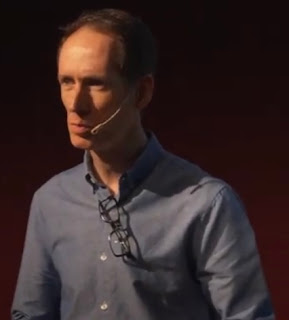
The wine world has been wracked by a number of leading-light deaths in the past two years or so but none has struck as close to home for me as the passing of the Tuscan and Mt. Etna giant Andrea Franchetti. I have eaten and drunk wines at both of his estates and been the beneficiary of a wealth of information and insights that he has directed my way. But not only did I benefit from knowing Andrea, I also benefited from the organizations and institutions that he established. The staff at both of his estates are some of the nicest, most helpful people that you would want to meet and Contrada dell'Etna, his formualtion, continues to be one of the most efficient methods for surveying the breadth of Mt Etna's offerings. I seek to honor Andrea by providing an overarching view of the structures that he built and the products that he offered.

Andrea Franchetti
(Source: Letizia Patanè)

Andrea Franchetti came from a famous and wealthy Roman family linked to the Frankfurt Rothschilds but struck out on his own and built a superlative brand in the wine industry. 

Andrea had been a wine broker and imported French and Italian wines to the US between 1982 and 1986. He wanted to come back to Italy but, before doing so, went to Bordeaux and spent some time learning winemaking from his friends Jean Luc Thunevin (Chateau Valandraud) and Peter Sisseck (Dominio de Pingus). He then returned to Italy and single-handedly build two wine estates -- Tenuta di Trinoro (Tuscany) and Passopisciaro (Mt. Etna) -- from the ground up, the former focused on wines made from Bordeaux varieties and the latter, primarily wines from traditional Mt Etna varieties.

Tenuta di Trinoro
In 2002 Jancis Robinson described Andrea Franchetti's Tenuta di Trinoro as an "idiosyncratic wine estate ... which has achieved quite remarkable renown considering it was first planted in 1992." Antonio Galloni, writing on vinous.com, described the estate as giving "new meaning to the expression 'in the middle of nowhere.'"

Armed with philosophies, practices, and cuttings that he had secured from his Bordeaux friends, Andrea went to the Tuscan hinterlands, to land that to him was reminiscent of the left- and right-bank Bordeaux soils, and bought the 200-ha property that is Tenuta di Trinoro.

The Val d'Orcia area in which Tenuta di Trinoro is located had been almost abandoned between 1960 and 1980 with the primary activity being sharecropping. Sheep-breeding came with the Sardinians when they emigrated here between 1960 and 1970. The houses in the area were primarily second homes for the wealthy.


Given its location, Tenuta di Trinoro gets sufficient sunlight to bring its grapes to maturity during the course of a growing season. Up until 2004, the area experienced Mediterranean growing seasons (mild, wet winters and warm, dry summers) but the growing seasons are now more tropical; that is, more rain and cooler summers (Andrea said that these new seasonal effects allow them to make better wines than they could with the scorching Augusts of the past. The prior August heat left the vines paralyzed which lengthened the ripening process and brought up the sugar. These are much better years, he says, with 2011, 2012, 2013, 2015, and 2016 all great vintages. He also pointed out that the concentration is better under these new growing conditions.).


Plants are kept low -- Bonsai vineyard concept -- with each allocated 1 sq meter of canopy. Sheep manure is the only type of fertilization used on the property and spray material consists of copper and sulfur. A mix of clay, propolis, and grapefruit seed extract is sprayed in the pre-harvest period to ward off botrytis and other molds that may occur on the grapes as they approach full ripeness. There is no irrigation except for newly planted vines.

Vini Franchetti characterizes its vineyard work at Tenuta di Trinoro as follows:
We generally every year go into the vineyard and treat every vine 20 to 25 times during the growing season: to thin, hold up, cut away, spray glues or powders, hoe and dig, top and pick. We then do innumerable pickings for two months at harvest. In the winter four more long visits are spent on each vine to prune, tie, and to mend the poles and wires,
As he does at Passopisciaro, Andrea walks the vineyards at Trinoro incessantly. He makes the decision to pick based on taste. Each plot is harvested, vinified, and aged separately according to the process shown in the chart below.


As regards the wines, the Le Cupole is the estate's second label. The 2015 edition is a blend of 58% Cabernet Franc, 32% Merlot, 6% Cabernet Sauvignon, and 4% Petit Verdot. The yield was 50 hl/ha. We tasted a cement vat sample. Concentrated with soft tannins.

The 2014 Magnacosta is a 100% Cabernet Franc which, like the other crus, had been aged in new oak for 8 moths and then transferred to cement vats for an additional 11 months of aging. The year had been cool but the grapes were ripe and showed as sweet and concentrated in the wine. Herbal and peppery with well-integrated tannins.

The 2014 Tenaglia showed black and blue fruits, licorice, and tea. Fruit carries through to the palate. A little more power than was the case for the Magnacosta. Salinity. Lengthy finish.

The 2014 Carmagi was not giving on the nose. Blue fruit, duskiness, and salinity on the palate.

The fruit was so good in 2009 that Andrea resurrected the Palazzi as a wine in that vintage. We tasted both the 2009 Palazzi (100% Merlot) and the 2009 Tenuta di Trinoro (42% Cabernet Franc, 42% Merlot, 12% Cabernet Sauvignon, and 4% Petit Verdot) but both were too cold to reveal themselves fully. The Palazzi showed mushrooms, a savoriness, and a hint of green. Mineral finish. The Tenuta di Trinoro did not reveal much on the nose and opened up just enough to give a hint of layered complexity.


A subsequent re-tasting of the Tenuta di Trinoro showed intense spice and dark fruits on the nose along with leather, cassis, and licorice. On the palate, dark fruit accompanying a rich, thick creaminess and beautifully integrated tannins. A long, rich, creamy finish. The Palazzi showed ripe dark fruit, licorice, spice and chocolate. Balanced. High note resulting of pleasing acid levels. A creamy finish.

Bianca Trinoro
In the same year that he launched his inaugural Mt Etna vintage -- 2001 -- Andrea planted some Semillon vines at his Tuscan property. According to Wine Searcher, the property had a sandy patch at its highest reaches (0.6 ha at 620 m). This plot reminded Andrea of the Medoc, prompting thoughts that it might be suitable for a white variety. Given the Bordeaux profile of the estate, he opted for Semillon as that white variety.

The vines are planted at 10,000 vines/ha with yields of 25 hl/ha. According to Andrea, he made 1000 bottles of wine from the harvested fruit each year and drank them after each vintage had matured for 10 years. After drinking the wines over the years, he got to a point where he felt that the vines had matured enough to support a high-quality commercial offering. This led to the release of the 2017 and 2018 vintages on the market. 

The grapes are harvested manually and then transported to the cellar where they are whole-cluster-pressed and then fermented. The 2018 vintage was fermented in stainless steel tanks for a total of 10 days (the 2017 vintage appears to have been fermented in barrels) and then aged (on lees) in cement tanks for 7 months (the 2017 vintage was aged in glass demijohns as they awaited delivery of the cement tanks).

Andrea viewed the wine as being approachable after 5 years but it will not reach its peak until 10 years have elapsed.


Even though Andrea thought the wine should be hidden for its first 5 years, it more than showed its mettle when I tasted the 2018 version. In the early stages of the tasting it showed rosemary, apple, dried hay, and intense herb/florality, spice, and menthol. As it evolved, a sweet white flower and  creamy vanilla with an attendant richness and complexity. With additional time, green herbs and talcum powder.

On the palate, lemon-lime, salinity, a marine character, a stemminess from the whole-cluster-pressing, and a drying, limey finish. With time, a blade-like precision, lime, and spiciness. The sweetness which is pervasive on the nose does not carry through to the palate. Gains weight with time. 

This wine is replete with promise.

Passopisciaro
According to Nesto and di Savino (The World of Sicilian Wine):
In 2000 Etna's wine industry awakened suddenly. Foreign attention and capital arrived. The newcomers Frank Cornelisen from Belgium, Marc de Grazia from Florence, and Andrea Franchetti from Rome bought vineyards on Etna and became evangelists of its potential (Ed. note: Andrea stipulates that Marc de Grazia came to Etna a little after Frank and him.).
Andrea came to Etna looking for high-altitude vineyards where the grapes would mature in the cool of autumn and settled on Passopisciaro on Etna's north face. 

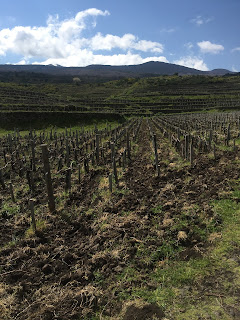
Guardiola, a 8-ha property just on the edge of the DOC, was bought in 2002 (Some of the vines are DOC and others are not). Two hectares were planted to Petit Verdot in 2001/2002 at between 800 and 1000 m altitude and another 2 ha to Cesanese d' Affile. These vines were planted at 12,000 vines/ha with 5 bunches/vine. The vines were subjected to green harvests in order to further concentrate their energy and are the sources of the Franchetti wine first introduced in 2005. The current configuration of Guardiola is 3 ha split between Chardonnay, Petit Verdot, and Cesanese d'Affile and the remainder dedicated to Nerello Mascalese.


Franchetti's first wine was a Nerello (Passapisciaro 2001) but, as he stated in a personal communication, "I tried to make a Nerello that I liked right away, but wasn't able, until 2005 when I finally started getting it. Since then our Nerello has been, I think, getting better because of new touches in the winemaking." 

Robert Camuto (Palmento: A Sicilian Wine Odyssey) provides telling insights into the Franchetti mindset and practices in those early years. In his visit to the Franchetti estate in the summer of 2009, he saw no Nerello Mascalese grapes planted there. In fact, "... Franchetti saw no need to plant local varieties when he could buy or lease Nerello from vineyards that were already established."

His perception of this early-times Franchetti is electric:
Most winemakers were coming to Etna to make their interpretations of Nerello, but Franchetti was here, it seemed, to interpret Franchetti. The others were like landscape painters who had come to paint the volcano; Franchetti was an abstractionist who had come to paint on the volcano. ... For other winemakers, Nerello Mascalese, with its delicate Pinot Noir color and structure, was part of the attraction. Franchetti, on the other hand, was here on Etna in spite of Etna.
Camuto reports that Franchetti told him, "I hated the stuff -- I thought it was coarse. I didn't want to use Nerello to make wine. I looked at it as an ingredient I had to use."

According to Camuto, the early Franchetti Nerello vintages "rolled out the Bordeaux new wave formulas that had worked so well for him at Tenuta di Trinoro" but the long maceration, and aging in barriques, produced a wine that was "as rude as it was rustic."

In an email communication with me, Andrea referred to the wines made before 2004 as the "pre-Socratic vintages."
In 2004, I tried to extract for a long period at low temperature before fermenting the berries; to no avail. I mixed some 2001 Trinoro Merlot in the 2002 Nerello Mascalese. I let the 2003 Nerello Mascalese start out with local wild yeast out of spite. No "philosophy" had been built.
Andrea sent me three of these early vintages to try. They bear no resemblance to the Franchetti Nerello Mascalese wines of today.


The 2001 showed a much deeper color than one would expect from an aged Nerello Mascalese. Hint of Nerello on the nose, but indistinct. Mushroom and earthiness dominates. Concentrated and unfocused on the palate. Bitter on the palate with a very bitter aftertaste. Metallic. Unpleasant finish.

The 2002 showed balsamic, spice, dark fruits, and lacquer on the nose along with hints of tobacco and cedar. Fruitier than the 2001. High acid level. Lack of focus on the palate. Big, dark fruit. red pepper spice. Bitterness and acidity competing on the palate. Severe dryness on palate leading to a furry feel in the mouth.

The 2003 exhibited stewed fruit, spice, and rust. Sweet fruit on the palate. Bitterness, salinity and kerosene.

But Franchetti eventually came to the realization that the problem was with his winemaking technique, rather than with the cultivar and, in 2004, he changed his approach (Camuto):
  • He ceased macerating on the skin
  • He lowered the fermentation temperature
  • He moved from barrique to botti for aging
Franchetti, as cited by Camuto: "You see, I learned that the best part of the Nerello grape is not in the skins, like with the Bordeaux grapes. Its all in the juice."

In his communication with me, Andrea said that he gained his initial feel for Nerello in 2004 when the wine came in "nice and tannic." The first applied thinking happened the following year (lightness, clarity, fining with egg whites). "What Nerello wine should be, or is in the heavens, struck me from 2005 on: I first modified the cellar activities, then the harvesting decision; then my vineyard management practices."

And the rest, as they say, is history.

He began planting Petit Verdot which he blended with Cesanese d' Affile to make a wine he called Franchetti.

Once Franchetti was introduced, Andrea pivoted and sought to make a great white wine from Chardonnay (first bottling in 2007) and Nerello Mascalese wines that reflected their terroir (first bottling of Contrada wines in 2008) . The distribution of vines by contrada, and the individual contrada characteristics, are shown in the figure below.

Source:vinifranchetti.com

In order to ensure that any differences in the wines are contrada-specific, the wines are given the same vinification treatment: fermentation in steel vats; malolactic and 18 months aging in large neutral oak barrels; fining with bentonite; and no filtering. The Franchetti is aged in barrique.


We began our tasting with the 2015 Passorosso (Passopisciaro until a few years ago). The grapes for this wine are sourced from 70 - 100-year-old, bush-trained vines grown at altitudes between 550 and 1000 m in the contrade of Malpasso, Guardiola (40% of grapes), Santo Spirito, Favazza, and Arcuria. High-toned red fruit with smoke, leather, and mineral notes. On the palate, bright red fruit, acidity, with drying tannins on the finish.

The 2015 Contrada Rampante was made from 100-year-old-vines which are planted at 8000/vines/ha and yielded 17.6 hl/ha. Herbs. smoke, iron, sweet tar, tobacco, and spices. Good fruit levels but not as focused as I would have liked.

The Contrada Chiappemaccine 2015 was the least complex of the wines I had tasted up to this point. Not very giving on the nose and non-complex on the palate. The 2014 edition of this wine showed fresh red fruit, sweet herbs and spice. Tobacco on the palate.

The 2014 Contrada G was elegant. Smoke, tobacco, leather, and sweet tobacco. Savoriness. Complex, big fruit but balanced by acidity. Silky tannins. Long finish.

The Franchetti 2014 is a blend of 70% Petit Verdot and 30% Cesanese d' Affile. Yields of 17 hl/ha. Fermented with selected yeasts in stainless steel tanks for 10 - 15 days.  Malolactic and 8 months aging in barriques, followed by 10 months in cement and 2 months in bottle. Bentonite fining. Rich, inky, with herbs and smoky barrel notes. Powerful. Not a classic Etna wine but I loved.

Andrea Franchetti's Mt. Etna Chardonnay Journey
When he arrived on Mt Etna in 2002, Andrea decided to restore some ancient terraces lying between the Guardiola and Passochianche Contradas and to plant the plots to Chardonnay rather than Carricante, the latter being best suited to the clime and soils of the eastern slope. The vines were planted at elevations ranging between 850 and 1000 meters in "very loose, deep, powder-like," mineral-rich lava. 

In 2009, Andrea planted an additional parcel of Chardonnay in Contrada Montedolce. 

Andrea's intent was to craft a long-lived Chardonnay reminiscent of the wines of Burgundy and, towards that end, planted at 12,300 vines/ha in order to force inter-vine competition and the production of small, concentrated berries. Andrea felt that the combination of stressed fruit, altitude, abundant sunlight, and significant day-night temperature excursions would produce wines with excellent body plus the acidity and minerality for which the zone is famed.

The first Chardonnay was introduced in 2007. It was called Guardiola initially but, since 2014, is called Passobianco. This 100% Chardonnay utilizes fruit from all Passopisciaro Chardonnay plots.

On every occasion that I have been to Passopisciaro, I have seen Andrea walking through the vineyard, plucking something here, tasting something there. So he knew the vineyards like the back of his hand; and he noticed that as the vines became older, individual plots were developing distinct characteristics. In 2018 Andrea decided to utilize his knowledge of the vineyard characteristics to bottle a Contrada Chardonnay using grapes drawn solely from one of the highest parcels (870 - 950 m) in Contrada Passochianche. The resulting wine is called Contrada Passochianche.

The fruit sources for the Passopisciaro Chardonnays are summarized in the chart below.


The first-ever edition of Contrada Passochianche was 2018.

According to Passopisciaro, 2018 "was one of the rainiest and most tropical vintages that we've seen on Etna in the last eight years, especially at the end of the summer." The number of leaf-pull passes through the vineyard had to be increased in order to provide air passage through the vines and mitigate the effect of the humidity. Additional mitigation efforts included the use of products such as clay, propolis, grapefruit seed extract, copper, and sulfur.

The harvested grapes were destemmed and cold-soaked for 12 hours. They were then fermented in large neutral oak barrels of no more than 20 Hl, followed by malolactic fermentation in barrel. The wines were aged on lees for 10 months in large neutral oak barrels and for an additional 12 months in bottle.


This wine was alive, taking on different characteristics as it spent more time exposed to the light of day. It was popped and poured. 

One of the first things that I noticed was the extremely high surface tension of the wine. I felt like even I could walk on that water. 

Restrained on the nose initially with hints of herbs, sweet white fruit, apple, and peach. Weighty on the palate at first blush. Bright, intense, racy acidity which was instantly ennervating of the salivary glands.  Citrus. Palate-coating chalky limestone and a peppery cupric finish.

The altitude is apparent, imparting a chiseled character. With the passage of time, a complex mix of minerality, acidity, bitterness, and slate on the palate and the finish.

The nose opens up to reveal tropical notes to include pineapple. As the initial bright acidity recedes, citrus (lime) and minerality rule the day. The wine continues to excite the salivary glands but in a less whole-palate manner. 

The wine becomes less weighty over time with lees and honeydew melon making their presence felt. More linear on the palate with consistent minerality and lime and a saline intrusion. Bitter finish with a lean, mineral, wet-rock aftertaste.

This is a complex wine which has all the characteristics and stuffing to hang around for a while.

Contrada dell'Etna
In 2008 Franchetti created and sponsored a wine fair called Le Contrade dell 'Etna where the region's producers showcase their wines -- within the contrada context -- to the wine press and enthusiasts. Brandon Tokash recounts receiving a call from Andrea one Christmas wherein Andrea discussed his idea for a gathering of north-slope producers to show their wares. In the continuing discussions on the topic, they expected 10 or so producers to show up for the inaugural event but over 30 did. The first two sessions were almost big parties, according to Brandon. This fair was held at Franchetti's estate for a while before moving elsewhere.

In Conclusion
Andrea's legacy is clear. He built two high-quality estates in two very different regions with differing grape varieties and grape-growing environments, all without the presence of a regional support system. He went into the Val d'Orcia boondocks and designed and built an enterprise that today produces some of the best Bordeaux-style wines coming out of Tuscany. He had no Consorzio to lean on for assistance. He had no surrounding collegial producers. Such an infrastructure does not even exist in the area to this day.

A similar situation existed at the time he came to Mt. Etna in that, even though the region had historical wine roots, with the exception of Benanti there were few high quality wine producers. Franchetti brought his Trinoro style to Etna but realized pretty quickly that the formula was inapplicable there and made the adjustments necessary to produce a high-quality wine.

How has Franchetti contributed to the shaping of the wine direction on Etna? First, he was part of the initial group of outside investors who brought the potential of this region to the eyes of the wider world. Second, he showed that a Bordeaux cultivar (Petit Verdot) could be blended with an almost extinct cultivar (Cesanese d'Affile) to make a world-class, non-indigenous wine on the mountain. Third, his focus on the importance of contrada effects, both in the stable of wines that he produced and in his establishment and support of Contrada dell"Etna.

One of the questions that will begin to boil to the surface in short order is "what's next?" There is always some concern as to how a wine brand will be affected by the passing of its founder and history is replete with both positive and negative examples. What is especially interesting here is that Andrea stood athwart two enterprises and it is not obvious that there is any other person possessing that vantage point. Both estates are equipped with highly competent operational management so there will be no problem in that regards. The areas where some differences could potentially emerge are in the knowledge of the vineyards and picking decisions. Andrea roamed the fields incessantly and alone. His picking decisions were made based on his intimate knowledge of those vines. His ideas for brand extensions came about through his knowledge of the evolution of those vines. We will all wait with bated breath and continued good wishes for the employees, management, and customers of Vini Franchetti.

©Wine -- Mise en abyme

The Catholic Church and wine: The Babylonian Captive Papacy and Châteauneuf-du-Pape

I have been tracking the role of the Catholic church in the spread of wine beyond its entry point into western civilization beginning with the story of the Cistercian monks and the wines of Burgundy. I continue now with the French popes and Châteauneuf-du-Pape.

France was embroiled in military conflict with the English as well as the independence-minded Flemish in the late 13th century. War is expensive and the French monarch (Philip IV; also called Philip the Fair) resorted to taxation, coin-debasement, and borrowing to acquire the needed funds. 

King Philip IV ("The Fair") of France
(Source: history.com)

Philip prompted loud outcries from the Catholic Church and Pope Boniface VIII when he levied taxes on the French clergy amounting to 50% of their incomes. Boniface "reminded" the King that only the Pope had authority to tax the clergy and issued a Papal Bull forbidding the transference of any church property to the French crown.

Pope Boniface 
(Source: the templarknight.com)

Philip retaliated by forbidding the removal of bullion from France. Matters were partially resolved when Boniface eventually (1299) agreed that Philip could tax the clergy in times of emergency.  But this was only a temporaray lull in an intense diplomatic battle between the two rulers which culminated with Boniface escaping an arrest ordered by the King (he was actually captured for three days at his Palace in Anagni prior to his escape). Boniface died soon after the escape and was succeeded by Pope Benedict XI.

Upon Benedict's death, Philip engineered the election of Bertrand de Got, former Archbishop of Bordeaux, to the papacy. Bertrand took the name Clement V and his ascendance marked the beginning of what came to be called the Babylonian Captive Papacy (due to the influence exerted on Papal affairs by French Kings during this period). Clement V (who was also linked to the Bordeaux estate of the same name) ruled from 1305 - 1314.

Pope Clement V 
(Source: thefamouspeople.com)

Word came over the Alps that a French Pope might not be very welcome in Rome so Clement accepted King Philip's offer to house the papacy in France. Clement decided to settle in the Comtat Venaissin (of the Avignon area) which had been sold to the papacy by Raymond VII of Toulouse in 1229.

Grapes were probably grown in proto-Chateauneuf-du-Pape in Gallo-Roman times but it is only in 1157 that we get the first mention of the vineyards of Geoffroy, Bishop of Avignon, who grew vines there and "maintained them in keeping with Roman tradition." Clement V, in 1314, discovered the "special soil" of the area.

Pope Clement V was succeeded by Jacques Duèze, former Bishop of Avignon, scion of an important merchant and banking family in Cahors, and a connoiseur of Cahors wine. Duèze took the name Pope John XXII. 

Pope John XXII

The Pope sought a location away from the hubbub of the Avignon Court yet close enough for a courier to complete a round trip within a single day and settled on the heights of the Village Calcernier which lay halfway between Avignon and Orange. A small castle had occupied the spot but John oversaw the entirety of the construction of a new Castle between 1317 and 1333.

Castle ruins at Châteauneuf-du-Pape

John did much to improve the viticultural practices of the area. He brought in winegrowers from Cahors to plant vineyards under the castle walls and regularly drank the wines. He eventually gave the wines the coveted designation Vins du Pape, opening the door to entrance into the grand courts of Europe. According to the archives of the Apostolic Chamber, a total of 3 million vines were planted in the vicinity of the Pope's Palace in 1334 (between 600 and 800 ha of vineyard) and annual consumption at the court exceeded 3000L.

The Carthusian monks grew and maintained these vineyards until the 18th century while the name Châteauneuf-du-Pape was officially adopted in 1893.


©Wine -- Mise en abyme

Saturday, December 11, 2021

Can Font (Emporda, Spain): Regenerating vineyards to take care of the planet

As part of my ongoing coverage of Regenerative Agriculture, I have reported on a number of ongoing deployments to include Tablas Creek Vineyards, Troon Vineyard, Solminer, and Familia Torres. I continue on that path with a look at the Can Font (Emporda, Spain) experience. The material covered herein was drawn from a Francesc Font presentation titled Regenerating vineyards to take care of the planet which was delivered at the recent Regenerative Viticulture Symposium.

Francesc Font, Can Font Farm Manager

According to Francesc, he comes from a long line of farmers, his family having been thus employed for over 300 years. The farm has always had strong ties to winegrowing with one of his grandfathers serving as the President of a regional wine cooperative for over 40 years. 

Both Francesc and his wife are trained Agricultural Engineers and they came to the realization that their farming practices were releasing significant amounts of greenhouse gases into the atmosphere and, therefore, contributing to global climate change. They were also contributing to desertification as their tilled topsoil is washed away when it rains and blown away when it is windy. Can Font studies showed that they lost about 20 tons of soil/ha/year. If the study area is extended to Penedes as a whole, that number rises to 25,000 tons/ha/year. This amounts to a loss of 1 centimeter of soil per year; it takes nature 40 years to create 1 centimeter of soil. This was not a sustainable operational model and it led them to ask the question: What can we do?

Broadly speaking, they did three things: Investigate. Learn. Apply. They began by investigating what was being done in the world beyond the borders of the farm to address the issues they had identified. They then dug deeper, seeking to truly learn about the new approaches/technologies they were discovering. And, finally, upon their return from an investigatory trip to Australia, they decided to become regenerative farmers and winegrowers. 

While in Australia they had seen how regenerative agriculture: (i) helps to sequester carbon and, in so doing, contributes to mitigation of the climate crisis; helps bring soils and the environment back to life, which, in turn, aids biodiversity; and allows the production of healthy foods without the use of toxic chemical inputs.

Even though they had committed to regenerative, they still had a question as to whether the approach was economically viable. They only way to find out, they realized, was to implement it.

For Francesc, implementing regenerative agriculture required action on three fronts:
  1. Stop degrading the soil (cease tilling and the use of chemical inputs)
  2. Understand the soil in a way that they had not understood it previously. They had to look at: the way the minerals in the soil interact; how the roots work (how they move, how they descend, and whether they run into obstacles); soil compaction; and soil microbiology.
  3. Begin putting regenerative techniques into practice.
Today Can Font is a no-till farm which operates without chemical inputs. The regenerative practices which have been implemented to date are indicated in the table below.

Table 1. Regenerative practices implemented at Can Font.

Regenerative Practice

Tool/Technique

Description

Cover Crops

Legumes

  • One of the most important
  • Fixes Nitrogen from the air (for free)
  • Includes, vetches, clovers, etc.


Grasses

  • Feed our microbial communities (also for free)
  • Mustard is interesting because (i) its taproot helps to de-compact soils and (ii) it plays an important role in the natural sulphur cycle


Flower-bearing crops

Feed the bees and animals that prey on the main pests that affect our almond trees

Soils Management

Nourish the soils

  • Compost applications
  • Manure applications
  • Application of mineral products
  • Application of natural products
  • Application of sea water (contains all the minerals that a plant needs)


Work with soil microbiology

  • They make their own preparations using natural, non-toxic materials from the farm
  • Apply these amendments using a home-made “subsoil plough” which breaks up and aerates the soil to feed the aerobic microbes
  • Use a tank-and-pump system to apply soil amendments close to the roots

Water Management

Keyline System

Encourages the natural flow of water through the cropland

Biodiversity

Boost biodiversity

Use Franco-era bunkers to harbor bats which help in the fight against loberia botrana

Animal Management

Introduce Pigs

  • Helps with management of the cover crops by continually grazing
  • Fertilizes the almond groves

Francesc spent time explaining the importance of managing cover crops; "unmanaged or poorly managed cover crops can become a problem" At some times, they will cut the cover crop down (all the way or to vine level, depending) while at other times they will flatten the crop with a roller crimper. Using the roller crimper in the summer time, according to Francesc, allows them to spread the flattened plant cover over the soil, creating a protective layer through a mulching effect. This protective layer makes it harder for soil water to evaporate, allowing maintenance of soil humidity and providing a favorable climate for the microbial communities. This environment also prevents erosion by mitigating the force of the impact of falling rain.

Cover crops are a powerful tool but they also have some downsides:
  • Can Fron sustained more frost damage than neighbors whose vineyards were covered with glyphosate
  • There is more competition when there are more plants. The farmer must build more robust soils that are able to feed both the cash and cover crops.
Mirroring some of the work being done by Regenerative Organic Certified, Can Fron has created indicators and is measuring against them (one of their mantras is "improvement through measurement"). The results indicate:
  • The soils contain a lot more life than when we were farming conventionally. Soils now have 80% more fungi, 80% more bacteria, and 1000% more protozoans, the latter of which plays a leading role in the natural nitrogen cycle.
  • The soils are more stable
    • Water stability of soil aggregates up by 64.69%
    • Water-holding capacity up 19.97%
      • Mainly because of the organic matter they have gained over the years
  • They have reduced greenhouse gas emissions by 20%
  • They are capturing 15 tons of CO₂/ha/year
    • That is equal to the emissions of 10 cars.
These were great results; and they were happy with them. But what was the impact on the bottom line. Francesc exhibited a chart which showed a period of declining profitability during the transition but increasing profitability after regenerative was fully implemented. Regenerative says Francesc, has a cost. If you know the cost, you can plan accordingly and choose the pace of implementation. They chose to go all in (as opposed to Familia Torres which is proceeding with a phased approach).

Can Font's experience shows that regenerative agriculture can be applied in Emporda, said Francesc, and when you apply the technique, you will produce healthier foods, you will make a better living while caring for the planet, and you will feel "super happy." That's how he feels. 

Francesc closed by exhorting attendees to embark, or continue, on the path to regenerative agriculture.

©Wine -- Mise en abyme

Tuesday, December 7, 2021

Il Palazzone's Rosso del Palazzone: In the vanguard of Montalcino vins de soif

Non-vintage bottlings are more frequent in the sparkling, fortified, and sweet wine spaces than for still wines. Some of the existing non-vintage still wines are flagships in their estate portfolios both in terms of quality and price (see, for example, Abacus and Reserva Especial). But that is not the case for the subject of this post, Il Palazzone's Rosso del Palazzone (RdP). 

In my discussions with Laura, she pointed me to two articles which distill the essence of RdP. The first article detailed Sauternes' introduction of a 4- to 5-year vintage blend which is much more accessible in terms of drinkability and price -- it is six times lower in cost than the estate label. The specific objective of the initiative is to get "people to enjoy the wine in a more relaxed way."

The second article was from the New York Times' Eric Asimov and described a wine class he called "thirst quenchers" (vins de soif in French and quaffers in England, according to Eric). These are "unpretentious wines that are measured not by their complexity, length or ageability but by the joy and refreshment they provide ... Generally they are relatively low in alcohol and high in acidity ... These wines cam come from anywhere ... They should be relatively inexpensive."

With this context in mind, let us take a closer look at RdP.

Rosso del Palazzone came about with Laura's elevation to General Manager in 2008. She inherited a cellar with "various dribs and drabs" and, given the complexity of managing DOCG compliance and accountability and the small lot sizes that abounded, they hit upon the idea of producing Rosso del Palazzone. In the short term, it would allow them to efficiently dispose of the inherited cellar without running afoul of the Consorzio and, in the longer term, would allow them to partially (and flexibly) plug the product hole left by the 2000 decision to discontinue the production of an appellation-approved Rosso.

Il Palazzone does not grow grapes destined for an RdP. Rather, it sets out to grow grapes for its Brunello products. After hand-harvesting, the grapes are vinified and stored separately based on the source vineyard. Once the Brunello blend is determined, the excluded barrels are declassified to become RdP stock. On average, the declassified wine will have spent 10 to 24 months in large Slavonian oak barrels. 

Il Palazzone has a stock of these wines and will blend them for each bottling. According to Laura, blending is to taste and with an eye on the customers' desire for "an authentic hit of Montalcino Sangiovese straddling old (wood aging, tertiary depth) and zippy youth." The wine bottling-date is indicated by the lotto number in the lower right of the label. It can be used to determine the wine composition using the key provided in the chart below. 


Approximately 10,000 bottles of RdP are produced annually.

You do not run into Il Palazzone products in my neighborhood wine shops so I was pleasantly surprised in August of last year when I saw bottles of the RdP at one of the local haunts. I bought a few bottles and couldn't wait to let Laura know that (i) I had seen her wine on the store shelf and (ii) I had drunk the wines and thought they were tasty. She asked after the lotto number. It was 01/16. She indicated that that was a blend of 2011 and 2014 wines, two vintages in which they opted to not produce Brunellos. One of the vintages, she said, was too hot and would have made an unbalanced and blowsy Brunello while the other had been incredibly rainy and the resulting wine was therefore too low in alcohol and high in acidity to make an estate-worthy Brunello. Together they were a perfect blend for the Rosso.


The coat of arms on the label above includes the name Parsons, the former owner. With new owners come new labels (and the Kern coat of arms) and these will be introduced with the 2/21 bottling (available January 2022). A representation of the new label is provided below.

Photo credit: Raffaella Cova

It seems as though Il Palazzone is out ahead of the pack with its RdP product. According to Monty Waldin, noted Brunello expert, "A small but growing number of producers in Montalcino are releasing non vintage red wines blended from different years. The first winery to do so was Il Palazzone with its Rosso del Palazzone ... Other estates to have followed this lead include Le Ragnaie, Cupano, and Campo di Fonterenza."

In a discussion more than five years ago  Laura told me "one of the special aspects of smaller wineries is that there are no fixed recipes or kneejerk logistical decisions but that we can behave in a very intuitive way both in the vineyard and in the cellar." That sort of intuitive reaction to the problem presented by a jumble of small lots yielded the pathbreaking (for Montalcino anyway) vins de soif that we know as Rosso del Palazzone.


©Wine -- Mise en abyme

Sunday, December 5, 2021

Regenerative Viticulture: Early steps on the road for Familia Torres

The recent Regenerative Viticulture Symposium, organized and presented by Familia Torres, was a harbinger of the still-then unformalized Regenerative Viticulture Association. The list of speakers was impressive and they covered topics ranging from holistic farming to regenerative agriculture to the soil biome and experiences with regenerative viticulture.

Miguel Torres, General Manager of Familia Torres, was the final speaker of the day. Unlike the other regenerative viticulture practitioners on the dais, his company is in the early stages of the journey. 

Miguel Torres, General Manager, Familia Torres

Familia Torres, according to Miguel, has strong roots in Penedes. The family operations are headquartered in Vilafranca del Penedes, "an area with more than 2700 years of wine history. Even the Iberians made wine here." The area is steeped in organic viticulture, with more than 39% of the DO compliant.

Miguel had two areas of focus in his talk: (i) the enterprise's carbon reduction initiative and (ii) its experimental efforts with regenerative viticulture. I focus on the latter in this post.

During the course of the carbon-reduction effort, Miguel noticed that many of their vineyards were eroded -- evidenced by the distance between the ground surface and the rootstock-scion graft point. That distance was much greater now than when the grafts were initially made. This problem is evident in many of the vineyards in Penedes and around the world. In Familia Torres' case, they lose 134 tons of topsoil for every 1-centimeter decline in soil height.

Familia Torres has historically practiced mono-crop viticulture, a cultural practice inculcated by parents, grandparents, and university teachings. This system does not, however, take the carbon cycle into account and, as a result, vineyard soils are some of the poorest around. Familia Torres have embarked on a journey to rectify this historic shortcoming.

As Miguel sees it, the only machines that exists today that can reliably sequester carbon from the air are plants. Plants sequester carbon and store it in the ground, thanks to the clay-hummus complex. Given the foregoing, Familia Torres will be focused on (i) carbon sequestration and (ii) mechanisms for recovering soil fertility; that is, regenerative viticulture. Increasing minerals, microoganisms, and organic matter are key to creating living soils that can sequester carbon. 

Learnings
Familia Torres has learned a few lessons in the early stages of its program and Miguel's recounting of those are summarized below.

People
One of the most important factors in the success of a regenerative viticulture program is the people. Miguel feels that if he had ordered the staff to adopt the program, it would have failed. Instead, he formed teams comprised of oenologists, vineyard managers, and R & D specialists. For a long time these teams took no action beyond reading, watching film, and debating. They created a chat group and talked constantly about new holistic and regenerative techniques. They even gave the program a new name -- living soils.

From that point on they began to work more and to plan. It was like planting a seed that began to grow. The group started to share ideas and to visualize the concept becoming reality.

Program Planning
Familia Torres set short- and long-term objectives for its regenerative viticulture program. The short-term objective was ambitious: 500 ha to be converted to regenerative viticulture in 5 years. The longer-term plan would be developed based on an understanding of each vineyard, the investments required, and the work schedule.

They stared on the journey with Mas La Plana (Penedes, calacreous-clay soils) and Mas de La Rosa (Priorat; metamorphic soils). These estates were chosen because of:
  • The different soil types
  • Both are high-value vineyards
  • Both produce premmium wines
  • Both are planted with old vines with established, deep reticular profiles that make it easier to manage change.
Soils
From the very beginning, they knew that the starting point had to be an understanding of the soils. They had to analyze the soil, its microbiology, and its mineral structure. When you are just starting with regenerative viticulture, you have to remember to feed the soil. Vineyards can be aided by an increase in soil organic matter. Familia Torres increased soil organic matter by using compost, animal manure, and bio-fertilizers to increase the richness of the soil.

From May/June onwards, mulching has been important in keeping soils fresh and humid thus increasing organic matter, reducing erosion, and increasing biomass in each vineyard.

Cover Crops
They always try to cover the soils 100% throughout the year. This enables carbon sequestration and increases organic matter that gradually accumulates on the ground.

They are willing to try anything as a cover crop: legumes, grasses, perennials, spontaneous, or a combination of the foregoing. The most important thing is to learn from each experiment. They currently have four cover-crop experiments ongoing:
  • CREA -- analyzing which cover crop can sequester the most carbon in the soil
  • Lleida University -- Seeking to determine which cover crop is best suited to meeting Familia Torres objectives
  • Vigo University -- Seeking to determine which cover crop has the most impact on biodiversity. 
  • Also conducting experiments to see which cover crop can absorb the most copper from the soil (copper has always been a problem for viticulture).
The most important thing, says Miguel, is to learn from each experiment. A current map of the engaged vineyards would show different plots with different objectives planted with different species.

Animals
Familia Torres does not raise animals on any of the estates involved in the regenerative tests but are working with neighboring shepherds to get sheep into the vineyards for short, intensive grazing sessions.

Machines
Doing regenerative does not mean doing away with machines. Rather, it means becoming familiar with a whole new range of machinery:
  • A machine to de-compact the soil
  • A compost spreader
  • A roller
  • A reaper
  • A seeder
  • A sprayer
  • A tiller.
Biodiversity
The regenerative viticulture program seeks to increase biodiversity by: creating wildlife corridors; building insectariums and bird boxes; planting fruit trees in the vineyards; planting vegetable patches; creating beehives; and creating amphibian ponds.

Hoped-For Results
Miguel hopes that the regenerative program will result in their wines reflecting the soils and the land and that the resilience they are pursuing will yield wines with a different profile to the wines of the 1990s (The aim of the '90s was to make denser wines from extremely poor soils.). 

He thinks that the wines they are making from more fertile soils are much more capable of expressing freshness:
  • They are finding less and less over-carmelized and over-ripe sensations
  • The wines are more elegant
  • The wines are more consistent because they are more resilient.
Closing Thoughts
In closing, Miguel noted the following:
  • There is no regenerative manual
  • Regenerative is mostly about experimenting and putting ideas into practice
  • It requires a long-term commitment with an understanding that challenges will be encountered along the way but it can be done. 
The planet will benefit from widespread adoption of such programs.

©Wine -- Mise en abyme

Thursday, December 2, 2021

The role of Saint Benedict in the identification and cru-ing of Burgundian terroir

As illustrated in my graphical summation of the history of wine styles -- described in Lukacs' Inventing Wine: A New History of one of the World's Most Ancient Pleasures -- the next significant development in wine after the Fall of Rome is place-based wines out of Burgundy. According to Lukacs, the "first wines prized for their ability to display ... individualized aroma and flavors" were made in Burgundy by the Cistercian order which had been founded in 1098. This order was focused on piety and hard work and devoted a lot of effort to tending their vineyards. In his APAVM FAW lecture (titled St. Benedict and the Blessings of Burgundy), Dr. Jonathon Britto provided insight into events leading up to and surrounding the Cistercians and Burgundian wine.


Gregory of Tours was a prelate, historian, and chronicler who "resided at the junction of Rome of antiquity and the emergence of the medieval world" and "documented the continuity of Gallo-Roman civic culture through the early Middle Ages." This Gregory was the first to sound the praises of the wines of Burgundy in a 591 writing. According to Dr. Britto, King Guntrum of Burgundy had donated land to the monks in 587.

Gregory of Tours

Saint Benedict established "the Rules," which became the governing principles of monastic life. The Rules provided for a balance of prayer, work, and study. Charlemagne was enamored and had them copied and distributed throughout his realm in the 8th and early 9th centuries in order to encourage monks to adopt the principles. Saint Benedict's Rules, according to Dr. Britto, "laid the groundwork for community discipline of labor and this ethic, plus the donation of fertile land for the growing of grapes, was the kernel for successful viticulture in Burgundy.

St. Benedict (Portrait (1926))  
Herman Nieg (1849–1928);
Heiligenkreuz Abbey, Austria

The Benedictine Abbey of Cluny was founded in 910 by Duke William I of Aquitaine and was given to the monks "untethered." The deed of gift "included vineyards, fields, meadows, woods, waters, mills, serfs, and lands (cultivated and uncultivated)." 

The Abbey started out on a modest scale, but at its peak was home to 1,000 monks and seeded monastic life throughout Europe. Such a large contingent of monks required administration, fields, and food and was financed partly through indulgences and partly through wine trade. The Benedictines became major landowners with holdings in Gevrey-Chambertin and Vosne-Romanee in Burgundy plus holdings in Rhone, Champagne, and the Loire Valley. 

When completed in the early 12th century, the Abbey was the largest church in Christendom and remained the largest building in Europe until the 16th-century completion of the new St. Peter's in Rome. Cluny was plundered and destroyed during the French Revolution.

While, on the face of it, Cluny was a success, a number of resident monks felt that monastic life had been "challenged and traded for a commercial life." These "conservatives" felt that the only way to resolve their internal conflict was to leave Cluny and return to a stricter observance of the Christian monastic tradition. 

In 1075, Robert Moleme was given permission by Pope Gregory to leave Cluny and establish his own Abbey. Robert de Moleme and his monks acquired a plot of marshland south of Dijon at a place called Citeaux and set up an Abbey as the seat of a new Cistercian Order. The Citeaux monks returned to the original Benedictine ideals of manual work and prayer, dedicating themselves to charity and self-sustenance. 

Robert was called back to Cluny and left the Abbey in the hands of Steven Harding, and Anglo-Saxon who had lost his holdings during the course of the Norman invasion. He was elected Abbot and led the Cistercian community ably. The Cistercians grew, "forging alliances with the Duke of Burgundy and, by both donation and purchase, acquired vineyards in Meursault and Clos Vougeot."  They eventually encircled Vougeot with the wall that stands to this day.  The wall was completed at the end of the 15th century. 

Harding was a prolific recorder of contemporary events and wrote that the Cistercians were the first to notice that different vineyard plots gave different wines consistently. According to Lukacs, over the course of many vintages, these monks were able to identify the characteristics of individual vineyard plots and to note that these differences were, in some cases, manifested by "only a few steps separating an excellent grape-growing spot from a merely good one." The monks marked out these plots by their differences, in some cases building a stone wall to create a "cloistered vineyard." 

Lukacs takes the position that the monks did not intend that their demarcations single out one vineyard as better than the other. Rather, they were saying that the grapes sourced from these vineyards made reliably noticeably different wines and they thus needed to be so identified. The wines from Clos Vougeot and other Cistercian crus were perceived as being so different as to be worth the trouble and expense of overland shipping to the relevant markets or waterways for onward transit.

Dr. Britto: The Cistercians therefore "laid the first foundation for labeling the Burgundy cru and the region's terroir philosophy. It was the Cistercians who defined every tiny parcel of vineyard land, identified the good and the bad points, the geology and micro-climate, and the different flavors and yields.

The diligence inherent in the Benedictine rules, and the application of the work ethic, were instrumental in the identification and mapping of the Burgundian crus that we know today.


©Wine -- Mise en abyme