Tuesday, October 19, 2021

Chinon AOC and the wines of Olga Raffault

The region that is currently called Chinon AOC has been producing grapes and wines for hundreds of years and was rewarded with an AOC designation in 1937. The Olga Raffault family has been making quality wines in this region for over five generations but I was only recently introduced to their offerings. I explore the region, the estate, and its wines in this post.

Chinon AOC
The Chinon AOC covers 18 communes on both sides of the Vienne River prior to its merger with the Loire. There are approximately 1,821 ha of Cabernet Franc vines in the region and, in general, the wines from the area are fresh and supple with flavors and aromas of red fruits and violets. Three different terroirs have been identified  and the wine styles vary based on their terroir of origin. The slopes and hills along the Vienne River are composed of a Late-Cretaceous limestone called Tuffeau and the wines from this soil have great structure and aging capability.  The area around the commune of Veron is characterized by a Late-Cretaceous clay and produces wines that are intermediate to the lighter Chinons produced in the alluvial sand and gravel soils that can be found in communes such as Panzoult.  Chinon wines are barrel-aged but the neutral barrels impart no oak flavors to the wine thus allowing the natural character of the grape to advance unimpeded to the bottle.


Olga Raffault
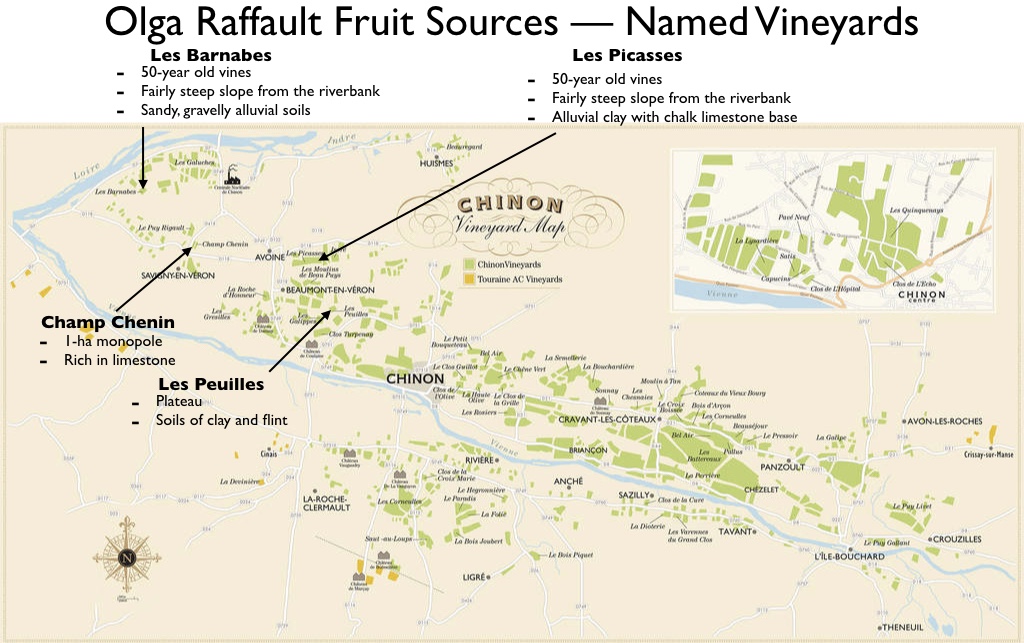
Olga Raffault is located in Veron commune of Chinon but farms 24 ha across the region: 23 ha of Cabernet Franc and 1 ha of Chenin Blanc. Estate vines average 30 years of age and are distributed over the three Chinon terroirs. The location of the owned vineyards are illustrated in the chart below while the wines, and their construction, follow immediately after.


Sources and composition of Olga Raffualt wines

I recently tasted three of the Raffault wines: the 2018 Chinon Blanc Champs-Chenin; the 2018 Olga Raffault Chinon Les Peuilles; and the 2016 Olga Raffault Chinon Les Picasses.

The Chinon Blanc Champs-Chenin showed intense white fruit on the nose along with sage, herbs, and spice. Complex and layered. Brisk acidity on the palate. Citrus and citrus rind accompanying a rust-like minerality. Drying on the palate. Lengthy finish. 


Rich, red fruit on the nose for the 2018 Les Peuilles, along with forest floor, gunflint, and a smokiness. Ripe red fruit on the palate. Concentrated. Full round mouthfeel. Late arriving tannins and salinity. Lengthy, coating finish.


The 2016 Les Picasses had a perfumed nose with bright red fruit, spice, minerality, licorice, saltwater taffy and wet cigarette. On the palate, a red fruit core and smooth tannins. Complex and balanced. Long, lean finish.


These three wines were of exceptional quality with the reds approachable but with the peaks 5 to 10 years out. The QPR here is awesome.


©Wine -- Mise en abyme

Wednesday, October 13, 2021

Trees in the vineyard (Agroforestry) and the effect on grapevine root systems

Agroforestry is one of the key soil health and land management practices of the Regenerative Organic Certification. The practice, as defined by the US Department of Agriculture (USDA), involves "the intentional integration of trees and shrubs into crop and animal farming." Trees provide a number of below- and above-ground services which may be of benefit to the viticulturist (documented by Favor). I have previously reported on the impact of trees on vineyard water parameters and soil-based nutrients. I continue herein with an examination of the effect of trees on vine root systems. Portions of this post draws heavily on the research reported out in Favor's work.

Soil Structure
The vineyard site is a key variable in the production of high-quality grapes, which is, itself, a key requirement for the production of high-quality wine. According to Wolf and Boyer (Vineyard Site Selection, Virginia Cooperative Extension), the best vineyard soils "permit deep and spreading root growth" and provide a moderate supply of water year-round. Katherine Favor posits that "much of the ability of vines to absorb both water and nutrients in the face of competition depends on the health and spatial distribution of the vine's root system" with research suggesting that "the depth and expansion of grapevine roots is highly dependent on soil structure and permeability ... and that grapevine root plasticity is also influenced by planting density and competition." 

What are the soil characteristics that will permit "deep and spreading root growth" and year-round access to water?  The most important requirements are internal water drainage and water-holding capacity. Geologic permeability (the capability of a porous rock or sediment to permit the flow of fluids through its pore spaces -- Dictionary.com) is seen by Wolf and Boyer as perhaps the most important consideration in a candidate vineyard's soil. Mark Chien (Soil and Site Selection Considerations for Wine Grape Vineyards, Pennsylvania State University) sees well-drained soils as a common denominator among all great vineyard sites. These soils "strike a balance between adequate depth and drainage and water-holding capacity" and vines deployed therein will have adequate water access during the summer and can rapidly drain water from the soils in the event of rainfall during the grape-ripening period. According to Favor, soil porosity is an even more important determinant of grape quality than is nutrient availability.

Another key soil feature is effective rooting depth. According to UCDavis, about 60% of the root structure of a vine plant can be found in the first two feet of the surface but individual roots can grow as deep as 20 feet, depending on soil permeability, the level of the water table, and the rootstock variety.

According to Favor, the above characteristics, among others, are influenced by soil structure. Soil structure -- the spatial arrangement of individual soil particles, their aggregates, and the pore space between them -- "affects soil strength, water holding capacity, nutrient retention, aeration, friability, erodibility, plant root movement and biological activity." A high-quality soil structure allows for deeper and stronger vine root systems and higher grape production quality. Soil quality characteristics are summarized in the chart below.


Agroforestry's Impact on Soil Structure
Agroforestry has been shown to improve soil structure through a variety of mechanisms (Favor):
  • A mulching effect from litterfall and pruning materials can have beneficial effects on topsoil structure
    • Soil cover improves soil structure by reducing raindrop and irrigation effect → conserved surface macroporosity → greater water infiltration rates → improved soil penetration
  • High amounts of root biomass produced by the trees
    • Tree roots improve soil macroporosity by breaking up compacted soils and leaving behind old root channels that grapevine roots are able to occupy for greater rooting depth capability
    • Finer roots contribute to improved soil structure
    • Tree buffer treatments produced higher porosity, increased mesoporosity, and improved soil structure
  • Increased organic matter (OM) content
    • Soil structure is largely influenced by the amount of OM in the soil
    • Higher levels of OM → higher aggregate stability and overall improved structure
    • Higher levels of OM contribute to increasing water infiltration and fertility
    • Organic matter is able to use "sticky substances" to glue soil particles together → stable soil pores.
In summary, the agroforestry-related increase in OM → increased soil structure → increased rooting capability → higher yields and higher quality fruit production (Favor).

Competition Between Tree and Grapevine Roots
According to Favor, "much of the ability of vines to absorb both water and nutrients in the face of competition depends on the health and spatial distribution of the vines' root system." 

Research has shown an overlap in the activity spheres of plants and vines: 63% of grapevine roots are in the upper 60 cm of soil compared to 77% of conifer roots while 80% of grapevine roots are in the upper 1 m of soil compared to 91% for trees. Grapevines might have a deeper concentration of roots at deeper soil profiles as their remaining roots extend to depths of as much as 12 m. Grapevine roots can spread out up to 10 m laterally from the trunk.

The most frequent agroforesty applications to date are olive trees with grapevines. Olive trees have similar lateral-root experiences as does the grapevine but its vertical roots grow even deeper. Similar to the grapevine, olive trees absorb the majority of nutrients in the top 1 m of soil and water in the top 1.2 - 1.7 m of soil. As Favor concludes, there may be substantial below-ground overlap between these systems.

Competition notwithstanding, Favor concludes that:
The positive effects that trees impart on soil structure, soil quality and root plasticity allow for deeper and stronger root systems that can better absorb nutrients and water despite competition from trees ... Fracture lines left behind by tree roots allow opportunities for grapevines to grow even deeper than they otherwise would have ... Additionally, competition from tree roots can trigger grapevine root plasticity, which results in increased root length density and increased nutrient and water absorption capacity per cm of soil. Tree roots and grapevine roots are indeed able to adapt to competition and thrive despite occupying overlapping niches.
**********************************************************************************************************
This concludes our examination of the below-ground services provided by trees in an agroforestry system. As per Favor, "there is growing evidence that incorporating trees into vineyards could play a valuable role in the future of viticulture in the coming years."

I will next turn to examination of the above-ground services provided by trees in an agroforestry system.


©Wine -- Mise en abyme

Sunday, October 10, 2021

Idda: The Gaja-Graci Mt Etna joint venture

The entry of "non-local" producers has long been a hallmark of winemaking on Mt Etna but a blue whale landed in 2017 with the announcement of a 50/50 joint venture between Angelo Gaja and Alberto Graci for the production of wines on the mountain. According to doctorwine.it, "The arrival of Angelo Gaja ... was one of the most important events in the recent history of Etna wine. The attention from a producer of such great and recognized prestige has confirmed the undisputed value of the volcano's terroir, strengthening its image and consolidating its position among the most interesting areas in the world for wine production."

Initially unnamed (subsequently called Idda -- "she" in local dialect -- a reference to the ever-present volcano), the venture --valued at €4 million by Club Oenethique -- was launched with the acquisition of the Masseria Setteporte vineyards (with the exception of 10 ha surrounding the Portale homestead). I herein reflect on the joint venture and taste two examples of its wines.

The Partners
Angelo Gaja
Angelo Gaja is, according to BBR, "... Italy's most renowned and dynamic wine personality and his impact on wine production in the last 30 years cannot be overestimated."

The 5th generation of the family to manage the estate founded in 1859 by Giovanni Gaja, Angelo began working at the winery in 1961 after completing Enology studies at Alba and Montpellier. He took the reins of the business in 1970 and initiated a number of groundbreaking and, in many cases, controversial practices. He installed temperature-controlled stainless steel tanks, aged wines in barriques, was the first to release single-vineyard Barbarescos, released wines that did not conform to regulations, and re-introduced French varieties to Piedmont. Controversies notwithstanding, the quality of his wines were high and customer acceptance unparalleled.

Today Gaja farms 101 ha in Barbaresco and Barolo in addition to efforts in Alta Langa (30 ha), Montalcino (Pieve Santa Restituta), and Bolgheri (Ca'Marcanda).

Alberto Graci
Alberto Graci is of Sicilian farming stock but left home to pursue studies in Rome and an investment banking career in Milan. He returned to Sicily upon his grandfather's death and sold the farm in order to buy vineyard property on Mt Etna. Alberto arrived on the mountain in 2004 and purchased property on its northern slope. In New Wines of Mt Etna, Benjamin North Spencer relates the Graci entry to the region as follws: "Many people come to Etna for a slice of adventure. But it was curiosity that first drew Alberto Aiello Graci to the mountain." Once he got there, though, " '... it was the honorable history ...' " that made him want to stay.

Graci's current holdings include Contrada Arcuria (20 ha), 80-year-old vines (1.5 ha) in Contrada Feudo di Mezzo, young vines in Contrada Muganazzi (5.5 ha), young vines in Contrada Santo Spirito (0.9 ha), and 100-year-old vines at 1000 m in Contrada Barbabacchi (2 ha). The estate pursues full maturity of the major native varieties in a certified-organic environment with vinification and aging of harvested grapes occurring in concrete tanks and large oak barrels.

Idda Vineyard Holdings
The figures below show the municipality-level locations of the Idda vineyards and the associated growing environments.

Map courtesy of Cittavino


The Biancavilla holdings were described previously while Monica Larner describes Belpasso  as "a little island of soil sandwiched between more recent lava flows" and the Idda vineyard therein as being resident on "rocky volcanic soils."

The Tartaraci vineyard is located on the northwestern flank of the mountain at 1000 m elevation. The property was once owned by Lord Admiral Horatio Nelson, bequeathed to him by the Kingdom of Naples for seeing off the French in 1799. The vineyard is planted to 90-year-old bushvines of Nerello Mascalese, Nerello Cappucchio, Garnacca, Grecanico, and Carricante. The vineyard, typically one of the latest on Etna to be harvested, lies outside of the DOC zone. Frank Cornelissen and Buscemi source grapes from Contrada Tartaraci.

According to Monica Larner (Wine Advocate), Idda's goal is the production of 90% whites and 10% reds as its final wine composition and has planted 12 ha of Carricante over the last 3 years in pursuit of that goal. In discussing the growing strategy in the south, Gaia Gaja indicates that they are planting on "hotter, more exposed terroir ... to try harvesting the white Carricante grape earlier and thus retain more of its celebrated acidity while giving it a bit more body." Further, they would like to move higher up on the slopes in the future as insurance against climate change.

The Wines
Idda currently produces a white (100% Carricante) and an Etna Rosso. I tasted the 2020 version of the former and the 2018 version of the latter.


In a recent Wilson Daniels panel conversation, Salvino Benanti described 2018 in the southwest as a "good vintage" and 2020 as "on the warm side ... quite dry ... similar to 2014 or 2017."

The white wine is classified Sicilia DOC. The wine is whole-bunch-pressed before cold decantation and fermentation in stainless steel tanks. The wine is aged for 1 year in 15 l oak casks and stainless steel tanks. 

I have tasted Carricante-based wines from all faces of Mt Etna and, more specifically, I have tasted Benanti, Tenuta di Fessina, and Feudo Cavaliere whites from the southwest, and I find no typicality in this wine vis a vis these others. In my tasting of Carricante-based wines, I stated thusly: "Carricante-based wines from the east to south flanks of Etna are characterized by salinity, minerality, and acidity and, at its optimum, these characteristics meld extremely well." The Idda white showed a perfumed nose with lime and lime skin and a honey-dew melon undertone. Light-bodied and unfocused with low-grade acidity, missing salinity, and a lack of complexity. 

Salvo Foti says that it takes between 10 to 15 years for Carricante juice to show concentration and I wonder if this is somehow involved here. Or this could have been a bad bottle of some sort. I will continue to explore to see if I get similar characteristics in future bottles.

The Etna Rosso was more readily identifiable as such. Ripe plum and vanilla bean on the nose. Light-bodied and smooth on the palate with broad-based fruit and low acidity. 

Some Observations/Thoughts/Questions on the Joint Venture
The joint venture serves as a vehicle for Gaja's entry into the Etna marketplace. This means that Gaja sees the market as underperforming and sees himself being able to capitalize on the upside potential. That upside potential may be realized organically or by Gaja's entry or by future things that he brings to the table.

It is a feather in Mt Etna's cap for Gaja to be making wine on the mountain and is definitely a feather in Graci's cap for him to be a part of the team. Why did Gaja pick Graci? Someone of Gaja's stature could have had his pick of partners from among the producers. There is some discourse that Gaja had met Graci previously and liked his spirit. There is also the sense that Gaja wanted a local expert to serve as a guide. But Graci, even though Sicilian, is not from Mt Etna. Further, his entry to the market came after "foreigners" like Franchetti and Cornelissen had already entered the market. The Salvo Foti-Rhyss Vineyard joint venture was a more classic insider-outsider play. In any case, given the passage of time, and the effort that they have expended, those early entrants have probably earned "insider" status by now.

In terms of experience, Graci is very involved with properties on the north face of the mountain so I found it intriguing that all of the properties involved in the JV are on the southwest and northwest faces. The best locale for white grapes on Mt Etna is the east face and if one is looking to make a great white wine, that is the terroir that I would have expected to see engaged. It is true that Benanti, Feudi Cavaliere, and Tenuta di Fessina all have white wines from the southwest but their primary white wines are from the east.

There appears to be some opportunity to beneficially leverage the Gaja name. Vineyard prices in the southwest and west are lower than in the east so the cost to get the project fully up and running would be lower in the former than in the latter. Meanwhile, the Gaja market power can be leveraged to price the wines aggressively (for example, a 2019 Masseria Settoporte is about $25 while a 2020 Idda is about $50), shortening to time to breakeven.

Salvino Benanti thinks that winemaking on Mt Etna will become an oligopoly in the near-term with winemakers being forced to make investments to stay competitive. There is no doubt that Idda has the resources to play -- and win -- in that game.

©Wine -- Mise en abyme

Wednesday, October 6, 2021

Throwback: Vineyard visit and lunch at Masseria Setteporte (Biancavilla, Mt. Etna), source of a portion of the land that comprises the Gaja-Graci Idda joint venture

Early in May 2017, my good friend, and Mt. Etna resident, Brandon Tokash sent a message informing me that Angelo Gaja, the famed Barbaresco producer, had formed a partnership with Alberto Graci to produce wines on the southwestern slope of the volcano. Further, a vineyard that we had visited a year earlier, Masseria Setteporte, was the source of a significant portion of the property. This was a development that piqued my interest on a number of levels: (i) I am a fan of Angelo and his wines (I have visited his Barbaresco property on two occasions) and was aware of the messaging impact such an announcement would have on producers and consumers of Etna wine alike; (ii) I was somewhat surprised by the location choice; and (iii) I had spent an entire day at Masseria Setteporte just a year prior and wondered if anyone in the room that day had seen this coming.

Since that original announcement, I have been planning to write about the venture and its product line. I finally got my hands on some product to aid in this discussion. I begin with my visit to the Biancavilla property.

The Masseria Setteporte estate has been a generational holding in the Portale-family portfolio. The estate was first modernized by Ferdinando Portale who transitioned from bush to vertically trained vines. Piero Portale took ownership of the property in 2002 and extended the size from 12 ha to 27 ha. Of the 27 ha, approximately 16 were devoted to vineyards.

The vineyards resided at altitudes ranging between 650 and 800 m and were south-facing. The farm was certified organic.

Brandon took me out to Biancavilla one Saturday to meet with Piero and partake of one of his famous culinary creations. We were joined there by Benjamin North Spencer (New Wines of Mt. Etna).


Lunch was prepared by Piero Portale who, in addition to owning the winery, was (at that time) a lawyer, a partner in a restaurant (La Cantinaccia), and a renowned and dedicated foodie.

We were welcomed to the dining area with glasses of Murgo Brut (from magnum), accompanied by farm-grown olives (Nocellera di Etna) and 4-month-old Sheep's milk cheese (sourced from sheep which forage on the farm).


The meat served as the main course was 45-day, dry-aged Chianina (native to Tuscany). This was accompanied by a salad comprised of tomatoes, onions, dried sardines ,olives, and olive oil. The course was accompanied by the estate's red wines. The Chef's preparation had the meat resting on the grill for 30 seconds so I had to give my portion additional time on the grill to ensure that it was not alive.

Piero (top middle) along with Brandon Tokash and
Benjamin North Spencer (New Wines of Mt. Etna)

The main course was followed by a chocolate dipped in rum and an Amaro from the German producer Underberg.


We did our vineyard tour post-lunch.


I will continue with the structure and composition of the joint venture and a tasting of two of its wines.

©Wine -- Mise en abyme

Sunday, October 3, 2021

Trees in the vineyard (Agroforestry) and the impact on soil-based nutrients

Agroforestry, as it relates to viticulture, is concerned with the co-location of trees and vineyards. Trees provide a number of below- and above-ground services which may be of benefit to the viticulturist (documented by Favor). I have previously reported on the impact of trees on vineyard water parameters and continue herein with the effects on soil-based nutrients. The effects portion of this post draws heavily on the Favor work.

Background on Soil-based Nutrients
Adequate amounts of the appropriate nutrients are required to support proper growth of the grape vine, fruit development, and fruit maturity; those nutrients are obtained from the soil by the plant.  The table below shows the mineral requirements of the vine plant, the role of each mineral, acceptable ranges of each mineral in the soil, and the impact of mineral deficiency on the vine.

Source: Compiled from LGRGP.org and others

Sources
Rocks
The earth is made up of varying proportions of the 90 or so naturally occurring elements but, according to Alex Maltman (Vineyards, Rocks, & Soils), four of these -- oxygen at 48%, silicon at 28%, aluminum at 8%, and iron at 6% -- are responsible for 88% of its composition. In most geological materials, these elements combine to form minerals -- "a naturally occurring combination of specific elements that are arranged in a particular repeating three-dimensional structure or lattice" (opentextbc.ca, Minerals and Rocks).

In nature, minerals are found in rocks "and the vast majority of rocks are composed of at least a few different minerals." Jackson (Wine Science: Principles and Applications) stipulates that (p. 245) "... the mineral content of soil is primarily derived from the parental rock substrate." The figures below show the weathering of rocks into minerals.

Decaying Organic Material
Jamie Goode (Rescuing Minerality) contends that the bulk of soil mineral content comes "from decaying organic material, not decomposed rock and it is microbial activity in the soil that affects the ability of soil to break down organic matter into mineral ions that can be used by the plant." Maltman agrees with Goode: "... in practice, it's the humus that's more important, indeed essential."

Atmosphere
According to Schwarcz and Schoeninger (Stable Isotope Analysis in Human Nutrition, Yearbook of Physical Anthropology 34, pp. 293-321), almost 100% of exchangeable nitrogen is found in the atmosphere or dissolved in the world's oceans and is transferred from these environments into the biological system through the terrestrial nitrogen cycle.

Cation Exchange
Soil-based nutrients are resident either in the soil solution (water and dissolved minerals in the soil pores) or in the soil matrix (mineral particles and organic matter).  Two problems present themselves, however: (i) the concentration of nutrients in the soil solution is low and (ii) the nutrients resident in the soil matrix are immobile.  Plant roots have developed adaptions to allow growth into the soil matrix and capture of the nutrients needed for metabolic activity (Dr. Paul Schreiner, USDA-ARS) and we will discuss these later.

Most of the mineral nutrients that the vine needs are cations so the soil's cation exchange capacity (CEC) is a major enabler of  it's nutrient acquisition. The positively charged mineral ions bind loosely to the clay and humus colloids in the soil and these minerals are released in exchange for hydrogen ions secreted by the vine roots. (Clay minerals act as harbors for nutrients because the positive ions of the nutrients are trapped by the negative charge of the clay minerals.  The abundance and types of minerals determine whether the clay is classed as low- or high-CEC.). The ion that makes the strongest link with the clay is the hydrogen ion "... and its almost as though the vine knows this! The vine's metabolism can prompt its roots to pump out hydrogen ions into the soil water, which then dislodges the other ions held on the clays, thus making them available to the vine roots" (Maltman). 

The Effect of Trees on Vine Nutrition Parameters
The effect of trees on vine nutrition parameters are summarized in the chart below and described in greater detail in the sections following.


Increased Nutrient Availability
As shown in the chart above, trees increase nutrient availability by increasing organic matter, cycling nutrients from deep to shallow profiles, fixing nitrogen, and transforming nutrients into a more plant-absorbable form.  

As regards organic matter (Favor):
  • Agroforestry systems have the potential to increase this material by 50 to 100% 
    • They return an average of 7.4 tons of organic matter/ha/year in the form of prunings
      • They also produce organic matter through litterfall, root slough, and root exudates
    • Nutrients that take the form of organic matter are released slowly at rates comparable to rates of plant absorption 
      • They also present in a stable molecular form that is resistant to leaching
    • Organic matter produced by trees serves as a source of food for microbes
      • Results in increased microbial populations (by as much as 30%)
      • Microbes excrete enzymes that mineralize nutrients, stabilize carbon and N in the soil, and decompose organic matter into simple, plant-available forms
        • Results in higher plant nutrient uptake
    • Results in increased cation exchange capacity
      • Translates to a greater ability of soil to hold onto exchangeable cations
      • Better retention of applied nutrients
      • Resistance from nutrient leaching
  • Nutrients that take the form of organic matter are released slowly at rates comparable to rates of plant absorption
    Trees cycle nutrients from deeper profiles by accessing those nutrients deep underground, converting them into plant tissue and organic material, and dropping organic material to the ground in the form of leaf-litter and above-ground debris. As this material degrades, it releases nutrients into the upper soil profiles where they become available for use by other crops (Favor).

    Almost 100% of exchangeable nitrogen is found in the atmosphere or dissolved in the world's oceans and is transferred from these environments into the biological system through the terrestrial nitrogen cycle illustrated in the figure below.  

    Source: http://tolweb.org/notes/?note_id=3920

    Depending on the species, trees can fix nitrogen at average rates of 40 to 200 kg N/ha/yr (Favor).

    Finally, the increased microbial life -- resulting from the tree-related increase in organic material -- excrete enzymes that decompose organic material into simple, plant-available forms, resulting in higher plant nutrient uptake.

    Reduced Nutrient Loss
    By reducing nutrient losses from leaching, erosion, and runoff, trees allow the retention of  greater amounts of soil-based nutrients in the vineyard. According to Favor:
    • Agroforestry systems increase soil organic by as much as 100% with as little as a 10% increase decreasing soil erodibility by between 13 and 23%
    • Litterfall increases ground cover which reduces runoff and erosion
    • Surface mulch associated with agroforestry systems reduces the kinetic impact of rainfall, retaining the soil surface structure.
    Competition Between Trees and Grapevines
    At distances of less than 4 m, there is intense competition for nutrients, especially nitrogen, between plants and grapevines. The negative effects observed were reduced vine vigor and yield with no obvious effect on berry quality. Beyond 4 m, no negative competitive effects were observed.


    ©Wine -- Mise en abyme

    Thursday, September 30, 2021

    Regenerative Agriculture and Agroforestry: The effect of trees on water parameters in the vineyard

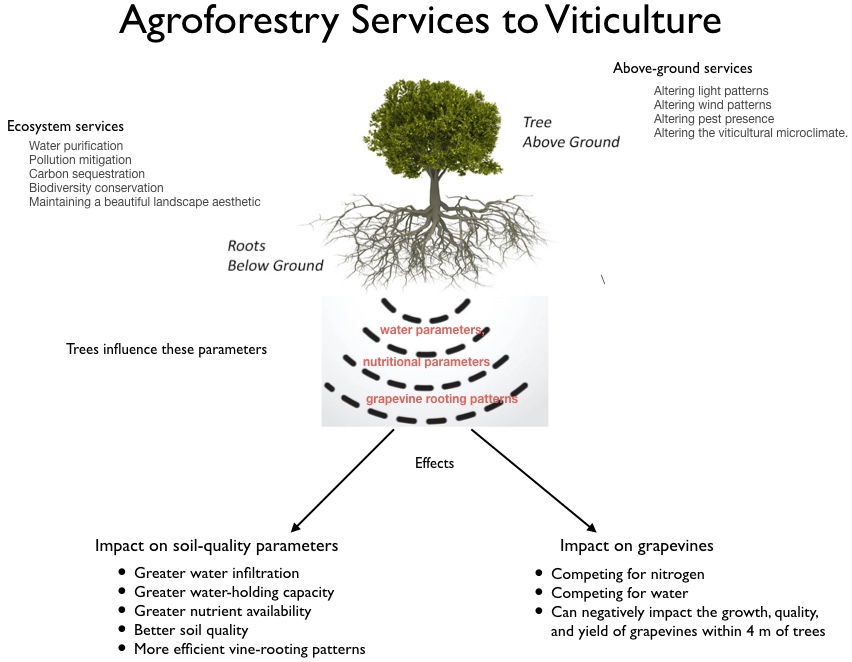
    Drawing heavily on Favor's Master Thesis, my recent post on Agroforestry practices in Regenerative Agriculture identified the range of above- and below-ground services provided by trees in the context of vineyards. I return to the topic to discuss the workings of those particular services and their detailed impacts. 

    The chart below summarizes the above- and below-ground services, with the below-ground component revolving around elements associated with water, nutrition, and grapevine rooting patterns. I treat the water aspect in this post.


    Water is extremely important to the functioning of the vine plant but too much, or too little, can have adverse effects, with run-on impacts on fruit quality. Water sources for the vine include stored soilwater, effective in-season rainfall, and any water that is added by the viticulturist. According to Favor, the presence of trees in the vineyard will result in (i) increased water conservation and (ii) competition between trees and grapevines for water.

    Increased Water Conservation
    Favor points out that even though grapevines are a relatively drought-resistant species -- most wine regions are located in relatively low-rainfall areas -- "conserving moisture is a high priority in most vineyards." While it would be difficult for droughts to kill off the vines entirely, they can:
    • stunt vegetative growth
    • reduce fruit quality
    • completely suppress fruit production
    • yield expensive water bills in the cases where irrigation is practiced
    • dry up the groundwater.
    Trees in agroforestry systems conserve moisture using the mechanisms illustrated in the chart below.


    Further, trees increase soil water-holding capacity by improving overall soil structure (Favor). The figure below shows the components included in a soil matrix. According to Favor, trees 

    Soil matrix cross-section (Source: serc.carletoon.edu)

    improve the soil structure by boosting both organic matter and microbial populations which, in turn, aid in the formation of stable aggregates and a higher incidence of micropores and macropores. These micropores and macropores are the storehouses in which the increased levels of water are held. According to Favor, agroforestry systems can increase organic matter by up to 100% with every 1% increase, yielding a 1.9% increase in soil water-holding capacity.

    "All in all, agroforestry systems are able to significantly increase soil moisture, water infiltration rates, water recharge capacity, and water holding capacity" resulting in "greater drought resistance and less reliance on irrigation" (Favor).

    Competition between Trees and Grapevines for Water
    Favor asserts that some competition for water between trees and grapevines in an agroforestry system is inevitable. The trick here is to avoid severe water deficits for the grapevine (see table below).

    Effects of Severe Water Stress on the Grape Vine
    Stage
          Effects
    Bud Break
    • Water stress infrequent at this stage
    • Moderate levels -- uneven bud break and stunted shoot growth
    • Severe levels -- poor flower cluster development; reduced pistil and pollen viability; nutrient deficiencies
    Post-Berry Set
    • Severe levels -- flower abortion and cluster abscission; reduced canopy development; impact on following season’s crop potential

    Post-Fruit Set
    • Restrict berry cell division and enlargement resulting in smaller fruit and lower yields
    • Reduced shoot development
    • Reduced yield potential
    • Reduced fruit soluble-solids accumulation
    • Higher pH fruit
    • Decreased acidity
    • Reduced color development in red varieties
    Post-Harvest
    • Reduced root growth with resulting decreased nutrient uptake and micronutrient deficiencies the following spring
    Source: Wample and Smithyman, Regulated deficit irrigation as a water management strategy in vitis vinifera production in Deficit Irrigation Practices, ftp://ftp.fao.org/agl/aglw/docs/wr22e.pdf%20.

    Overlapping somewhat with the above, Favor sees excessive water stress:
    • reducing the number of bunches per vine
    • reducing photosynthesis (reduced leaf area and increased stomatol closure yield lower berry sugar levels)
    • reducing both fruit and vegetative growth
    • negatively affecting sugar metabolism and flavor development.
    Excessive water stress, then, is to be avoided at all costs. Some water stress, on the other hand, does seem to have positive quality implications for the grapevine.

    Vine water stress is created when this available water supply is reduced beyond the vines climatic needs.  In areas where irrigation is allowed, viticulturists use controlled irrigation to induce vine water stress. In this scenario, the soil water resources are utilized for the plants needs up through bud break and then amounts less than required are provided to the plant (This would include effective rainfall plus irrigation). This limited water access creates a stress situation for the vine, which, in turn, results in the quality enhancements that the viticulturist seeks. That is, the soil will provide for the vine's needs with stored soil water and the vines will dive deeper -- a stressed situation -- in search of additional water when the near-in sources have been depleted. 

    Research carried out by UCDavis' Dr Terry Prichard on berry size and vine balance shows that:
    • For a given berry size, vines grown with low irrigation have a higher anthocyanin concentration (between 15% and 33%) than those grown under higher irrigation conditions
    • There is a higher concentration of skin tannins in low- versus high-irrigation environments
    • Water deficits result in lower yields which, in turn, results in lower veggie characteristics and fruitier wines.
    According to Favor, mild water stress has been shown to:
    • Improve wine quality by increasing the sugar:acid ratio, lowering malate and total titratable acid concentrations, and increasing total soluble solids
    • Increase grape phenological profiles
    • Increase sugar concentration in berries
      • In a study comparing the effects of 25%, 50%, 70%, and 90% soil moisture regimes, the 25% regime was found to produce the smallest berries and the highest concentrations of sugars and phenological compounds.
    Trees and grapevines do impart some levels of water stress through "competition and root niche overlap" but this is more than offset by the beneficial water contributions provided by trees (as detailed in the foregoing section). Some stress is good for the vine plant; and trees in an agroforestry system will provide that. According to Favor, "given all the tradeoffs, research findings suggest that trees would not induce damagingly high levels of water stress."

    I will continue in my next post with agroforestry's impact on vine nutrition parameters.


    ©Wine -- Mise en abyme

    Tuesday, September 28, 2021

    Piccolo Derthona: A Colli Tortonesi Timorasso entry point for the impatient

    Timorasso is a notoriously difficult grape to grow. And your troubles are not over once you get it into the cellar: it requires extended vessel and bottle aging before it is truly ready to be released on the market. Making Timorasso wine is expensive when you factor in the additional vineyard labor costs and the time, material, and opportunity costs associated with extended aging. Producers wanted a mechanism whereby they could realize some offsetting revenue while they awaited the release of the Derthona and thus was born the concept of the Piccolo Derthona, an earlier-release, lower-cost, 100% Timorasso wine.

    I have previously characterized the Piccolo Derthona as being akin to a Rosso di Montalcino but recently came across a more pointed reference: "The name, Piccolo Derthona, is inspired by what is done in French Chablis, a great territory for white wines, where the Petit Chablis is produced with the same goal, that of creating a distinctly fresh and pleasant wine, compared to the richer and more structured Chablis, in our case the Derthona."

    The Colli Tortonesi Consorzio has submitted an application to the appropriate authorities for the designation of a Derthona sub-appellation within the Colli Tortonesi DOC covering the production of Timorasso vines within its borders. The submittal covers a Riserva (released a minimum of 2.5 years after harvest), a Derthona, and a Piccolo Derthona (both requiring a minimum of 1 year aging). The difference between a Derthona and a Piccolo Derthona will be based on quality parameters as well as tasting panel assessments.

    The picture below show the eight Piccolo Derthonas currently produced from Colli Tortonesi Timorasso grapes. 

    Piccolo Derthona wines currently produced in
    Colli Tortonesi (Picture courtesy of Conrad Mattern)

    The producers currently utilize a mix of reduced aging time (Pomodolce, Boveri Giacomo, Massa, Cantina di Tortona), lower quality/younger grapes (Repetto), or both (Canavero Luca) to distinguish the Piccolo Derthona from the Derthona. The proposed Derthona appellation calls for a similar aging period for both Piccolo Derthona and Derthona so producers will either have to declassify grapes, use grapes from younger vines, or use grapes from lower-quality production sites for the Piccolo wine. 

    It should be noted that extending the aging period of Piccolo to one year will increase its aging costs and will also cut out an early revenue source for producers who had historically aged the wine for less than one year. 

    It should be noted that only one of the big-name producers - La Spinetta -- currently offers a Piccolo Derthona and that none of the non-Langhe outsiders do. It will be interesting to see whether this state of affairs continues into the future. 

    I personally have been concerned that a wine drinker encountering Piccolo as her/his intro to Timorasso may wonder what the fuss is all about and not take the time to explore the variety further. 

    Below I describe the individual offerings in some more detail.

    **********************************************************************************************************

    Pomodolce Piccolo Derthona
    Pomodolce farms 3 or 4 ha (depending on source) in the Montemarrone municipality of Val Curone. The estate, established in 2005, sources its estate grapes from the areas of Fontanino, Pomodolce, and Barone. The vineyards -- average elevation 380 m -- are sited on calcareous clayey soils and are exposed to the southwest. Vines are planted at 3500 vines/ha and are farmed using organic principles.

    The grapes are fermented in stainless steel tanks and aged in-place for 8 months. In contrast, the estate's two Derthona wines are each agaed for 10 months.

    Boveri Giacomo Piccolo Derthona
    The grapes for this wine are sourced from a Costa Vescovato plot which has been farmed by the family for decades but which has been planted to Timorasso beginning in 2013. Vines are trained Guyot with the between-row spaces grassed.

    The grapes are hand-harvested and then soft-pressed with the must clarified prior to fermentation. The wine remains on the lees for 5 - 6 months and is then bottled in the spring following harvest.

    Canevaro Luca Piccolo Derthona
    This 8- (or 9-) ha estate is located in the municipality of Avolasca at elevations ranging between 300 and 350 m. The vines are farmed organically with grapes for the Piccolo Derthona sourced from younger vines (A total of 1.5 ha is dedicated to Timorasso vines).

    The grapes are hand-harvested and soft-pressed prior to fermentation in stainless steel tanks. The wines are aged for 5 months on the lees, with batonnage, and are filtered prior to bottling.

    Vigneti Repetto Piccolo Derthona
    The Piccolo Derthona is a new wine for the estate. Gian Paolo has described his Piccolo Derthona as "an entry-level wine made from young vines and/or lower quality grapes. This wine has less structure, less body, and a lower price point than the (estate's) Derthona. It exhibits freshness and is suitable for a wine bar."

    I tasted the 2019 version of the wine and found saline green olive, a hint of sweet white fruit, and spice on the nose. It was very broad on the palate (wide open, I would say) with underripe citrus fruit and hints of salinity. No hint of the structure that is notable for this variety. The heat on the chest stands in contrast to the 12.5% stated alcohol on the label. Mid-weight, with average length.

    Vigneti Massa Piccolo Derthona
    The grapes for the Massa Piccolo Derthona are sourced from the Boscogrosso and Sigala vineyards. The production regime for Massa wines are, in general, as follows:
    • Hand-harvesting
    • Maceration on the skins in concrete vessels for 48 to 60 hours without sulfuring
    • Soft pressing
    • Fermentation with indigenous yeasts in stainless steel tanks (20 - 25ºC)
    • Spontaneous malolactic fermentation after temperature reduced to 10 - 18ºC
    • Wine aged in stainless steel tanks for one year (with batonnage)
    • Light filtration prior to bottling
    • Minimum 6 months bottle aging.
    I tasted the 2018 Piccolo Derthona. Stone fruit, sea spray, minerality, spice, menthol, and a hint of burnt orange on the nose. Much more powerful on the palate than is the case for the the La Spinetta. Lime and lime skin, green tamarind, minerality, salinity, and lip-smacking tannins. Drying finish.

    On the day following, sweet white fruit, tempered by a grey slatiness, pea soup, menthol, and spice. Weighty, bracing lime on the palate along with salinity, spice, and a leaden minerality. Bright. Lively. Lengthy finish.

    Cantina di Tortona Piccolo Derthona
    Grapes for this wine are sourced from Avolasca, Vigguzolo, and Vho where they are grown at elevations ranging between 250 and 450 m in clay and sandy soils with south and southwest orientations.

    The grapes are subjected to a 6-hour maceration in an inert environment prior to alcoholic fermentation. The wine is aged for 6 months in continuously suspended fine lees.

    Terralba Piccolo Derthona
    No information on this wine was available from traditional sources. Conrad Mattern reached out to the proprietor but he had not yet responded at press time.

    La Spinetta Piccolo Derthona
    La Spinetta purchased 5 ha of land distributed between Montegiocco, Monleale, and Montemarzino for its entry into Colli Tortonesi Timorasso production. The soils are calcareous and clay at elevations ranging between 350 and 400 m and with southeast and southwest exposures.

    The grapes are hand-harvested and fermented naturally in stainless steel tanks. La Spinetta's wine ages for 8 months on the lees after which it is filtered and bottled. The wine spends another 3 months in bottle before its release on the market. 

    The 2019 Piccolo Derthona was La Spinetta's inaugural Timorasso vintage.  Neither the nose or palate yelled "Tortonesi Timorasso." This Piccolo was relatively thin.

    ©Wine -- Mise en abyme