Friday, February 7, 2020

David Ramey and Aaron Pott: A brief comparison of the career trajectories of these American winemakers

David Ramey and Aaron Pott are numbered among the most respected American winemakers and both craft some of the most sought-after domestic wines (primarily Chardonnays for Ramey and Cabernet Sauvignons for Aaron). I recently wrote a post based on a tasting of Ramey wines here in Orlando and, in that document, presented a timeline of developments in his career. I recently had the pleasure of attending a tasting of Aaron Pott wines -- led by him -- and constructed a similar timeline as part of my reporting.
Author with David Ramey (left block) and Aaron Pott

A few common threads caught my attention, leading to me stacking the two timelines up for comparison purposes. The result is shown below.


Some observations:
  • Both men did collegiate work at UC Davis, David gained a graduate degree in Enology in 1979 and Aaron an undergraduate degree in 1990
  • Aaron did eventually gain a graduate degree, circa 1997, but in Viticulture and from a University in Burgundy
  • Early experience to French powerhouse winemakers: Moueix in the case of Ramey and Rolland and Lafon for Pott while he was Assistant Winemaker at Newton Vineyard
  • They both did stints on the Right Bank of Bordeaux: Ramey two short spells with Moueix in 1979 and 1989; Pott six years as the winemaker at Tropolong-Mondot and then La Tour Figeac.
  • Ramey has much more domestic winemaking experience in the part of his career that preceded ownership of his own shop while Pott added to his international experience (France, Italy, Chile) by becoming Beringer's "Flying Winemaker."
  • Ramey has now owned his own business for 24 years. He primarily uses purchased fruit. Pott has been crafting his own wines for 13 years and uses a mix of estate and purchased fruit. In addition, Aaron helms a flourishing and well respected consulting business (Huis Clos; see below).
  • Both of their winemaking philosophies and practices draw heavily on their French experience.

Table 1. Partial list of Huis Clos former and current consulting clients
Fisher VineyardsSeven StonesPerliss
Krupp BrothersSt Helena WinerySomnium
Quixote WineryAdler Deutsch VineyardAErena Wines
Blackbird WineryGreer WineResolute Wines
Bello Family VineyardMartin Estate
¿Como No?


©Wine -- Mise en abyme

Wednesday, February 5, 2020

The DOC sparkling wines of Umbria, Italy

Umbria, one of the smallest of the Italian regions, lies almost dead center on the peninsula and is the only region that does not border on a body of water or a country.

Italian regions map with Umbria as the beating heart of the boot
(Source:sottasoprainc.blogspot.com)

Umbria lies in the cultural and vinous shadows of its northwestern neighbor Tuscany but is renowned in its own right for its lush, rolling hills, its hilltop villages (Assisi, Perugia, Orvieto, Spoleto, Todi, Spello, Gubbio), and unique historic towns.

Assissi

Author and spouse in Umbria

Grapegrowing at Carmine Estate

Looking down on the great Umbrian Valley from the hills 
above Cannara

Umbria's main business activity is agriculture, with olive oil, truffles, sunflowers, and wine grapes as the primary offerings.

The Umbrian climate is continental; cold, rainy winters and dry summers. This climate is modified by the waters of Lake Trasimeno in the area west of Perugia.

Geologic processes through the ages have resulted in the following soils distribution in Umbria:
  • Alluvial sediments and debris along major river valleys
  • Gravels, sands, and clays deposited during the Pliocene and early Pleistocene
  • Marly deposits during the Oligocene - Miocene
  • Stratigraphic Umbria-Marche deposits from the Jurassic-Miocene
  • In the southwest, volcanic deposits from the eruptions of the Vulsino volcano.
This distribution is illustrated graphically in the figure below.

Schematic geologic map of Umbria.
Blue = Limestone; Gold = Sandstone rocks;
 Yellow = Inter-mountain basins; and
Purple = Volcanic complexes (Source:
Andrea Moti, researchgate.net)
Between 600,000 and 800,000 hl of wine is produced annually, a total that is 1/3 of Tuscany's production and places the region 14th or 15th of the 20 Italian regions. The region is known for its white wines (18% of its wines are from the Orvieto DOC) from the Trebbiano and Grechetto varieties but its only two DOCGs (Sagrantino di Montefalco and Torgianno Rosso Riserva) are red wines made from the Sagrantino and Sangoiovese varieties, respectively. Sangiovese represents 22% of the vine plantings while Trebbiano and Grechetto come in at 17% and 13%, respectively. Most of the vineyards are planted on terraces that have been cut into the hillsides.

As shown in the chart below, Umbria has six sparkling wine DOCs distributed over its surface area.


A few observations:
  • None of the major Umbria DOC/DOCGs (Sagrantino de Montefalco DOCG, Torgiano Rosso Riserva DOCG, and Orvieto DOC) produce any sparkling wine
  • A small number of varieties (six) have been formally designated by name for the production of sparkling wine. Only Valle d'Aosta (one) and Liguria (three) have fewer identified sparkling-wine-designated varieties
  • A preponderance of the international varieties have been designated as raw material for sparkling wine production in Umbria. Only Spoleto DOC -- of the six sparkling wine DOCs identified in the chart above -- does not specify, by name, one of the international varieties for use in the production of its sparkling wine.
  • Three of the sparkling wine DOCs are located in the north of the region, one in the middle, and two in the south.
  • Two Metodo-Classico-only DOCs and one Charmat-only DOC. The remaining four DOCs allow a mix of both production methods
  • The Spoleto DOC wine could have been designated a varietal sparkling wine.
******************************************************************************************************
In this post I have continued on my path to identify and map each sparkling wine DOC/DOCG in Italy. To date I have completed the mapping of Northern Italy as well as Toscana and Umbria (herein) of Central Italy. My next effort will identify the sparkling wines of Marche.


©Wine -- Mise en abyme

Saturday, February 1, 2020

Spanish wines on the cutting edge: Ribeira Sacra's Guímaro Finca Meixemán 2017

What is the new face of Spanish wines as the modernist movement retreats? According to panelists in a seminar titled Wines on the Cutting Edge, a part of Wines from Spain's Great Match Miami (November 5, 2019), it is a movement to different and unusual wines and areas.

I have covered the cutting-edge whites (Tajinaste BlancoMuradella BlancoEdetària Selecció Blanc Vinyes Velles, and Conde de los Andes Rioja Blanco) in prior posts and will now turn to the reds, beginning with Guímaro Finca Meixemán 2017. In this post I will discuss the wine region, the producer, the variety, the vineyard, the wine, and the tasting.

The Region
The subject wine is produced in Amandi, one of the five sub-regions of the Galician DO Ribeira Sacra. While Galicia is primarily know for its white wines, Ribeira Sacra is known for its reds; and, especially, its Mencia.


Winemaking in Galicia originated with the ancient Romans and those traditions were upheld during the Middle Ages by the monks who resided in the still-evident monasteries. This religious history is captured in the DO name -- Ribeira Sacra -- which translates to Sacred Shore. But this winemaking tradition collapsed with the Italy-wide movement from farms to cities in the last century, resulting in the loss of know-how and varieties.

Riberia Sacra attained its DO in 1996. Its approximately 1200 ha (2965 acres) hugs the the contours of the Miño and Sil rivers prior to their convergence and the transit of the surviving Miño into Portugal,. The landscape is dominated by steep slopes and river canyons with some vineyards resident on 50-degree slopes. The steepness of these slopes require "heroic" farming a la Mosel and Liguria.

Source: https://ribeirasacra.org/
While the Galician climate is considered Atlantic, Riberia Sacra's remove from the coast renders it continental: long, warm summers and cold, wet winters. Soils here are well-drained slate and granite.

Spanishwinelover.com observes that: "... Ribeira Sacra seems to have ticked off all the boxes to become a top player: breathtaking landscapes with dizzying vineyards; a great array of local grape varieties in the process of being recovered; the complexity derived from the diversity of soils, exposure, and elevations; and a generation of terroir-driven, quality-focused producers determined to leave behind the attitudes and short-sighted views of yesteryear."

There are some challenges, however:
  • Removing a single ha of traditional vineyard, including stone walls and a railing system to transport harvest cases uphill, costs between 80,000 and 100,000 euros. Solution is potentially to replace stone walls with soil terraces
  • Villages are empty
  • Difficult to hire people; once hired, they need to be trained.
The Producer
The Guímaro farm, 8 ha in size, is located in the village of Sober in Ribeira Sacra's Amandi sub-region. The farm has been in the family for ages and has historically operated a mixed agricultural regime. Grapes were sold in bulk until Luis Buitrón signed on as winemaker and encouraged the family to bottle some of the wine on the estate. Luis was also instrumental in the wine education of young Pedro Rodriguez, family scion, taking him to visit wineries in other regions in Spain as well as in France and Italy.

Pedro is the grower today but his parents still work in the vineyards. The vineyards are south-facing  and resident on the slate soils just above the River Sil.

Pedro was introduced to Raúl Pérez, the famed Bierzo winemaker, in the early 2000s. The advice that he imparted resulted in Pedro:
  • Reducing Mencia yields
  • Eliminating the use of chemicals in the vineyard
  • Paying closer attention to plot-exposition
  • Re-claiming old-fashioned winemaking methods
    • Wild yeast fermentation
    • Foot-treading in open-top vessels
    • Stem inclusion
    • Working with low sulfur
    • Aging in used barrels.
Pedro's stewardship has yielded "some of the most distinctive and age-worthy wines being produced today on the Sacred Banks."

Pedro is currently moving towards organic certification and is also planting heirloom grape varieties at high elevations in Amandi.

The Variety -- Mencía
The Mencía grape variety is principally found in the northwest of Spain in the DOs of Bierzo (where it has the greatest renown), Ribeira Sacra, Monterrei, and Valdeorras. A total of 9000 ha of vines across those regions are devoted to the variety.

Mencía had historically been dismissed as an indifferent local table wine -- "astringent, pale, and forgettable" -- planted as it was on unsuitable soils. The true capability of the variety was brought to the fore by Alvaro Palacios's successful revitalization efforts in Bierzo and Galicia in the 1990s. Replanting the grape on more suitable hillside schist soils yielded a more concentrated, profound, and elegant wine.

Mencía is a thick-skinned blue grape which ripens early. It is susceptible to botrytis and mildew and will lose its acidity if picked outside of its ripeness window. Picking late also results in increased alcohol levels in the finished wine.

In a discussion on one of the Guildsomm Discussion Boards, James Vercoe spoke to change in Mencía tannin structure as you move inland in Spain.
The wines of Ribeira Sacra are the lightest and most elegant with a gentle schist like (sic) minerality of cold rocks with a gentle tannin but still shows the classic soy character of Mencía (but perhaps more toned down than the more continental regions). The Valdeorras wines are a touch fuller and more deeply marked with amaro-astringency -- I always think of a whole rose bush; the pretty red florals  with the sapid astringent stems. In Bierzo the tannin is nutty and ripe and the most pronounced. Here it is the most continentally influenced region and the wines can handle a touch more oaking ... think fuller wines with more plum fruit and less floral ...
The Wine
The grapes for the Guímaro Finca Meixemán 2017 were grown on a 1.2 ha namesake plot which sits between 400 and 450 m on southeast-facing slopes. The vines here are 70 years old.

The grapes were subjected to partial whole cluster fermentation with foot treading. After a lengthy maceration, the wines were aged for 13 months in used 225 liter French oak barrels.

Notes: One of the panelists indicated that 2017 was a hot, concentrated year. Deep red fruit on the nose with a hint of tomato and talcum powder. Elegant. Not overbearing on the attack but seems to form a comfortable, soothing resting place on the palate. Strawberries and cherries with a mineral texture. Young and tight but filled with promise.


Another panelist indicated that this wine would cost $30 at retail.

**********************************************************************************************************
Mencía wines are gaining critical acclaim as "... one of the country's most exciting and original red wines ... rapidly making a name for itself with wine lovers across the world ..." And high on the list of recommended producers and wines is Guímaro Finca Meixemán.


©Wine -- Mise en abyme

Wednesday, January 29, 2020

Constructing the wines of Martin Woods Winery (McMinnville, Oregon)

The high quality of the Martin Woods' wines, as tasted at Swirlery, set me on a mission to elaborate the environment and the processes that yielded these sterling wines. In my first post on the topic, I reported on the pedigree of the vineyards from which the grapes are sourced. In this post I investigate the construction of the wines that we tasted.

Evan Martin, winemaker/owner at Martin Woods

Lineup of the wines we tasted

The tools and techniques employed in constructing the wines are displayed in the table below. It should be noted that, with two exceptions, the wines are all single-vineyard; a key focus of the estate.


Techniques/Practices Employed in the Construction of the Martin Woods’ Wines Tasted at Swirlery

Wine Press Vessel Fermentation Aging  (Mths) Barrel Type Barrel Size (L) Barrel Age (Years) Lees
Willamette Valley Chardonnay 2018 (Yamhill (55%) and Havlin (45%) Whole Cluster Oregon Oak Indigenous yeasts
11
Oregon Oak 228, 400
7-8
Stirring
Eola-Amity Hills Chardonnay 2017 (Willakia) do. French, OR Oak do.
9
French, OR Oak do. N/A No stirring
Havlin Vineyard Pinot Noir 2017

1.5 ton open-top fermenters; 20% whole cluster/whole berries  Ind. yeasts; 17 days on skins; pumpovers & punchdowns 22 (12 on lees) French (50%) & OR (50%) oak 228 (< 5% new)

Yes
Hyland Vineyard Pinot Noir 2017

1.5 ton open-top fermenters; 20% whole cluster/whole berries Ind. yeasts; 15 days on skins; pumpovers & punchdowns
10
French (50%) & OR (50%) oak 228, 400

Yes
Jesse James Vineyard Pinot Noir 2017

1.5 ton open-top fermenters; 20% whole cluster/whole berries Ind. yeasts; 17 days on skins; pumpovers & punchdowns 18 (12 on lees) French (50%) & OR (50%) oak 10% new 2 - 10 Yes
Havlin Vineyard Gamay Noir 2017

1.5 ton open-top fermenters; 35% whole cluster/whole berries Ind. yeasts; 14 days on skins; pumpovers & punchdowns
9
French oak
228
8
Yes
Walla Walla Valley Cabernet Franc 2017 (Seven Hills Vineyard and McClellan Estates

1.5 ton open-top fermenters; 100% destemmed Ind. yeasts; 16 days on skins; pumpovers & punchdowns 18 (11 in barrel and 7 in Flextanks)


3 - 4 Yes


1.5 ton open-top fermenters; 50% whole cluster Ind. yeasts; 16 days on skins; pumpovers & punchdowns 18 (11 in barrel and 7 in Flextanks)


3 - 4 Yes


1 ton closed-top fermenters; 100% carbonic Ind. yeasts; 5 weeks for carbonic; pumpovers & punchdowns 18 (11 in barrel and 7 in Flextanks)


3 - 4 Yes

White Wines
The Martin Woods' Chardonnays are whole-cluster-pressed, barrel-fermented and barrel-aged on the lees. They are unfined and lightly filtered.

Whole-Cluster Pressing
According to Dawson Raspuzzi, whole-cluster pressing is employed in the making of high-end white wines. During this process the entire grape bunch is pressed very gently to release the juice. The resulting product, if the process is done properly, produces a more delicate and less astringent wine due to limited contact with those areas (skins, seeds, stems) with the highest tannin concentration. In addition to its textural contribution, whole cluster pressing increasing the juice/solids ratio as the stems facilitate the complete draining of the press cake.

Alcoholic Fermentation in Oak Barrels
According to Ibern-Gomez, et al*., "Fermentation in oak barrels leads to wines with much more complex sensory properties, largely attributed to the phenols extracted from oak wood."

In a study on barrel-fermentation of white wines (S. Herjavec, et al., The quality of white wines fermented in Croatian Oak, Food Chemistry, 100, 2007), the authors stated thusly:
One of the practices used to intensify the aroma and flavor characteristics of white wines is to ferment the must in oak barrels, and Chardonnay is one of the most suitable varieties for this. Wines produced by fermentation and maturation in oak barrels have different flavor characteristics to those which have undergone barrel maturation only after fermentation in stainless steel. One reason for this is that actively growing yeasts are capable of transforming volatile flavor components, extracted from oak wood, into other volatile metabolites.
This metabolite transformation results in what Zac Brown, Winemaker at Alderlea Vineyards, describes as "better integration of the oak and softer mouthfeel when compared to a white that is finished and then transferred into oak barrel to age."

Oak Aging
Wine is aged in wooden barrels to: (i) enhance its flavor, aroma, and complexity through transfer of substances from the wood to the wine; and (ii) allow gradual oxidation of the wine.

In the first instance, many of the wood's native aromatic compounds, as well as the aromatic compounds created during seasoning and toasting, are absorbed, and integrated, into the wine, thus contributing to wine richness and aromatic complexity. As noted by Dr. Murli Dharmadikari, common descriptors of oak-aged wines are oaky, vanilla, smoky, toasty, spicy, and coconut.

In terms of gradual oxidation, wine loss from barrels amount to approximately 2% per year, resulting from the fact that water and ethanol are smaller molecules and will diffuse into the wood and, ultimately, escape as vapor.  If the air in the cellar is dry, more water is lost and the wine is more concentrated in terms of alcohol.  If the environment is too humid then more alcohol is lost, reducing the ethanol content in the remaining wine.  This loss of liquid opens up a space between the wine surface and the barrel which the winemaker generally "tops up" in order to prevent oxidation and acetic spoilage.  During this "topping-up" process, small amounts of oxygen are dissolved in the wine.  Oxygen is also introduced into the wine during winery operations such as filtering and racking.

The oxygen which is now in the wine reacts with resident phenolic compounds in a manner such that: (i) tannins are softened (polymerization and precipitation as well as tannin-polysaccharide combinations); (ii) complex aromas develop; and (iii) there is improvement in the wine's body and mouthfeel.  It should be noted here that the tannin resident in the wine at this time is the oak tannin absorbed from the barrel (30% from the innermost four millimeters of wood).

In the aforementioned Herjavec, et al., study, the authors found that the sensorial characteristics of barrel-aged wines were modified, due to the wood-derived compounds. These wines manifested roundness in taste with a complex retro nasal aroma." Barrel toast also affected flavor perception: aging in medium-toast barrels yielded a smoky, roasted, and raw oak flavor while light toast resulted in a more fruity aroma.

Cooperage
The oak used in the maturation of alcoholic beverages fall into one of three species: Quercus albaQuercus robur, and Quercus sessilis.  Q. robur and Q. sessilis, and their respective subspecies, are European white oaks while Q. alba is the source of 45% of the white oak lumber produced in the US.  American oak used in barrel production is sourced from Kentucky, Missouri, Arkansas, and Michigan but there is no apparent regional distinction.  European oak, on the other hand, may have designations which reach all the way to the forest from which the oak originated.  For example, French oak from the department of Alliers may be sourced from a forest named Tronçais.

It should be noted that Martin Woods utilizes Oregon Oak in its elevage, a practice I had not previously encountered. Subsequent research has shown that this oak species (Quercus garryana) has characteristics and chemistry similar to European oak and "if very well seasoned the resulting wine might benefit substantially rather like one of the features  of French oak" (http://www.oregonbarrelworks.com/Oregonoak.html). Martin Woods restricts the use of new oak to 5% or less.

Lees Aging
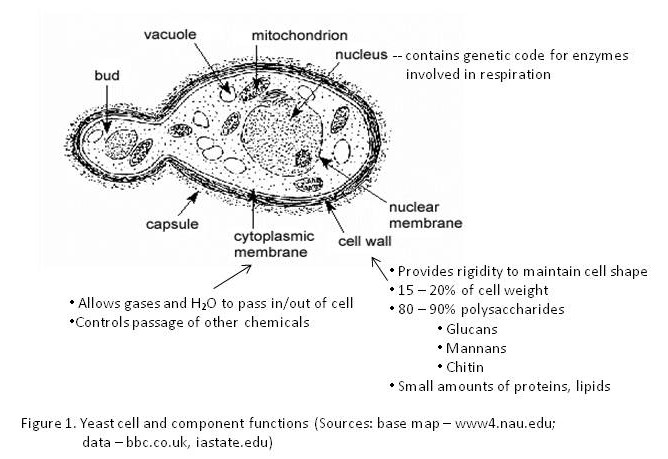
Murli Dharmadhikan (Yeast Autolysis, extension.iastste.edu) defines yeast autolysis as "... self-destruction of the cellular constituents of a cell by its own enzymes" following its death. Figure 1 below shows the component parts of a healthy yeast cell while Figure 2 shows an overview of the process  -- autolysis -- that occurs once that yeast cell has consumed all of the available nutrients and dies. At a high level, autolysis encompasses (i) the degradation of intracellular materials and (ii) degradation of the cell wall.


The detailed autolysis process is shown in Figure 3 below. The yeast extract, product of the degradation of intra-cellular material, is confined to the cell until such time as the cell wall becomes porous enough to allow the material to seep out. It should be noted that degradation and compound creation continues outside the degraded cell walls.

Figure 3. Details of yeast autolysis
The lees-aged wine is enriched by the compounds released during the constituent-degradation process.
Red Wines
There is no pre-fermentation cold soak nor is any sulfur added anywhere in the processing. The red wines are mostly whole-cluster-fermented for 14 -17 days with indigenous yeasts in open-top fermenters after which they are transferred to cooperage for elévage. The exception is the Cabernet Franc which is fermented differentially in both closed and open-top fermenters. The benefits that accrue to the white wines from oak usage in elévage are relevant here also.

Whole Cluster Fermentation
Paul Adams (SevenfiftyDaily) identifies the following benefits from whole-cluster fermentation:
  • Influences the tannin character of the wine (due to stem inclusion)
  • Less intense color but the color that is there is more stable in that it is bound with the tannins
  • Provides air space among the grapes and creates channels for juice to flow and circulate
  • Helps dissipate the heat created by fermentation.
There is no pump over or punch downs for 7 - 10 days thus allowing carbonic maceration.  There is one punchdown per day after this initial period.

Carbonic Maceration
In this method of vinification the grapes are hand-picked in whole bunches and placed serially into the fermentation tank.  The weight of the most recently placed grapes causes the lower bunches to burst and the juice that is released begins to ferment.  The carbon dioxide that is released during this process causes in-berry fermentation and the production of brightly colored, low-tannin wines with a characteristic fruity flavor. 

********************************************************************************************************
Over two posts I have described the sources of the grapes and the winemaking process of Martin Woods Winery. Both elements are of the highest order and clearly explain the quality that the final product displays. The practices are in line with the best winemaking are in line with the best in Burgundy and is innovative in its extensive use of Oregon Oak in fermentation and elévage.

©Wine -- Mise en abyme

Tuesday, January 28, 2020

A tasting of Martin Woods (McMinnville, Oregon) wines: Fruit sources

Swilery, one of my favorite hometown wine bars, has been working with its distributors to provide focused tastings with artisanal winemakers from around the world. A case in point -- and the subject of this post -- was the early-November tasting of the wines of Martin Woods, a small Oregon-based producer of, primarily, Chardonnay and Pinot Noir. The winery was represented by Evan Martin who owns the enterprise along with his wife Sarah.

Evan Martin (Owner/Winemaker at Martin Woods), Natasia Lynn
And Frank Zaun (Terroir Selections)
I have not delved into the wines of Oregon at any depth and was very impressed with the offerings at this tasting. We sampled two Chardonnays, three Pinot Noirs, one Gamay, and a Cabernet Franc from the Walla Walla Valley AVA and the results drove me to further explore the source(s) of their quality. This exploration will be rolled out over two posts: this one, dealing with fruit sources, and a subsequent post detailing key aspects of the Martin Woods winemaking process.


Martin Woods' goal, according to Evan, is the production of single-vineyard wines with a sense of place, "textural elegance," "expressive aromas," and with long aging potential. High quality fruit is a key part of any winemaker's success and, if the winery does not grow its own, the winemaker has to be diligent to ensure reliable sources with verifiable track records and vineyard management practices that align with his/her philosophy.

Fruit for the Martin Woods wines are purchased from the Willamette Valley and Walla Walla Valley vineyards identified in the two charts below and are discussed further in the text following.


  • The Willakis Vineyard, sole source of the fruit for the Eola-Amity Hills Chardonnay, is owned by Erath Winery, itself a major producer of Oregon wines. The 298-acre hillside estate has 19 acres devoted to Chardonnay vines and 100 acres devoted to Pinot Noir. Willakia is 100% sustainably farmed and is certified by the LIVE and Salmon Safe programs.
  • Yamhill Valley Vineyards, another Chardonnay source, was originally planted (34 acres) to Pinot Noir in 1983. The area under vines has since expanded to 150 acres and Chardonnay vines.
  • Havlin Vineyard is a source of both Pinot Noir and Chardonnay grapes. This vineyard was first planted (10 acres) in 2008 with the Pinot Noir clones Pommard, 115, and 777. The vineyard has since expanded to 40 acres.
  • Hyland Vineyards, located in the foothills of the Coast Range, is one of Oregon's oldest and most storied vineyards. First planted in 1971, it sits on 200 acres -- 180 under vine. "For decades its fruit has produced many award-winning wines from benchmark producers under their own labels."
  • Seven Hills Vineyard and McClellan Estate in Walla Walla Valley are the sources for the Cabernet Franc grapes. Seven Hills was first planted in 1984 (one of the first commercial vineyards in the Walla Walla Valley AVA), was expanded to 20 acres in 1989, and further expanded to 200 acres in 1997. Vineyard management practices include vertically trained canopies and controlled cluster spacing. The fruit from this vineyard is currently sold to 25 producers.
One of the shared experiences of the Willamette Valley vineyards shown above is the influence of the Van Duzer Corridor. This pathway through the Coast Range funnels cool marine air into the Willamette Valley from the Pacific Ocean 30 miles to the west. This air moderates temperatures which, in turn, delays fruit ripening and preserves acidity. A specific component of the Van Duzer Corridor, lying between the McMinnville and Eola-Amity Hills AVAs, has been designated as an AVA. The main characteristics of the new AVA is captured in the chart below.


The fruit from these organically farmed vineyards are purchased under long-term contracts. It appears as though the fruit sources for the Martin Woods wines have the appropriate pedigree.

©Wine -- Mise en abyme

Tuesday, January 21, 2020

The DOC sparkling wines of Toscana, Italy

As aptly described on tripadvisor.com, "The achingly beautiful Tuscany region of Italy is a touchstone of art, food, and culture. Made up of stunning countrysides and distinguished cities, Tuscany is the perfect escape for gastronomes, cognoscenti, and fans of the Italian Renaissance." The characteristic Tuscan landscape is a blend of gently rolling hills (66.5% of the region's 22,985 sq. km) leading to steep-peaked mountains (25%) and plains (8.5%).

But Tuscany is also a wine powerhouse, ranking sixth among Italian regions in overall wine production and third in terms of DOP wine production. It is renowned for its red wines with Sangiovese ruling the roost in Chianti, Montalcino and Montepulciano, and Bordeaux varietals prominent in the Maremma region (especially Bolgheri and Suvereto) as well as having some presence in Chianti and Montalcino.

Climate and soil composition in Tuscany is location-dependent. For example, Chianti-based producers operate in a continental climate with galestro and albarese soils while their coastal counterparts operate in temperate climates with stone- and rock-imbued clay soils.

Tuscany's focus on Sangiovese and red wines is reflected in the relative paucity of sparkling wines in the region. As shown in the following chart, a total of six DOCs offer approximately 11 labels to the market.


The Pomino DOC is Metodo-Classico-only. Four of the remaining sparkling DOCs are Charmat while sparkling wines made in the Maremma Toscana DOC could utilize either the Charmat or Metodo Classico processes.

The dominant variety used in these sparkling wines is Trebbiano Toscana; Pomino DOC (Metodo Classico) makes use of the classic Italian version of the Champagne varieties (Chardonnay, Pinot Bianco, Pinot Nero).

Toscana sparkling wines live in the deep, dark shadows of their red, still counterparts. There are no indications that this will change anytime soon.


©Wine -- Mise en abyme

Wednesday, January 15, 2020

The DOC sparkling wines of Liguria, Italy

The world of Italian sparkling wine is vast. And I have been capturing it graphically, one region at a time. To date I have mapped Piemonte, Valle d'AostaLombardia, Friuli-Venezia Giulia, Trentino-Alto Adige, Veneto, and Emilia-Romagna. In this post I present a picture of Ligurian sparkling wines.

As shown in the map below, Liguria, the third smallest of the Italian regions, hugs the coast of the Gulf of Genoa and the Ligurian Sea in a thin semi-circle that runs from France to Tuscany. Squeezed between the Maritime Alps, the Ligurian Apennines, and the sea, this relatively skinny region is sized at 5422 km2 and is home to a population numbering 1.567 million.

The region is characterized by mountainous hinterlands and a lengthy coastline which is itself separated into the Riviera di Ponente and Riviera di Levante by the capital city of Genoa. The cliffs of the former fall to the sea whiole the latter is noted for its bays and beaches.

Liguria has a relatively warm climate given its northerly location. There is some agricultural activity in the region -- mainly flowers, olive trees, and vineyards -- but the bulk of economic activity is attributable to tourism and shipping through the ports.

The region supports about 6000 ha of vineyards, of which 500 ha is DOC. Vineyards are small and non-contiguous with most of the wine produced by artisans who grow, tend, and harvest the grapes heroically on steep limestone slopes. Annual wine production is approximately 280,000 hL, of which 75% is white. Only Valle d'Aosta produces less wine than does Liguria.

As shown in the chart below, sparkling wine is produced in the Val Polcèvera and Golfo del Tigullio - Portofino DOCs.


In both of these DOCs, Bianchetto Genovese and Vermentino are featured players while a variety called Albarola is additionally given prominence in Val Polcèvera DOC. It should be noted that a 2009 DNA study has concluded that Albarola and Bianchetto Genovese are genetically identical.

As was the case in Valle d'Aosta, neither Chardonnay, Pinot Nero, or Pinot Bianco feature in the production of sparkling wine in Liguria.

Abissi Sparkling Wine
Bisson Winery has been aging its Metodo Classico wines in 60 meters of water off the coast of Portofino since 2005. The wines -- there are three of them: Spumante Classico, Spumante Riserva, and Spumante Rosé -- are fermented traditionally to produce the base wines and are then bottled and lowered into the sea in July so that the second fermentation can be completed in the anaerobic conditions below the surface of the water.

The Spumante Classico and Riserva are blends of Bianchetto Genovese, Vermentino, and a third cultivar called Cimixià. The Rosé is a blend of Granaccia and Ciliegiolo.

The innovative method of aging is the brainchild of Pierluigi Lugano, the enterprise's winemaker. "When the wine bottles are picked up, they are enriched with incrustations (sic), seaweeds (and sometimes shellfishes, too) ... For health and sanitary reasons, bottles are then dried and wrapped under a protective, clear film, which also serves the purpose of preserving the natural ornament made by the sea,"

Source: Cellartracker.com

©Wine -- Mise en abyme