Friday, November 29, 2019

The DOC(G) sparkling wines of Piemonte

I have been contemplating the construction of an Italian Sparkling Wine Map -- akin to the one I developed for France -- for a while. Every time I sat down to begin the effort, though, I would retreat into a corner, cowed by the vast amount of data that exist and the paucity of real estate on which to model same. After continuously banging my head against the wall, I came to the conclusion that the only way forward -- in order to be as comprehensive as I wanted to be -- was to attack the problem in bite-sized chunks; that is, one region at a time. To that end I have put together the Sparkling Wines of Piemonte map shown below. One look at this map will alert the reader as to the impossibility of capturing the entirety of Italian sparkling wine production on a single chart.


While the region is best known for its Nebbiolo grapes, and the resulting Barolo and Barbaresco wines, the above map shows that many of the appellations provide frameworks for the production of sparkling wine. In most of the cases, the dominant DOC variety serves as the source material. If the producer does desire to do so, he/she could also utilize the much more forgiving Piemonte DOC for sparkling wine production.

The map shows the designation under which sparkling wine is produced in each region and specifies the mix of allowed varieties and their relative proportions. The map also illustrates which wines are made via the Charmat Method and which use the traditional Champagne Method. The Champagne method utilizes re-fermentation in the bottle to produce its bubbles while the Charmat method accomplishes that goal in the following manner:
At the conclusion of alcoholic fermentation, the base wines are assembled into batches and pumped into large, sealed tanks (autoclaves) for the secondary fermentation. Sugar and yeast are added to the tanks and the consumption of the sugar by the yeast results in the Carbon Dioxide that gives the sparkling characteristic to the finished wine.  This method of sparkling wine production is called the Italian (because it was first demonstrated as industrially viable by an Italian, Martinotti) or Charmat (the name of the Frenchman who refined the process such that it became feasible for large-scale industrial production), or Martinotti-Charmat method.  It is felt that this method preserves the aroma of the grapes yielding fruity, floral wines. This second fermentation can run between 20 days and 3 months after which the wine is bottled.
Selected Piemonte sparkling wines are discussed below.

Asti DOCG
Asti DOCG is by far the largest sparkling wine appellation in Piemonte with 9700 ha under vine in 52 municipalities stretching across the provinces of Alessandria, Asti, and Cuneo. Most Asti production is via the Charmat method but, as the map shows, there is a designation for Asti Metodo Classico. The Moscato Bianco grape is used as the raw material for the Asti wine.

Muscat is a large family of grapevines characterized by a unique "muscat" flavor. Moscato Bianco is the primary member in that it is grown in every Italian region and is the key component in at least 13 DOC(G) wines (Moscato d'Alessandria and Moscato Giallo are also very important members of the family.). All red Muscat varieties are directly related to Moscato Bianco which, in addition, has parent-offspring relationships with the two Moscato's mentioned previously as well as Moscato di Scanzo, Moscato di Violetto, and Moscato Rosa.

Outside of Italy, Moscato Bianco has long been cultivated in many temperate European countries. Within Italy, it is mainly associated with Piemonte. In the 16th century, it was widely planted in Asti Alessandria, and Cuneo, with the most important centers of production being Canelli, Santo Stefano Belbo, and Loazzolo. A Moscato d'Asti Consortium was initially formed in 1932, two years prior to the formation of the similar Barolo organization.

The key details of Asti DOCG is presented in the chart immediately following.
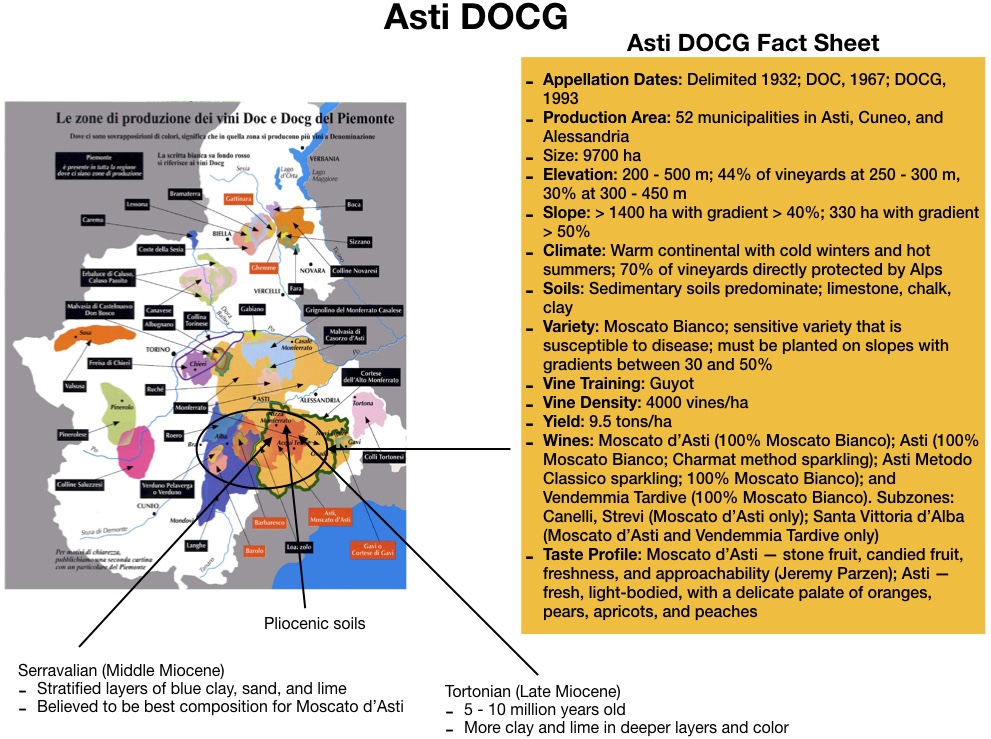

The Metodo Classico wine is produced using the Champenois method but the stars in this region are the Asti and Moscato d'Asti wines, both made using the Charmat method. The Charmat method is preferred, not only because of its lower cost of production and quicker-time-to-market, but also due to its ability to preserve the primary aromas of the variety through the process. The Asti production process is illustrated below.


Alta Langa DOCG
Alta Langa -- DOC in 2002, DOCG in 2011 -- is the new kid on the sparkling-wine block but the combination of its terroir, traditional Champagne varieties, traditional production method, skilled growers, and savvy producers bode well for the future.

The Alta Langa DOCG is spread over 142 communes in the provinces of Alessandria, Asti, and Cuneo. Given the geographic scope of the region, one encounters a variety of climates, exposures, elevations and soil types. In general, the soil is a mildly fertile calcareous clay marl.
Source: altalangadocg.com

Growers in the region have looked enviously at Champagne since the early 1800s. So much so that the Counts of Sumbay planted Chardonnay and Pinot Noir vines with an eye to making a Champagne-like sparkling wine. The chart below summarizes the history of the effort to make a Metodo Classico wine in Piemonte.


Vineyards are required to be planted at 250 m and above on the region's steep, terraced hillsides. Allowed varieties are Pinot Noir and Chardonnay and other non-aromatic grapes. Planting density is a minimum of 4000 vines/ha with the vines trained using the low espalier system and pruned traditional Guyot and spurred cordon. The maximum allowed yield is 11,000 kg/ha.

The Alta Langa producers -- 27 currently -- do not grow enough fruit to meet their needs but that gap is bridged with fruit from 80 growers who own their land and are guaranteed producer-payment for their grapes and labor.

The above two Piemonte sparkling wines would be the ones that most American consumers would encounter domestically.

Gavi/Cortese di Gavi DOCG
Villa Sparina Metodo Classico is produced at the Villa Sparina Resort and Winery, located in Monterotondo, the heart of Piemonte's Gavi DOCG. The facility was founded by the Moccagatta family in the 1970s. The location of the winery is shown in the following slide.


The estate sits on 100 ha, 70 of which are dedicated to grapes for the production of Gavi and Barbera.

Monterotondo is a cru for the Cortese grape of Gavi, the grape that is the basis for the Villa Sparina Metodo Classico Brut. The grapes are grown in vineyards resident at 250 - 300m altitude with mainly south and southwest exposures and soils of clay and marl. The vines are trained Guyot and are planted 4000 vines/ha density.

The grapes for the base wine are fermented in stainless steel tanks over a 3-week period. Second fermentation is carried out in bottles with the wine spending 36 months on its lees.

The wine had an initial breadfruit nose upon opening which gave way to a sweet white flower/fruit, citrus, citrus skin, pineapple and a steadily increasing pepper spice. Peach on the palate with a lemony-lime acidity. Medium weight, not as crisp as I prefer. Sparing, emaciated bubbles. Mineral persistence -- chalky clay -- on the palate. Short finish. The taste profile falls somewhere between a Franciacorta and a Prosecco; shaded towards the Prosecco end of the spectrum.

©Wine -- Mise en abyme

Saturday, November 23, 2019

On the cutting edge of Spanish wines: Quinta da Muradella's Muradella Blanco (DO Monterrei)

Panelists in a seminar titled Wines on the Cutting Edge -- one of the events that comprised Wines from Spain's Great Match Miami (November 5, 2019) -- proposed eight wines they viewed as fitting that description (as it relates to Spanish wines). The panel tasted and discussed four whites and four reds and I will report on each in individual posts. I covered Tajinaste's Blanco in a previous post and cover Quinta da Muradella's Muradella Blanco herein.

Panelists from left to right: Allegra Angela, Sommelier and
Beverage Director, Mandarin Oriental; Daniel Toral, Sommelier,
Florida Wine Company; Mia Van de Water MS, Eleven Madison
Park; and Michael Schacter, Editor of Spanish and South American
Wines, Wine Enthusiast (Panel Leader)

DO Monterrei
Quinta da Muradella is located in Galicia's DO Monterrei, which takes its name from the medieval castle which dominates the area.


Monterrei Castle

The DO falls within the Douro River Valley (as most of its vines are planted in the valleys along the Tamega River, itself a tributary of the Douro) and has two sub-zones (Slopes of Monterrei and Monterrei Valley) and three growing districts (Pazo de Monterrei, Oimbra, and Tamaguelos).

The climate is continental, warm and dry during the summer and very cold in the winter. The mountain ranges proximate to the DO, combined with its distance, limits the moderating influence of the Atlantic Ocean. The rain-shadow effect -- caused by the mountains -- limits annual rainfall to 23 inches, less than 1/4th the 93 inches experienced by Rais Baixas, a DO that is closer to the ocean.  During the ripening period, the area experiences 20-degree diurnal temperature variation.

Elevations in the DO range between 300 and 900 m.

There are three major soil types in the DO:
  1. Slate and Schist
  2. Granitic and sandy -- low pH soils resulting from the erosion of granitic rock
  3. Sedimentary.
Soil composition will vary depending on altitude.

Aromatic white varieties (Godello, Treixadura, Dona Blanco, Albarino) comprise 67% of all plantings.

Quinta da Muradella
Jose Luis Matteo, the owner and winemaker at the estate, has been described by Julia Harding MW (writing in Jancisrobinson.com) as a "skillful and intuitive winemaker." For his part, Jose Luis pursues "wines with fresher notes, mixed wines that reflect the balance of the vineyard and have ... good acidity." It should be noted that that is a challenging endeavor, given the Monterrei climate.

Jose Luis began making wine in 1991 to sell to patrons in his father's shop. Today he owns 14 ha and rents and borrows an additional 10 ha. A total of 36 small plots are spread across various elevations, aspects and soil types. Vineyards are managed as biodynamic but are certified organic, with head-pruned vines planted at 8000/ha.

Muradella Blanco
The Muradella is 100% Treixadura, a Galicia native that is naturally low in acidity and develops high sugar levels. It is generally used as a blending grape to mitigate the racy acidity of the the other whites actively utilized in the region. Its flavor profile includes citrus, apple, pear, and stone fruits.

The vines for this particular wine are 21 years old and reside on quartz soils. The fruit is placed -- 50% whole cluster, 50% whole berry -- into stainless steel tanks where they macerate for 48 hours. The first half of the fermentation (indigenous yeasts) is conducted in the stainless steel tanks after which the material is transferred into 3-year-old, 600 L barrels for completion of fermentation. The wine remains in barrel for 8 to 10 months before decantation into stainless steel tanks for another 12 months of residence. The wine is not filtered prior to bottling.

The 2015 Muradella Blanco had a textured nose: oyster shells, waxy minerality, and fennel. Savory on the palate with herbs and spices in abundance. Seashell flavor. Acidity not as bright as I would have liked. Chalky mineral finish.


The panelists felt that this wine would go well with shellfish. And they priced it at around $80.

This is a cutting-edge wine because of the treatment of this relatively obscure varietal by the "deft, light-handed winemaking of a skillful and intuitive winemaker."

©Wine -- Mise en abyme

Monday, November 18, 2019

Spanish wines on the cutting edge: Tenerife's Tajinaste Blanco

For the last two decades of the prior century, European winemaking was consumed with the  traditionalist versus modernist battles, a pre-occupation which did not avoid the Spanish industry. The modernist movement in Spain is encapsulated in Sarah Jane Evans MW description of new-wave Riojas:
What set the new-wave Riojas apart was their densely colored, super-concentrated character, which won new fans who liked bold, fruity reds. These wines were the result of a new focus on the vineyard, including specific clonal studies ..., reduced yields, fermentation in small, separate lots and aging in French oak. ... They were released after a shorter time in barrel and bottle.
Writing in The World of Fine Wines, Mike Steinberger, sees the modernist movement in retreat as a result of: changing sensibilities; global economic crisis; a renewed passion for the authentic, the local, the natural; and the waning influence of previously influential wine critics.

What is the new face of Spanish wines as the modernist movement retreats? According to panelists in a seminar titled Wines on the Cutting Edge, a part of Wines from Spain's Great Match Miami (November 5, 2019), it is a movement to different and unusual wines and areas.


The Wines on the Cutting Edge masterclass was helmed by Michael Schacter, Wine Enthusiast's Editor of Spanish and South American Wines. Other panelists were: Allegra Angela, Sommelier and Beverage Director, Mandarin Oriental; Daniel Toral, Sommelier, Florida Wine Company; and Mia Van de Water MS, Eleven Madison Park. The group tasted and discussed four whites and four reds that they considered as being on the cutting edge of Spanish wine. I will cover these wines individually beginning herein with the Tajinaste Blanco.


First, some background.

Tenerife is the largest island in the Canary Island archipelago, seven Atlantic-Ocean islands held under the Spanish flag. These islands were formed as a result of a mantle plume hotspot acting on the African plate as it wends its way to Morocco. The easternmost island -- Lanzarote -- emerged from the sea 20 million years ago while Hierro, the westernmost, was formed only 1 million years ago. Tenerife is dominated by El Teide, at 3,718 m (12,200 feet), the tallest mountain in Spain.

Tenerife's climate is tropical but is moderated by the mountain and the moisture-laden clouds brought to the area by the trade winds. These clouds are blocked by the mountain, depositing the moisture on its northern face and foothills.

Tajinaste Winery -- named after a flower that grows on the island -- is located in the valley at the foot of the mountain. The winery falls within the boundary of the DO Valle de la Orotava, a 400-ha appellation that spans the villages of La Orotava, Los Realjos, and Puerta de La Cruz. The winery is managed by Augustin Garcia Farrás, a Bordeaux-trained winemaker and scion of a family that has been making wines on Tenerife since the second decade of the 20th century. The winery owns 3 ha in the DO -- with the oldest vines planted since 1914 -- but, in addition, rents 9 ha under 25-year contracts and buys grapes from an additional 16 ha.

Vines on the estate are trained in the traditional braided-strand method (see pic below) wherein vine branches are braided together in large bunches of multiple strands:
  • Vine lengths range between 3 and 15 m
  • Allowed branches to be moved easily leaving the earth below free for the planting of other food crops
  • Evolved due to space constraints on the island.
Source:escapementmagazine.com

The wine under consideration -- Tajinaste Blanco -- is a blend of 90% Listan Blanco an 10% Albilo Criollo, the latter adding acidity to the wine. Listan Blanco is a white cultivar with "modest aromatic intensity" and is "crisp and  lively with lemon-lime and green apple flavors." One half of the fruit for this wine is grown at 500 m with the remainder grown at 250 m.

Listan Blanco (Palomino) cultivar

The grapes are harvested manually and placed into 15 kg boxes for transport to the winery. In the winery they are subjected to a 12-hour cold soak prior to a 8-day fermentation in stainless steel tanks and new French and American oak barrels (15%). The wines are aged in their fermentation vessels for 2 months before blending and bottling.


The 2018 Tajinaste Listan Blanco showed lime peel, lemon peel, turpentine, and guava on the nose. Brisk, clean, and zesty on the palate with tamarind flavors and minerality. A herb-laden aftertaste. Not an overly complicated wine. Can be drunk on its own but will pair well with seafood and white meats. This wine ranges between $20 and $22 at retail.

This wine is on the cutting edge because of one of the qualities identified by Mike Steinberger: a renewed passion for the authentic, the local, the natural.

  • This wine is made from a grape that is best known for its role in Sherry but it handles its leading role in this environment with flair
  • The vines used to grow these grapes have been around since 1914
  • The vine training system is just as old and it is sexy as hell
  • A current love for volcanic wines (see, for example, Zoltan Szabo's Volcanic Wines wherein, by the way, this winery is profiled)
  • Due to the volcanic soils, this area is Phylloxera-free and the vines own-rooted.

Yeah, I would say a cutting-edge wine. And a value-based one at that.

©Wine -- Mise en abyme

Tuesday, November 12, 2019

Sub-Zones versus crus: A conversation with a Brunello di Montalcino insider

I recently read Cathrine Todd's Forbes article titled Brunello di Montalcino's Grand Cru Vineyard, a paean to Montalcino's Montosoli vineyard. Having tasted the "creme de la creme" of 2010 Brunello di Montalcino's with Antonio Galloni, a tasting which did not include any of the Montosoli producers, I forwarded the article on to a Montalcino-resident estate manager to get their input on the cru. The response from my interlocutor expanded the discourse beyond my initial narrow query to one encompassing alternative mechanisms for interrogating the rich vinous diversity of Montalcino. Before exploring my colleague's discourse, I provide some context.

Brunello di Montalcino DOCG is, unquestionably, one of the leading red wine regions of Italy and the world but defining a typical Brunello is a challenge. According to Monty Waldin (Brunello: The many crus of Montalcino, Decanter, 3/19/15), 30 - 35% of Brunello is sourced from the cooler grounds north of the town (yielding paler Brunellos) with the remainder from the warmer south (darker colored, more overtly fruity, savory wines). Of course, producers can blend grapes from the two areas to ameliorate stylistic differences.

In an effort to gain an even finer definition of the wines, a sub-zoning proposal (spearheaded by wine writer and educator Kerin O'Keefe) -- with the nomenclature and relative characteristics indicated in the chart below -- has been advanced.


But all hands are not on board with this proposal. According to Waldin, "Vineyards zoned in less highly regarded spots may be penalized by the media and then by the marketplace." In a blog post passed on to me by my Montalcino whisperer, Stefano Cinelli Colombini, owner and winemaker at Fattori dei Barbi, states that sub-zoning only works on paper, given the diversity in Montalcino vineyards. In a response to one of the comments on his post he notes that, in mapped areas, soil and geography stays constant but weather and things associated with humans are changeable. "You cannot make a reliable map of quality areas," he says. Stefano foresees journalists creating a ranking between zones and it being very difficult to change these down the road "because important economic interests will be involved."

Waldin proposes a different path forward for those seeking to comprehend Montalcino's rich vinous diversity: "... break the region down into its constituent parts by familiarizing oneself with Brunellos from single vineyards or single terroirs." And he has provided the roadmap summarized in the table below.


My Montalcino compatriot is torn: "I will admit that I am confused and a little resistant to the Montalcino Cru argument while agreeing wholeheartedly about the very real and multiple manifestations of terroir in Montalcino. Montosoli is indeed a great site (depending on vintage) but there are many others emerging and the most sought after land these days is high altitude (see the €1 million/ha purchase price at Villa Le Prata) due to the sad effects of climate change. However, in Montalcino it is always about the vintage/position combo so I am reluctant to see one area lauded above all others. Nature tends to give all areas a turn at greatness."

Continuing: "I agree ... that it is not useful to apply a podium paradigm to Montalcino wines, vis-à-vis single versus blended, vineyard against another -- what I enjoy sharing with visitors are the differences between the sub-zones and the different aspects of each that emerge depending on vintage and canopy management."

That being said, my Montalcino friend is considering creating a new label for some of the estate's high-altitude vines. Sometimes Montalcino leaves the best of us "confused."

©Wine -- Mise en abyme

Sunday, November 10, 2019

A tasting of selected F. E. Trimbach wines with Jean Trimbach and George Miliotes MS at Wine Bar George (Orlando, FL)

I have been a fan of Trimbach wines since an epic, Jean-Trimbach-led tasting of the estate's high flyers (Clos Ste Hune, "Cuvée Frédéric Emilé") at the 2015 edition of TEXSOM. The quality of the wines, and Jean's dry-humor presentation style, render Trimbach tastings must-attend events. Jean recently brought his wines and style to a tasting at Orlando's Wine Bar George. I report on that tasting in this post.

The tasting was late getting started due to a delay in Jean transiting from a Disney event to Wine Bar George. That fact was quickly buried once Jean took the microphone into his hands.

Jean Trimbach and George Miliotes MS

The Trimbach family has been making wines in Alsace since 1626 and, according to Jean, three generations are currently involved in the functioning of the enterprise: the 11th generation, Bernard and Hubert, remain integrally involved in the business; the daily operations are managed by the 12th generation, the brothers Pierre and Jean; and Anne and Julien, members of the 13th generation, have recently entered the business.

Jean was fulsome in his praise of the microclimate governing the Alsace vineyards. He especially mentioned the Vosges Mountains which serves to protect the vineyards from cold winds and also, through its rainshadow effect, minimizes the amount of rainfall to which the area is exposed.

Trimbach's 55 ha of vineyards are located primarily in Ribeauvillé and surrounding towns (limestone-dominant soils) with a 2-ha plot in the granitic Grand Cru of Schlossberg. The distribution of the Trimbach vineyards are shown in the chart below.


As shown in the table below, Trimbach produces a wide array of wines. In general, the estate hand-harvests at maximum ripeness and transports the resulting fruit to the winery for further processing. At the winery the grapes are gently pressed and fermented in stainless steel -- and/or concrete vats -- for 2 to 3 weeks. The wine is bottled early to preserve freshness and retained in the cellar for a number of years before release on the market.


The figure below shows the subset of Trimbach wines that were included in the tasting.

Tasting Lineup

The first flight was comprised of the 2014 F. E. Trimbach Pinot-Gris "Réserve" and the 2012 Pinot-Gris "Réserve Personnelle" paired with a Big Board of Charcuterie.

The Big Board

According to Jean, Pinot Gris is a natural mutation from Pinot Noir and is very sensitive to rot. It takes on sugar rapidly and ripens easily. Fruit for the Réserve is sourced from estate and grower vineyards while the Réserve Personnelle is made from estate fruit only. 2014 was not an easy vintage, visited as it was by heavy rains and grey rot. In comparison, 2012 was a serene vintage.

The "Réserve Personnelle" was harvested close to vendages tardives (late harvest) level. This wine had a golden color with sweet white fruit and a honeyed nose. Rich, thick, honeyed on the first pass, giving way to a chalky minerality with citrus skin and spice.

The 2014 Réserve was fermented in a mix of stainless steel and concrete vats. Mustier smelling than its stable mate with lower levels of honey. More acid on the palate with a hint of oxidation. Relatively austere. Lime and a chalky finish.

The second flight included a 2015 Riesling Réserve and a 2015 Riesling Sélection de Vieilles Vignes, paired with a Frisée Salad.

Frisée Salad

Jean stipulated that 50% of Trimbach's production is Riesling. The 2015 vintage experienced very hot conditions but the grapes surprised winemakers by retaining high levels of acidity.

All grapes for the Riesling Réserve were rigorously selected from Trimbach vineyards in and around Ribeauvillé. The wine shows a waxiness, dried herbs, lime, and stone fruits on the nose. Light and crisp with a lengthy finish. Jean sees this wine as the steelier of the two.

The Vieilles Vignes label was produced for the first time in 2009 and the wine is always "softer" than the Réserve. Grapes were sourced from 50-year-old vines grown on marl and limestone parcels in Ribeauvillé-area vineyards. This wine had a clean nose with a lime-infused freshness, stone fruit, and minerality. Powerful and concentrated on the palate with a hint of pear. A lengthy mineral finish.

Next up was the 2011 Gewürtztraminer "Cuvée des Seigneurs de Ribeaupierre", accompanied by Crispy Mac & Cheese Bites.

Crispy Mac & Cheese Bites

Named in honor of the Lords of Ribeaupierre -- governors of Alsace during the Middle Ages -- this cuvée is only produced when the vintage is deemed to be of high enough quality. Grapes for this wine were sourced from 40-year-old vines from Ribeauvillé vineyards -- including Grand Cru Osterberg parcels.

Jean noted that 2011 had been a ripe vintage. The wine showed faded lychée and honeysuckle on the nose. Delicate and elegant on the palate. Balanced, with a lengthy finish.

The final dry-wine flight was the 2010 Riesling "Cuvée Frédéric Emile" and 2016 Riesling Grand Cru Schlossberg, both paired with an Ibérico Pork Pluma.

Iberico Pork Pluma

Grapes for the Riesling "Cuvée Frédéric Emile" were handpicked from the Geisberg and Osterberg Grand Cru vineyards. On the nose, petrol, citrus, and white flowers. Citrus, minerality and good acid levels on the palate. Medium weight. Mineral finish.

Schlossberg is the largest (80 ha) of the Alsace Grand Crus and Trimbach owns 2 ha therein. It was the first granitic vineyard that the estate owned so they had to learn its characteristics. Over time they have reduced the yields and have increased wine quality as a result. Only 400 cases are produced annually.

Restrained on the nose with hints of lemon-lime and petrol. Also restrained on the palate. Faded citrus and a mineral finish. I liked this wine a lot.

The dessert pairing was the 2007 Gewürtztraminer "Vendanges Tardives" with an Orange Blossom Trifle.

Orange Blossom Trifle

This late-harvest Gewürtztraminer is made with grapes sourced from Grand Cru Osterberg in Ribeauvillé and very old vines planted at the Muelforst site in Hunawihr. Lychee, apricot, peaches, and honey on the nose. Fresh and elegant, with purity of fruit. Honeyed, with a lengthy finish.

Jean Trimbach and the author

Wine Bar George staffers

Group pic

This was a wonderful tasting. The wines showed well, Jean showed well, the food was excellent, and the group's rendition of "Bring back my Trimbach to me" -- led, of course, by Jean, was memorable.

I have been to a few of these tastings at Wine Bar George and I am pleased at the commitment that George has shown by leveraging his contacts and acquaintances into high-quality tasting experiences for Orlando residents.


©Wine -- Mise en abyme

Thursday, October 24, 2019

Alsace: Landscape creation

At a recent tasting of Trimbach wines held at Orlando's Wine Bar George, Jean Trimbach noted that the Alsace region was geologically unique and home to 800 different soil compositions. Wines of Alsace supports this contention: "Experts say if you walk 100 feet in any direction, you'll find a different soil composition, making Alsace a complex mosaic unlike any other wine region." I explore the origin of these soils in this post.

I have elsewhere described the Variscan Orogeny (380 - 280 mya) -- the mountain building resulting from collision of Gondwana and Euramerica and the formation of the supercontinent Pangea -- and note that at its conclusion, the current Vosges Mountain (France) and Black Forest (Germany) was a single north-south mountain range.

Nothing is ever static in nature though. Over millions of years, the range was eroded. Further, warming temperatures resulted in sea level rise and the submersion of the mountain range. The following chart shows depositional activity on the range over the ages.

Sedimentary deposits on the north-south mountain
and the succeeding Rhine Graben, Vosges Mountain,
and Black Forest (Source: moore.no)

During the Triassic period, sandstone, limestone, and marl layers accumulated over the mountain range. Eroded sand from the continents were transported to, and deposited in, the shallow seas (Bunsandstein). The remains of shelled organisms compressed the sand below -- while creating a layer of their own (Muschelkalk) -- leading to the creation of sandstone. This shelled layer eventually became a limestone layer. The Keuper (marl) layer is the youngest of the three and was formed by 'clay-sized particles of clay minerals, limestone, and organic material."

Another 570 - 790 m of sedimentation were laid down during the Jurassic area. Deposits were marls and limestone containing gypsum, iron, and fluorite.

The third of the significant European-landscape-creating Orogenies was the Alpine Orogeny which occurred about 50 mya and resulted from the collision of the European and African plates. This collision uplifted the north-south mountain range, cracking the Jurassic rock and causing a collapse of its central portion along two fault lines. The Jurassic and Triassic strata overlying the uplift were shed, with the shoulders of the graben bared to the basement granites. These shoulders became the Vosges of Alsace and the Black Forest of Germany.

Uplift was less intense in the north and, as a result, some of its Triassic sandstone was retained. Based on this uplift dichotomy, the southern Vosges is referred to as the High or Crystalline Vosges while the northern portion is referred to as the low or Sandstone Vosges.

"... the western side of the graben was not one clean break but a series of somewhat sinuous faults stepping down to the central gutter. The westernmost fracture is a major break along the base of the mountain known as the Vosges Fault. A second major break, sometimes as much as 3 km east of the Vosges Fault, is known as the Rhine Fault" (Wilson). The step faults -- "fault bundles" -- show minor displacement but are cut into criss-cross patterns by cross faults. Differential erosions of these fault blocks have produced low hills  -- the sub-Vosges Hills -- each with its own erosion-determined dominant strata, upon which the bulk of the Alsace vineyards lie.

The extent and a cross-section of the Rhine Graben are shown in the two charts following.


Cross-Section of Rhine Graben (Source:vinsalsace.com)

During the Oligocene era, the Jurassic and Triassic rocks in the lower parts of the valley were converted to limestone-rich marly conglomerates. At this time, the rock composition of the structural units were as follows:

  • Vosges Mountains -- Granite and sandstone; sometimes shales
  • Sub-Vosges Hills -- Incredible soil diversity
  • Rhine alluvial plain -- Marl and alluvium.

During the Quaternary period the Vosges was subjected to glaciation down to the 1000 m altitude with a resultant scraping of the Triassic layers and revelation of the underlying granite. Below 1000 m the granite remains covered by sandstone.

The valley floor has been filled with water on numerous occasions with the associated carriage and deposition of fertile soil material.

In this post I have identified the origin and interplay of rock types in the Alsace region. In an upcoming post I will describe how these rocks relate to the soil types in place today.

©Wine -- Mise en abyme

Sunday, October 13, 2019

Augustan Wine Imports as seen through a rearview mirror: Interview with Proal Perry, founder

I recently saw that Proal Perry and his wife are now engaged in managing a B&B in North Carolina. That brought to mind an interview I conducted with him nine years ago to gain his perspective on the current and future state of the regional wine market and to expound on what actions, if any, he had taken to ensure that the company retained its relevance in those tumultuous times.  The interview took place at one of the most beautiful outdoor restaurant locations in the metro-Orlando area: the dock on the lake at the then Houston's.  Augustan had brought its local customers together on the dock for a lunch-time introduction of the Talley Vineyards offerings. I reported on that interview in three separate posts but have consolidated them herein in my effort to honor him for his contributions to the Orlando Wine Scene.


Once the customers and Augustan staffers had vacated the premises, Proal and I had the dock to ourselves and settled down for what turned out to be a wide-ranging discourse on the origin and evolution of Augustan Wine Imports, the company philosophy and operating principles, and the state of the broader wine industry.

Proal Perry has a restaurant background and one of his frustrations while in that space was the unavailability of small-producer, estate-bottled wines in the Florida market.  Proal was trying to exit the restaurant business and began looking at opportunities to address this niche.  Bruce Neyers, the National Sales Director for the then fledgeling Kermit Lynch Wine Merchants, came to Florida at that time seeking a distributor for the company's products and suggested that Proal form a company for that express purpose.  Proal listened and Augustan Wine Imports was launched in 1993.  Proal's wife Connie joined the business 1 year later to focus on business operations while he focused on sales.

A number of factors contributed to the early-life success of Augustan: (i) the timing was right; (ii) Augustan was exploiting a niche that was unserved; (iii) there was little competition; and (iv) Augustan was not viewed as a threat by the large distributors.  Augustan was, according to Proal, one of the first small distributors in the state and after its initial success a number of smaller players entered the market.  There are now over 200 licensed distributors in the state.

As Augustan began doing business across the state, its business model became problematic.  The logistics costs associated with a small company trying to distribute small-estate wines across the state was steadily eroding profitability.  By this time, the company had brought on a number of European and domestic producers but had only one distribution center in South Florida from which to dispatch products across the state.  Distributing product to the Panhandle could mean that a truck would be gone for three days and be empty for two of those days.  If the company wanted to extend the model across the state efficiently and effectively, another path would have to be pursued.

The chosen path was a partnership with Premier Beverage.  Premier saw prestige value in Augustan and preserved that value by allowing its management to retain a high degree of autonomy and independence.  Augustan saw value in Premier's distribution muscle (4 distribution centers across the state) and willingness to provide an environment wherein the founding vision of the company could be pursued in an untrammeled fashion.  Further, the partnership would allow Augustan to become even more specialized as it would now be representing a smaller group of suppliers.

Augustan Wine Imports” goal is to be the most-valued company in the space where their upper-tier customers are doing business. Meeting this goal requires, according to Proal, that the company exhibit the following characteristics: quality of service; knowledge; education; creativity; and innovativeness.

The critical success factors (CSFs) for goal attainment are (i) provision of high-quality wines to the market and (ii) the fostering of an entrepreneurial culture within the organization. The first CSF is of paramount importance and the company has implemented a rigorous screening process to ensure that only the highest-quality wines are offered to its customers. The second CSF is being addressed by giving a strong sense of ownership to the people in the field. The message from management to the field is “We are lending you a $1 million+ business that you should treat as your own. Invest in yourself by continually acquiring wine and industry knowledge and we will give you the support required to ensure your success.” A forcing function for this new management approach was Daniel Pink’s book Drive: The Surprising Truth About What Motivates Us.


According to Proal, “The carrot and stick approach does not work; a perception of mastery of your environment does.”


Proal believes that commissioned sales forces spend too much time “chasing the money” and not enough time servicing the customer. In the Augustan scheme, salespersons are salaried and this allows them to devote whatever time is necessary to ensure a satisfied customer. In addition to salaries, salespersons have benefits packages and expense accounts. Proal sees the latter as an essential element of the salesperson “managing his/her own company.”

Augustan has a strong support structure facilitating the activities of the field force. The General Manager/Sales Manager reports directly to Proal and is charged with balancing responsibilities across the company. Two Portfolio Managers – one responsible for the U.S. and the other for the rest of the world – handle issues such as inventory, profitability, costing, and supplier contact and coordination. The Marketing Specialist handles referrals (The Company only solicits “iconic” wines.). New opportunities are assessed as a group. A prospect wine is tasted blind and assessed both on its own merit as well as against other potential entrants. Price does not enter the assessment until after the wine has been judged to have the type of quality that Augustan is pursuing.

When asked to categorize Augustan’s customers, Proal indicated that this was an issue they have been wrestling with for a while and had not fully resolved. Historically, a disproportionate share of the business had been with the restaurant trade but that is now down to 60% from the 70% level. On the retail side, they only do business with independent fine wine retailers. The retailers who depend on Wine Spectator “shelf talkers” are not their preferred customers. He wants customers who: (i) understand what distinguishes Augustan from the competition; (ii) want to partner with Augustan; and (iii) Augustan wants to partner with. Proal cites Tim’s Wine Market as an example of the ideal Augustan customer. Tim’s has been an Augustan customer from day 1 and, 15 years on, remains one of the company’s best customers.

Prior to the onset of the current recession, there was already a move to greater concentration in the industry.  This was a troubling trend, in Proal's view, because larger companies tend to be less forward-looking than their smaller, nimbler counterparts.  Proal likes the idea of a large number of distributors in the Florida market as it results in more wine choices for the consumer and leads to stronger wine consumption.  On the other side of the equation, wine sales are inhibited by a lack of consumer knowledge and an intimidation factor.  Retailers have seized the opportunity to increase their sales by allaying the fears of, and providing education to, retail-level customers.

According to Proal, high-end wineries have historically been loath to sell their wines to independent retailers.  Rather, they have wanted their wines sold in restaurants because of the belief that that channel provided the greatest exposure for both the wine and the winery: the wine is prominently displayed on the wine list; the bottle is brought to the table and consumed by multiple persons; and while the wine is being consumed, the bottle is on display on the table for other diners to see.  Not so for the independent retailer, according to the wineries.  These high-end wines are never displayed on the racks in the store.  Rather, the retailer makes them available only to his/her best customers in a dark back room from where it goes into a collector's cellar never having seen the light of day.  And having provided no broad-based exposure to the winery in that market.

In today's straitened environment very few wineries are placing restrictions on where their wines can be sold due, in large part, to the current restaurant environment.  It has been a difficult time for small operators who, in many cases, lack the capital to ride through the rough times.  Further, it is toxic for startups who, even in the best of times, require two years from startup to profitability.


Proal Perry with the Talley Vineyards winery Rep.

On the consumer side, Proal sees the "top-end" buyers continuing to spend on their favorite collectibles.  It is the "aspirants," as he calls them, who have retreated from the market.  This particular type of customer lacked wine knowledge but bought it because it was "cool" and bestowed "status" on the consumer.  In today's environment this type of consumer has fallen back to wines that are more moderately priced.

With the "aspirants" retreating to the lower-priced end of the market, this segment is showing a marked propensity for trying a more diverse array of wines: diverse both in terms of styles and geography.  And producers are responding.  Good value wines from around the world have increased their presence significantly over the past two years, with independent retailers leading the way in providing customers with exposure to these products.

Proal sees the current market dynamics enduring for some time.  As he sees it, the $50-$75 retail price range has been hurt badly and may never regain its prior elevated levels.  The <$30 market, on the other hand, will continue to be robust going forward, especially given the fact that the quality of the wines produced at that level has improved dramatically over the past 5 years.  It has, historically, been been difficult to get "big spenders" to try lower-priced wines but as the quality of these wines have improved, they have become more open to giving them a try.

Given the foregoing market dynamics, and a strong sense that the <$30 market will continue to grow, Augustan has focused all of its referral assessment activity on that space.  Iconic (read high-end) wines will continue to be pursued as the opportunities present themselves.  A full listing of the Augustan portfolio can be viewed here.

With market positioning set, Augustan has to take all of the necessary steps to ensure that its customers are on board and are prepared to carry that message on to the ultimate consumer. Augustan eschews the trade-show-type approach in favor of education-themed interactions with its customers which provides those retailers with the tools to then educate the end customer.  For example, last year, the company brought many of its producers to Florida for a three-city road show where small groups of customers had dedicated interaction time with each producer over a four-hour period.  This year the company is doing a number of education-themed sessions with customers in various markets to include a Fall show in the Orlando market where Master Sommelier Andrew McNamara will be leading a seminar on Grower Champagne and South America.


©Wine -- Mise en abyme