Tuesday, October 8, 2019

Differing perspectives on the constituent components of the historic To Kalon Vineyard

The recently amended lawsuit filed by Jeremy Nickel (Vineyard House Winery) against Constellation Brands has revealed a divergence in the narrative as to the constituent parts of the historic vineyard. As shown in the chart below, William Heintz, a famous Napa historian, ajudged the To-Kalon Vineyard to be comprised of the 1868, 1879 (rather than 1881) and 1891 parcels. On the right side of the chart, Nickel postulates that the 1991 parcel is excluded and replaced by an 1868 Crabb purchase of a 168-acre parcel. I will explore these two positions in this post.

1881 Parcel was actually bought in 1879

Sizing the historic To-Kalon Vineyard
The To-Kalon Vineyard National Register nomination proposes that the To Kalon Vineyard did measure 500 acres during Crabb's lifetime and cites a number of sources to support that position:
  • An 1883 article in the San Francisco Merchant (12/21/1883) refers to a 500-acre Crabb estate (prior to the purchase of the Baldridge Tract) as did the San Francisco Call, Volume 68, Number 141 (10/19/1890).
  • According to the nomination, "Multiple primary source references corroborate that at its peak, the pre-Prohibition To-Kalon Vineyard included approximately 500 acres of planted vines ..."
The case for the inclusion of the Baldridge Tract (1889 purchase)
Let's begin with the Nickel story. According to the Nickel telling, Crabb bought the 168-acre hillside property from William Baldridge in 1889, bringing his total holdings to 527 acres, a number close to the 500 acres that is mentioned in multiple contemporary sources as the size of the To Kalon Vineyard. In this telling, this new purchase became a part of the To-Kalon estate. According to the Nickel telling, the 1891 purchase was not part of the historical To Kalon because Crabb sold it back to the Davis family one week after purchase.

The case for the inclusion of the 1891 purchase
The nomination also stipulates as to why the 1891 purchase was included as a component of the historic To-Kalon Vineyard:
  • Crabb had planted the first vines on this property (at that time owned by his in-laws-to-be) in 1873 and had been purchasing the fruit to include in his To-Kalon wines since 1879.
  • Crabb purchased the land at auction in 1891 and immediately sold it back to his daughter-in-law via a mortgage valued at one-third the price he had paid for the property just seven days earlier. In 1893 he filed a quitclaim deed for the property and Margarethe Davis (his daughter-in-law) sells the property to A. L. Williams in November of the following year.
  • Prior to the 1891 purchase, Crabb regularly referred to the parcel as his own
  • According to the nomination,, "Additional primary sources state that the historic To-Kalon Vineyard was contiguous and stretched from the highway back to the foothills."
Factors that mitigate against the inclusion of the Baldridge Tract
Based on the nomination:
  • "Additional primary sources state that the historic To-Kalon Vineyard was contiguous and stretched from the highway back to the foothills"
  • The Crabb probate lists the To Kalon Vineyard (359 acres after the sale of the 1891 purchase) and Baldridge Tract separately
  • The Baldridge Tract is "valued to lumber and having no vines planted on it"
  • A 1917 mortgage from the Churchills separates the To-Kalon Vineyard and the now-Sullivan Tract
  • Aerial photographs from the 1940s, 1950s, and 1960s show the hillside plot under forest
  • The first vines were planted on the hillsides (now the homes of Harlan, Futo, and Vineyard House Winery) by Doug Stelling sometime around 1980.
This Blog's Position Going Forward
Based on the apparent use of the fruit from the 1891 plot in To Kalon wines during his lifetime, and the apparent introduction of vines to the Baldridge Tract during the Stelling Period in the 1980s, this blog will consider the historic To Kalon Vineyard as being comprised of the Crabb tracts purchased in 1868, 1879, and 1891.


©Wine -- Mise en abyme

Saturday, October 5, 2019

Cress Restaurant (DeLand, FL) is back (and is serving lunch to boot)

Cress Restaurant is back. Long one of the leading restaurants in the Greater Orlando area, this creation of Chef Hari Pulapaka, and his wife Jenneffer, had been withdrawn from daily operations and, instead, presented as a special-events/limited-operations entity. This "retreat" was driven by the growth in civic and charitable causes to which the owners had became devoted while still holding down full-time jobs (he as a Math Professor at Stetson, she as a Podiatrist).

But buttressed by a brand new team, Cress has resumed normal dinner operations (Tuesday through Saturday) and has expanded to now include lunch service (Tuesday through Friday). The new members of the team are:
  • Tom Brandt, General Manager and Co-Owner
  • Suran Brandt, Manager
  • Sam Bove, Executive Sous Chef
I had not dined at the restaurant since its return to full service but corrected that by making a reservation for the first day of its lunch service. The city was in the midst of a road-beautification project on the day of my visit so we had to park some distance away from the destination and lug our wine bags back. Our pain was diminished significantly by Suran's warm welcome. There were some changes to the decor but overall it was the same inviting space that I had come to know and love.

We were shown to our seats and presented with the lunch menu. I loved it at first sight: substantial offerings in categories titled Soups, Salads, Appetizers/Sharing Plates, Sandwiches, Signature Mains, and Sweet Plates. I sat back and popped a cork. It was going to be a long day.

I started out with the Bell & Evans Chicken and Andouille Gumbo: chunks of chicken and sausage in a thick, rich, spicy sauce. A slightly rustic taste with a note of acidity. Parlo went for the North African Lentil Stew for her soup course. I tasted and it was awesome.

Bell & Evans Chicken and Andouille Gumbo
with steamed rice and parsley

North African Lentil Stew with harissa toast.
mint, lemon

Parlo and I shared the Signature Escargot. This dish has always been one of my favorites on the dinner menu and it did not disappoint this time. Mushroom as a through line.

Signature Escargot with clarified butter, garlic,
mushrooms, and grilled bread


I have had Pork Belly at Cress before but not suited up in this manner. I do not like bread getting between me and my pork belly so I disrobed it to reveal the thick juicy slab of PB nestled within. It went well with the accompanying fire-roasted vegetables. Substantial and tasty.

Berkshire Pork Belly Banh Mi with sauce
 Manchurian, house slaw, spiced peanuts,
cilantro, mint

For my main dish I had the Tikka Masala curry but also snared some of Saru's Creole Shrimp and Cress Grits. The Tikka Masala is a Cress staple and was just as good as ever. The Shrimp and Grits did not disappoint.


Tikka Masala Curry with Tofu and vegetables,
steamed basmati rice, garlic naan, cilantro

At the end of the service Chef Hari came over and spent some time with us. He was in a very relaxed mood and seemed especially pleased with the current state of affairs. As we lauded him on the dishes, he again stressed the importance of spices in his cuisine (the through line, he said).

Chef Hari

The team

Orange Infused Vanilla Bean Créme Brûlée with fresh berries,
strawberries

We also got to spend some quality time with Suran once her duties were complete. We sat around talking and drinking and then took the party over to The Elusive Grape. Just like we always do.

I am wishing this incarnation of Cress Restaurant all the best. They have all of the ingredients in place to be successful. Tom brings significant restaurant management experience to the table, as does Suran. This frees up Chef Hari to focus on the menu and training the Sous Chefs and Jenneffer to focus on the wines and wine pairings. It also allows them to travel to civic/charitable commitments knowing that things will continue apace on the home front.

If you have not visited the restaurant, now is as good a time as any. If you have visited previously, try lunch. Please note that this is not an unbiased review of this restaurant: I like the people and I like the food.

©Wine -- Mise en abyme

Wednesday, October 2, 2019

To Kalon: Land or Brand?

Constellation Brands, the company behind brands such as Robert Mondavi, Kim Crawford, The Prisoner, Corona Extra, and SVEDKA Vodka, is currently engaged in a Goliath-versus-David battle to overturn the creek-naming iniative of the MacDonald brothers and, in so doing, strengthen its argument that "To Kalon is a brand, not a place." In this post I provide some background to this 'conflict."

I like to say that I have written the second best history of Oakville's To Kalon Vineyard, with Matt Stamp's effort on Guildsomm being demonstrably the best. What both efforts have in common, though, are the testimonies and documents on the vineyards provided by the MacDonald brothers, Alex and Graeme. In addition to providing 90% of the fruit for the Robert Mondavi To Kalon label, a large portion of the fruit for the Mondavi Reserve, and the fruit for their limited-production wine, the MacDonalds are avid preservationists and curators of the history of the land on which they ply their trade.

The MacDonalds believe that "... there is a genealogy of the land and that we have a responsibility to preserve that history for future generations." Towards that end they have conducted extensive research on the origin, owners, and utilization of the To Kalon Vineyard through the ages and have freely shared their findings with all interested parties.


In addition, they have:
  • Registered the creek running through the vineyard as To Kalon Creek with the US Board of Geographic Names
  • Published the To-Kalon Vineyard Historic American Landscape Survey
  • Submitted a To-Kalon Vineyard National Register of Historic Places nomination with the National Park Service
Constellation has appealed the creek-naming effort on the grounds that To Kalon Vineyard is a brand and not a place.

The To Kalon name has been embroiled in a number of legal battles over the years. Robert Mondavi registered the name To Kalon in 1988 and To Kalon Vineyard in 1994, trademarks that came into the possession of Constellation with its purchase of Robert Mondavi in 2004. The first of the trademark battles was with Andy Beckstoffer.

Beckstoffer requires that winemakers purchasing his fruit designate the vineyard of origin on the wine label.  Schrader Cellars followed this dictate and placed the To Kalon name on the label of its 2000 Cabernet Sauvignon which was made from Beckstoffer-sourced grapes. Robert Mondavi promptly filed suit against Schrader and Beckstoffer for infringement of copyright.  After a year of back and forth the suit was settled with Mondavi granting a perpetual, royalty-free trademark license to Beckstoffer allowing him to use the To Kalon Vineyard designation for grapes grown on his part of the original Crabb estate.

In 2011 Constellation applied for three new trademarks -- To Kalon Wine Company, To Kalon Vineyard Company, and Rooted in To Kalon -- but abandoned those applications in the face of staunch opposition from Andy Beckstoffer "who argued that To Kalon is 'geographically descriptive.'"

More recently, Vineyard House Winery filed a claim to gain the right to use the To Kalon name based on (i) its small plot being in the original Crabb holdings, (ii) large portions of the current To Kalon Vineyard falling outside of those original holdings, and (iii) an assertion that the original trademark names were obtained fraudulently because To Kalon has always been a place name and, as such, is not "trademark-able." This case is still pending before the courts (The To-Kalon Vineyard Historic American Landscapes Survey stipulates that Crabb had purchased 165 hillside acres in Oakville, proximate to present-day Harlan Estate, but that his probate specified this land as used for timber production rather than being planted to vines.).

In an attempt to lure the brothers into their camp, the Constellation legal team, in a meeting at their New York offices, offered them the rights to use the To Kalon designation on their label in exchange for support of the removal of the To Kalon Creek name. In other words, to trade in their integrity for future monetary benefits (as the use of the word To Kalon on their label would allow the brothers to immediately increase the price of their wines into the range of current To Kalon offerings). The brothers demurred.

The MacDonalds' efforts to memorialize To Kalon as a place has received broad-based support, with 9 of 11 owners signing on for the National Register nomination and Constellation being the sole dissenter in the To Kalon Creek appeal. On a more global level, Antonio Galloni has spoken out in an Instagram post in support of To Kalon as a place:
What is at stake is not just the legacy of To Kalon but the entire concept of place in American wine... My position is clear: To Kalon is a place not a brand, no matter what might be written on some legal document somewhere. Napa Valley and the US need to protect the integrity of our sites ...
I also believe in To Kalon as a place and had provided Constellation with a path-forward to leveraging the brand acquired with the purchase of Schrader while further entrenching To Kalon as a place. In 2017 Schrader Vineyards sold its business to Constellation Brands for a little less than $50 million dollars (even though it owned no vineyard or winery). Schrader was a brand built on the marketing prowess of Schrader, the winemaking reputation and skills of Thomas Brown, and the quality of fruit and name recognition of the Beckstoffer Vineyard.

My thought process at that time was that Constellation intended to leverage the Schrader name into creating new branded products with fruit obtained from its own vineyards. Much as I had proposed in my discussion of the Vietti sale, Constellation could create a number of high-end vineyard designates from fruit that is "underutilized" today based on the prices that Beckstoffer To Kalon wines command.

In this model, Constellation would treat To Kalon as a cru with multiple owners (much as is done in Burgundy and Barolo), each practicing its own discipline but leveraging the reputation of the vineyard into ever-increasing rewards from the marketplace. The current commercial owners of To Kalon land are Andy, the Macdonald Family, the Detert Family, Opus One, and Constellation.

If Constellation focused on delivering premium lines from the property it owns in the historic vineyard -- the two large plots on either side of the Beckstoffer et al block -- it could designate a number of sub-cru plots and label the products as Schrader Alpha To Kalon, Schrader Beta To Kalon, etc., and these would line up seamlessly with the naming convention established with the Schrader Beckstoffer To Kalon wine.

This opportunity is still available to Constellation.

©Wine -- Mise en abyme

Thursday, September 12, 2019

Zonin 1821 Wine Pairing Dinner at The Old Jailhouse (Sanford, FL)

In its heyday, Journeys (the Longwood location) was one of the top-rated restaurants in the Greater Orlando area. At the recent Zonin 1821 Wine Pairing Dinner, Chef Bram Fowler emphatically demonstrated why that was so, plating course after extraordinary course for appreciative diners.

I am a fan of Zonin 1821 as a result of my interactions with Luca Paschina (GM) and the wines of Barboursville Vineyards. I am a fan of The Old Jailhouse due to a longstanding friendship with Chef Bram and his family. It was a no-brainer that I would attend the Zonin 1821 Italian Dinner at the Old Jailhouse when it was announced. I attended in the company of Parlo and our good friend Saru Walsh.

Parlo, Chef Bram Fowler, and the author
shortly after the opening of The Old Jailhouse

Zonin 1821 is an Italy-based wine producer with nine estates around the world and over 2000 ha under vine. The Zonin 1821 holdings are shown in the map below. I have previously written about Barboursville Vineyards and its wines.


The Old Jailhouse was closed to the public for this event. Upon arrival, we were shown to our seats and presented a glass of Ca Bolani Prosecco Riserva. This wine was not impressive on a stand-alone basis. Sweet cantaloupe and a slight yeastiness on the nose. Weighty on the palate with a little too much residual sugar for my liking. It was a different story when this wine was eventually paired with a meal.


Chef Bram opened the proceedings by welcoming attendees and laying out how things would progress over the course of the evening. He then turned the floor over to the Breakthru Rep who, after a short speech, turned things over to Erin DeMara, Florida District Manager for Zonin's 1821 Fine Wine and Spirits.


As Chef Bram described it, for the first course he had placed a 2 oz Burrata on a bed of Arugula bolstered with a White Balsamic Reduction. The Burrata was topped with Basil Salt and the entire assemblage framed with Heirloom Tomato quarters.

This dish brought the Prosecco to life, revealing a lemongrass character and extending its finish. The dish itself was complex with the interplay of the salt and relative blandness of the Burrata, the crunchiness of the tomatoes versus the smoothness of the arugula. The presentation was not unattractive.

Arugula, Burrata, Hierloom Tomatoes, Basil Salt,
White Balsamic Reduction

The second course was built around Wild Mushrooms -- toned with olive oil -- and Shaved Summer Truffles on a bed of Mascarpone Polenta. This dish was paired with a 2017 Masseria Altemura Fiano.

The mushrooms were little gems with saltiness, acidity, and earthiness contrasting nicely with the creamy, grainy blandness of the polenta and the roughness of the truffles. The wine elevated the mouthfeel before totally cleansing the palate.

Wild Mushrooms, Mascarpone Polenta, Shaved
Summer Truffles

For the third course, Chef Bram poached and chopped lobster and shrimp and encased the product in a House Ravioli. The Ravilio was garnished with Toasted Pine Nuts and Wilted Spinach, all lightly doused with a Chianti Beurre Rouge.

There were two large Ravioli pillows; one might have done quite nicely, thank you. The texture of the pillows was somewhat reminiscent of the polenta that had gone before. I would have preferred a little less chew in my pillow. The filling was amazing; rich, creamy, tasty.

This dish was paired with a 2015 Castello di Albola Chianti Classico. The wine showed blue fruit, mint, and licorice on the nose and was elegant, layered, and complex on the palate, with a lengthy finish. While the beurre rouge struggled manfully to provide context, another wine might have provided a better fit.

Lobster and Shrimp House Ravioli, Toasted
Pine Nuts, Wilted Spinach, Chianti Beurre Rouge

The fourth course had a Pan-Seared Duck Breast sitting atop a Cipollini Onion braised in Agrodolce with Roasted Brussel Sprouts providing sentinel service at the north end of the plate, all within a Basil-Oil reduction ring. This dish was paired with a 2017 Rocca di Montemassi Sassbruna, a Supertuscan that is 80% Sangiovese with the remainder split equally between Merlot and Syrah.

The onion popped -- and took the duck with it. The wine showed dark fruit, tobacco and tea.

Pan-Seared Duck Breast, Cipollini Onion
Agrodolce, Roasted Brussel Sprouts

The final meat course was an Ossobuco (cooked in white wine) on a bed of Risotto Milanese and topped with a Gremolata. This was decadent and rich with the meat literally falling off the bone. My portion size was perfect, especially given the food that had gone before. This dish was paired with another Supertuscan, the 2014 Castello di Albola Acciaiolo.

Ossobuco, Risotto Milanese, Gremolata

The dessert course was a Gorgonzola Dulce on a Chocolate Brownie, paired with a 2016 Masseria Altemura Sasseo. I found the Gorgonzola Dulce too salty for my liking but loved the Brownie. The Sasseo, from the Primitivo variety, was an eye-opener for a Zinfandel-averse person.

Gorgonzola Dulce, Chocolate Brownie


This was the first wine-pairing dinner that had been held at The Old Jailhouse since its opening and I think that they did a fantastic job. Chef Bram took us outside of the constraints of his day-to-day menu and showed his wide-ranging capabilities and the tastiness of his creations.

The staff was excellent in this their first rodeo. Table space was managed effectively in that the wines were poured centrally and then brought to the table. Used glasses, dishes, and silverware were cleared in a timely fashion and water glasses were continuously topped up.

One of the attractive features of the Old Jailhouse as a restaurant is the nook-and-cranny dining spaces. This structural advantage becomes a bit of a challenge, however, in conducting a restaurant-wide wine tasting. Chef Bram's voice has a stentorian quality and, as such, is unyielding in its search for auditory receptors. The Zonin representative addressed this issue by constantly circulating among the tables after his presentation of each wine.

It would have been nice to have had some Barboursville Vineyards wines included in the tasting given it is Zonin's only US property and given that the winery does produce some Italian varietal wines.

I will be on the lookout for future tasting dinners The Old Jailhouse.


©Wine -- Mise en abyme

Wednesday, August 14, 2019

Contratto: A high-potential sparkling wine estate in Alta Langa DOCG

Alta Langa DOCG will need to ride the coattails of one or two highly successful producers to attain the prominence coveted by current industry participants  and to act as a magnet to potential market entrants. Contratto, with its lengthy history, savvy ownership, high-quality products, and the marketing muscle provided by its Unesco Heritage Cellars, is in a pretty position to play that leadership role.

I was introduced to Contratto wines by Giampiero Cordero, Sommelier at Ristorante Il Centro (Prioca d'Alba), and he was also instrumental in arranging my visit to its cantina. I used my Apple map for the drive between Alba and Canelli -- home of the Contratto cantina -- which turned out to be a white-knuckle ride up and down the steep hillsides which popped up early in the trip and did not end until a few minutes before its conclusion. I was dreading the ride back.


At the cantina we were welcomed by Luca Cigliuti who is currently responsible for sales to Asia and Latin America. Luca showed us around the cellar as he described the history of the establishment.


Contratta was founded by Giuseppe Contratto in 1867 with the express intent of making an Italian spumante metodo classico and, according to Luca, its 1919 Extra Brut was the first vintage sparkling wine made in Italy.

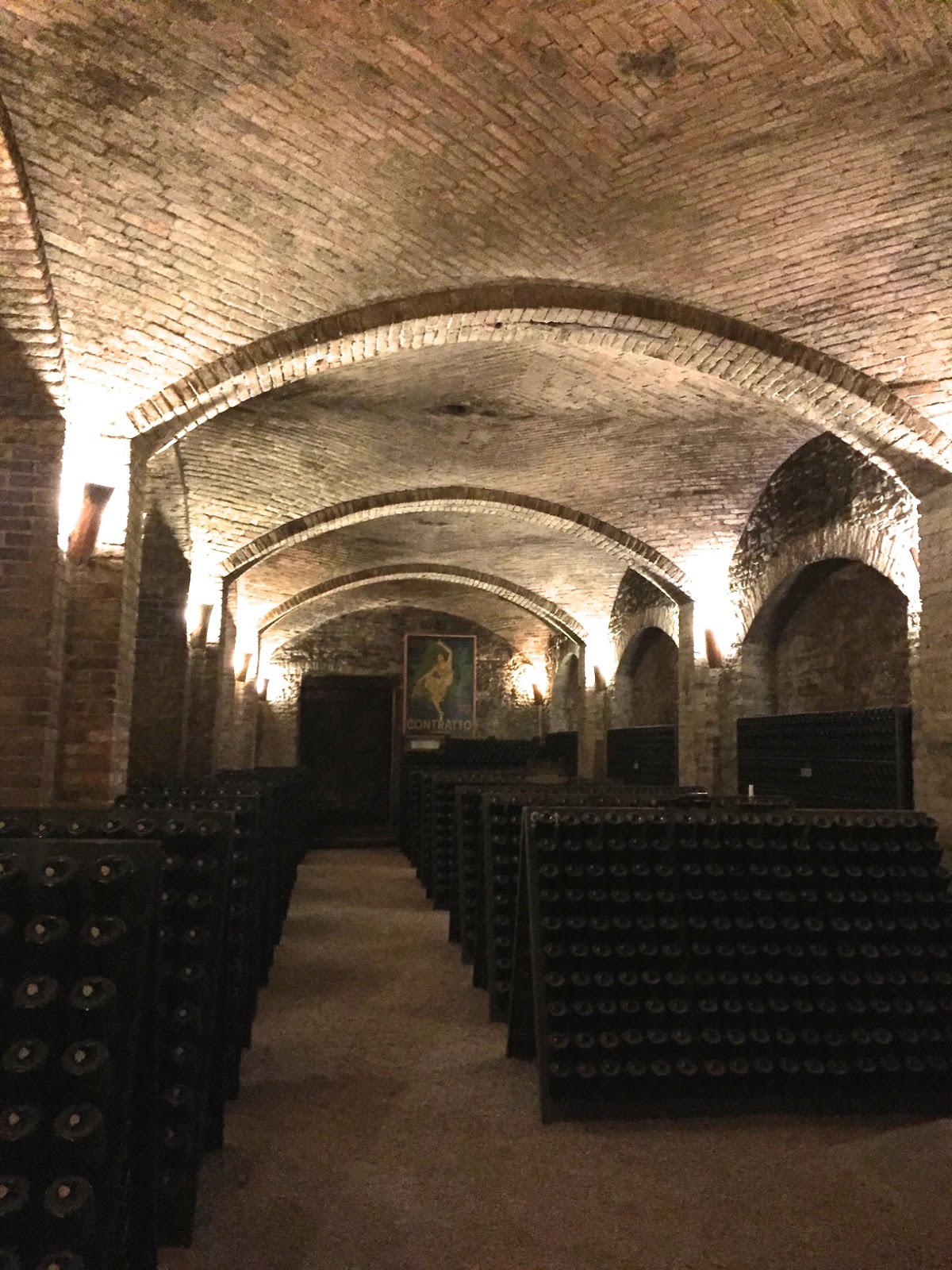
The Contratto cathedral cellars are absolutely stunning; so much so that they are designated a UNESCO Heritage Site. Work on the cellars began in 1872 and was completed after 3 years of labor by 200 workers. The cellars are more than 5000 m² and is built into the heart of the hill that protects Canelli. It is excavated to a depth of 32 m in the tuff limestone.


The estate was in decline when it was bought by Carlo Bocchini in 1993. Bocchini restored the cellars before selling to the Rivetti's in 2011. Prior to buying the property, Giorgio Rivetti had been providing winemaking counsel and had been using the facility to make a metodo classico sparkling wine using grapes sourced from the Oltrepo Pavese region.

At the time of the purchase Contratto produced sparkling wines under the Metodo Classico - Vini Spumante di Qualita, Piemonte DOC, Asti Spumante DOCG, and Asti Spumante Metodo Classico appellations with fruit sourced from vineyards in Oltrepo Pavese, Lozzola, Costigliole d'Asti, and Canelli.

This lineup of fruit sources did not align with the Rivetti vision. This vision was to be a player in the Alta Langa appellation using fruit sourced from its own estate. Vision-realization was a two-step process, the first accomplished in relatively short order, the second unfolding over a longer timeframe. The first step (2014) was to transfer the source of Chardonnay and Pinot Noir from Oltrepo Pavese to Alta Langa. The second step was the purchase of 45 ha of land in Bossolasco to serve as the estate-fruit-source for its Alta Langa DOCG wines.

The Bossolasco vineyard, acquired in 2015, is located just outside of the village of the same name. It sits at 750 m and has a southern exposure. The land was initially used to grow Dolcetto vines and, more recently, medicinal herbs. The vineyard is being farmed organically and, by 2021, will provide the fruit for all Contratto Alta Langa wines.

The winery poduces a couple of Moscato-based wines (De Miranda label) for its Asti Spumante offerings and three non-Alta-Langa metodo classico wines (Millesmate, Cuvée Novicento pas Dosé, Riserva Special Cuvée pas Dosé). The Alta Langa wines are For England Blanc de Noir Pas Dosé (100% Pinot Noir, 48 months on lees, zero dosage), For England Rosé Pas Dosé (100% Pinot Noir, 48 months on lees, zero dosage), and Blanc de Blanc Pas Dosé (100% Chardonnay, 48 months on lees, zero dosage).

With the exception of the Asti Spumantes, all Contratta wines share the same production process:

  1. Grapes are handpicked
  2. Selection in the cellar
  3. In the cellar, staged separately based on vineyard location
  4. Cooled down prior to crushing
  5. Gentle pressing (1 hour pre-press skin contact for grapes destined for the Rosé)
  6. First-run juice used for fermentation
  7. Indigenous-yeast fermentation in stainless steel tanks
  8. 8 months in tanks post-fermentation
  9. Bottled with liqueur de tirage for second fermentation (4 weeks)
  10. Minimum 36 months on lees
  11. Riddling
  12. Disgorgement (glace method)
  13. Aged in bottle 6 months post-disgorgement.

Parlo and Luca

At the end of our cellar tour Luca ushered us into a tasting room. Giorgio Rivetti was on premises because one of his relatives was getting married on the grounds later in the day so Luca invited him in to join us.


Giorgio Rivetti joins us for the tasting

The For England Blanc de Noir Pas Dosé 2011 showed white fruit, yeast and white bread. Tart apple and lemony character on the palate. Small bubbles. Sour finish.

The For England Rosé 2011 had a clean, unyielding nose with a subdued mousse, strawberry flavor, and a bitter finish. Bitter rose water on the palate with limited persistence.

The Blanc de Blanc 2011 was elegant on the nose with biscuit, citrus and yeast on the nose.  Mineral and saline on the palate along with citrus flavors. Persistence on the palate and tight finish.

*********************************************************************************************************************
The Rivetti purchase was consequential for both Contratto and the future of sparkling wines in Piedmont. First, the Rivettis know sparkling wine -- they are the largest Champagne importers in the area. Second, Giorgio is well respected as a winemaker in his own right. Robert Parker, Jr has described him as "One of Italy's most formidable winemaker/proprietors ..." who "displays a masterful touch." Third, the Rivettis have the vision and resources needed to make the estate a powerhouse in the region and the region a powerhouse in the sparkling wine world.

The Rivetti's will need to concentrate all of these positives in order to realize the full potential of this estate.

The ride back was even more harrowing than the inbound journey.

©Wine -- Mise en abyme

Sunday, August 11, 2019

Alta Langa DOCG: Piemonte's burgeoning answer to Franciacorta?

During the Labor of Love pre-launch dinner party, Giampiero Cordero, the Sommelier at Ristorante Il Centro (Prioca d'Alba), introduced me to a sparkling wine -- Contratto Metodo Classico -- with which I was unfamiliar. The wine was intriguing so I sought out Giampiero later on in the evening, seeking additional information. He indicated that the wine was from a new sparkling wine DOCG called Alta Langa and promised to make arrangements for me to visit the winery on the Saturday post the dinner. He did make the arrangements and Parlo and I did make the visit. Before discussing the winery and its wines, I provide some background on the region.

The leading lights of Italian sparkling wine are Prosecco, Franciacorta, and Asti. If you confine your horizon to Piemonte, Asti and Moscato d'Asti are the most prominent. Alta Langa -- DOC in 2002, DOCG in 2011 -- is the new kid on the sparkling-wine block but the combination of its terroir, traditional Champagne varieties, traditional production method, skilled growers, and savvy producers bode well for the future.

Source: altalangadocg.com

Growers in the region have looked enviously at Champagne since the early 1800s. So much so that the Counts of Sumbay planted Chardonnay and Pinot Noir vines with an eye to making a Champagne-like sparkling wine. The chart below summarizes the history of the effort to make a Metodo Classico wine in Piemonte.


The Alta Langa DOCG is spread over 142 communes in the provinces of Alessandria, Asti, and Cuneo. Given the geographic scope of the region, one encounters a variety of climates, exposures, elevations and soil types. In general, the soil is a mildly fertile calcareous clay marl.

Vineyards are required to be planted at 250 m and above on the region's steep, terraced hillsides. Allowed varieties are Pinot Noir and Chardonnay and other non-aromatic grapes. Planting density is a minimum of 4000 vines/ha with the vines trained using the low espalier system and pruned traditional Guyot and spurred cordon. The maximum allowed yield is 11,000 kg/ha.

As is the case in Champagne, the Alta Langa producers -- 27 currently -- do not grow enough fruit to meet their needs. That gap is bridged with fruit from 80 growers who own their land and are guaranteed producer-payment for their grapes and labor.

Alta Langa DOCG covers a Spumante and Spumante Rosata, each built from a minimum of 90% Chardonnay and/or Pinot Noir and a maximum of 10% non-aromatic grape(s), fermented in the traditional method, and aged for a minimum of 30 months on the lees. A Riserva has to spend 36 months on the lees. An Alta Langa Rosso DOC has the same varietal requirements but no stated aging requirement.

Using Avezza Paolo's (one of the producers) practices as an example, the grapes are hand-harvested (a requirement) and taken to the cellar where they are crushed whole. Only the free-run juice is fermented.

Most of the producers ferment in stainless steel tanks but Bera Valter uses a mix of stainless steel and wood, with the majority done in steel. The base wine is placed under crown seal with the liqueur de tirage for the second fermentation (Bretta Rossa blends in a small amount of cuvée from the prior year's production.). The wine rests on its lees for a minimum of 30 months prior to disgorgement and dosage. The aforementioned Contratto always produces a vintage wine with zero dosage and a minimum of 48 months on the lees.

Franciacorta is the most significant Metodo Classico wine in Italy so some comparisons are in order.

Category Franciacorta Alta Langa
First Sparkling wine
1961
1848
DOC
1967
2002
DOCG
1995
2011
Size (ha)
3000
106
Municipalities
19
142
Grape sources Estates (104) Estates and Growers (107)
Soils Glacial morainic (4 types) Calcareous clay marl
Elevation “Gentle hills” Minimum 250 m

One of the things that I find disconcerting about Franciacorta is its richness. This stems from fruit ripening afforded by its relatively southerly location and acidity-robbing, low elevation vineyards. Alta Langa has the potential to produce a crisper sparkling wine given its more northerly provenance and its relatively high elevation.

The Piemonte region has a good track record in handling the Chardonnay grape. While not in the same geographic region, Gaja's Chardonnays take a back seat to no one and I am personally enamored with Aldo Conterno's Bussiador.

In most of the cases, the Alta Langa product is one component of a red-wine centric portfolio for both the growers and the producers. Contratto is one of the exceptions in that it is a standalone sparkling wine establishment within the broader Rivetti portfolio. The challenge for the region will be its relatively small size in a red-wine centric region where there will always be competition for attention and vineyard space vis a vis the the region's red wines.


©Wine -- Mise en abyme

Sunday, August 4, 2019

An exploration of selected Alto Adige wines

Orlando is a dyed-in-the-wool Napa Cab town but a small number of wine bars, retailers, and wine-services providers (Tim's Wine Market, Digress, Wine Bar George, and Slate Wine & Spirits Academy (SL&SA), for example) from time to time host tasting events aimed at the acid hounds among us. One such recent event was a SL&SA-hosted event titled Explore Alto Adige - Sudtirol Wine Region: Italy's Brightest Gem.

This is the fourth or fifth high-value, no-cost tasting that I am aware of that Jeanne K. Reilly MW has organized for her community of interest. Her modus operandi is to opportunistically engage a visiting winemaker, or other wine-aware personnage, and gaining a commitment from them to present their wines to her group. The "volunteer" in this case was May Matta-Aliah, DWS, CWE, the Alto Adige US Brand Ambassador. May led us in an informative lecture on the region and a tasting of six of its wines. I have previously reported on the region and will thus focus on the tasting in this post.

May Matta-Aliah, DWS, CWE

The wines included in the tasting were as follows (all wines were Alto Adige DOC):

White Wines
1. Nals Margreid Pinot Bianco Sirmian 2014
2. Elena Walch Sauvignon Castel Ringberg 2016
3. Castelfeder Gewürztraminer Vom Lehm 2018

Red Wines
1. Colterenzio Winery Lago di Caldaro 2016
2. Produttori San Michele Appiano Pinot Nero 2015
3. Cantina Andriano Lagrein Rubeno 2015.

White Wines
Nals Margreid Pinot Bianco Sirmian 2014
The current Nals Margreid is the end-product of the Kellerei Nals Cooperative, founded in 1932, and subsequent combinations with Magreid-Entikler (1985) and the remnants of the Schramsberg Coop (2007). The Coop is owned by 138 winegrowers farming a total of 145 ha (359 acres).

The grapes for the wine are grown in the Sirmian area, "... an authentic grand cru area ... within the Terlano sub-region where Italy's best Pinot Bianco are grown." The vines are, on avearge, 13 years old and reside on soils comprised of moraine debris and porphyry bedrock plus gneiss, mica, and marble inclusions. The vineyards are found at elevations ranging between 550 and 680 m.

The Pinot Bianco Sirmian was first produced in 1971. The grapes are fermented in stainless steel tanks after which they undergo malolactic fermentation and 8 months aging in 20 - 30Hl oak barrels.

Notes: A green floral note , sweet white flower, pineapple and pepper spice. On the palate, bright acidity, lemon lime, tartness, minerality. Persistence on palate and lengthy finish. Alcohol burn.


Elena Walch Sauvignon Castel Ringberg 2016
Elena Walch is a leading Alto Adige wine estate farming 60 ha in, among others, top cru vineyards Vigna Castel Ringberg (Caldaro) and Vigna Kastelaz (Tramin). Castel Ringberg, at 20 ha, is Alto Adige's largest cru. Its modestly steep slopes are mostly chalky moraine with loamy and sandy soils.

The Sauvignon is fermented 85% in stainless steel (with extended yeast contact) and 15 % in barrique with assemblage just prior to bottling.

Notes: This wine exhibited a nuanced complexity. Florality, pungency, rust, green papaya, green bark, green herbs. Broad on the palate. Not as bright as the Pinot Bianco. Spicy. long, hot finish.

Castelfeder Gewürztraminer Vons Lehm 2018
Castelfeder is a 60-ha estate located in the middle of South Tyrol's southeast vineyards. The vineyards are planted on medium-heavy clay and loam soils at 300 - 500 m elevation.

Grapes are handpicked and cold-macerated for 12 hours before being gently pressed and fermented in stainless steel. The wine spends 6 months on lees.

Notes: Gewurtz nose. Sweet barley, sweet sop, lychee and lifted aromatics. Light on the attack but weighty on the mid-palate. Slight pricking of effervescence. Juicy. Mineral. Bitterness. Long, hot finish.

Red Wines
Colterenzio Lago di Caldaro 2018
Colterenzio Winery was founded in 1960 when 28 winemakers left the historical Cornarono wines to found a new venture. Today the Coop has 300 winegrowers farming 300 ha at elevatioins ranging between 230 and 650 m. The estate's Schiava vines are planted on hillside vineyards sited on morainal soils mixed with sand and eroded porphyry deposits.

Grapers are gravity-fed from the receiving area to the destemmer-crusher area. Red grapes are destemmed, crushed, and transferred to stainless steel tanks for fermentation. The wine undergoes malolactic fermentation and four months of refinement in those tanks.

Notes: Floral. Faded rose, strawberry, and sweet red fruit on the nose. A lot more power than indicated by the color. Not a lot going on in terms of flavor complexity. Mineral. Metallic finish.

Cantina Produttori San Michele Appiano Pinot Nero 2015
Cantina San Michele was founded in 1907 in the land surrounding the town on the outskirts of Bolzano. A total of 340 families are involved in the cooperative.

The growing area experiences over 2000 hours of sunshine per year and significant diurnal temperature variation enabled by wartm ventilation from the south during the day and fresh breezes from the Mendola Massif during the evening hours.

Soils are moraine debris and limestone gravel at altitudes ranging between 400 and 550 m.

Notes: Darkest of the three red wines. Faded rose, dried herbs, spice, and elegance. Restrained on the attack but intensity increases as the wine makes its way to the back of the palate. Salinity. Thick and creamy. Gentle, late-arriving tannins. Rich, lengthy finish.

Cantina Andriano Lagrein Rubeno 2015
This estate was founded in 1893, the first of its kind in the area. It was absorbed into Cantina Terlano in 2008 but its operation and wines have been kept separate from the larger enterprise.

The estate's 70 ha of vineyards experience cooler growing conditions due to being in the sjadow of Mount Gantkafel and only being exposed to direct sunlight from early morning to mid-afternoon. Soils are eroded sedimentary rock of dolomitic rock and calcareous stone at altitudes ranging between 260 and 340 m.

Lagrein in this area dates back to the 17th century, one of the oldest in the South Tyrol region. The northeast-southeast exposed vineyards sit on red clay soil with gravel and stones at 250 m.

Grapes are handpicked and fermented in stainless steel tanks, then transferred to large oak casks for malolactic fermentation.

Notes: Deep, dark, brooding nose with earth and pruned dark fruit. Weighty, minty and licorice on the palate. Dark fruit with great acidity. lack of mid-palate. Sweet finish. Barkiness. Unfulfilling.


********************************************************************************************************
In general, the white wines were more appealing than the reds, not unexpected in that the region's whites are highly regarded. In the case of the reds, the Pinot Nero was attractive. In general these wines are high in alcohol but the diurnal variability ensures balancing acidity retention.

In terms of pricing, these wines represent good value for money with the highest priced (the Pinot Nero) coming in at $46. The whites average $23. I would purchase the Pinot Nero and any of the whites if the opportunity presented itself.

©Wine -- Mise en abyme