Fans of white Burgundy wines know Jean-Marc Roulot as the producer of Meursault wines which have been variously described as "subtly powerful," "feline," and Puligny-Montrachet-like.
But his skills are not bounded by the world of wine. According to Jonathon Nossiter (Liquid Memory), Jean-Marc is an "actor of considerable talent and courage" who entered the prestigious Conservatoir (the French national acting school located in Paris) at the age of 20 and only returned to Burgundy to helm the family Domaine after the premature death of his father.
It was this pedigree, and a fondness for Jean-Marc and his wines, that drove me to sign up to attend his play, and subsequent lunch, which, both held at Daniel, comprised the official Thursday events of the 2015 La Paulée de New York.
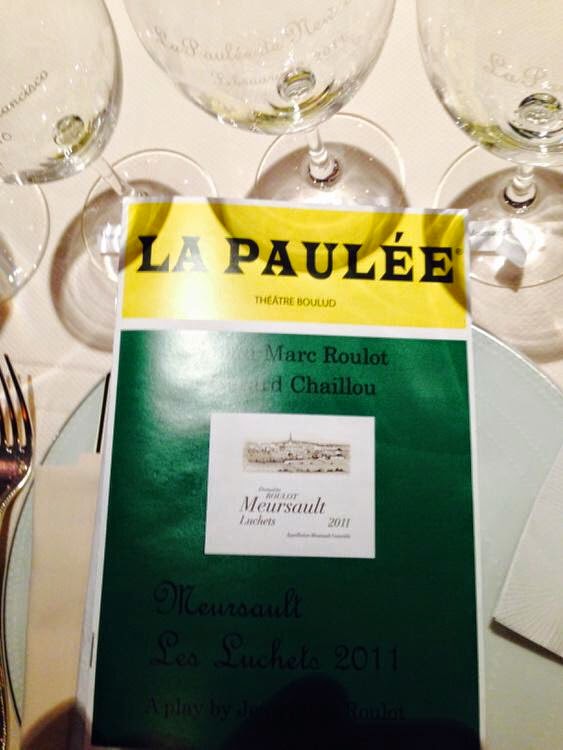
The play (the subject of this post) was titled Meursault Les Luchets 2011 and would precede the Roulot-Roumier lunch (For those unfamiliar with the Domaine, Les Luchets is one of its terroirs and wines.). I had not fully recovered from the previous evening's Collectors Dinner with Armand Rousseau because of (i) over-consumption and (ii) I had left my new camera, with my pictures of the night's events, in the back seat of a taxi. And, frantic calls notwithstanding, I had been unable to recover same.
We traveled by taxi from our hotel to Daniel. As I entered the cab, I asked the driver if he had seen my camera. He looked at me as though I had recently been released from a psycho ward. "What camera you talkin' 'bout Bro," he said. "Nothing," I said, my resolve crumbling away as I silently called down the wrath of the heavens on all taxi drivers. Well, enough about my negligence. Let's get back to the matter at hand.
We had gotten to the restaurant pretty close to noon so by the time we had deposited our coats at the coat check (darn NYC winters), checked in, gotten our programs, and were shown to the room, all of the choice seats had been taken. All of the tables in the Daniel backroom had been taken out and chairs had been arranged in an arc around a raised platform set against the rear wall. That rear wall had two openings to a passage that led to who knows where. Towards the front of the stage there was a single wooden table and chair; bare if my recollection serves me well (I had pictures on my iPhone but I lost those when my phone fell into the urinal on Saturday night.). There was an additional chair on the platform stage right and a couch stage left. Stage right, and floor level, was another solitary chair with an accordion on the floor beside it.
We made our way to some open seats house left which gave us a less-than-head-on view of the stage. Shortly after we took our seats, a solitary figure wandered through the opening in the rear wall, sauntered over to the chair associated with the accordion, and began strapping into the instrument. All the while with a bemused smile on his face. According to the program, this was Eric Proud. And he sure acted that way.
Shortly after, another individual made his way onto the stage and sat on the chair stage right. As I was familiar with Jean-Marc, this could only be Gérard Chaillou, who was playing Largeau opposite Jean-Marc's Monplaisir. Finally, Jean-Marc strode onto the stage, an impassive look on his face, staring into the distance. He was carrying a valise which he placed on the table and from which, after rummaging around inside for awhile, he produced a bottle of wine and a corkscrew. While he was opening the wine, Largeau went off stage and returned with two wine glasses into which Jean-Marc poured generous portions. The wines were sniffed and then tasted. And then the dialogue began, each man tapping "into his own language, their words to describe taste linked to their own personal memories and to the sensory world that each and every one of us build and define patiently, year after year" -- Jean-Marc Roulot.
The passion and enthusiasm of the dialogue was captivating, a testament to the skill of the actors as the entire discourse was in French. There was a TV screen high up on the rear wall stage right which displayed subtitled translations of the dialogue but it was tiring -- and tiresome -- to keep switching between the text and the players. A lot was lost in this fashion. Secondly, some of the nuances and subtleties of the situations could not be captured adequately by the subtitled presentation as evidenced by knowing snickers and laughter and expressions of appreciation along the way by French-speaking members of the audience while I sat blank-faced and unknowing.
Sometime during the course of the proceedings Jean-Marc said words akin to "presenting Les Luchets 2011" and, magically, the Somms who were assisting in the event appeared in the glass-walled hallway house right bearing lighted trays with glasses of wine. They stood there momentarily before making their way into the audience and distributing the glasses to the attendees. It was Meursault Luchets 2011. And it was then that I realized what I had been missing all along. I had not had a drink all day.
After all the wine had been distributed, the actors returned to their labors. Including, at one point, a lusty soundtrack in which all three participated.
At the conclusion of the play the attendees showed their appreciation for the actors' efforts with multiple rounds of ovations. It was very revealing to see Jean-Marc in this new environment. I have tasted wine with him at his Domaine and seen him expounding on his wines and engaging in technical discussions with Raj Parr and another US winemaker who had joined us at the tasting. We had enjoyed joyous banter and a bottle of his wine at a chance encounter at Charle Bird's when we went up to NYC for the inaugural La Fete du Champagne. And here he had peeled away those personas, or covered them over with this, the persona of the accomplished, confident, the-world-is-my-oyster actor. I was mesmerized.
©Wine -- Mise en abyme
Sunday, March 22, 2015
Friday, March 20, 2015
Before the Judgment of Paris, there was the Battle of Versailles: Different industry, same result
Before the Judgment of Paris, three words -- and an event -- of moment in the wine world, there was the Battle of Versailles, another event which pitted an upstart American industry against a dominant -- and domineering -- French counterpart. And once again the results were tectonic; and provided the protagonists with the fuel that drove them to previously unimaginable heights.
The industry of record in the Judgment of Paris was Wine; the industry of record in the Battle of Versailles was Fashion. The story of the Judgment of Paris is told in a book of the same name written by the only reporter present, George M. Taber. The story of the Battle of Versailles is recounted in a tome of the same name by Robin Givhan, Fashion Critic of the Washington Post and 2006 winner of the Pulitzer Prize for Fashion Criticism. Information about the Battle of Versailles used in this post is gleaned from an interview of the author by Renee Montagne on the March 19th edition of NPRs Morning Edition.
Prior to 1973, as was the case for the US wine industry prior to 1976, "Paris was everything" in the fashion industry and the American industry took its marching orders from the Parisian designers. "Whatever the French designers said was fashion, ... the Americans said, OK, that's fashion ..."
The Judgment of Paris (the event) took place at the Paris InterContinental Hotel on May 24, 1976 and pitted six Napa Chardonnays (vintage 1972 - 1974) and six Napa Cabernet Sauvignons (1969 - 1973) against four White Burgundies (1972 and 1973) and four Red Bordeauxs (1970 and 1971). The wines were tasted blind. Attendees, based on Taber's account, were the judges, Steven Spurrier (the event organizer), two unofficial observers, Taber, and the wait staff. Spurrier had secured the room at the hotel as a favor granted by the Food and Beverage Manager with the proviso that they had to be out before 6:00 pm as the room was committed to a wedding at that time. At the conclusion of the tasting, a California wine had been judged to be the best in each of the two categories.
The Battle of Versailles was held on November 28, 1973 at the Palace of Versailles and was at once a fundraiser to help in the restoration of the palace and a competition pitting five French couture designers against five up-and-coming American designers:
The disparity in time and setting notwithstanding, the show was a huge success for the Americans. According to Givhan, "It was a predominantly French crowd and they went bonkers ..." for the Americans. One of the keys to the American success was their models, 10 of whom were black. Again, the author: "There was a context of black chic that made the models particularly attractive. It was cool. It was progressive to use black models."
According to Robert Parker (a 2001 comment reproduced in Taber's book), "The Paris Tasting destroyed the myth of French supremacy and marked the democratization of the wine world. It was a watershed in the history of wine." According to Givhan, things also changed significantly after the Battle of Versailles, especially the way that American designers saw themselves. "... their success at Versailles convinced them that no, what they were producing wasn't less than, it was different, but it was just as good and in many ways more relevant to the way that women lived their lives."
It must have been traumatic to have lived in Paris in the mid-1970s. The persons responsible for the maintenance of French superiority took blows in that timeframe that they never fully recoverd from. And I am still waiting for Napa to build that richly deserved statue of Steve Spurrier right in the heart of its revitalized downtown.
©Wine -- Mise en abyme
The industry of record in the Judgment of Paris was Wine; the industry of record in the Battle of Versailles was Fashion. The story of the Judgment of Paris is told in a book of the same name written by the only reporter present, George M. Taber. The story of the Battle of Versailles is recounted in a tome of the same name by Robin Givhan, Fashion Critic of the Washington Post and 2006 winner of the Pulitzer Prize for Fashion Criticism. Information about the Battle of Versailles used in this post is gleaned from an interview of the author by Renee Montagne on the March 19th edition of NPRs Morning Edition.
Prior to 1973, as was the case for the US wine industry prior to 1976, "Paris was everything" in the fashion industry and the American industry took its marching orders from the Parisian designers. "Whatever the French designers said was fashion, ... the Americans said, OK, that's fashion ..."
The Judgment of Paris (the event) took place at the Paris InterContinental Hotel on May 24, 1976 and pitted six Napa Chardonnays (vintage 1972 - 1974) and six Napa Cabernet Sauvignons (1969 - 1973) against four White Burgundies (1972 and 1973) and four Red Bordeauxs (1970 and 1971). The wines were tasted blind. Attendees, based on Taber's account, were the judges, Steven Spurrier (the event organizer), two unofficial observers, Taber, and the wait staff. Spurrier had secured the room at the hotel as a favor granted by the Food and Beverage Manager with the proviso that they had to be out before 6:00 pm as the room was committed to a wedding at that time. At the conclusion of the tasting, a California wine had been judged to be the best in each of the two categories.
The Battle of Versailles was held on November 28, 1973 at the Palace of Versailles and was at once a fundraiser to help in the restoration of the palace and a competition pitting five French couture designers against five up-and-coming American designers:
- French designers
- Yves St. Laurent
- Hubert de Givenchy
- Pierre Cardin
- Emmanuel Ungaro
- Marc Bohan (of Christian Dior)
- American designers
- Halston
- Oscar de la Renta
- Bill Blass
- Anne Klein
- Stephen Burrows
... there are men in, like, full livery with the white wigs and the uniforms. And people are arriving and they are the jet set of the time. And the theater where this took place is gilded and filled with blue velvet seats and fleur-de-lis, you know, embroidered on the curtains and the chandeliers.The French presentation at the Battle of Versailles lasted two hours while the American portion lasted 30 minutes. The French had constantly changing backdrops and a full orchestra to flesh out their effort while the American set was a sketch of the Eiffel Tower and its music was a taped Al Green and Barry White soundtrack.
The disparity in time and setting notwithstanding, the show was a huge success for the Americans. According to Givhan, "It was a predominantly French crowd and they went bonkers ..." for the Americans. One of the keys to the American success was their models, 10 of whom were black. Again, the author: "There was a context of black chic that made the models particularly attractive. It was cool. It was progressive to use black models."
According to Robert Parker (a 2001 comment reproduced in Taber's book), "The Paris Tasting destroyed the myth of French supremacy and marked the democratization of the wine world. It was a watershed in the history of wine." According to Givhan, things also changed significantly after the Battle of Versailles, especially the way that American designers saw themselves. "... their success at Versailles convinced them that no, what they were producing wasn't less than, it was different, but it was just as good and in many ways more relevant to the way that women lived their lives."
It must have been traumatic to have lived in Paris in the mid-1970s. The persons responsible for the maintenance of French superiority took blows in that timeframe that they never fully recoverd from. And I am still waiting for Napa to build that richly deserved statue of Steve Spurrier right in the heart of its revitalized downtown.
©Wine -- Mise en abyme
Thursday, March 19, 2015
Bentonite fining and protein stability
The need for bentonite fining is driven by the propensity of unstable proteins present in the wine to precipitate out in warm conditions and present as a cloudy haze in the bottle. By adding bentonite to the wine, significant amounts of these unstable proteins can be removed, minimizing the potential for haze. There is a down side to bentonite use though as over-fining can lead to flavor stripping. How do we minimize this? By determining the smallest amount of bentonite that can be used to remove the largest amount of protein with the least sensorial impact.
Protein and Polysaccharide Stability
Clarity has no apparent gustatory impact on wine quality but features prominently in the wine tasting schemes of both the Wine and Spirits Education Trust and the Guild of Sommeliers. The biggest challenges to wine clarity are proteins and polysaccharides, both of which, when unstable, manifest as hazes in the wine: off-white flakes in the case of the former and gelatinous masses in the case of the latter (Table 1, Harbertson).Wine proteins are derived from grape and yeast sources with their levels dependent on variety, vintage, maturity, fruit condition, pH, and processing methodology (Zoecklein 1988; Butzke). The protein’s ability to retain its stability is determined by its "isoelectric point" plus a number of other factors. Proteins can be either positively or negatively charged based on pH and their isoelectric points are attained when the positive and negative charges of the fractions are equal. They are least soluble (stable) at this point. In addition, the lower the difference between the pH and the isoelectric point, the lower the charge and, hence, the lower the solubility of the protein (Zoecklein 1988). Other factors impinging on solubility include temperature and the “concentration of wine complexing factors” and any one of these factors can cause protein precipitation. It should be noted that yeast proteins are not implicated in haze formation.
The overarching factor in haze formation, however, is heat which causes a denaturation and precipitation of the proteins or formation of insoluble complexes with polysaccharides or polyphenols.
As is the case with proteins, polysaccharides have both grape and yeast components. The grape elements come from healthy and Botrytis-infected fruit and are released by yeasts, lees, and bacteria (AWRI). Most polysaccharides are insoluble in ethanol and, as a result, the population is low in wine. Those that do remain can form a gelatinous mass in the presence of alcohol. As is the case with proteins, yeast-derived polysaccharides do not contribute to haze formation.
The hazes formed by proteins and polysaccharides are irreversible and must be removed. According to Budzke, “most consumers prefer a wine free from unappetizing-looking protein instabilities.”
Bentonite Fining
The approach utilized most frequently within the wine industry to remove unwanted juice/wine components is the use of fining agents. Fining agents are adsorptive or reactive materials which bind to undesirable elements with the denser compounds thus formed precipitating out, leaving the wine much clearer (as well as increasing its filterability). The effectiveness of a fining agent is dependent on (Zoecklein): the agent utilized, the method of preparation and addition, the quantity employed, wine pH, wine metal content, temperature, age of the wine, and previous treatments.
The fining agent that is most widely used to remove protein haze is bentonite, a clay with a layered structure which is added to wine as a clay-water suspension. Bentonite, having a slight negative charge, will bind with positively charged particles (such as proteins) and the complex thus formed will fall to the bottom. Bentonite fining will remove protein fractions with the largest cationic charge and will, especially if conducted simultaneously with bitartrate stabilization efforts, aid in the compaction of lees. The issues associated with bentonite fining are as follows (Butzke; Vincenzi, et al.):
- Flavor stripping
- Potential for oxidative damage if slurry mixing allows air exposure
- Fining before fermentation may lead to a sluggish fermentation due to stripping of certain growth factors
- Creates a solid waste problem
- Long settling times
- Certain quantity of wine lost as bentonite lees.
The process generally employed for bentonite fining is to conduct a fining trial wherein some number of samples are treated with regularly increasing doses of bentonite and with one of the samples untreated and held out as a control. The post-fining turbidity of each of these samples is then tested after which they are heated, cooled, and then turbidity-tested again. If the initial fining was sufficient, then the change in turbidity between tests would be less than 2 NTU (Nephelometruc Turbidity Units). If the change is greater than 2 NTU, additional fining trials would be run until the NTU fell below 2 because this shows that enough protein is left in the wine that it would precipitate under the right temperature conditions.
Assuming that all of the samples pass the turbidity test, the team is then able to conduct sensory evaluations to determine which sample attains protein stabilization with the least sensorial impact and then to use the trial results as the basis for bentonite fining of the production lots.
References
AWRI, Amorphous deposits, www.awri.com.au.
Butzke, Chris, Fining with Bentonite, Purdue Extension FS-53-W, www.extension.purdue.edu.
Harbertson, James F. A Guide to the Fining of Wines, Washington State University Extension Manual EMO16.
Vincenzi, Simone, et al., Removal of Specific Protein Components by Chitin Enhances Protein Stability in a White Wine, AJEV 56(3), 2005.
Zoecklein, Bruce (1988), Protein Stability Determination in Juice and Wine, Virginia Cooperative Extension, Publication 463-015.
©Wine -- Mise en abyme
Wednesday, March 18, 2015
Acidity vs sourness, bitterness vs astringency, and the tongue taste map: Some sensory misapprehensions
The overall taste of a wine is a combination of its odor, taste, and tactile perceptions as generated by specialized nerve cells resident in the nasal and oral cavities. Understanding the stimuli to which each of these specialized cells react is important to effective wine tasting and description. This brief post attempts to shed some light on a few oral sensory misapprehensions
Acidity versus Sourness
Acids play an important role in the cellular and metabolic functions of the grape berry and in the color and texture of the fermented wine. The primary acids found in grapes and fermented wine are tartaric, malic, and citric acids, as well as the tartaric and malic derivatives potassium hydrogen tartrate (cream of tartar) and potassium hydrogen malate. Acidity (as it relates to wine) is the measure of its acid content.
Total acidity is the sum of the hydrogen ions of both fixed and volatile acids that are present in the wine and, as such, is the most accurate representation of acid concentration. Total acidity is difficult to measure accurately, however, and so the more easily measurable titratable acidity (TA) is used as its proxy. Red table wines generally range between 0.6% and 0.8% TA as levels below 0.4% render the wine susceptible to infection and spoilage.
A second method for measuring the acidity of a wine is through observation of its pH (potential of hydrogen) level. The higher the number of hydrogen ions (H+) in a liquid, the more acidic it is while the higher the number of hydroxide ions (formed when an oxygen ion bonds to a hydrogen ion and represented as OH-) in the liquid, the higher its alkalinity. The pH scale runs from 0-14 with acidic solutions falling below 7.
Bitterness versus astringency
As indicated above, bitter is one of the five taste sensations. Sources of the bitter sensations in wine are flavonoid phenolics (primary), with several glycosoids, terpenes, and alkaloids contributing from time to time (Jackson, Wine Tasting). Bitterness and astringency are sometimes confused with each other because (i) they are both induced by the same compound; (ii) they are late-arriving (sweet and sour are the first taste sensations to make their presence felt); and (iii) they are slow to depart. The perception of bitterness is reduced by sugar, enhanced by alcohol, and hidden by astringency.
The Tongue Taste Map
The tongue taste map is truly a myth. A turn-of-the-century research paper indicated that certain areas of the tongue had been shown to be sensitive to specific tastes. Subsequent research had found these findings to be inaccurate because, in fact, most taste buds have receptors that can sense and report on all of the taste sensations. And though two-thirds of the taste buds are located on the tongue, they are also present in the soft palate and epiglottis and a few may even be located on the pharynx, larynx, and upper portion of the esophagus (Ronald S. Jackson, Wine Tasting: A Professional Handbook, Elsevier, 2002). Thenibble.com identified that early researcher as D.P Hanig, a German scientist, and also revealed that the findings were based on “subjective responses of volunteers.” This initial qualitative research was “coated” with numbers in 1942 by Edwards Boring of Harvard University (thenibble.com). Work in 1974 by Dr. Virginia Collins, and additional subsequent research, has shown that all tastes can be detected wherever there are taste buds yet the tongue taste map retains its Dracula persona.
©Wine -- Mise en abyme
Acidity versus Sourness
Acids play an important role in the cellular and metabolic functions of the grape berry and in the color and texture of the fermented wine. The primary acids found in grapes and fermented wine are tartaric, malic, and citric acids, as well as the tartaric and malic derivatives potassium hydrogen tartrate (cream of tartar) and potassium hydrogen malate. Acidity (as it relates to wine) is the measure of its acid content.
Total acidity is the sum of the hydrogen ions of both fixed and volatile acids that are present in the wine and, as such, is the most accurate representation of acid concentration. Total acidity is difficult to measure accurately, however, and so the more easily measurable titratable acidity (TA) is used as its proxy. Red table wines generally range between 0.6% and 0.8% TA as levels below 0.4% render the wine susceptible to infection and spoilage.
A second method for measuring the acidity of a wine is through observation of its pH (potential of hydrogen) level. The higher the number of hydrogen ions (H+) in a liquid, the more acidic it is while the higher the number of hydroxide ions (formed when an oxygen ion bonds to a hydrogen ion and represented as OH-) in the liquid, the higher its alkalinity. The pH scale runs from 0-14 with acidic solutions falling below 7.
Sour is one of the five recognized taste sensations (the others being sweet, bitter, salt, and umami) and is the human mechanism for recognizing the presence of acidity. According to Jackson (Wine Tasting, p.204), “sourness is a complex function of the acid, its dissociation constant and wine pH.”
To summarize then, acidity (as it relates to wine) is a measure of acid concentration in the wine while sourness is the way that that acidity manifests itself as a human taste sensation.
Bitterness versus astringency
As indicated above, bitter is one of the five taste sensations. Sources of the bitter sensations in wine are flavonoid phenolics (primary), with several glycosoids, terpenes, and alkaloids contributing from time to time (Jackson, Wine Tasting). Bitterness and astringency are sometimes confused with each other because (i) they are both induced by the same compound; (ii) they are late-arriving (sweet and sour are the first taste sensations to make their presence felt); and (iii) they are slow to depart. The perception of bitterness is reduced by sugar, enhanced by alcohol, and hidden by astringency.
According to sensorysociety.org (and Richard Gawel, Secret of the Spit Bucket Revealed, aromadictionary.com), astringency is a tactile sensation, rather than a taste, and is primarily caused by polyphenolic compounds contained in certain foods (including wine) but can also be caused by acids, metal salts (such as alum), and alcohols. A key characteristic of astringency is the fact that it is difficult to clear from the mouth and, as such, builds in intensity on repeated exposure to the source. The source of astringency in wines is tannins, "a heterogeneous group of phenolic compounds" with properties to include: astringency (caused when the tannin binds with protein in saliva; evidenced by mouth pucker and a bitter aftertaste); bitterness; the ability to react with ferric chloride; and the ability to bind with proteins (Dr. Bruce Zoecklin, Enology Note #16).
There are two theories as to how astringency presents in the mouth (sensorysociety.org): (i) Polyphenols bind with the proteins in saliva and the resultant proline-rich proteins precipitate out (Gawel sees these precipitates as being reflected in the "stringy" salivary material that we spit into the buckets at wine tastings), thus reducing the ability of saliva to lubricate the mouth (this loss of "lubricity" is perceived as an increase in oral friction). (ii) The astringents directly effect the oral epithelium with a sensation of harshness presenting when the gums brush against the insides of the mouth.
According to both Gawel and sensorysociety.org, individuals with high saliva secretion rates will experience lower levels of astringency. Gawel alludes to three types of astringency:
- The feeling of having fine particles on the surface of the mouth; referred to by terms such as Powdery, Chalky, and Grainy
- Roughness of feeling inside the mouth; referred to by words such as Silky, Emery, Velvety, and Furry
- Causing the mouth to move; referred to by words such as Pucker, Chewy, Grippy, and Adhesive.
In summary, then, while sharing a few characteristics, bitterness and astringency differ in that the former is a taste sensation while the latter is a tactile sensation.
The Tongue Taste Map
The tongue taste map is truly a myth. A turn-of-the-century research paper indicated that certain areas of the tongue had been shown to be sensitive to specific tastes. Subsequent research had found these findings to be inaccurate because, in fact, most taste buds have receptors that can sense and report on all of the taste sensations. And though two-thirds of the taste buds are located on the tongue, they are also present in the soft palate and epiglottis and a few may even be located on the pharynx, larynx, and upper portion of the esophagus (Ronald S. Jackson, Wine Tasting: A Professional Handbook, Elsevier, 2002). Thenibble.com identified that early researcher as D.P Hanig, a German scientist, and also revealed that the findings were based on “subjective responses of volunteers.” This initial qualitative research was “coated” with numbers in 1942 by Edwards Boring of Harvard University (thenibble.com). Work in 1974 by Dr. Virginia Collins, and additional subsequent research, has shown that all tastes can be detected wherever there are taste buds yet the tongue taste map retains its Dracula persona.
©Wine -- Mise en abyme
Monday, March 16, 2015
American Gymkhana: Modern Indian cuisine wends its way to Orlando
Raj Parr recently visited Orlando for a tasting of his domestic and Burgundy wines. At the completion of the tasting, he tarried a bit to taste some of the wines that Ron and I had brought to the event. In discussing his schedule for the remainder of the day, he mentioned that he was having dinner at American Gymkhana. I knew that it was a new restaurant on the Orlando scene and that the cuisine was Indian but we had not eaten there (and not because of lack of effort on my wife's part). When I ran into Raj at La Paulée I asked him about his experience at American Gymkhana and he said the food had been surprisingly good. In the intervening period, my wife had gotten excellent reviews from friends who had visited. With this growing mountain of evidence that this restaurant was cooking good food, my wife would be restrained no longer. We were going to American Gymkhana. And so we did. Last Thursday.
American Gymkhana is owned by Restaurateur Rajesh Bhardwaj, the Founder and CEO of Junoon New York (the only Michelin-starred Indian-cuisine restaurant in NYC) and Junoon Dubai. I struggled a bit with the choice of the name, both before and after its meaning was explained. Gymkhana's were the meeting places of the elite during the period of the British Raj in India. Go figure.
The restaurant is located on the top floor of the westernmost building in the "Vines Plaza" in the heart of Sand Lake Road's Restaurant Row. You climb two sets of stairs to get to the reception area and arrive there winded. Our guests had not yet arrived so we repaired to the bar. The bar, and associated lounge, were both pleasing to the eye; places where you would want to sit and have a drink or two. My wife is currently into a Jalapeno Grey Goose cocktail that the mixologist was unfamiliar with but which he constructed magnificently once told the components.
Once our guests arrived, we were shown to our seats. The restaurant is spacious; and the distribution of the seating adds to the sense of expansiveness. A large, clean-looking, open kitchen is sited at the eastern end of the restaurant. The barrel ceilings provide a sense of coziness and are accented by purple-hued lighting.
The menu was clean and simple with between six and eight items in each category and each dish having a subtext describing its components.
The first item brought to our table was a basket of Naan Bread. This leavened, oven-baked flatbread was the canary; except that there was no coalmine. It was heralding the gustatory pleasures to come. It was freshly made and accompanied by a mint dipping sauce. It had great flavor and texture and really did not need any hand-holding.
The Amouse Bouche was a Pineapple Salsa on a Masala Cracker. Cilantro, spiciness, and light tanginess. The mix of textures was intriguing with the crackling crunch of the cracker contrasting with the give of the pineapple chunks.
We had each ordered a dish from the starters and they began to arrive. The Gymkhana Chicken looked a little much but was a treat on the palate. A dash of Yogurt Sauce and a portion of seasonal Lettuce were in attendance in the event that cooling influences were necessary but the intense flavors, the spiciness, and the temperature were right up my alley.
I also ordered a dish called Adraki Gobhi which was a cauliflower fritter made with ginger and galangal (also a part of the ginger family). At first glance it looked like a meatball but tasted anything but. The spicy red sauce was the cocoon for cauliflowers that had been firmed-up by slight roasting.
The Aloo Chaat was a "potato slider" with Yukon Potatos on the top, Purple Potatos on the bottom (in the styling of a potato chip), and Fingerlings in the middle. These were accompanied by a seasonal Fruit Chutney.
We accompanied the starters with a bottle of Paul Déthune Champagne.
My wife ordered a Lobster dish for her main course while I ordered Lamb Chops. Our table companions ordered Lamb Curry, Goat Curry, and Fish so that we could sample a broad array of the fare on offer. The Lobster dish was comprised of two whole Maine lobsters that were Saffron-Marinated and accompanied by a spiced lobster butter. The Nahile Lamb Chops were cooked with whiskey, ginger, black cardamom, and a garlic-whipped yogurt. The lobster was excellent but I could not wrap my head (or palate) around the Lamb. It had a cloying texture and the meat was not firm enough for my liking. I had gone from some very spicy foods to a milky, taste-free dish. I did not like it (In conversations the following day, the Chef told my wife that this meal was designed for people who did not like spicy meals. I wish the waiter had told me that.).
One of my tablemates had gotten the Goat Roganjosh, which is goat on the bone braised in Kashmiri chili and clarified butter, while the other had gotten the Lamb Vindaloo which was constructed with apple cider vinegar, Goan chilies, black pepper, and twice-fried potatos. Both of these were outstanding dishes, especially when some Roti was added to the mix. I lived in my neighbors plates.
At the conclusion of the dinner my wife asked the waiter about the owner and the waiter said that he happened to be in the building that evening. We asked to speak to him and once he had concluded the meeting with which he was engaged, he came over. Nice conversation. We thanked him for bringing this venture to Orlando. He talked a bit about the concept and about the fact that he was flying out from Orlando to Dubai to visit the Junoon there. We also met the Chef (Aarthi Sampath), and congratulated her on the food, and the Wine Director (David Pennisi) with whom we tasted a few wines.
All in all a wonderful evening. This modern twist on Indian cooking is pleasing on the palate and wallet.
©Wine -- Mise en abyme
American Gymkhana is owned by Restaurateur Rajesh Bhardwaj, the Founder and CEO of Junoon New York (the only Michelin-starred Indian-cuisine restaurant in NYC) and Junoon Dubai. I struggled a bit with the choice of the name, both before and after its meaning was explained. Gymkhana's were the meeting places of the elite during the period of the British Raj in India. Go figure.
The restaurant is located on the top floor of the westernmost building in the "Vines Plaza" in the heart of Sand Lake Road's Restaurant Row. You climb two sets of stairs to get to the reception area and arrive there winded. Our guests had not yet arrived so we repaired to the bar. The bar, and associated lounge, were both pleasing to the eye; places where you would want to sit and have a drink or two. My wife is currently into a Jalapeno Grey Goose cocktail that the mixologist was unfamiliar with but which he constructed magnificently once told the components.
Once our guests arrived, we were shown to our seats. The restaurant is spacious; and the distribution of the seating adds to the sense of expansiveness. A large, clean-looking, open kitchen is sited at the eastern end of the restaurant. The barrel ceilings provide a sense of coziness and are accented by purple-hued lighting.
The menu was clean and simple with between six and eight items in each category and each dish having a subtext describing its components.
The first item brought to our table was a basket of Naan Bread. This leavened, oven-baked flatbread was the canary; except that there was no coalmine. It was heralding the gustatory pleasures to come. It was freshly made and accompanied by a mint dipping sauce. It had great flavor and texture and really did not need any hand-holding.
The Amouse Bouche was a Pineapple Salsa on a Masala Cracker. Cilantro, spiciness, and light tanginess. The mix of textures was intriguing with the crackling crunch of the cracker contrasting with the give of the pineapple chunks.
We had each ordered a dish from the starters and they began to arrive. The Gymkhana Chicken looked a little much but was a treat on the palate. A dash of Yogurt Sauce and a portion of seasonal Lettuce were in attendance in the event that cooling influences were necessary but the intense flavors, the spiciness, and the temperature were right up my alley.
I also ordered a dish called Adraki Gobhi which was a cauliflower fritter made with ginger and galangal (also a part of the ginger family). At first glance it looked like a meatball but tasted anything but. The spicy red sauce was the cocoon for cauliflowers that had been firmed-up by slight roasting.
The Aloo Chaat was a "potato slider" with Yukon Potatos on the top, Purple Potatos on the bottom (in the styling of a potato chip), and Fingerlings in the middle. These were accompanied by a seasonal Fruit Chutney.
We accompanied the starters with a bottle of Paul Déthune Champagne.
My wife ordered a Lobster dish for her main course while I ordered Lamb Chops. Our table companions ordered Lamb Curry, Goat Curry, and Fish so that we could sample a broad array of the fare on offer. The Lobster dish was comprised of two whole Maine lobsters that were Saffron-Marinated and accompanied by a spiced lobster butter. The Nahile Lamb Chops were cooked with whiskey, ginger, black cardamom, and a garlic-whipped yogurt. The lobster was excellent but I could not wrap my head (or palate) around the Lamb. It had a cloying texture and the meat was not firm enough for my liking. I had gone from some very spicy foods to a milky, taste-free dish. I did not like it (In conversations the following day, the Chef told my wife that this meal was designed for people who did not like spicy meals. I wish the waiter had told me that.).
One of my tablemates had gotten the Goat Roganjosh, which is goat on the bone braised in Kashmiri chili and clarified butter, while the other had gotten the Lamb Vindaloo which was constructed with apple cider vinegar, Goan chilies, black pepper, and twice-fried potatos. Both of these were outstanding dishes, especially when some Roti was added to the mix. I lived in my neighbors plates.
At the conclusion of the dinner my wife asked the waiter about the owner and the waiter said that he happened to be in the building that evening. We asked to speak to him and once he had concluded the meeting with which he was engaged, he came over. Nice conversation. We thanked him for bringing this venture to Orlando. He talked a bit about the concept and about the fact that he was flying out from Orlando to Dubai to visit the Junoon there. We also met the Chef (Aarthi Sampath), and congratulated her on the food, and the Wine Director (David Pennisi) with whom we tasted a few wines.
| Aarthi Sampath, Chef de Cuisine |
| David Pennisi, Wine Director |
| What we drank |
All in all a wonderful evening. This modern twist on Indian cooking is pleasing on the palate and wallet.
©Wine -- Mise en abyme
Friday, March 13, 2015
Iconic Swiss Varietal Tasting with Paolo Basso: Clos de Tsampéhro Tsampéhro Rouge 2011
This is another in a series of posts recounting a Tasting of Iconic Swiss Wines at DWCC2014 with Paolo Basso, the World's Best Sommelier. The wines that have been treated previously are listed at the bottom of this post. This missive covers the tasting of the Clos de Tsampéhro Tsampéhro Rouge Edition I 2011 AOC Valais. But first, a little background.
Clos de Tsampéhro is a newly reconstituted estate located in the town of Lens in the district of Sierre and the wine region of Valais. The 2013 vintage was the first under the new ownership, hence the designation Edition I. The maps below show the AOC Valais and the location of Lens and Flanthey (the name on the label) in what is colloquially referred to as the Middle Valais.
The climate in the Middle Valais is Mediterranean-like with 2500 hours per year of sunshine. The towering mountain slopes to the north of the region provide a rain-shadow effect for the Rhone Valley at this spot, with most of the rain deposited on the slopes on the northern side of the mountain. This keeps the valley rainfall levels to approximately 500 mm/year. Only the dry, hot wind called the Foehn can scale these mountain barriers. Temperatures range between a low of 0.2 degreesC in January and 20 degreesC in July. A significant diurnal temperature variation promotes slow and balanced grape ripening.
A soil survey and analysis was conducted in 2009 and characterized the soil as a limestone scree composed of shales, acidic, and of a sandy-loam texture.
The vineyard extends over three contiguous hectares at 600 m elevation with a length of 320 m amd a width of 115m. Slopes in the middle of the vineyard can range between 35% and 55%. Aspect is primarily south and southwest, providing excellent sun exposure for the fruit. The vines are sited on small terraces to reduce the shade from one line to the next.
The vineyard is farmed organically and biodynamically but the estate is certified in neither. The existing soil is bolstered with micro-doses of manure, as needed, and organic material from ground pruning material. The dry climate and rapidly draining soils do, on occasion, dictate irrigation which is satisfied by meltwater from surrounding alpine glaciers routed through ancient water channels.
The varieties planted on the estate are as follows:
Whites:
The vegetative period of the 2011 vintage in Lens had well-above-normal temperatures (> 4.8 degreesC) which gave way to a long summer with dry conditions which allowed optimal flowering and berry development. It was cooler and wetter after July and a Foehn (strong, hot, dry wind) episode was recorded in late August. Weather conditions were favorable during harvest.
The Tsampéhro Rouge is a blend of Cornalin (40%), Merlot (35%), and Cabernet Sauvignon and Cabernet Franc (25%). The grapes were hand-harvested and then cold-macerated. The must was inoculated with selected yeasts and fermented for 20 - 28 days in solid oak tapered bowls. The wine was then transferred to 10 hl conical oak vats for four months for MLF and development. They were racked to oak barrels for a further 24 months of aging.
A total of 6000 bottles of 750s and 150 magnums of this wine was produced.
Tasting Note -- On the nose, overripe cherries, currants, fresh strawberries, and blackpepper. On the palate a sweet character, pointing to overripeness. Extracted wine with intensity and character. Ripe, extracted tannins. Long, intense aftertaste of spice and licorice.
**********************************************************************************************************
Previous Iconic Swiss Varietals Tasting posts:
Leyvraz St-Saphorin Grand Cru Les Blassinges 2012
St-Jodern Kellerei Visperterminen Veritas Heida 2012 AOC Valais
Jean-René Germanier Vétroz Cayas Syrah du Valais Réserve 2009
©Wine -- Mise en abyme
Clos de Tsampéhro is a newly reconstituted estate located in the town of Lens in the district of Sierre and the wine region of Valais. The 2013 vintage was the first under the new ownership, hence the designation Edition I. The maps below show the AOC Valais and the location of Lens and Flanthey (the name on the label) in what is colloquially referred to as the Middle Valais.
![]() |
| Lens and Flanthey shown in solid ovals |
A soil survey and analysis was conducted in 2009 and characterized the soil as a limestone scree composed of shales, acidic, and of a sandy-loam texture.
The vineyard extends over three contiguous hectares at 600 m elevation with a length of 320 m amd a width of 115m. Slopes in the middle of the vineyard can range between 35% and 55%. Aspect is primarily south and southwest, providing excellent sun exposure for the fruit. The vines are sited on small terraces to reduce the shade from one line to the next.
![]() |
| Source: tsampéhro.com |
![]() |
| Source: tsampéhro.com |
The varieties planted on the estate are as follows:
Whites:
- Savagnin Blanc -- 1,250 square meters
- Chardonnay -- 1000 sq. meters
- Reza -- 1,250 sq meters
- The Completer -- 750 sq meters
- Pinot Black -- 2,500 sq meters
- Cornalin -- 3,000 sq meters
- Merlot -- 4,500 sq Meters
- Cabernet Sauvignon -- 1,600 sq meters
- Cabernet Franc -- 1,400 sq meters
The vegetative period of the 2011 vintage in Lens had well-above-normal temperatures (> 4.8 degreesC) which gave way to a long summer with dry conditions which allowed optimal flowering and berry development. It was cooler and wetter after July and a Foehn (strong, hot, dry wind) episode was recorded in late August. Weather conditions were favorable during harvest.
The Tsampéhro Rouge is a blend of Cornalin (40%), Merlot (35%), and Cabernet Sauvignon and Cabernet Franc (25%). The grapes were hand-harvested and then cold-macerated. The must was inoculated with selected yeasts and fermented for 20 - 28 days in solid oak tapered bowls. The wine was then transferred to 10 hl conical oak vats for four months for MLF and development. They were racked to oak barrels for a further 24 months of aging.
![]() |
| Source: thomasvino.ch |
A total of 6000 bottles of 750s and 150 magnums of this wine was produced.
Tasting Note -- On the nose, overripe cherries, currants, fresh strawberries, and blackpepper. On the palate a sweet character, pointing to overripeness. Extracted wine with intensity and character. Ripe, extracted tannins. Long, intense aftertaste of spice and licorice.
**********************************************************************************************************
Previous Iconic Swiss Varietals Tasting posts:
Leyvraz St-Saphorin Grand Cru Les Blassinges 2012
St-Jodern Kellerei Visperterminen Veritas Heida 2012 AOC Valais
Jean-René Germanier Vétroz Cayas Syrah du Valais Réserve 2009
©Wine -- Mise en abyme
Tuesday, March 10, 2015
La Paulée Collectors Dinner and the wines of Domaine Méo-Camuzet
The reputation of La Paulée precedes it. A decadent, boisterous celebration of Burgundy rotating annually between San Francisco and New York, it was the brainchild of Sommelier Extraordinaire Daniel Johnnes but is now, to all intents and purposes, owned by New York Chefs, New York Sommeliers, Burgundian vignerons, and Burgundy lovers from all over the US. It was held in NY this year and we were there. It was all that was promised; and more.
La Paulée initially extended over a few days but it has now grown to the point where official events stretch out over an entire week and local wine retailers milk it for almost a month. The first event that we attended was the Collectors Dinner held at ElevenMadisonPark and featuring the wines of Domaine Méo-Camuzet. Dinner would be served in the private dining room above and to the left of the main dining room (as you enter the restaurant) so, after we were relieved of our coats, we were ushered up the stairs to the check-in area.
Ron and Bev were already there and were positioned strategically at the entrance to the cocktail/dining area. After stopping at the check-in station, we joined them and were quickly accosted by a waiter offering glasses of Champagne Delamotte Blanc de Blancs Grand Cru 2007. We were informed that this was the first place in the world that this vintage of this Champagne was being poured.
A variety of Canapés were served during the cocktail hour and were consumed with delight by the arriving attendees. After much socializing and imbibing, we were invited to take our seats. Daniell Johnnes, in the introduction, mentioned that this particular dinner used to be held on the weekend (and used to be the highlight of the weekend). Given the growth of La Paulée, it had now been pushed back to Wednesday night.
The first course served was a Cyclopean (my word) Oyster Vichyssoise with Caviar which was accompanied by additional copious amounts of Delamotte.
The second course was Lobster Poached with Daikon Radish and Citrus accompanied by a Champagne Salon 1983 en magnum. We were informed that the Champagne House only had 24 of these mags in its cellar and five had been sent to this event. The wine had been disgorged in June 2012. The 1983 vintage had experienced bad spring and winter weather but had been very good for Champagne, with high acidity and excellent sugar levels in the fruit being the order of the day.
The lobster was exceptional and bolstered by the Salon with its notes of orange rind, citrus, distant bread, tropical fruit, and green apple. Excellent acidity and mousse.
At the conclusion of the second course, Jean-Nicolas Méo, the winemaker at Domaine Méo-Camuzet, was introduced to talk about his estate and the wines on offer for the dinner. He began by noting that his domaine is both recent and old. Old in that the vineyard has been in the family since its founding by Etienne Camuzet in the early 1900s but recent in that producing its own wines is a relatively recent endeavor. His father, Jean Méo, inherited the estate upon the death of his aunt in 1959. Jean-Nicolas came to Burgundy in 1989 to run the estate and encountered Henri Jayer, one of the sharecroppers working on the estate -- and a brilliant winemaker in his own right -- and learned at his feet.
In Jean-Nicolas' view, Burgundy has changed dramatically over the past 25 years: Vintages seem to have been more difficult in the last few years and have been cooler. He sees 2006 as the end of an era. It was a ripe vintage which was harvested at the end of September. It was high in alcohol but balanced and not as lush as the 2005. It is a vintage which has evolved slowly. He wished us an enjoyable dinner.
The third course was a Foie Gras marinated with Black Truffle and Purple Potato accompanied by a quartet of 2006 Méo-Camuzet wines:
The next course was Celery Root Braised with Black Truffle. The wines were from the Vosne-Romanée Premier Cru Les Brûlées climat and were produced in the years 2002, 1999, and 1990. The wines were served youngest to oldest in this flight, an approach that differs from my preference. The dish was excellent. The 2002 Les Brûlées showed strawberry, spice, dried herbs, and rosemary. Vibrant. Jumped off the palate. Chewy. Long, herby, savory finish. This turned out to be the wine of the flight. The 1999 Les Brûlées exhibited strawberries, spice, walnut, coffee, and mocha. Savoriness on palate. Finish could have been longer. Strawberry, vanilla, and elegance were the hallmarks of the 1990 Les Brûlées along with a marked color differential. Blackpepper on palate. Evolved. Slight bitterness. Finish interruptus.
The meat course was Venison Roasted with Parsnip and Mushrooms braced by Vosne-Romanée Premier Cru Cros Parantoux (1999 and 1988) and Richebourg Grand Cru (1999 and 1988) wines. Prior to the start of the course, Jean-Nicolas rose once again to describe the wines. He sees these two wines as being flagships of the domaine. He thinks that the 1999 shows "tight" at this time but is the greatest vintage that he has ever made. Nineteen eighty-eight was Henri Jayer's last year and so this vintage is made unfiltered. His (Jean-Nicolas) style is a little more "hands on."
The 1988 Richebourg exhibited deep red fruit, rhubarb, créme brulée, spice, earth, and vanilla. Weight and intensity on the palate. Long, savory finish. This is still a young wine. The 1988 Parantoux was corked. The 1999 Richebourg had a nose of classic Pinot fruit and spice. A little shoe polish. Delivers on the palate. Great intensity and life. Long, spicy finish. A young wine. The 1999 Parantoux was open and less finely honed than the other wines in this flight. Still young though. Overall the Richebourgs were better wines than the Cros Parantouxs in this flight. Slightly disappointing for me as I have a romantic attachment (Jayer-inspired) to the Parantoux.
This was an excellent event. Fifty-three Burgundy devotees, excellent food, great wines, and one of the leading winemakers in the world explaining his wines to us. Daniel Johnnes invited the Chef, Daniel Humm, to take a bow for the excellent fare that he had placed before us. We showed our appreciation for his great work. What a start to our La Paulée.
©Wine -- Mise en abyme
La Paulée initially extended over a few days but it has now grown to the point where official events stretch out over an entire week and local wine retailers milk it for almost a month. The first event that we attended was the Collectors Dinner held at ElevenMadisonPark and featuring the wines of Domaine Méo-Camuzet. Dinner would be served in the private dining room above and to the left of the main dining room (as you enter the restaurant) so, after we were relieved of our coats, we were ushered up the stairs to the check-in area.
Ron and Bev were already there and were positioned strategically at the entrance to the cocktail/dining area. After stopping at the check-in station, we joined them and were quickly accosted by a waiter offering glasses of Champagne Delamotte Blanc de Blancs Grand Cru 2007. We were informed that this was the first place in the world that this vintage of this Champagne was being poured.
A variety of Canapés were served during the cocktail hour and were consumed with delight by the arriving attendees. After much socializing and imbibing, we were invited to take our seats. Daniell Johnnes, in the introduction, mentioned that this particular dinner used to be held on the weekend (and used to be the highlight of the weekend). Given the growth of La Paulée, it had now been pushed back to Wednesday night.
The first course served was a Cyclopean (my word) Oyster Vichyssoise with Caviar which was accompanied by additional copious amounts of Delamotte.
The second course was Lobster Poached with Daikon Radish and Citrus accompanied by a Champagne Salon 1983 en magnum. We were informed that the Champagne House only had 24 of these mags in its cellar and five had been sent to this event. The wine had been disgorged in June 2012. The 1983 vintage had experienced bad spring and winter weather but had been very good for Champagne, with high acidity and excellent sugar levels in the fruit being the order of the day.
The lobster was exceptional and bolstered by the Salon with its notes of orange rind, citrus, distant bread, tropical fruit, and green apple. Excellent acidity and mousse.
At the conclusion of the second course, Jean-Nicolas Méo, the winemaker at Domaine Méo-Camuzet, was introduced to talk about his estate and the wines on offer for the dinner. He began by noting that his domaine is both recent and old. Old in that the vineyard has been in the family since its founding by Etienne Camuzet in the early 1900s but recent in that producing its own wines is a relatively recent endeavor. His father, Jean Méo, inherited the estate upon the death of his aunt in 1959. Jean-Nicolas came to Burgundy in 1989 to run the estate and encountered Henri Jayer, one of the sharecroppers working on the estate -- and a brilliant winemaker in his own right -- and learned at his feet.
In Jean-Nicolas' view, Burgundy has changed dramatically over the past 25 years: Vintages seem to have been more difficult in the last few years and have been cooler. He sees 2006 as the end of an era. It was a ripe vintage which was harvested at the end of September. It was high in alcohol but balanced and not as lush as the 2005. It is a vintage which has evolved slowly. He wished us an enjoyable dinner.
The third course was a Foie Gras marinated with Black Truffle and Purple Potato accompanied by a quartet of 2006 Méo-Camuzet wines:
- Vosne-Romanée Premier Cru Les Chaumes
- Nuits-Saint-Georges Premier Cru Aux Murgers
- Clos Vougeot Grand Cru
- Corton Grand Cru Clos Rognet
The next course was Celery Root Braised with Black Truffle. The wines were from the Vosne-Romanée Premier Cru Les Brûlées climat and were produced in the years 2002, 1999, and 1990. The wines were served youngest to oldest in this flight, an approach that differs from my preference. The dish was excellent. The 2002 Les Brûlées showed strawberry, spice, dried herbs, and rosemary. Vibrant. Jumped off the palate. Chewy. Long, herby, savory finish. This turned out to be the wine of the flight. The 1999 Les Brûlées exhibited strawberries, spice, walnut, coffee, and mocha. Savoriness on palate. Finish could have been longer. Strawberry, vanilla, and elegance were the hallmarks of the 1990 Les Brûlées along with a marked color differential. Blackpepper on palate. Evolved. Slight bitterness. Finish interruptus.
The meat course was Venison Roasted with Parsnip and Mushrooms braced by Vosne-Romanée Premier Cru Cros Parantoux (1999 and 1988) and Richebourg Grand Cru (1999 and 1988) wines. Prior to the start of the course, Jean-Nicolas rose once again to describe the wines. He sees these two wines as being flagships of the domaine. He thinks that the 1999 shows "tight" at this time but is the greatest vintage that he has ever made. Nineteen eighty-eight was Henri Jayer's last year and so this vintage is made unfiltered. His (Jean-Nicolas) style is a little more "hands on."
The 1988 Richebourg exhibited deep red fruit, rhubarb, créme brulée, spice, earth, and vanilla. Weight and intensity on the palate. Long, savory finish. This is still a young wine. The 1988 Parantoux was corked. The 1999 Richebourg had a nose of classic Pinot fruit and spice. A little shoe polish. Delivers on the palate. Great intensity and life. Long, spicy finish. A young wine. The 1999 Parantoux was open and less finely honed than the other wines in this flight. Still young though. Overall the Richebourgs were better wines than the Cros Parantouxs in this flight. Slightly disappointing for me as I have a romantic attachment (Jayer-inspired) to the Parantoux.
![]() |
| Sorbet with Crème Fraîche and Maldon Salt Shortbread |
©Wine -- Mise en abyme
Subscribe to:
Posts (Atom)