Monday, June 24, 2024

Donnafugata Pantelleria wines: 2021 Lighea Sicilia DOC Zibibbo and 2021 Ben Ryé Passito di Pantelleria DOC

I have previously reported on the grape-growing environment, viticultural practices, and wine types associated with the Zibibbo grapes grown on the island of Pantelleria. Herein I explore two of the wines produced from grapes grown in that environment: Donnafugata Ben Ryé Passito di Pantelleria DOC 2021 and Donnafugata Lighea Zibibbo Sicilia DOC 2021.

"The Rallo family has been making wine in Sicily since 1851, adopting the Donnafuguta name in 1983." The company operates two estates in western Sicily, one in the southeast, a fourth in the northeast (on the slopes of Mt. Etna), and a fifth on Pantelleria. Each has distinctive growing conditions, allowing Donnafugata to produce an impressive range of fine wines using both indigenous and international grape varieties" (nuvomagazine.com). 

The grapes for Donnafugata Pantelleria wines are sourced from the Contrade highlighted in the map below. Not shown on the map is the fact that the vineyards are planted on terraced slopes hewn out of the deep, fertile, lava-origin, sandy, mineral-endowed soils.

(Source: Donnafugata)

Donnafugata has planted 68 ha of vines on Pantelleria; 2500 vines/ha for Ben Ryé (2500 - 3600 vines/ha for Lighea) with yields of 4 - 5 tons/ha (5 - 6 tons/ha for the Lighea). The vines average 60 years of age with some of the ungrafted Phylloxera survivors being in excess of 100 years old.

Grapes are ready for harvesting between late July and early August. Harvesting is done by hand, with portions of the earliest-harvested grapes placed in the intense sunlight to reduce the moisture content and concentrate the bounty.

A second harvest takes place in early September. The grapes are selected in the field and further sorted on a vibrating table prior to pressing, followed by fermentation in temperature-controlled stainless steel tanks.

It is at this point that the paths of the Ben Ryé and the Lighea diverge. The must intended for Lighea is brought to full fermentation, aged for 2 months in tanks, and further aged in bottle for 3 months prior to release on the market.

Ben Ryé fermentation, on the other hand, extends over one month. First, the previously dried grapes are destemmed, hand-selected, and batch-entered into the fermenting fresh wine must. During maceration, the dried grapes contribute "sweetness allied with freshness, acidity, and unique, persistent aromas." The Ben Ryé is aged for 7 months in stainless steel and an additional 12 months in bottle before release.

I tasted the 2021 vintages of both wines.


That was an excellent year for grape growing on Pantelleria. Rainfall levels were lower than normal and a warm August lowered grape quantity. Quality, however, was very high.

The Lighea was popped and poured. Hint of mint, green flowers, and green herbs on the nose initially. Sweet fruit coming to the fore with the passage of time. Bright on the palate, giving way to lime and dried citrus skin. Stony minerality and bitter finish. Over time settles down to a fresh, non-complex, young, dry white wine. Tasted 24 hours later and this wine was popping. Mint, turpentime, and lime on the palate with retention of the bitter finish. Brightness from beginning to end.

The Ben Ryé showed sweet citrus notes along with burnt orange, white raisins, and molasses. Complex, layered wine on the nose and palate. Thick, rich, viscous and enveloping of all aspects of the palate. Balanced. Rich, creamy, saline finish.

******************************************************************************************************
Ben Ryé is a highly regarded Passito wine described by Millon (Italy in a Wine Glass) as "... a glorious, wondrous expression of the fermented grape: at once concentrated and complex, yet at the same time fragrant and exhilarating." It is a wonderful wine.


©Wine -- Mise en abyme

Sunday, June 23, 2024

PDO Muscat of Rhodes

My exploration of the Muscat family of cultivars continues herein with Greece's PDO Muscat of Rhodes. The Greek Muscat wines studied to date have been, with the exception of Muscat of Lemnos, drawn from the small-berried (Petits Grains) instance of this cultivar family. PDO Muscat of Rhodes is no exception.

Rhodes is the largest of the Dodecanese Islands and, based on archaeological evidence was one of the first Greek islands to engage in the cultivation of grapes.

PDO Muscat of Rhodes (indicated by arrow)

Wine exportation was a key aspect of ancient Rhodian commerce and the amphorae in which their wines were transported were engraved with either a rose or an image of the Sun God Helios. Wine production. Wine production and exportation retained their importance until Rhodes was overrun by Suleiman the Magnificent in 1522.

Rhodes experiences mild winters and long summers, the latter of which is moderated by cool winds form the north. Winters are short and rainy.

The island's early geological history shows deposits of cherry limestone in the shallow waters to the north in the 210 - 65 million years ago. Subsequent compression of the crust led to the formation of mountains which themselves eroded over time. Finally, basins developed and infilled with marls, which make fertile soils. The oldest limestones were erosion-resistant and represent the highest point on the island today. The dominant soil types currently are clay and limestone. 

PDO Muscat of Rhodes can be 100% Muscat of Rhodes or can be made from a clone called Muscat di Trani (called Moscato di Triani Reale in Puglia) which was introduced by the Italians during their rule of the Dodecanese from 1912 to 1947. Muscat of Rhodes vineyards  are few and "scattered on small isolated lanes of land" and today there are only "a handful" of vineyards planted to Muscat di Trani.
The wine is available in two styles:
  • Vin naturellement doux (sun-dried)
  • Vin doux naturel - Vin du liqueur (fortified).
If the grapes are sourced from a low-yield, producer-owned vineyard, the wine can be labeled Grand Cru. 

The white Muscat from Rhodes has "outstanding complexity" with notes of fragrant rose petals and ripe fruit. It is refreshing on the palate with moderate acidity and great aging potential. Muscat of Rhodes made from the Muscat di Trani has notes akin to the Muscat of Lemnos.


©Wine -- Mise en abyme

Thursday, June 20, 2024

Puglia's Moscato di Trani

I have been flipping between the Muscat wines of Greece, Italy, and Turkey and between the Petits Grains and Alexandria branches of the Muscat family and my hope was to close out the Greek phase of the review by reporting on the Muscats of Rhodes, Patras, and Rio Patras. But, the best laid plans ...

In studying the PDO Muscat of Rhodes, I discovered that the wine can contain both Muscat of Rhodes and Muscat di Trani. That was a blow because my approach does not allow passing mentions so I would have to contextualize Muscat di Trani before listing it as a component of PDO Muscat of Rhodes. Herein the contextualization of Muscat di Trani.

Moscato di Trani, is considered one of the oldest wines in Puglia, with a history stretching back to 1000 AD when the Venetians began to offer it in trade; even signing an agreement called the Trani Customs House. The wine eventually became so popular that, in the 14th century, the Count of Trani placed a limit on the export of quality wine from the ports of the Kingdom of Naples.

In the 16th Century, Moscato di Trani was described by the artist Leandro Alberti as "a product so excellent as to be very delicate in taste."

Today Moscato di Trani is grown primarily in Puglia's Bari province, in vineyards close to the Adriatic Sea. The climate is Mediterranean while the soils are limestone and clay. 

Moscato di Trani DOC (Map ©Federdoc)

The region gained its DOC status in 1974 and, under that regime, the following wines are allowed:
  • Dolce Naturale: > 85% Moscato Reale di Trani; < 15% other aromatic white grapes; 10% abv; RS > 3.5%; Aging > 6 months
  • Liquoroso: > 85% Moscato Reale di Trani; < 15% other aromatic white grapes; 16% abv; RS > 3.5%; Aging > 5 months.
According to Domenico Valenti of the Pandala Agricultural Company, the grapes for Moscato di Trani are dried directly on the plant without cutting the shoots or placing the bunches on racks. During the growth phase the grapes are subjected to green pruning.

Azienda agricola Francesco di Filippo

… continues the tradition by working its own Moscato Reale grapes through a refinement process based on naturalness, simplicity and professionalism, all essential elements to make its wines * Ecstasy * Unique and Unmistakable. The grapes are ripe for harvest in the first ten days of August, but by choice they are harvested late at the end of October, when the bunches have dried naturally on the vine until they reach an ideal concentration of intense and persistent aromas and scents. We wait for Mother Nature to take her slow and natural course, totally different from artificial drying in greenhouses more commonly called fruit rooms with artificial hot air to accelerate ripening or bunches spread out on racks in the sun.  

During the manual harvest, only the healthy bunches are chosen, while the bunches with mold (botrytis cinerea) are not collected, so as not to compromise the extraordinary organoleptic qualities of the wine's nectar, in order to obtain an elegant and entrancing wine.  

Another important and fundamental element is the Time factor (our ally) as the wine is left to rest and mature only and exclusively in stainless steel silos for several years so that it can refine and release its personality made of intense aromas and aromas, persistent and elegant deriving from the native vine and above all from its territory of origin (Trani).

Ilaria Introzzi, writing in marieclaire.it, describes the aromas and flavors of Muscato di Trani thusly:
First of all, the muscat grape, which is followed closely by honeyed and buttery notes, with a strong presence of hints of yellow fruit jam (apricot, peach, etc...) as well as the aromas of yellow and strongly odorous flowers such as acacia, linden, broom, to move on to dried flowers, withered rose in particular, until it then widens to pleasant hints of tropical fruit, from pineapple to mango, papaya, until it opens to elegant and clean citrus saline notes, to spicy aromas of vanilla, star anise, white chocolate, with a light and pleasant almond finish.
Rather breathless but captures the kaleidoscope of aromas and flavors inherent in the wine.

©Wine -- Mise en abyme

Friday, June 14, 2024

The Zibibbo (Muscat of Alexandria) wines of Pantelleria

In his book Italy in a Wine Glass, Marc Millon refers to the Donnafugata Ben Ryè Passito di Pantelleria as 
... a glorious, wondrous expression of the fermented grape: at once concentrated and complex, yet at the same time fresh and exhilarating. The bouquet is intensely fragrant, with aromas of dried apricots, candied citrus zest and notes of Mediterranean thyme and rosemary. The considerable sweetness that comes from the dried grapes is balanced by fresh acidity and minerality. The finsh is long and persistent, truly a vino da meditazione.
This wine is the result of heroic viticulture surrounding the Zibibbo variety grown on the island of Pantelleria. Zibibbo is the name given to Muscat of Alexandria grapes grown on Pantelleria. I continue my coverage of the Muscat family with a review of this region, the variety, and the wine (s).

Pantelleria
"Pantelleria is a tiny volcanic island located in the Sicilian Channel between mainland Sicily and the coast of North Africa. Its history of habitation mirrors that of Sicily, the native peoples taken over successively by Carthaginians, Romans, Byzantines, Arabs, Normans, Aragonese and more. It is a harsh and windswept land with severe climatic conditions" (Millon).

Pantelleria (Source: en-academic.com)

The island, according to vinipantelleria.doc.it, "... has developed a strong peasant tradition and culture over time" with three main habitation centers (Pantelleria, Scauri, Khamma) and numerous other smaller districts. Its landscape "is a rugged mix of black lava shapes, dramatic and jagged cliffs that descend straight into the sea, hot springs, a thermal lake, the occasional palm tree, terraced farms, and ... densely packed aromatic shrubs" (dreamofitaly.com). These "wild and uncontaminated" landscapes alternate with thousands of kilometers of dry stone walls, constructed by humans over an extended period of time.

The climate is subtropical Mediterranean with mild, low-rain (460 mm/year) winters but it is dry and hot during the growing season with strong, warm winds blowing in off the North African coast. The original Arab name for the island was Bint al-Riyāh (Daughter of the Winds) in honor of those strong winds. Constant sea breezes moderate the daytime summer temperatures.

The volcanic-origin sandy soils are deep, loose, and mineral-endowed.

Zibibbo
Zibibbo is the Sicilian name give to the Muscat of Alexandria variety. This triple-threat (wine, table and raisin) cultivar has been grown in the Mediterranean area for thousands of years and exhibits relatively insignificant genetic variation over that time. The origin of the variety is unclear but the official name suggests some association with the Nile Delta -- and the ancient city of Alexandria -- while the name Zibibbo (Arabic origin word that translates to "dried grape") attests to its use by the Arabs during their occupation of the area.

Two main Zibibbo biotypes have been identified in Pantelleria and they are characterized in the figure below.

Zibibbo biotypes: A -- Golden-yellow, loose bunches; higher alcohol potential;
milder acidity; wines with solid structure and great longevity. B -- Green berries;
medium compact bunches; lower-alcohol, higher-acidity, and thinner-structured
wines (Source: cantinebarbera.it)

Outside of the biotype differences, Zibibbo grapes contain high levels of terpenes and "super concentrations" of linalool, geraniol, and nerol, compounds responsible for the wine's intense aroma. The grape is resilient in that, while sensitive to extreme humidity, it is resistant to botrytis, drought, and hot climates. It is susceptible to downy mildew and highly susceptible to powdery mildew.

Viticulture
A typical Pantelleria vineyard landscape is illustrated below and the elements of the viticultural environment are immediately following.

Typical Pantelleria landscape with vines
(Source: wikipedia.com)


The viticultural scheme, as inscribed on the UNESCO Representative List of the Intangible Cultural List of Humanity (2014), is called Alberello Pantesco and is, according to donnafugata.it, both a creative and a sustainable practice:
Creative because founded on the 'hollow', the cradle dug in the soil to receive the vine, protect it from the wind, nourish it with the night-time humidity that is collected and not lost. Creative because the pruning system makes the plant grow horizontally and almost creeping along the ground, and therefore able to survive the constant wind that blows on the island. Sustainable because its cultivation is entirely manual, because the terraces sustained by dry stone walls delineate the landscape of Pantelleria and defend it from erosion.
Typical head-trained bush vines of Pantelleria
(Source: vinipantelleria.doc.it)

The Wines
The various Pantelleria DOC wine styles are shown in the chart below.


Sweet Wines
Grapes are harvested -- by hand -- early for dry and sparkling wines and late for the Passito wines.

A typical Pantelleria Passito wine has two components: a base wine (or fresh must) and the raisinated grape. "Grapes closer to the water achieve more ripeness and serve as the best candidates for raisination." 

Grapes for raisination are dried for between 2 to 4 weeks on mats under the sun in open-air racks (stenditoio), or in drying tunnels or tents (serre). The hot, dry winds that are a feature of the environment aid in this drying process; 8 lbs of fresh grapes yields 2 lbs of dried grapes.

For wine assembly, the raisinated grape is pressed then added to the base wine/fresh must. The pressing splits the grape, allowing the release of acid, sugars, and aroma and flavor compounds into the base when added.

Dry Wines
The first Pantelleria dry wine was introduced by Marco Di Bartolo in the early 1980s but today every major producer has a dry wine in its arsenal. 

In the case of Donnafugata, its Lighea dry wine is the base wine of its Passito blend. Di Bartolo currently has two dry wines on offer. The first is Pietranera, the first ever dry wine on the island. This wine is vinified and aged in stainless steel. The second wine -- Intiger -- is fermented in used barrels and amphorae and spends some time on the skins. It is aged on the lees. 

Most producers source grapes for dry or base wines from higher elevations in order to ensure the highest possible levels of freshness and acidity.

©Wine -- Mise en abyme

Wednesday, June 5, 2024

PDO Muscat of Cephalonia

The Muscat grape is one of the oldest and most widespread grape families in the world and I have periodically reported on instances of its implementation. Previous writings include Asti DOCG, Muscat of Samos, Muscat of Spina, Muscat of Lemnos, and Muscat of Bornova. I continue the work with this post on the Muscat of Cephalonia.

Cephalonia, largest of the Ionian Islands, is covered in mountain ranges, with the highest peaking out at 1600 m.

Cephalonia has a rich viticultural history "that dates back to ancient times, steeped in myth and legend ... but, after a lengthy down period, "it wasn't until the mid-1960s that interest was rekindled with the establishment of modern wineries. It was then that the island's excellent local wines ... became known internationally" (cephaloniawineclub.com).

PDO Muscat of Cephalonia was established in 1971and covers wines made from Muscat grapes grown in the western portion of the island on the Paliki Peninsula. As the below chart shows, Cephalonia is a sub-region of the Ionian Islands appellation. The Paliki Peninsula, home of the Muscat PDO, has distinct breccia and limestone and sandstone and conglomerate soil zones.


The climate is classic Mediterranean with mild winters and warm summers moderated by sea breezes. Annual rainfall ranges between 800 and 1200 mm.

Vineyard plots on the island are relatively small, averaging 4.5 acres/grower. 

Muscat PDO wines can be either vin naturellement doux (from sun-dried grapes) or vin doux naturel -- vin de liquer (fortified). If the grapes are sourced from the producer's vineyard, and the yields are low, the wine can be labeled Grand Cru.

I have used the 2019 Petrakopoulos to illustrate the production elements of a PDO Muscat of Cephalonia. This estate's grapes are grown on terraces on clay and sandy soil in a semi-mountainous area in the western part of the island. 

The grapes were subjected to "strict" pruning during the growing season. The late-harvested fruit were carefully sorted. Further concentration of the sugars was achieved by short, indirect exposure of the grapes to the sun. The grapes were fermented naturally and the resulting wine was bottled with no clarification or filtration.


©Wine -- Mise en abyme

Wednesday, May 29, 2024

Tasting the first 10 vintages (2005 - 2014) of Pritchard Hill's Continuum plus a 2022 Sentium and a 1980 Robert Mondavi Fumé Blanc

The launch of Continuum represented an attempt to resurrect (in short order) the Robert Mondavi branch of the winemaking family tree. The line from Cesare, founder of the Mondavi winemaking tradition, ran through his sons Robert and Peter. Robert was pushed out of the family-owned Krug Winery and founded Robert Mondavi Winery. This family winery was partially lost to the Market and fully lost when bought out by Constellation in 2004. "The sale of the company left the family wealthy but adrift." Peter, on the other hand, retained Krug as a family business -- one of his proudest achievements -- and has passed it on to his sons Peter Jr. and Marc. 

For the Robert Mondavi branch, the world would be unbalanced if wine was not being produced on their side. They had the funds coming out of the sale to Constellation and the requisite winemaking know-how. It was up to Robert's kids, then, to uphold the family honor. And so they did, with Tim and his sister launching the Continuum label.

I have previously discussed the pedigree and operations of the estate and will, herein, recount a recent tasting of its first 10 vintages.

The charts below provide background material on the estate, its wine blends, grape sources, and wine production environment.


The tasting was organized into the following flights:
  1. 2022 Sentium, 1980 Mondavi Fumé Blanc -- White wines
  2. 2005, 2006, and 2007 Continuum -- No Merlot and fruit sourced from Constellation vineyards
  3. 2008 and 2009 Continuum -- Transition in fruit source from Constellation to Pritchard Hill
  4. 2010 and 2011 Continuum -- All fruit from Pritchard Hill but not all Estate-grown
  5. 2012, 2013, and 2014 Continuum -- All Sage Mountain Vineyard fruit.
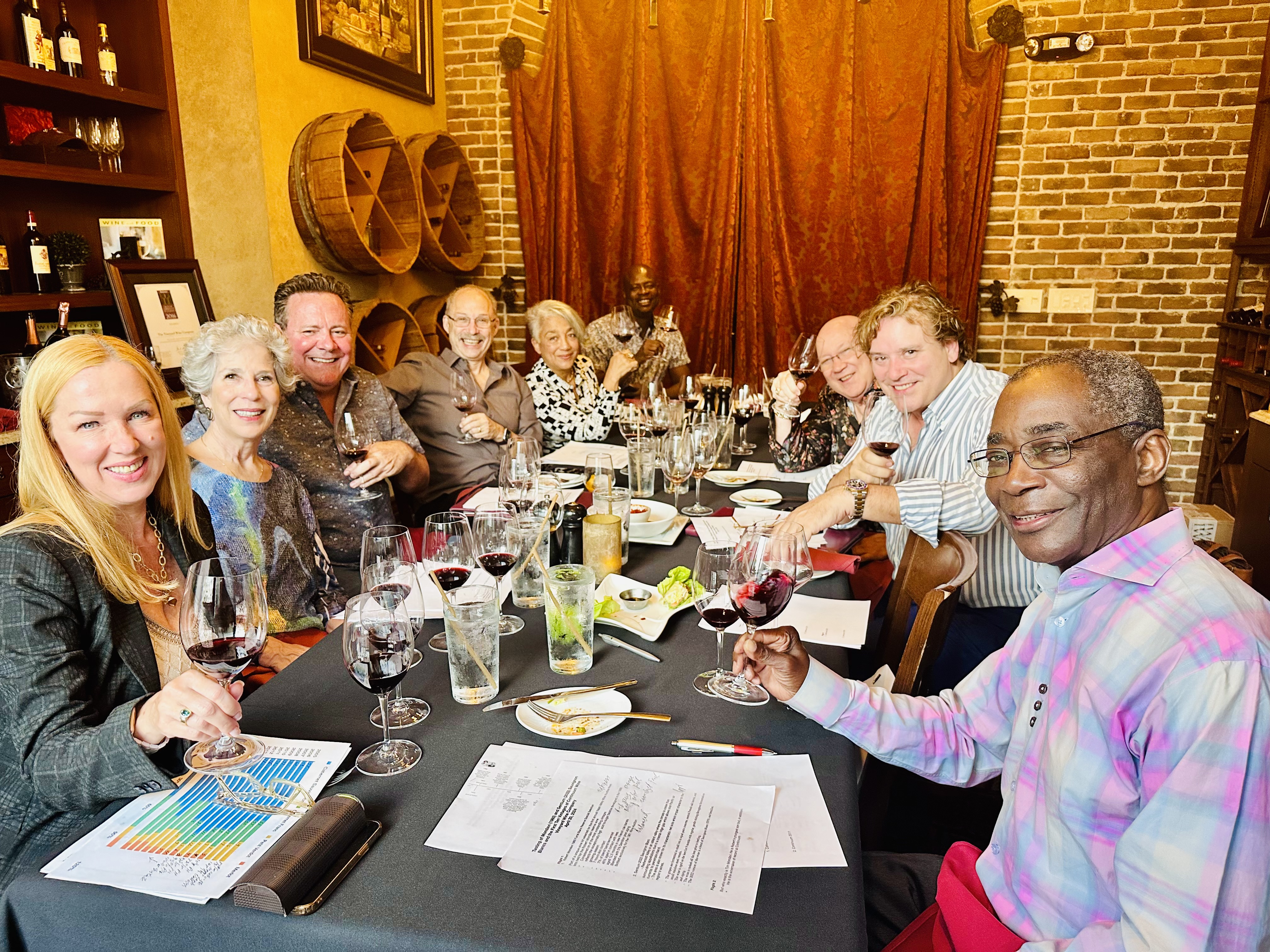
The Tasting Team. From left, clockwise,
Caryn Reiker, Laurie Levin, Matthew Martin,
Fred Wittenstein, Carol Lopez-Bethel, Al Archibald,
Richard Cohen, Sean Charles Hall, and the Author

Flight 1: 2022 Sentium and 1980 Robert Mondavi Fumé Blanc
It was thought that these Mondavi Family bookend wines would serve as perfect lead-ins to the main event. The Fumé Blanc was Robert Mondavi’s first hit wine and here was his granddaughter Chiara seeking to recreate that magic by releasing a Sauvignon Blanc through the Continuum vehicle.

These wines are both primarily Sauvignon Blanc but the similarity ends there. Chiara sourced her grapes from Mendocino County and fermented them in small lots in equal parts concrete, neutral French oak barrels, and small stainless steel vessels. The 2022 edition of this wine was aged for 9 months on the lees with regular, gentle stirring applied throughout fermentation and aging. The wine was racked off the lees and blended with 7% Semillon prior to bottling. 

The wine was disappointing. Perfumed nose of sweet white fruit which carried through to the palate in an unflattering manner. No attack and a flaccid finish. 

Just 13 years removed from its launch vintage, the Robert Mondavi 1980 Fumé Blanc Reserve Special Selection is a wine that demands your full attention.

This vintage is considered one of the most outstanding in Napa, reflecting “the exceptionally high acid-to-sugar balance developed” during the growing season. The wine experienced 7 hours of skin contact with 7% of the blend barrel-fermented and 46% aged in contact with the lees. The wine was aged for 12.5 months in new French oak barrels and blended with 5% Semillon post-aging. These specific bottles were part of a unique wine kit selected for the first (1981) annual Napa Valley Wine Auction.

This wine was spectacular from the get go and improved with residence in the glass.

The wine had a rich golden brown color. On the nose, carmelization, beeswax, figs, mint, tangerine, and orange rind. Bright acidity initially with almost a crystalline affect at the palate rear. Lemon flavor along with green and dried herbs

After some time in the glass, dried tamarind, hot pepper, and used bourbon barrel. A long, bitter, metallic finish. After additional time, Tokaji-like effect without the sweetness. Absolutely stunning wine.


Flight 2: 2005, 2006, and 2007 Continuum
The 2005 exhibited chocolate-covered red fruit and silky tannins while the 2006 showed dark fruit, tobacco, leather, and spice. An elegant wine which presented a step up from the 2005.

The 2007 was a crowd pleaser: Red and black fruit, lavender, cassis, spice, forest floor, and graphite. Balanced, with a lengthy finish.


Flight 3: 2008 and 2009 Continuum
The 2008 Continuum exhibited red and dark fruit, minerality, leather, and lead pencil. Concentrated yet balanced. Tannins fully integrated. Lengthy finish.

Rich red and dark fruit on the 2009 along with leather, spice, tobacco, and a florality. Medium body with a savoriness and integrated tannins. Long finish.


Flight 4: 2010 and 2011 Continuum
For the 2010, rich dark fruit, earth and baking spices. Balanced, with a lengthy finish.Dark fruit, plum, graphite, leather on the 2011. Balanced with deep, complex flavors and a long finish.


Flight 4: 2012, 2013, and 2014 Continuum
The 2012 showed dark fruit, chocolate, and graphite enveloped in a tannic shell while the 2013 showed a similar fruit profile accompanied by notes of forest floor, tobacco, graphite, and cassis. This full-bodied wine had a long, tannic finish. The 2014 showed rich dark fruit, leather, earth, baking spices, chocolate, and tobacco. Full-bodied on the palate with aflavor pull-through. Smooth tannins and a long, smooth finish


Post-Tasting thoughts of Selected Participants
Overall the wines were good, not great.  Certainly not for the price. I liked the 06 and 13 best. I went back and forth on the 07.  -- Fred

It was very interesting and informative. I liked the 1980 Robert Mondavi Fumé Blanc and the 2013 Continuum. Of the horizontal I felt it had opened the most. I was surprised that these didn’t have the typical Napa fruit bomb. I got a green olive taste. I think I liked the Sage Mountain Vineyard wines the best. -- Richard

I thought they were great.  Not your typical Cali.  In order: 2013, 2007, 2005.  -- Matt

I like Continuum wine in general. Some tend to be a bit typical big Cali, sometimes a bit too much for me, but also can be a nice accompaniment to steak or lamb, or salts and fats. Definitely a food wine. The ones which stood out the most to me were the 07, which is typically a vintage which I usually enjoy from Cali. I know you said it was at its end, but I actually felt it was young and in need of some air to open it up more. It was improving the longer it was in the glass. I would buy another bottle of that to try over the course of an evening and watch it evolve. 13 is another favorite vintage, so not sure I’m just leaning into my historically favored vintages out of habit, but that 13 was one which lingers on in my mind these days after the tasting as one of the top wines served. I didn’t really take notes, so just going on what I remember from the tasting. If I recall correctly I also liked the 05 vintage, but most definitely the 07, and 13. The 1980 white was interesting in that I rarely get white wine that old. The other white, while I get what they wanted to do with it, it just didn’t really work for me. If it was all there was to drink at some event I could easily quaff it down. Could be good at the beach perhaps, but not one I’d typically purchase myself. 

Thanks again for organizing this. I think the food at the Vineyard paired well with the wines. I need to frequent that restaurant a bit more. 

All in all a good time was had with good wine and good people. -- Sean

Thanks, I thoroughly enjoyed the lineup. My overall favorite of the night was the 1980 Fumé Blanc; remarkably preserved, nuanced and totally interesting. You suggested that it was a stellar year and yet that still doesn't explain all of how it kept its acidity and complexity. Good winemaking, I would guess. I could have sat with it for an hour.  Of the reds, although I did not find the variances by vineyard and blend to be as expansive as expected, they worked together well. The  '07 was the most approachable and easy to drink, I liked  the '09 the best. -- Carol

********************************************************************************************************


Like Carol, even though not a part of the main line of the tasting, I thoroughly enjoyed the 1980 Fumé Blanc. The Continuum's seemed to operate within a defined range of good not great. The wines tend towards balance. Most of the wines in the tasting were purpose-bought but I did not feel the urge to immediately go add the label to my collection.


©Wine -- Mise en abyme

Saturday, May 25, 2024

Tasting Tignanello 1990 - 2020 (Selected vintages)

A small group of Orlando-area wine enthusiasts have been holding monthly in-depth tastings of specific wines in order to improve our understanding of the producer, variety, and wine characteristics. Our most recent tasting was held at Enzo's on the Lake and covered selected vintages of Antinori's Tignanello. The three charts following provide background information on (i) the genesis of the wine, (ii) the vineyard, and (iii) production characteristics. The winemaker was covered in great detail under separate cover.


The wines were tasted in three flights organized as follows:
  • Late Teens and 2020: 2016, 2018 2019, 2020
  • 2000s and Early Teens: 2008, 2012, 2014
  • 1990s: 1990, 1997, 1998, 1999.
The tasting Team is pictured below. 

Tasting Team. From left to right: Ron Siegel, author, 
Bev Siegel, Al Archibald, Sean Charles Hall, Richard
Cohen, Fred Wittenstein, Laurie Levin, Matthew Martin,
Caryn Reiker

The specific tasting notes were recorded by Ron Siegel while overall impressions were provided by a subset of the attendees.

Late Teens and 2020
The 2020 was fat, rich, and mostly primary. Still youthful red fruit. Nice spice. The 2019 had more structure and detail. Lighter in weight than the 2020. Ron liked this wine. 

The 2018 exhibited spice and underbrush on the nose. Reminded him of the 2020 in style: big, rich, with lots of fruit and spice. Still youthful and primary. The 2016 has so much material. It is structured for the long term. Sweet red fruit with an acid spine.


2000s and Early Teens
The 2014 was lighter in style with not as much fruit. More linear in style. The 2012 was lighter in style and weight while the 2008 was a younger 2016. Great wine with lots of structure. I would buy this.


1990s
The 1990 was more advanced than Ron liked while the 1997 showed nice fruit and spice along with leather, tobacco, and florality.

The 1998 showed beautiful fruit and spice and was a far more complete wine. Balanced. His favorite wine so far and very much the wine of the nite. The 1999 lagged a little behind the 1998 and 1997. It showed classic red cherry, leather, spice, underbrush, and tobacco.


Post-tasting thoughts of selected participants
Fred thought that the wines were great and all showed well. He felt that the 1990 was fading a little but, conversely, the 1998 was stellar.

Sean felt that Tignanello is very much a food wine in that the wines got even better when the food came out. He agreed with the group on the eminence of the 2016 but did not feel that the 2019 garnered enough attention. According to Sean, "It was young but very much sour cherries, smoke (or tobacco) and mushroom with a spiciness on the nose. Long finish." The 2019 surprised him the most. The standouts were, he felt, the 2019, 2016, 2014, 2012, and 1998. "The 2014 was drank with the pasta course which, I think, upped its quality. Good tannins and nice acidity, so the best of both worlds, and went well with that pasta and red sauce. I wsa surprised at how well the wine drank young as well as old, although that 1990 was perhaps near its end, or past, but the 1998 was still alive and well. Very smooth tannins in the 1998."

Al was" excited to taste a well-balanced and delightful wine." The later vintages, he felt, showed amazingly well with the fruit and acidity levels balancing each other perfectly. His favorite vintages were the 1998, 2008, and 2016.


*******************************************************************************************************
All in all a stellar tasting that was enjoyed broadly. The consensus best wines were the 1998, 2008, and 2016 and the one least appreciated was the 1990.


©Wine -- Mise en abyme